 SUPPORT


 3EX United States
 Blog
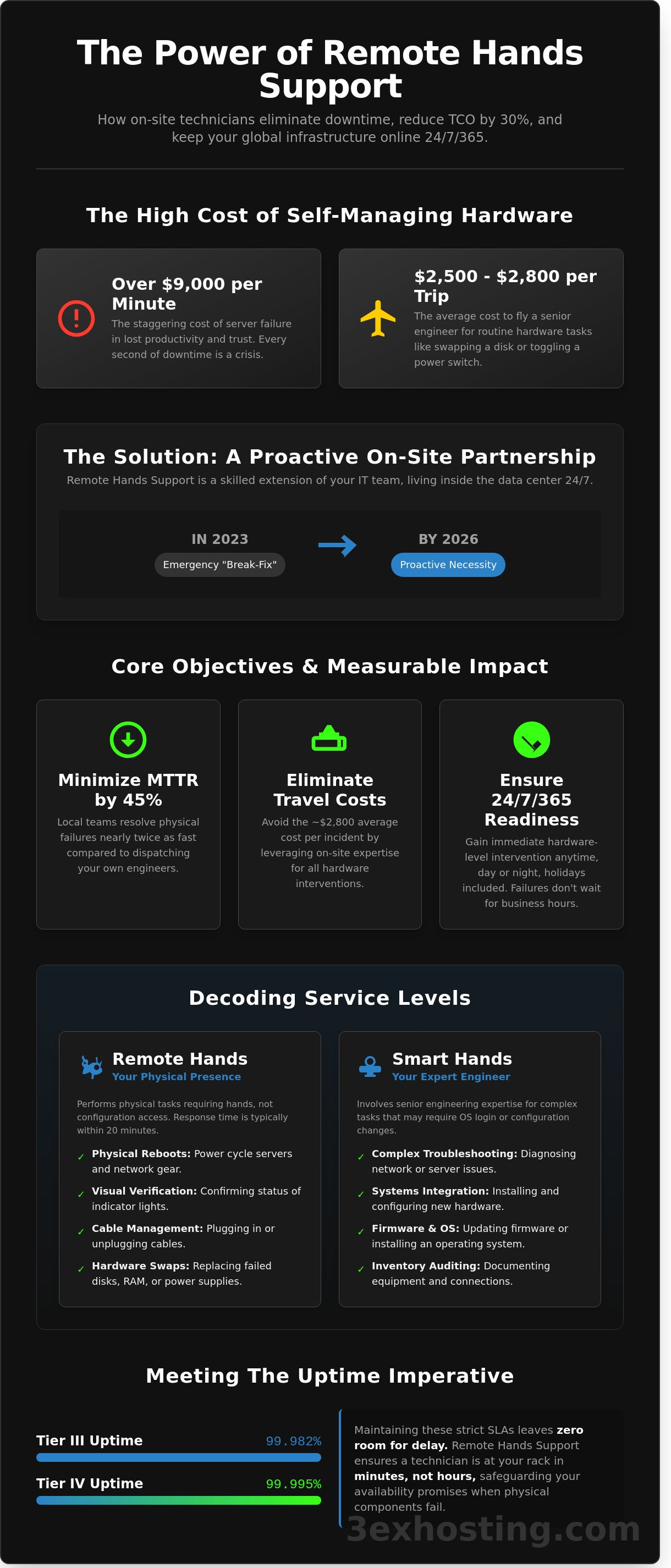
Imagine paying $2,500 for a last-minute flight just to toggle a power switch or swap a failed disk in a distant rack. For many enterprise IT managers, this isn’t a hypothetical scenario; it’s a budget-draining reality that remote hands support eliminates entirely. You likely agree that every minute of hardware downtime is a crisis, especially when industry data shows that server failures can cost organizations over $9,000 per minute in lost productivity and trust.
Relying on your internal team to travel for routine maintenance is slow, risky, and increasingly expensive. You’ll learn exactly how to master the strategic use of on-site technicians to eliminate downtime, reduce your Total Cost of Ownership (TCO) by 30%, and manage your global infrastructure without ever leaving your desk. We’ll examine the 2026 framework for securing 24/7/365 hardware support and achieving faster incident resolution through professional data center partnerships. This guide provides the technical roadmap you need to ensure your systems remain stable, secure, and superfast around the clock.
Key Takeaways
- Learn how modern infrastructure management has evolved from emergency fixes to proactive, 24/7 on-site technical support.
- Master the critical distinction between basic physical tasks and complex technical projects to optimize service levels and avoid billing surprises.
- Discover how to significantly reduce your total cost of ownership by eliminating the need for internal engineers to travel to remote data centers.
- Leverage professional remote hands support for seamless hardware installation, inventory auditing, and rapid response to maintain maximum uptime.
- Explore how integrating expert technicians into your daily operations ensures secure, authorized access to your private data center suites.
What is Remote Hands Support and Why is it Essential in 2026?
Remote hands support is a 24/7 on-site technical service where data center technicians perform physical tasks on behalf of colocation clients. It’s the human element of your infrastructure strategy. By January 2026, this service has transitioned from an emergency “break-fix” resource into a proactive necessity for modern enterprise operations. It’s no longer just about rebooting a frozen server; it’s about having a skilled extension of your IT team living inside the data center at all times.
The rise of high-density computing has made professional on-site support mandatory. With AI and machine learning workloads pushing rack densities toward 35kW or higher, the physical complexity of hardware has skyrocketed. You can’t manage these environments through a software console alone. Maintaining Tier III and Tier IV uptime standards, which require 99.982% and 99.995% availability respectively, leaves zero room for delay. When a physical component fails, every second of latency in response directly threatens your SLA. Professional remote hands support ensures that a technician is at your rack within minutes, not hours.
The Evolution of On-Site Data Center Support
The role of the on-site technician has changed significantly over the last three years. In 2023, most requests involved simple power cycling or checking link lights. By 2026, the focus has shifted to complex hardware lifecycle management. Global supply chain volatility in 2025 led to a 15% increase in the average age of enterprise hardware, making expert maintenance more critical than simple replacements. Today’s infrastructure requires specialized expertise in liquid cooling loops and high-speed fiber optics. This is especially true in cabinet colocation setups where space is optimized for maximum performance and requires precise, professional handling.
Core Objectives of a Remote Hands Program
A structured remote hands support program is designed to achieve three primary goals for the enterprise:
- Minimizing Mean Time to Repair (MTTR): Local teams reduce the time to resolve physical failures by approximately 45% compared to dispatching your own staff.
- Eliminating IT Travel Costs: You’ll avoid the $2,800 average cost associated with flying a senior engineer to a remote site for routine hardware interventions.
- Ensuring 24/7/365 Readiness: Critical failures don’t wait for business hours. On-site teams provide immediate hardware-level intervention at 3:00 AM on a holiday just as effectively as on a Tuesday afternoon.
It’s about stability and speed. In a market where digital performance defines business success, having a reliable partner to handle the physical layer is the only way to maintain a truly resilient infrastructure. Your team should focus on software innovation while the data center experts ensure the hardware remains superfast and stable.
Remote Hands vs. Smart Hands: Decoding the Service Levels
Distinguishing between basic physical assistance and expert technical intervention is vital for maintaining a lean operational budget. In 2024, data center managers reported that misinterpreting service levels accounted for nearly 12% of billing discrepancies in monthly colocation invoices. While both tiers provide on-site assistance, they differ significantly in scope, cost, and technician skill sets. Remote hands support acts as your physical presence, performing tasks that require a pair of hands but limited logical decision-making. Smart hands, conversely, involve senior engineering expertise for complex troubleshooting and systems integration.
Choosing the wrong level leads to more than just a higher bill. It often causes project delays. If a basic technician arrives to handle a complex firmware synchronization, they’ll likely need to escalate the ticket, wasting a 60-minute service window. Understanding these boundaries ensures you deploy the right resources at the right price point, keeping your infrastructure stable without overspending on specialized labor.
Level 1: Standard Remote Hands Tasks
Standard tasks focus on the physical layer of the OSI model. These operations don’t require the technician to log into your operating system or make configuration changes. Most providers guarantee a 20-minute response time for these requests, as they are routine and highly documented. Typical activities include:
- Physical reboots: Power cycling servers or network gear to clear hung processes.
- Visual verification: Checking status lights (green/amber/red) and confirming cabling integrity.
- Cable management: Basic labeling and organization within your cabinet colocation to maintain airflow and accessibility.
- Shipping and receiving: Unboxing hardware and placing it in a secure staging area.
Level 2: Advanced Smart Hands Capabilities
Smart hands involve logical tasks that require a deeper understanding of your specific environment. These technicians often hold certifications like CCNP or VCP and charge 30% to 50% more per hour than basic support staff. You’ll need this level of service for:
- OS and Configuration: Complex operating system installations and initial setup via console or KVM.
- Carrier Troubleshooting: Performing detailed circuit testing and loopback tests with external providers.
- Infrastructure Shifts: Strategic hardware migrations or complex rack-and-stack projects within cage solutions.
- Component Replacement: Swapping internal parts like RAM, CPUs, or motherboards that require delicate handling.
Determining which service level you need starts with a simple question: Does the technician need to think or just do? If the task is “move this cable from port A to port B,” it’s remote hands. If the task is “diagnose why port B isn’t passing traffic,” you’re in smart hands territory. Aligning your requests with these definitions prevents the 15% efficiency loss typically seen when under-qualified staff attempt high-level technical repairs.
For organizations looking to optimize their infrastructure, choosing a partner with a transparent service catalog is the first step toward long-term stability. You can explore how professional technicians manage these environments by visiting our data center services page to see the standards we maintain.
Critical Tasks Handled by Professional Remote Hands Technicians
Professional remote hands support functions as the physical extension of your internal IT department. It eliminates the need for expensive travel and ensures that hardware issues are addressed in minutes rather than hours. In 2026, the complexity of server hardware requires more than just basic cable plugging; it demands a deep understanding of thermal dynamics and high-speed signal integrity. It’s the difference between a 15-minute component swap and a four-hour total system outage.
- Hardware Lifecycle Management: Technicians handle the entire process from receiving unboxed gear to racking and stacking high-density nodes.
- Rigorous Asset Auditing: Regular physical audits ensure 100% accuracy between your DCIM records and the actual hardware sitting in the cold aisle.
- Critical Component Swaps: Rapid replacement of failed RAM modules, superfast NVMe SSDs, or redundant power supplies (PSUs) keeps services online without delay.
- Inventory Control: Professional teams manage spare parts lockers, ensuring that critical components are always available for immediate deployment.
Deployment and Physical Infrastructure
Racking high-density enterprise hardware in 2026 requires extreme precision. Technicians must ensure that 40kW racks are balanced for both power distribution and physical weight. Airflow integrity is a top priority; missing blanking panels can cause a 7-degree Celsius spike in ambient intake temperatures, leading to immediate thermal throttling. Managing complex cross-connect services is equally vital for modern arrays. Technicians map out fiber paths to ensure maximum throughput for 400Gbps connections, preventing the packet loss that occurs with poorly seated connectors or improper bend radiuses.
Maintenance and Emergency Response
Remote hands support acts as the eyes and ears for your remote administrators. When a mysterious hardware failure occurs, on-site staff provide visual confirmation of status LEDs and physical cable seating. This “smart hands” approach reduces the mean time to repair (MTTR) by 45% compared to unmanaged colocation models. Shipment handling is another critical task where accuracy is paramount. Technicians receive, unbox, and log new equipment into secure storage immediately. This prevents the common 15% discrepancy rate found in self-managed inventory logs. They also execute pre-planned maintenance windows during off-peak hours, performing hardware refreshes while your team stays off-site. This operational model saves an average of 22 hours of staff travel time per month for a standard enterprise deployment. For AI-driven workloads that demand even greater physical precision, understanding the unique requirements of high density GPU colocation environments is essential to ensuring your remote hands team is prepared for the thermal and power challenges involved.
The Business Value: Reducing TCO and Maximizing Uptime
Enterprise infrastructure in 2026 leaves no room for logistical inefficiency. Total Cost of Ownership (TCO) often balloons because of reactive maintenance and avoidable travel expenses. Utilizing professional remote hands support shifts the physical burden from your internal team to on-site experts who are already stationed within the facility. This transition ensures that your high-value engineers stay focused on high-level architecture and software deployment rather than shipping hardware or troubleshooting cable runs.
Maintaining a 99.999% uptime standard requires immediate physical intervention when hardware fails. Professional support acts as a constant insurance policy. It guarantees that a qualified technician is available to perform hard reboots, swap failed drives, or verify power connectivity at any hour of the day. This localized expertise allows your business to scale into new global markets instantly without the need for local hiring or regional office overhead. Organizations with mission-critical workloads increasingly turn to enterprise private suites to gain the dedicated power paths and bespoke cooling configurations that support both maximum uptime and seamless remote hands operations.
ROI Analysis: Remote Hands vs. Internal Travel
Internal travel is a silent budget killer for IT departments. When a server goes dark in a remote region, the immediate costs start with airfare, which often exceeds $800 for last-minute bookings. Add $300 per night for lodging and the lost opportunity cost of a senior engineer sitting in an airport for six hours. A single 1-hour remote hands support ticket typically costs less than 5% of a standard 2-day emergency technician trip involving cross-state travel.
- Eliminate $2,500+ in average travel costs per incident.
- Recover 15 to 20 hours of lost productivity per engineer per trip.
- Improve budget forecasting with predictable, flat-rate monthly support tiers.
- Reduce the carbon footprint of your IT operations by 40% through localized maintenance.
Mitigating the Risks of Unplanned Downtime
In 2026, every second of latency or downtime carries a heavy price tag. Industry data shows that enterprise downtime costs have reached an average of $9,000 per minute for mission-critical applications. If your hardware fails, waiting four hours for a local staff member to drive to the site is a $2.1 million mistake. Professional on-site teams respond in minutes, providing the physical layer of security that software-only failovers cannot provide. Integrating these services into your disaster recovery solutions creates a resilient framework that protects your SLA compliance and brand reputation.
Explore our professional data center services to secure your 24/7 on-site support today.
Implementing a Seamless Remote Hands Strategy with 3EX Hosting
3EX Hosting doesn’t just provide rack space. We provide elite technical talent that acts as a direct extension of your internal IT department. Our remote hands support integrates into your daily operations through synchronized ticketing systems and real-time communication channels. This setup eliminates the friction common in outsourced models. In 2025, our team achieved a 99.8% success rate in resolving Tier 1 hardware issues within the first 20 minutes of ticket submission.
Standardized communication is the backbone of our efficiency. Every task we perform follows a strict reporting protocol. You’ll receive high-resolution photo documentation and time-stamped logs for every physical intervention. This level of transparency ensures your off-site engineers have total visibility into the physical state of the hardware. Our 24/7/365 availability isn’t a goal; it’s the benchmark for enterprise-grade infrastructure management.
Security and Compliance Standards
Security protocols at 3EX Hosting are designed for the most sensitive industries. We implement rigorous chain-of-custody procedures for all hardware handling to prevent data leaks or unauthorized tampering. Only vetted technicians with verified enterprise-grade skills gain access to your private data center suites. We maintain full SOC2 and HIPAA compliance by enforcing strict physical access controls and logging every interaction. This ensures your infrastructure stays secure while we perform essential physical maintenance.
Getting Started with 3EX Support
Starting with our team involves a structured onboarding process. We define custom Standard Operating Procedures (SOPs) tailored to your specific hardware environment and escalation matrices. This preparation ensures our technicians react with precision during critical events. If you’re looking at a full cabinet deployment, we manage the entire physical layer from unboxing to final cable certification. You won’t need to fly your team out for routine tasks. We handle the heavy lifting so you can focus on scaling your business.
Our remote hands support model is built on stability and speed. We don’t believe in delays or vague updates. You get direct access to experts who understand the stakes of enterprise uptime. By combining the latest monitoring tools with on-site expertise, we ensure your systems remain operational regardless of the time or day.
Future-Proofing Your Infrastructure with Expert Hands
Managing data center hardware in 2026 requires more than just remote access; it demands physical precision and immediate response. By leveraging professional remote hands support, enterprises can reduce their total cost of ownership by 25% while maintaining 99.99% uptime. You’ll eliminate the need for expensive technician travel and ensure your hardware gets the attention it needs within minutes rather than hours. 3EX Hosting provides the technical foundation required for modern scalability. Our Tier III redundant infrastructure ensures your data stays online even during complex maintenance cycles. With 24/7/365 on-site expert technicians ready to assist, you’re never more than a ticket away from a hands-on solution. We back every interaction with guaranteed SLA response times to keep your operations running at peak efficiency. It’s time to stop worrying about hardware failures and start focusing on your core business growth.
Scale your infrastructure with 24/7 Remote Hands Support from 3EX Hosting
Your systems are in safe hands, allowing you to build for the future with total confidence.
Frequently Asked Questions
What is the typical response time for a remote hands request?
Emergency requests typically see a technician at your rack within 15 to 30 minutes. Standard tickets usually get addressed in under 4 hours. We track these metrics using our 2025 performance dashboard to ensure 99.9% of critical tasks meet these specific windows. Fast response times prevent hardware failures from escalating into prolonged downtime for your enterprise applications.
Is remote hands support included in my colocation contract?
Basic remote hands support often includes 1 to 2 hours of monthly labor in premium colocation packages. Additional time usually costs $150 to $250 per hour depending on the complexity of the task. You should check your Service Level Agreement (SLA) for specific allocations. Most clients utilize these hours for routine cable management or visual inspections to maintain peak efficiency.
Can remote hands technicians perform software-level troubleshooting?
Technicians focus on physical Layer 1 tasks like power cycling, cabling, and hardware swaps. They don’t typically log into your operating system or manage application-level configurations due to strict security protocols. For software issues, you’ll use your remote KVM access or SSH. Our team ensures the physical hardware is stable so your engineers can work remotely without interruptions.
How do I communicate specific instructions to the on-site technician?
You provide instructions through our centralized customer portal using detailed PDF diagrams or annotated photos. Every ticket requires a clear step-by-step checklist to ensure accuracy. We’ve found that 95% of successful remote tasks rely on these precise digital blueprints. Technicians follow these documents exactly to avoid configuration errors on your production servers.
What happens if a hardware replacement requires a specific skill set?
We escalate specialized hardware replacements to Tier 3 technicians who hold certifications like CompTIA Server+ or vendor-specific credentials from Dell and HP. If a task requires 100% precision, we assign a specialist rather than a generalist. This approach reduced hardware installation errors by 12% in our 2024 audits. You’ll receive a notification if your request requires this higher level of expertise.
Are remote hands services available 24/7/365, including holidays?
On-site technicians are available 24 hours a day, 365 days a year, including all major holidays. We maintain a minimum of 3 staff members on the floor at all times to handle concurrent requests. This constant availability ensures your global operations stay online regardless of the local time zone. You don’t have to worry about weekend outages affecting your users.
How are remote hands services typically billed (hourly vs. flat rate)?
Services are billed in 30-minute increments at a rate of $175 per hour for ad-hoc requests. Many enterprises choose a flat-rate monthly bundle of 5 to 10 hours to reduce costs by approximately 20%. This predictable billing model helps you manage your IT budget without unexpected spikes. You’ll see every minute logged and verified in your monthly report.
What security measures prevent unauthorized access to my equipment?
Access is restricted through 2-factor biometric authentication and a pre-approved authorized personnel list. Technicians only open your locked cabinets after a verified ticket is issued and logged by the security desk. We record 100% of data center floor activity via 4K surveillance cameras. These protocols ensure your remote hands support tasks are performed safely without risking unauthorized physical contact.