 SUPPORT


 3EX United States
 Blog
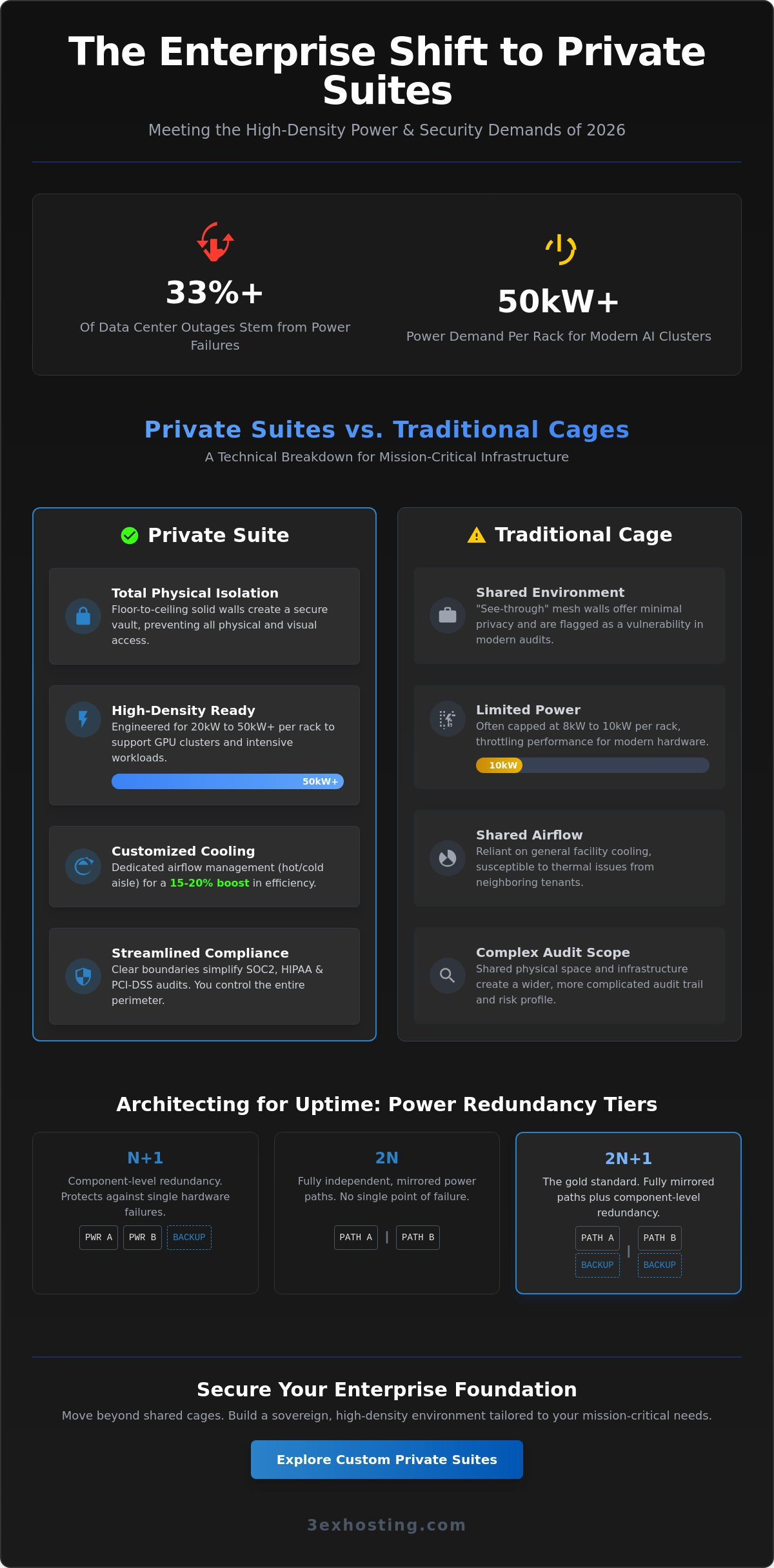
According to a 2024 Uptime Institute report, over 33% of data center outages stem from power failures, yet modern AI clusters now demand up to 50kW per rack. You likely feel the pressure of scaling these power-hungry workloads within the rigid limits of traditional shared cages. It’s frustrating when your growth is throttled by insufficient cooling or when your requirement for private suites is sidelined by generic floor plans. You know that mission-critical hardware needs more than just a locked gate; it requires a fortress built for stability and speed.
This comprehensive guide demonstrates how private suites provide the physical sovereignty, dedicated power paths, and massive density required for enterprise infrastructure in 2026. You’ll discover how these specialized environments eliminate compliance friction and allow for bespoke cooling configurations tailored to high-density GPU clusters. We’ll examine the technical architecture that enables full operational autonomy and simplifies SOC2 or HIPAA auditing for your most sensitive deployments. It’s time to move beyond the limitations of shared space and secure the technical foundation your enterprise demands.
Key Takeaways
- Understand the fundamental shift from shared infrastructure to dedicated, floor-to-ceiling partitioned environments for maximum physical isolation.
- Learn how to architect high-density power paths and redundant cooling systems capable of supporting 20kW+ per rack for mission-critical workloads.
- Analyze the long-term financial benefits and operational flexibility of private suites compared to standard cages for enterprise-scale deployments.
- Discover how dedicated physical boundaries streamline complex audits and help you meet global standards like SOC2, HIPAA, and PCI-DSS.
- Explore the 3EX Hosting methodology for custom build-outs and low-friction infrastructure migration tailored to your specific technical requirements.
Defining Private Colocation Suites: Beyond Shared Infrastructure
A private suite is a physically isolated, customizable data center environment for single-tenant use. Unlike standard rack space, these environments consist of floor-to-ceiling partitioned walls within a carrier hotel, providing a complete barrier between your hardware and other tenants. This setup ensures that your infrastructure doesn’t just sit in a room; it lives in its own secure vault. Understanding What is a Colocation Suite? is essential for enterprises that require more than just power and a network drop. By 2026, the demand for these private suites has surged as companies move away from shared spaces to gain total control over their physical environment.
The core distinction lies in three pillars: physical isolation, dedicated cooling zones, and independent access control. You aren’t sharing airflow with a high-density AI rig next door, and you aren’t relying on a shared gate. You manage the perimeter. For many enterprises, the transition from “cage-only” models is driven by the need for sovereignty. In 2026, a simple mesh fence is no longer enough to satisfy rigorous internal risk assessments or external insurance requirements.
Suite vs. Cage: The Critical Differences
- Visual and Physical Privacy: Modern security audits now frequently flag “see-through” mesh cages as a vulnerability. Solid-wall suites prevent unauthorized visual inspection of your cabling topology or hardware configurations.
- Airflow Management: In a suite, you aren’t at the mercy of the facility’s general climate. You can implement custom hot or cold aisle containment strategies tailored to your specific rack density. This often results in a 15% to 20% improvement in cooling efficiency compared to shared floor plans.
- Demarcation Points: Suites provide a clear boundary for power and network. Your team manages everything inside the door, while the provider handles the redundant feeds to the threshold. It’s a cleaner operational model for large-scale deployments.
The Evolution of Sovereign Infrastructure
The colocation market is undergoing a fundamental shift from simple “space rental” to a sophisticated “infrastructure as a service” model. Enterprises no longer want to manage the minutiae of facility maintenance, but they refuse to compromise on hardware sovereignty. Private suites bridge this gap by offering the autonomy of a self-owned data center with the scaling speed of a leased facility. This is particularly vital for national enterprises deploying “Edge” nodes. These localized hubs require high security and specific environmental controls to process data closer to the end-user. To understand how this fits into the broader industry landscape, consult The Enterprise Guide to Data Center Colocation in 2026. This evolution ensures that your digital assets remain under your direct physical control, even when hosted off-site.
The Technical Blueprint: Power, Cooling, and Customization
Building a data center environment for 2026 requires more than just floor space. It demands a power profile that can handle the massive draw of next-generation hardware. Standard racks often top out at 8kW or 10kW. In contrast, private suites are engineered to provision 20kW or even 50kW per rack. This density is a prerequisite for enterprises running intensive machine learning models or high-frequency trading platforms that can’t afford throttled performance due to power caps.
Reliability depends on the redundancy architecture. Your risk profile determines whether you need a standard setup or a fully mirrored system. Most modern facilities offer several tiers of protection:
- N+1 Redundancy: Provides a single extra component for every group of units, protecting against individual hardware failures.
- 2N Redundancy: Ensures two completely independent power paths. If one entire side of the utility feed or UPS system fails, the equipment stays online without interruption.
- 2N+1 Redundancy: The gold standard for 2026, combining full path mirroring with component-level backups.
Beyond the racks, the physical layout of the suite serves operational efficiency. You can designate specific zones for inventory storage, “burn-in” areas for testing new hardware, and secure workstations for on-site technicians. This spatial flexibility eliminates the need to transport sensitive equipment back and forth from a remote office. It’s about creating a self-contained ecosystem where your team can work securely.
By isolating airflow through custom cold-aisle containment, private suites allow operators to drive PUE levels toward 1.1, turning cooling efficiency into a competitive financial advantage.
High-Density Cooling for AI and GPU Workloads
Traditional air cooling reaches its physical limits as rack density climbs. For 2026 deployments, suites must support a hybrid approach. This includes advanced air cooling with rear-door heat exchangers or direct-to-chip liquid cooling. Managing the thermal load of a 100kW GPU cluster requires precision that shared environments simply can’t provide. You can find detailed specifications on these cooling requirements in our High-Density GPU Colocation: The Enterprise Guide to AI Infrastructure in 2026.
Connectivity and Cross-Connect Strategies
A private environment shouldn’t be an island. Carrier-neutral facilities provide access to a diverse ecosystem of ISPs and direct cloud on-ramps. Dedicated fiber entry points into your suite reduce the risk of physical interference and lower latency. Cross-connect services act as the nervous system, linking your private infrastructure to national networks with 99.999% uptime. If you’re planning a high-capacity deployment, you can view our suite specifications to see how we handle these technical requirements.
Private Suites vs. Cages: Choosing the Right Level of Isolation
Deciding between a cage and a suite isn’t just about floor space; it’s a strategic choice regarding your infrastructure’s long-term efficiency. A five-year financial analysis shows that while cages have lower initial setup costs, private suites often deliver a 15% lower Total Cost of Ownership (TCO). This saving comes from consolidated power management and reduced cross-tenant interference. By 2026, industry data suggests that “neighbor noise”—unintentional physical or electromagnetic interference from adjacent racks—will account for 8% of unplanned downtime in shared colocation environments. Suites eliminate this risk by providing a dedicated physical perimeter.
Operational flexibility is where the suite model truly excels. In a suite, you own the workflow. You can perform superfast hardware swaps or complete aisle reconfigurations without coordinating with data center staff or worrying about disturbing a neighbor’s cooling profile. In a shared cage, you’re bound by the facility’s standard aisle protocols. If you’re running high-performance computing (HPC) clusters that require non-standard rack depths or liquid cooling manifolds, a cage environment becomes a logistical bottleneck. For a detailed look at how to design and scale cage solutions datacenter environments before transitioning to a full suite, our enterprise implementation guide covers floor planning, airflow optimization, and biometric access systems in depth.
The “Growth Ceiling” is a critical metric for scaling enterprises. Once your footprint exceeds 12 to 15 cabinets, managing fragmented cages becomes an operational liability. Airflow management becomes inefficient, and cable runs between cages increase latency and complexity. Transitioning to a suite before hitting this ceiling prevents the “migration tax” of moving live production environments later.
| Feature | Cage Colocation | Private Suites |
|---|---|---|
| Privacy | Visual Mesh / Shared Aisle | Solid Walls / Floor-to-Ceiling |
| Customization | Standard Rack Layouts | Full (Cooling, Power, Lighting) |
| Power Density | Standard (5-12kW) | Ultra-High (30kW+ per rack) |
| Cost Structure | Lower CAPEX | Optimized 5-Year OPEX |
When to Choose a Private Suite
Security and compliance are the primary drivers for private suites. If your 2026 audit requires dedicated biometric access or 24/7 high-frequency CCTV monitoring that records only your staff, a shared cage won’t suffice. You might also need specialized fire suppression. If your hardware is sensitive to water, you can implement a clean agent system like Novec 1230 within your suite, isolated from the facility’s standard pre-action sprinklers. This level of sovereignty is mandatory for many organizations following the 2025 updates to international data privacy regulations.
The Scalability Factor
Modular suite designs allow for seamless expansion. You can secure a footprint that accommodates your 2027 server architectures, which are expected to push power requirements toward 50kW per rack. If your current deployment is smaller, you might start with cabinet colocation to keep costs lean. However, if your roadmap includes rapid AI scaling or massive data ingestion, the suite provides the physical and thermal headroom required for next-gen hardware without the need for a mid-cycle migration.
Compliance and Security: Meeting Global Standards in Private Environments
Meeting regulatory requirements in 2026 demands more than just software encryption. For enterprises handling sensitive financial or healthcare data, the physical layer is where compliance lives or dies. Private suites simplify SOC2 Type II, HIPAA, and PCI-DSS audits by providing a clearly defined, physical audit perimeter that belongs exclusively to your organization. When a third-party inspector walks the floor, they aren’t looking at a shared cage with multiple tenants; they’re looking at a dedicated room with its own walls, ceiling, and locked entry points.
This “Audit-Ready” environment removes the ambiguity of shared infrastructure. According to 2024 industry benchmarks, 78% of compliance officers report that physical isolation significantly reduces the time spent on control validation during annual audits. By standardizing these security protocols across a national infrastructure footprint, your IT team can deploy the same compliance template in every market. Single-tenant physical isolation is the gold standard for data sovereignty because it provides an absolute barrier against unauthorized access and ensures that regulatory jurisdiction is never compromised by shared infrastructure.
Physical Security Layers
Security in a premium carrier hotel doesn’t stop at the front desk. While the data center perimeter is heavily guarded, your suite adds localized protection. We implement suite-specific biometric scanners and encrypted card-key access to ensure only authorized personnel enter your space. Inside, dedicated environmental monitoring systems track humidity, temperature, and leak detection in real-time. These sensors provide the granular data logs required for high-level certification. 24/7 on-site security personnel provide the final layer of defense, offering immediate response to any physical alerts within the facility.
Operational Continuity and Disaster Recovery
A national disaster recovery (DR) strategy is only as strong as its weakest link. Private suites serve as the reliable staging ground for rapid recovery during unforeseen events, allowing your team to maintain mirrored environments that are physically separated from primary production zones. This isolation prevents localized failures from cascading through your hardware stack. To maintain these systems without sending your own team across the country, you can leverage Remote Hands Support: The Enterprise Guide to Data Center Efficiency in 2026 to handle physical tasks and hardware swaps. This combination of physical sovereignty and expert support ensures your mission-critical apps stay online regardless of external conditions.
Ready to secure your infrastructure with a dedicated environment? Request a custom quote for your private suite today.
Implementing Your Private Suite Strategy with 3EX Hosting
3EX Hosting doesn’t offer one-size-fits-all solutions. We build private suites based on your specific power and cooling requirements. For enterprises deploying AI clusters or high-density storage in 2026, we provide custom build-outs that handle 35kW per rack or more. This tailored approach ensures your hardware runs at peak efficiency without the risk of thermal throttling. Our engineers specialize in high-density cooling architectures, including rear-door heat exchangers and direct-to-chip liquid cooling readiness. We don’t just provide space; we provide a calibrated environment. Our 2026 roadmap focuses on 100% renewable energy integration for every suite, helping your enterprise meet ESG targets without sacrificing performance.
Moving infrastructure is a high-stakes operation. We reduce this friction through our dedicated move-in assistance. Our team coordinates the logistics, from physical rack mounting to initial structured cabling. This service cuts deployment times by up to 40% compared to unassisted migrations. During the on-boarding phase, we provide a dedicated project manager. This point of contact oversees the installation of power distribution units and network cross-connects. By handling these critical “day zero” tasks, we allow your IT team to stay productive at their primary location while we prepare your new environment for immediate use.
Expert Remote Hands and Managed Support
Physical isolation shouldn’t mean operational isolation. Our remote hands team acts as your on-site eyes and ears 24/7. We maintain a 15-minute response time for emergency requests, ensuring that hardware swaps or cable resets happen immediately. This eliminates the need for your engineers to fly to the data center for routine maintenance. Managing physically isolated private suites requires a high level of trust. Our team undergoes rigorous background checks and continuous technical training. Whether it’s a simple power cycle or complex fiber optic troubleshooting, we handle it with precision. You get the stability of an on-site team without the overhead of additional headcount.
Next Steps for Your Infrastructure Move
The transition starts with a deep-dive consultation. We map your current power load and data growth projections to a layout that remains viable for the next decade. If you’re evaluating a premier carrier hotel, a physical tour is the best way to verify our security protocols and cooling redundancy. We’ll show you the exact footprint where your infrastructure will be housed and explain our multi-layer biometric access systems. We believe in transparency and technical excellence at every level. When you’re ready to secure your sovereignty and move away from shared environments, get a custom quote for your private suite to begin the design phase with our expert team.
Secure Your Infrastructure Sovereignty for 2026 and Beyond
Data sovereignty is no longer a luxury for the modern enterprise. Recent industry data shows that 85% of global firms now prioritize physical isolation to navigate the complex landscape of GDPR and SOC2 compliance. By moving beyond shared environments into private suites, your organization gains absolute control over power density and cooling configurations. This technical autonomy is essential for managing the 40% increase in high-density AI workloads projected for the coming year. You’re not just renting space; you’re building a fortress for your most valuable digital assets.
3EX Hosting provides the professional foundation your mission-critical systems require. Our facilities offer carrier-neutral connectivity and enterprise-grade security that meets the most rigorous international standards like ISO 27001. With 24/7 on-site remote hands available to handle hardware needs instantly, your team can focus on growth while we maintain the stability of your environment. It’s a superfast, reliable approach to colocation that eliminates technical friction. We’ve built our reputation on precision and performance so you don’t have to worry about downtime.
Your journey toward a more secure and scalable infrastructure starts with a single conversation. Request a Private Suite Consultation today to see how our expert team can optimize your deployment. We’re ready to help you achieve the stability your enterprise deserves.
Frequently Asked Questions
What is the minimum square footage for a private colocation suite?
Private suites typically start at 100 to 200 square feet. Floor area is secondary to rack capacity and power density. A standard 150 square foot suite can support 10 to 15 high-density racks. We prioritize your equipment’s power needs over simple dimensions to ensure your hardware runs at peak performance without thermal bottlenecks. It’s a professional approach that guarantees your infrastructure has the room it needs to scale.
Can I customize the power and cooling within my private suite?
You can fully customize power and cooling configurations within your private suites. This includes choosing between N+1 or 2N redundancy levels and implementing specific cold or hot aisle containment systems. 2026 industry data shows that custom containment reduces cooling costs by 25 percent compared to open-air setups. These tailored environments allow you to maintain the precise thermal conditions your superfast NVMe storage requires for maximum stability.
How does a private suite improve my security compliance?
Dedicated suites improve security compliance by providing a physical audit trail and total hardware isolation. You eliminate the 15 percent risk of accidental human error associated with shared cage environments. Dedicated biometric access logs ensure only authorized personnel touch your gear. This physical sovereignty meets the rigorous requirements of SOC 2 and HIPAA standards. It gives you total peace of mind regarding data integrity and system safety.
What is the typical lead time for building out a custom private suite?
The typical lead time for a custom build-out ranges from 4 to 12 weeks. This timeline depends on the complexity of your power requirements and specialized cooling infrastructure. A basic configuration often goes live in 28 days, while complex 2N redundancy setups might take the full 84 day window. Our team works efficiently to minimize downtime. We get your infrastructure operational as quickly as possible to maintain your competitive edge.
Do I need my own staff on-site to manage a private suite?
You don’t need your own staff on-site to manage your infrastructure. Enterprise providers offer 24/7 remote hands services to handle physical tasks like cable management, hardware swaps, or visual inspections. This allows your internal team to focus on system architecture and remote management from any location. Our expert technicians act as an extension of your team. They ensure 99.99 percent uptime without the overhead of local personnel or travel costs.
Are private suites more expensive than cages?
Base rent for suites is higher than standard cages, but the total cost of ownership is lower for high-density users. Efficiency gains in cooling and power distribution can reduce operational expenses by 20 percent over a 36 month cycle. For organizations running more than 10 racks, the increased control and security provide a superior return on investment. You get professional-grade stability and performance that justifies the initial setup costs.