 SUPPORT


 3EX United States
 Blog
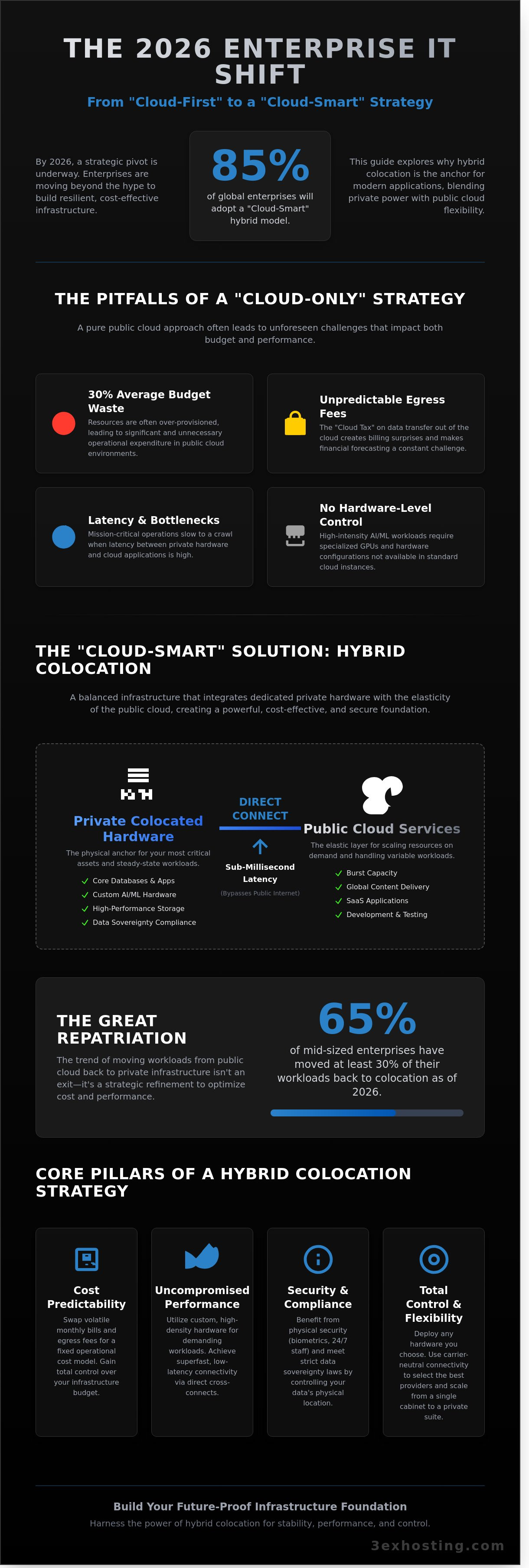
By 2026, 85% of global enterprises will pivot from a “cloud-first” to a “cloud-smart” strategy to escape the 30% average waste currently found in public cloud budgets. You’ve likely felt the sting of unpredictable egress fees or struggled to squeeze high-intensity AI/ML workloads into virtualized environments that lack direct hardware-level control. It’s frustrating when latency between your private hardware and cloud applications slows mission-critical operations to a crawl. This guide shows you how to use hybrid cloud infrastructure colocation to anchor your IT strategy, providing a predictable cost model and the raw power of dedicated hardware. You’ll gain the stability and superfast performance required for modern applications without sacrificing the flexibility of the public cloud. We’ll explore the specific technical configurations that ensure seamless connectivity and maximum uptime for your most demanding 2026 workloads. From optimizing your rack density for AI to establishing low-latency direct connects, you’ll learn how to build a resilient foundation that keeps your data secure and your infrastructure costs under total control.
Key Takeaways
- Understand the 2026 shift toward balanced infrastructure and how to combine private hardware with public cloud services for maximum flexibility.
- Learn to secure mission-critical applications through dedicated server environments and superfast cross-connects that bypass the public internet.
- Discover how to eliminate the “cloud tax” and unpredictable egress fees by integrating hybrid cloud infrastructure colocation into your financial strategy.
- Identify the right physical scale for your needs and how to utilize colocation as a high-performance secondary failover site for disaster recovery.
- Explore the advantages of carrier-neutral connectivity and 24/7 expert remote hands to ensure your infrastructure remains stable and professional.
Understanding Hybrid Cloud Infrastructure Colocation
The landscape of enterprise IT has shifted significantly. In 2026, the industry has pivoted from a “cloud-first” obsession to a “balanced-infrastructure” reality. Hybrid cloud infrastructure colocation is now the standard for organizations that need high performance without the unpredictable costs of public cloud egress fees. This model integrates private, physical hardware with the scale of public cloud services. By utilizing a professional colocation centre, businesses gain a secure environment for their proprietary data while maintaining high-speed connections to global cloud platforms.
Carrier hotels are the heart of this setup. These facilities house multiple network providers and cloud on-ramps, allowing for sub-millisecond latency. For a business running high-frequency trading or real-time data processing, these speeds aren’t optional; they’re a requirement. The ability to cross-connect directly to a cloud provider’s edge node within the same building eliminates the delays of the public internet.
The Synergy of Private and Public Environments
Steady-state workloads, such as core databases and internal applications, perform best on dedicated physical hardware. You don’t pay for “noisy neighbors” or fluctuating resource availability. When traffic spikes occur, the public cloud provides the necessary burst capacity. It’s a matter of efficiency. Managing these environments requires a unified management plane to ensure visibility across all assets. Hybrid colocation is the bridge between physical security and virtual elasticity.
Why 2026 is the Year of Hybrid Infrastructure
The surge in AI and high-performance computing (HPC) has forced a return to specialized hardware. Standard cloud instances often lack the specific GPU configurations needed for modern LLM training. In 2026, industry reports indicate that 65% of mid-sized enterprises have moved at least 30% of their cloud workloads back to cabinet colocation to save on long-term operational costs. This “cloud repatriation” isn’t an exit from the cloud, but a refinement of where data lives.
Regulatory pressure is another major factor. New data sovereignty laws in 2026 mandate that specific datasets, especially in the healthcare and finance sectors, remain on physical hardware within national borders. This makes localized colocation essential for compliance. Companies are no longer willing to gamble with their data’s location. They want to know exactly which rack holds their drives. It’s about stability, security, and reclaiming control over the hardware stack. Using superfast NVMe storage in a private rack ensures that performance remains consistent, regardless of external network congestion.
- Data Sovereignty: Keep sensitive files on hardware you own and control.
- Cost Predictability: Eliminate the “sticker shock” of monthly public cloud bills.
- Hardware Customization: Deploy specialized AI chips and high-density storage that public clouds don’t offer.
How Colocation Serves as the Physical Anchor for Hybrid IT
Colocation acts as the bedrock for modern IT by bridging the gap between local control and cloud scalability. According to the NIST definition of cloud computing, a hybrid model requires portable applications and data across distinct infrastructures. Colocation provides the physical environment for that private component. It allows for total hardware control. Mission-critical applications often require dedicated server environments to maintain 99.999% availability. You can secure these assets using cage solutions that provide physical isolation from other tenants. Security isn’t just digital; it starts with biometric scanners, mantrap entries, and 24/7 onsite security personnel. This level of physical protection is often impossible to replicate in a standard office building or a small private server room.
Direct Cloud On-Ramps and Connectivity
Connecting to major providers like AWS, Azure, or Google Cloud shouldn’t happen over the open web. High-speed cross-connect services allow you to bypass internet congestion and potential security bottlenecks. These Layer 2 connections drop latency to sub-millisecond levels, which is vital for real-time synchronization between your private servers and public cloud instances. Being in a carrier-neutral data center gives you the freedom to choose from dozens of network providers. You aren’t locked into one carrier’s pricing or performance limits. It’s a strategic move for any hybrid cloud infrastructure colocation deployment, ensuring your data moves at the speed of your business.
High-Density Infrastructure Requirements
Modern GPU-heavy workloads for AI processing have shifted power requirements significantly. By 2026, server configurations will regularly exceed 25kW per cabinet. Most standard office infrastructure fails under this heat and electrical load. Professional facilities use N+1 redundancy for both power and cooling systems to maintain 100% uptime for the hybrid anchor. They employ advanced thermal management, such as hot aisle containment or liquid-to-chip cooling, to protect high-performance computing (HPC) clusters. This infrastructure ensures that your most demanding applications run without thermal throttling or unexpected shutdowns. If you want to see how these systems integrate with your current setup, you can check our cabinet options for high-density power delivery.
A reliable hybrid strategy depends on where you place your data. By using hybrid cloud infrastructure colocation, you gain the stability of a Tier III environment while maintaining the agility of the public cloud. This combination allows you to scale resources up or down without compromising the security of your core assets.
Cost Efficiency: Colocation vs. Public Cloud Migration
Public cloud services often attract enterprises with low initial entry costs, but the long-term financial reality is frequently different. The “Cloud Tax” refers to the complex web of fees that accumulate as operations scale. Data egress fees are the most significant silent killer of budgets. When you move data out of a public cloud environment to your on-site users or other platforms, providers charge per gigabyte. For an enterprise handling large datasets, these monthly invoices become unpredictable. Implementing a hybrid cloud infrastructure colocation strategy allows you to regain control over these variables.
The financial debate between Capital Expenditure (CapEx) and Operational Expenditure (OpEx) has shifted. While the public cloud is a pure OpEx model, it often leads to “cloud sprawl” where unused instances continue to drain resources. A hybrid model utilizes CapEx for core, predictable hardware while keeping OpEx for the data center footprint. Over a 3 to 5 year hardware lifecycle, the Total Cost of Ownership (TCO) for owned equipment in a colocation facility is significantly lower than renting equivalent compute power from a hyperscaler. This approach provides the technical stability your business needs without the fluctuating costs of the public cloud.
Eliminating Data Egress and Hidden Fees
Predictability and Scaling
Budgeting for full cabinet colocation provides a level of financial clarity that per-instance cloud pricing cannot match. Public cloud costs fluctuate based on API calls, storage IOPS, and regional demand. In contrast, colocation providers use metered power billing. This means you pay only for the electricity your hardware actually consumes, with a transparent rate per kilowatt-hour. It allows infrastructure teams to forecast monthly expenses with high precision. Hybrid colocation turns infrastructure from a variable risk into a fixed asset. By combining the speed of modern hardware with a stable billing model, you ensure your hybrid cloud infrastructure colocation remains a driver of growth rather than a financial burden.
Designing Your Hybrid Strategy: From Cabinets to Private Suites
Building a resilient hybrid cloud infrastructure colocation environment starts with selecting the right physical footprint. It’s not just about finding a place for servers; it’s about creating a foundation that supports your specific power, cooling, and security requirements. For most mid-sized enterprises, a single 42U cabinet provides enough space for initial deployments. However, once your hardware demands exceed 10 to 15 kW of power density, or if your industry requires strict physical separation for audits, moving to private data center suites becomes a necessity.
Security and compliance are the primary drivers for this transition. According to the 2023 Flexera State of the Cloud Report, 82% of respondents cited security as their top challenge. By utilizing physical isolation, you can meet the rigorous physical access controls required for HIPAA, PCI-DSS, or SOC2 Type II certifications. This isolation ensures that your hardware is never accessible to other tenants, providing a “clean room” environment for your most sensitive data sets.
Scalability in Physical Environments
Modular growth allows you to manage capital expenditure while staying ready for sudden traffic spikes. You don’t have to commit to a massive footprint on day one. Most Tier III facilities allow for incremental expansion:
- Modular increments: Start with a quarter or half cabinet and scale to full units as your storage needs grow.
- Custom cage configurations: For complex network topologies, custom cages provide the space needed for dedicated cooling paths and cable management.
- 24/7 Physical Access: Reliable uptime depends on your team’s ability to reach hardware. Authorized personnel must have biometric access at any hour to perform emergency upgrades or maintenance.
Disaster Recovery and Business Continuity
A well-designed hybrid cloud infrastructure colocation setup acts as the ultimate safety net. While public clouds offer high availability, they aren’t immune to regional outages. The July 2024 global IT outages demonstrated that relying on a single cloud provider creates a single point of failure. By maintaining a secondary failover site in a colocation facility, you ensure that your critical workloads remain operational even if the public cloud goes dark.
The speed of your recovery depends on high-speed cross-connects. These direct, physical fiber connections between your colocation rack and the cloud provider’s edge gateway reduce latency to sub-1ms levels. This allows for real-time data replication without the bottlenecks of the public internet. If you can’t be on-site during a crisis, you’ll need a partner who can. You can learn more about managing these environments in our guide on Remote Hands Support: The Enterprise Guide to Data Center Efficiency in 2026.
Ready to secure your hardware in a facility built for enterprise performance? Explore our scalable cabinet colocation options today.
Future-Proofing with 3EX Hosting Enterprise Solutions
Choosing the right partner determines the longevity of your IT strategy. 3EX Hosting builds environments that scale alongside your ambitions. Technical stability isn’t just a goal; it’s the foundation of our facility. We provide carrier neutrality, which means you aren’t locked into a single provider. You gain direct access to multiple Tier 1 carriers, ensuring your hybrid cloud infrastructure colocation setup maintains the lowest possible latency for mission-critical applications.
Modern enterprise hardware demands more than just floor space. High-density power configurations are essential for the next generation of servers, especially those running AI or intensive data analytics. While standard facilities might struggle with power draws exceeding 5kW per rack, we offer high-density solutions ready for 10kW or 20kW deployments. This capacity ensures your hardware stays cool and operational even under peak loads. Our commitment to 99.999% uptime provides the peace of mind that your services remain online 24/7.
The human element sets us apart. Our remote hands service acts as your personal on-site engineering team. You don’t need to send a technician to the data center for routine maintenance or emergency hardware swaps. We handle the physical labor, from cable management to component replacement, at any hour of the day or night. It’s a professional, hands-on approach that treats your hardware with the same care as our own.
Expert Support for Complex Deployments
Getting Started with Your Hybrid Journey
Transitioning from a cloud-only model to a high-performance hybrid setup requires precision. According to a 2023 Flexera report, 72% of enterprises now utilize a hybrid cloud strategy to balance costs and performance. We start every partnership with a professional site audit and infrastructure assessment. This process identifies bottlenecks before they become outages. We help you map out the most efficient path for your data and hardware. Ready to optimize your infrastructure? Get an instant quote for your colocation needs and take the first step toward a more stable, superfast future.
Secure Your Competitive Edge in the 2026 Hybrid Landscape
Navigating the technical demands of 2026 requires a strategy that balances public cloud agility with the absolute control of physical hardware. Your hybrid cloud infrastructure colocation strategy serves as the anchor for this balance. It’s not just about renting space; it’s about ensuring your private data remains accessible, secure, and high-performing. Industry data suggests that by 2026, enterprises will prioritize these hybrid models to mitigate the rising costs often associated with unoptimized public cloud migrations.
We provide the technical stability your enterprise demands. Our facilities feature high-density N+1 Power Redundancy and carrier-neutral connectivity with high-speed cross-connects to keep your operations running at superfast speeds. You don’t have to worry about hardware failures when you have 24/7 On-site Remote Hands Support standing by. This professional approach to infrastructure ensures your systems stay modern and stable while maintaining 99.999% uptime standards.
Explore Enterprise Colocation Solutions at 3EX Hosting
The future of enterprise IT is hybrid. Building a stable, superfast foundation today ensures your business stays ahead of the curve tomorrow.
Frequently Asked Questions
What is the main difference between hybrid cloud and colocation?
Colocation is a physical service where you rent space for your own hardware, while hybrid cloud is a strategy that integrates private and public environments. Colocation serves as the physical foundation for the private portion of your hybrid cloud infrastructure colocation setup. It provides the redundant power, cooling, and security for servers you own and manage yourself.
Is hybrid cloud infrastructure cheaper than public cloud?
Hybrid cloud often reduces total cost of ownership by 30% for predictable workloads compared to 100% public cloud models. While public cloud scales fast, egress fees and compute costs accumulate quickly. By moving steady-state data to colocation, companies avoid the 2023 industry average of high monthly variable expenses. You gain fixed hardware costs and lower long-term operational spend.
How does colocation improve latency for hybrid cloud workloads?
Colocation reduces latency by providing direct, high-speed fiber connections to major internet exchanges and cloud on-ramps. Instead of routing traffic over the public internet, data travels via dedicated cross-connects. This physical proximity can drop network pings to sub-5 millisecond levels. It’s essential for real-time applications that require superfast data processing between your private hardware and public cloud nodes.
Can I connect my colocation cabinet directly to AWS or Azure?
You can use services like AWS Direct Connect or Azure ExpressRoute to link your colocation rack to public providers. These dedicated lines bypass the public internet for better security and 10 Gbps or 100 Gbps speeds. Most Tier III data centers feature pre-provisioned carrier rooms to make these connections active within 24 to 48 hours. It’s a reliable way to sync your hybrid cloud infrastructure colocation assets.
What are the security benefits of using a private suite for hybrid IT?
A private suite adds a physical layer of security by isolating your hardware behind floor-to-ceiling cages and biometric access points. This setup ensures that only 100% authorized personnel touch your servers. It helps meet strict compliance standards like PCI-DSS or HIPAA, which require documented physical access logs and restricted environments. You maintain total control over your equipment without sharing space with other tenants.
What happens if I need technical support for my hardware at 3 AM?
Professional colocation providers offer 24/7/365 Remote Hands support to handle emergency hardware tasks at any hour. Certified technicians stay onsite to perform server reboots, cable swaps, or component replacements within a 30-minute response window. You don’t need to send your own staff to the data center in the middle of the night. This ensures your systems stay stable and online regardless of the time.
How does N+1 redundancy affect my hybrid cloud reliability?
N+1 redundancy means every critical system has at least one independent backup component to ensure 99.99% uptime. If a power unit or cooling fan fails, the +1 system takes over immediately without interrupting your operations. According to Uptime Institute standards, this architecture prevents hardware failures from becoming service outages. It’s the technical foundation for a reliable, superfast environment that keeps your business running.