 SUPPORT


 3EX United States
 Blog
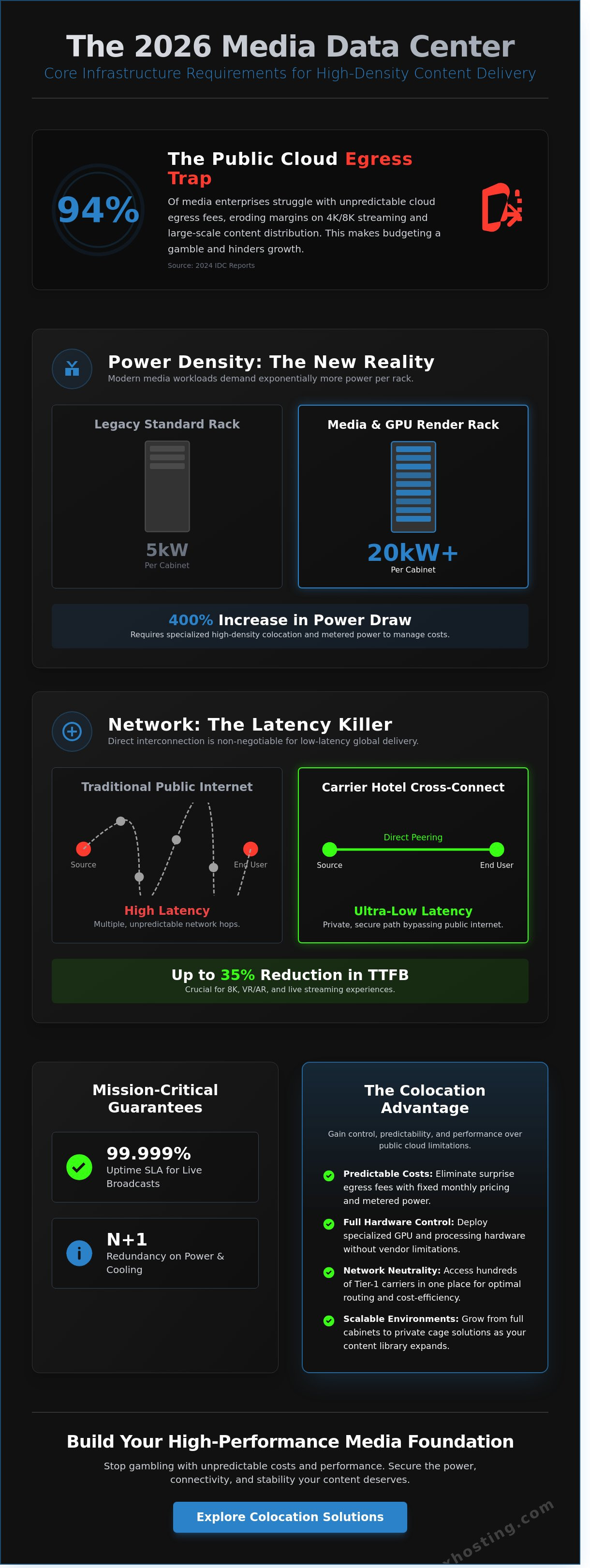
If 94% of media enterprises are struggling with unpredictable cloud egress fees according to 2024 IDC reports, why is the industry still treating public cloud as the default for 4K streaming? You’ve likely seen your margins shrink under these hidden costs or watched your GPU rendering stall because your current facility lacks sufficient power density. It’s a common frustration for technical leaders who need their infrastructure to match their creative speed. Selecting the right data center for media and content delivery shouldn’t be a gamble on your quarterly budget or your end-user experience.
You need a foundation that prioritizes technical stability and predictable performance. This 2026 enterprise guide will help you master the technical requirements and selection criteria for high-density media infrastructure to ensure seamless global content distribution. We’ll show you how to move from reactive scaling to a proactive strategy. We’ll explore the shift toward zero-latency peering with major ISPs and how to secure scalable high-density cabinet space that handles the most demanding rendering workloads without breaking your budget. It’s time to build a superfast, reliable environment that supports your growth instead of hindering it.
Key Takeaways
- Understand the 2026 shift from traditional storage to high-density real-time processing within a modern data center for media and content delivery.
- Identify the critical infrastructure requirements for media-heavy workloads, including managing 20kW+ rack densities and N+1 redundancy for live broadcasts.
- Avoid the “egress trap” by evaluating the cost-efficiency and hardware control of colocation versus the limitations of public cloud models.
- Master the selection criteria for providers by prioritizing network neutrality and access to multiple Tier-1 carriers for seamless global distribution.
- Discover how strategic carrier hotel positioning and customizable cage solutions ensure the technical stability required for mission-critical media delivery.
What is a Data Center for Media and Content Delivery?
A data center for media and content delivery is a specialized facility engineered to handle the massive throughput and high-density compute cycles required by modern digital workflows. It’s not a standard server warehouse. These environments prioritize extreme bandwidth and low-latency network paths to ensure seamless playback for millions of concurrent viewers. By 2026, the industry has shifted away from simple “store and forward” models. Today, the focus is on real-time content processing and edge distribution, where data is transcoded and optimized within milliseconds of a user’s request.
The “Carrier Hotel” serves as the heart of this infrastructure. These strategic locations house hundreds of different network providers under one roof. This density allows media companies to reduce the number of network hops between the source and the Content Delivery Network (CDN). Fewer hops mean less latency. Standard enterprise data centers often fail to meet these media-specific needs. They usually lack the 99.999% uptime guarantees for live broadcasts or the specialized cooling required for the high-density GPU racks used in video rendering.
The Role of High-Performance Interconnection
Direct connectivity is the backbone of modern streaming. Utilizing cross-connect services allows content providers to bypass the congested public internet. This creates a secure, private path for data transit that’s immune to external traffic spikes. It’s a critical requirement for 8K streaming and VR/AR delivery, where even a 15ms delay can lead to buffering or motion sickness. By implementing a strategic network architecture, providers can reduce Time to First Byte (TTFB) by as much as 35% compared to traditional routing methods.
Evolution of Media Workloads: From HD to AI-Enhanced Content
Media workloads have evolved from simple HD files into massive sets of unstructured data. This explosion in file size requires scalable cage solutions datacenter environments that can grow as content libraries double every 14 to 18 months. AI now plays a lead role in modern workflows. Real-time metadata tagging and AI-driven upscaling require specialized hardware that generates significant heat. Modern media data centers must support power densities exceeding 25kW per rack. This infrastructure is essential for predicting and meeting the capacity needs of the next generation of immersive, 16K media experiences.
Core Infrastructure Requirements for Media-Heavy Workloads
Media companies no longer operate on standard hardware. The shift toward 4K and 8K video, real-time CGI, and AI-driven post-production has fundamentally changed what a data center for media and content delivery must provide. You can’t run modern workloads on legacy infrastructure that was designed for simple web hosting. Today, the focus is on raw power, extreme cooling, and absolute redundancy.
Power Density and High-Density Colocation
The power density crisis is a reality for any firm handling high-resolution rendering. A single rack of modern GPU-accelerated media servers can easily exceed 20kW of power draw. This is a 400% increase compared to the industry standard of 5kW per rack seen just a decade ago. Calculating the power draw for these systems requires analyzing peak loads during intensive rendering cycles, not just idle states.
Choosing full cabinet colocation is the most efficient way to manage these requirements. It provides dedicated power allocation that ensures your hardware isn’t throttled by shared circuit limits. Smart operators use metered power to control costs. This allows you to scale your spending based on actual consumption during high-intensity production phases. As the industry has seen with global CDN expansion, having a scalable power foundation is the only way to maintain a competitive edge in content distribution.
Cooling and Environmental Control for 2026 Hardware
Heat management is the biggest bottleneck for 2026-ready hardware. High-density GPU clusters generate enough thermal energy to trigger safety shutdowns in minutes if cooling fails. Standard air conditioning isn’t enough anymore. Advanced facilities now use liquid-to-chip cooling or high-airflow cold aisle containment to move heat away from sensitive components instantly.
Humidity control is just as vital. Maintaining a stable range between 40% and 60% prevents electrostatic discharge and hardware corrosion. 3EX Hosting manages these complex thermal loads for high density GPU colocation using precision-engineered environmental controls. This keeps your hardware running at peak performance without the risk of thermal throttling.
Reliability in this sector is measured by redundancy. For live broadcast and streaming, N+1 redundancy is the bare minimum, but 2N redundancy is preferred. This means every power and cooling component has a dedicated backup. If one system fails, the other takes over without a millisecond of downtime. Physical security also plays a role in protecting high-value pre-release content. Multi-factor biometric access and 24/7 caged monitoring ensure that your intellectual property remains safe from physical breaches.
If you’re planning a high-performance deployment, you can get a custom quote to see how our infrastructure fits your specific power and cooling needs.
Colocation vs. Public Cloud: Choosing the Right Model
Selecting a data center for media and content delivery requires a balance between immediate scalability and long-term financial stability. Public clouds offer an easy entry point, but they often hide costs within complex egress fee structures. High-definition video files create massive outbound traffic. When these assets leave a public cloud network, providers charge for every gigabyte transferred. This “egress trap” can quickly erode the margins of a streaming service or production house. Colocation provides a more predictable alternative by offering fixed bandwidth or direct wholesale transit rates.
The choice between control and convenience is central to this decision. Public clouds provide managed services that reduce setup time. However, they limit your ability to optimize hardware for specific media tasks like 8K rendering or AI-driven transcoding. Owning your hardware in a colocation facility allows for custom GPU configurations and specialized storage arrays that public providers don’t support. Most modern media enterprises now use a hybrid model. They maintain their baseline traffic on stable, private hardware and use the public cloud only for unexpected bursts in demand.
The Economics of Media Infrastructure
Media companies often find that monthly cloud subscriptions become unsustainable as their libraries grow. Investing in private colocation suites offers a higher long-term ROI by turning an ongoing expense into a predictable operational cost. You won’t face hidden fees for internal data movement or variable “API call” charges that plague cloud bills. In a colocation environment, your primary costs are rack space, power, and simple cross-connects to your preferred carriers. This transparency is vital for budgeting multi-year projects. By 2026, the cloud repatriation trend will see 80% of media giants moving high-bandwidth workloads back to private hardware to escape unpredictable public cloud billing.
Operational Flexibility and Managed IT
You don’t need a full-time team on-site to maintain a private server footprint. Professional remote hands support acts as an extension of your team, performing physical tasks like hardware swaps, cabling, and visual audits 24/7. This allows your engineers to focus on content delivery logic rather than unboxing servers. Integrating managed IT infrastructure services further simplifies the process by handling hardware lifecycle management and software patching.
- Disaster Recovery: Colocation allows for true hardware redundancy across different power grids.
- Data Sovereignty: You retain physical control over your disks, which is essential for meeting GDPR and strict licensing requirements.
- Performance: Direct connections to Tier-1 carriers ensure a superfast experience for your end users.
A dedicated data center for media and content delivery also solves the “noisy neighbor” problem found in public clouds. In a shared environment, another user’s heavy processing task can slow down your video encoding speeds. Physical hardware ownership ensures that 100% of your CPU and NVMe SSD performance is dedicated to your content, providing the stability and speed your audience expects.
Selection Criteria: Evaluating Providers for Media Delivery
Choosing a data center for media and content delivery involves more than just checking floor space. You need a partner that understands the massive throughput requirements of modern post-production and streaming. Network neutrality is the first requirement. Access to at least 15 Tier-1 carriers ensures your traffic takes the shortest path to the viewer. This can reduce buffering by up to 40% in high-traffic regions compared to single-homed facilities.
Standard “three nines” (99.9% uptime) allows for nearly 9 hours of downtime annually. That’s unacceptable for live broadcasts or global releases where every second of black screen costs thousands. Look for 100% uptime SLAs on power and cooling. Scalability matters as your library grows. A provider must offer a path from a single colocation cabinet to private data center suites without requiring a full network redesign.
Support isn’t a luxury; it’s a 24/7/365 necessity. Your criteria should include:
- Response Times: Guaranteed technician response within 15 minutes for critical issues.
- Expertise: On-site staff who understand media-specific hardware and high-density configurations.
- Availability: Remote hands services available every hour of every day, including holidays.
Interconnection and Peering Capabilities
A robust ecosystem includes direct peering with major ISPs and CDNs. Low-latency fabric is critical for real-time collaboration between remote editors and local storage. Don’t settle for high-latency hops. Audit the provider’s history. A facility with zero unplanned outages over the last 60 months demonstrates the reliability your brand needs. Direct cloud on-ramps to providers like AWS or Azure reduce egress costs and improve transfer speeds for hybrid cloud workflows.
Physical Infrastructure and Compliance
Security is paramount for pre-release content. Verify SOC2 Type II compliance to protect intellectual property from unauthorized access. High-density storage arrays for 8K masters require cabinets that support over 3,000 lbs and power densities exceeding 10kW per rack. Specialized move-in assistance is vital for complex media server deployments. Expert technicians handle the physical logistics and cable management, so your team focuses on the software stack. It’s about getting your superfast hardware online without the typical deployment headaches.
Enterprise Solutions: Why 3EX Hosting is the Media Choice
3EX Hosting positions your hardware in a premier carrier hotel, a critical factor for national distribution. This location provides direct access to hundreds of carriers and peering points, making it an ideal data center for media and content delivery. We offer infrastructure that scales alongside your production needs. You can choose from cage solutions that provide physical separation or fully private enterprise suites for maximum security and control. This flexibility allows media firms to expand their footprint without the typical growing pains associated with legacy facilities.
Modern media processing, especially AI-driven upscaling and GPU-heavy rendering, demands extreme power density. While standard facilities often struggle with 5kW racks, our environment supports high-density configurations exceeding 20kW per cabinet. Your hardware stays cool and powered even during peak rendering cycles. Our 24/7 remote hands support is staffed by technicians who understand the specific requirements of media hardware. Whether it’s swapping a failed drive in a SAN array or re-cabling a high-speed encoder, our team acts as your eyes and ears on-site, ensuring that physical troubleshooting never delays a broadcast or a major content upload.
The 3EX Hosting Advantage for Content Providers
Low latency is non-negotiable for live streaming and real-time collaboration. Our superfast cross-connects bypass the congested public internet, reducing transit times to absolute minimums. We offer flexible colocation terms that respect the cyclical nature of media production. You won’t be locked into rigid, legacy contracts when your project needs change after a wrap. Additionally, clients get direct access to enterprise-grade disaster recovery and managed cloud services. This ensures 99.999% uptime for your most critical digital assets and archive libraries.
Getting Started with Your Media Infrastructure
Building a robust data center for media and content delivery starts with a technical plan tailored to your bitrate and storage requirements. You can request a customized quote for high-density media racks through our online portal. Our senior engineers are available to consult on network design and hardware placement. We help you optimize for airflow and connectivity from the moment your gear arrives at the loading dock. Don’t let infrastructure bottlenecks slow down your creative output. Empower your content delivery with 3EX Hosting today.
Future-Proof Your Media Architecture for 2026
Success in the coming years hinges on moving beyond generic storage. Selecting a specialized data center for media and content delivery ensures your infrastructure can handle the massive throughput required by 4K streaming and AI-driven processing. High-density power support is no longer optional; it’s a requirement for modern GPU workloads. Enterprises must prioritize carrier-neutral connectivity with Tier-1 providers to eliminate bottlenecks and guarantee global reach.
3EX Hosting delivers the technical excellence your project demands. We provide high-density power configurations optimized for GPU and AI loads alongside 24/7 expert remote hands for all media hardware. Our network leverages Tier-1 carriers to maintain super-fast speeds and maximum reliability. You don’t need to struggle with complex server management when you have a partner that understands the technical nuances of media delivery. It’s time to build on a foundation that’s as stable as it is fast.
Scale your media infrastructure with a custom 3EX Hosting quote today
Your audience expects perfection, and we provide the stability to deliver it every time.
Frequently Asked Questions
What makes a data center ‘media-ready’ compared to standard facilities?
High power density and specialized cooling distinguish media-ready facilities from standard enterprise data centers. These sites support 15 to 30 kW per cabinet to handle the intense heat generated by GPU-heavy rendering clusters. They also provide direct, low-latency access to global Content Delivery Networks (CDNs). This infrastructure ensures that 4K or 8K video streams reach viewers without buffering during peak traffic periods.
How do cross-connects improve content delivery performance?
Cross-connects eliminate the latency of the public internet by establishing a physical point-to-point cable between two providers within the same building. In a data center for media and content delivery, these hardware links reduce latency to sub-1 millisecond levels. Direct peering with ISPs through cross-connects ensures your video data moves at the fastest possible speeds. It’s a method that bypasses congested public routes entirely.
Can I host high-density GPU servers for rendering in a standard cabinet?
Standard cabinets usually lack the cooling capacity for high-density GPU servers, which often require 20 kW or more of power. Most traditional racks are limited to 4 or 7 kW, which leads to rapid overheating and hardware throttling. You’ll need specialized cabinets equipped with rear-door heat exchangers or cold aisle containment systems. These thermal solutions maintain a stable 22 degree Celsius environment for NVIDIA A100 or H100 clusters.
Is colocation more cost-effective than the public cloud for video streaming?
Colocation becomes more affordable than the public cloud once your monthly data egress exceeds 50 terabytes. While cloud providers charge high fees for outgoing traffic, colocation facilities offer flat-rate bandwidth or 95th percentile billing. Organizations often see a 30% reduction in monthly infrastructure costs after moving consistent streaming workloads to private hardware. It provides predictable monthly expenses for high-bandwidth applications that don’t fluctuate wildly.
What is the role of a carrier hotel in media distribution?
A carrier hotel acts as a central hub where hundreds of telecommunications providers meet to exchange traffic. These buildings, such as 60 Hudson Street in New York, house the physical infrastructure for global internet backbones. Media companies use these locations to access a massive ecosystem of 200 or more network providers. This density allows for rapid content distribution to any geographical region with the fewest possible network hops.
How does remote hands support work for media companies located in different states?
Remote hands services provide on-site technicians to perform physical tasks like server reboots, cable swaps, or hard drive replacements. These professionals act as your local team, responding to tickets within 30 to 60 minutes depending on your specific agreement. It’s a service that eliminates the need to fly staff to the facility for routine maintenance. You manage the software remotely while the data center staff handles the physical hardware 24/7.
What security standards should I look for when hosting pre-release media content?
Look for SOC 2 Type II and ISO 27001 certifications to ensure the facility follows rigorous physical and digital security protocols. Pre-release content requires facilities with 24/7 armed guards, biometric access controls, and 90-day video retention. A secure data center for media and content delivery also offers private cages to prevent unauthorized physical access to your storage arrays. These standards protect high-value intellectual property from digital leaks or physical theft.
How can I scale my infrastructure if my content goes viral?
You can scale rapidly by utilizing a hybrid approach that links your colocation racks to public cloud bursts. Modern data centers offer private links that provide 10 Gbps or 100 Gbps connections to providers like AWS or Azure. When traffic spikes 500% in a single hour, you offload the excess demand to the cloud instantly. Once the viral event subsides, you pull the workload back to your cost-effective private servers to save money.