 SUPPORT


 3EX United States
 Blog
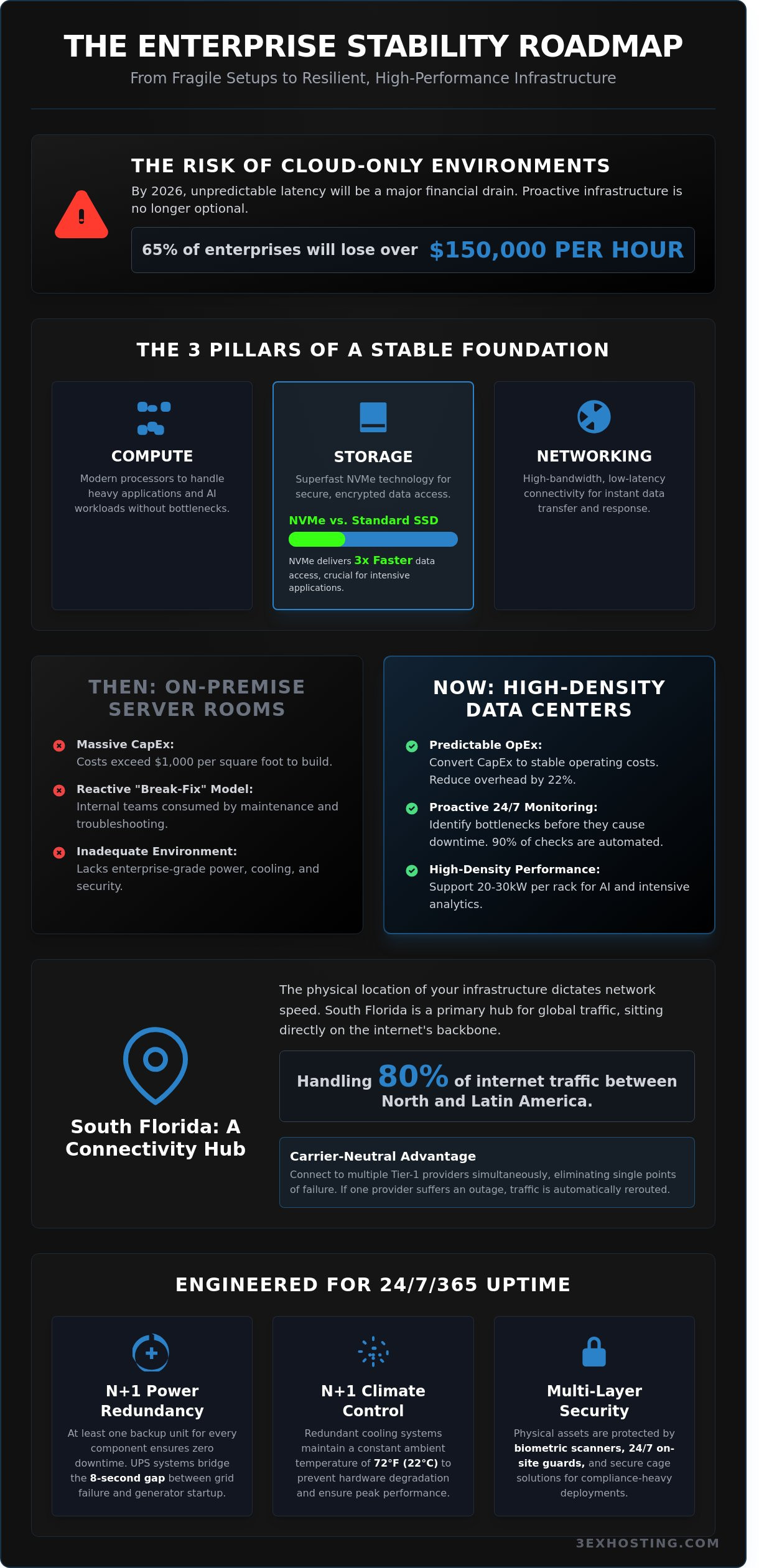
By 2026, 65% of enterprises will lose over $150,000 per hour due to unpredictable latency in cloud-only environments. You probably already know that relying on distant server nodes isn’t a sustainable way to scale. Maintaining a massive in-house data center is equally draining on your bottom line. Speed matters. Optimizing your managed IT infrastructure is now a core business requirement for stability.
In this guide, you’ll discover how high-performance managed infrastructure and carrier-neutral connectivity provide the stability your modern enterprise needs. 3EX Hosting will provide technical validation for N+1 redundancy and demonstrate how superfast NVMe performance delivers 3x faster data access than standard SSDs. You’ll walk away with a clear roadmap for a hybrid strategy that reduces operational overhead by 22% while securing your data against failure. We’re breaking down the move from fragile setups to a resilient, robust foundation that keeps you running 24/7.
Key Takeaways
- Learn how the transition from on-premise server rooms to high-density data centers provides the technical foundation for modern enterprise stability.
- Discover why carrier-neutral connectivity and proximity to carrier hotels are essential for achieving maximum network speed and resilience.
- Evaluate the performance trade-offs between cloud and colocation to build a more predictable and cost-effective south florida managed it infrastructure.
- Identify the critical performance indicators and monitoring protocols necessary to maintain 24/7/365 uptime through a dedicated Network Operations Center.
- See how enterprise-grade facilities and expert remote hands support ensure your hardware deployments remain stable across national networks.
What is South Florida Managed IT Infrastructure?
South Florida managed IT infrastructure represents the professional integration of enterprise-grade hardware, high-speed network connectivity, and 24/7 technical oversight. It marks a decisive shift away from the era of cramped, on-premise server rooms. Instead, businesses now rely on high-density, off-site data centers that offer superior reliability. The geographic designation of South Florida is vital; it serves as a primary high-speed connectivity hub for 80 percent of internet traffic moving between North and Latin America. When you invest in south florida managed it infrastructure, you aren’t just buying hardware; you’re securing a stable foundation for digital growth.
This infrastructure consists of three core pillars. First is compute power, utilizing modern processors to handle heavy applications. Second is secure, encrypted storage often powered by superfast NVMe SSD technology. Finally, high-bandwidth networking ensures data moves without latency. By centralizing these components in a professional facility, companies gain a level of technical stability that’s impossible to achieve in a standard office environment.
The Evolution of Infrastructure Management
The industry has moved past the reactive “break-fix” models of the early 2010s. Modern management relies on proactive, 24/7 monitoring that identifies bottlenecks before they cause downtime. By 2026, standard automation tools perform 90 percent of routine health checks and patch management. Technologies like Software-Defined Networking (SDN) and virtualization allow for instant scaling. This means your south florida managed it infrastructure adapts to traffic spikes in seconds rather than days.
Why Enterprise Businesses Outsource Infrastructure
Building a private data center requires a massive capital expenditure (CapEx) that often exceeds $1,000 per square foot. Outsourcing converts these costs into predictable operating expenses (OpEx). Managed providers deliver enterprise-grade cooling and redundant power systems that a typical office building cannot match. This allows internal teams to stop worrying about hardware maintenance and focus 100 percent of their energy on core business applications and revenue-generating projects.
The Strategic Value of High-Density Environments
Modern AI workloads and data-heavy analytics require immense power density. High-density cabinets allow businesses to pack more performance into a smaller physical footprint, often supporting 20kW to 30kW per rack. This efficiency reduces costs while maximizing throughput for intensive tasks. In 2026, high-density colocation is defined as a specialized infrastructure environment engineered to sustain the extreme power and cooling requirements of AI-driven enterprise computing within a compact, scalable footprint. For organizations running machine learning workloads that push beyond these thresholds, high density GPU colocation provides the purpose-built power and cooling architecture needed to prevent thermal throttling at scale.
- Redundancy: N+1 or 2N power configurations ensure zero downtime.
- Security: Biometric access and 24/7 on-site guards protect physical assets.
- Connectivity: Direct peering with major providers reduces latency to under 10ms for local traffic.
The Physical Foundation: Data Centers and Carrier Hotels
Your digital speed isn’t just about software. It’s about physics. The physical location of your south florida managed it infrastructure dictates the floor of your network latency. Data traveling from Miami to international markets relies on the subsea fiber landing stations concentrated in this region. Choosing a facility within a “Carrier Hotel” ensures your hardware sits directly on the backbone of the internet, reducing the physical distance packets must travel.
Carrier-neutrality is a non-negotiable requirement for enterprise resilience. It allows you to connect to multiple Tier-1 providers simultaneously. If one provider experiences a 35% packet loss or a total outage, your system automatically reroutes through another. This prevents the single point of failure inherent in proprietary data centers that lock you into a single network path.
Security requires multiple physical layers. We utilize biometric hand scanners and 24/7 on-site security teams to monitor every entry point. For businesses with strict compliance needs, secure cage solutions provide a physical barrier that prevents unauthorized contact with your hardware. Environmental stability is maintained through N+1 cooling systems. These systems ensure that even if a primary cooling unit fails, the ambient temperature remains at a constant 72 degrees Fahrenheit to prevent hardware degradation.
Power Redundancy and N+1 Architecture
N+1 redundancy is the baseline for mission-critical operations. It means for every N units of equipment needed, there’s at least one backup available. Uninterruptible Power Supplies (UPS) bridge the 8-second gap between a grid failure and generator ignition. Modern facilities use metered power to provide 100% transparency. You only pay for the kilowatts your south florida managed it infrastructure actually consumes, which often reduces monthly overhead by 12% to 18% compared to flat-rate billing models.
Connectivity and Cross-Connect Services
Direct cross-connects offer a massive technical advantage. Instead of routing traffic through the congested public internet, a physical fiber patch cord links your rack directly to a service provider. This reduces latency to sub-millisecond levels. Diverse fiber entries protect your business. If a construction crew cuts a line on one side of the building, the secondary entry point keeps your superfast infrastructure online without a second of downtime.
Secure Enclosures: Cabinets, Cages, and Suites
Standard enterprise needs are met with full 42U cabinets. These provide 19-inch mounting rails and integrated cable management. If your business requires physical isolation, custom cages offer a dedicated perimeter. For large-scale deployments exceeding 600 square feet, enterprise private suites offer a fully controlled environment. These suites allow for custom cooling configurations and private security cameras, providing the highest level of physical sovereignty over your server hardware.
Comparing Infrastructure Models: Colocation, Cloud, and Hybrid
Selecting the right south florida managed it infrastructure requires moving beyond the “cloud-first” hype. While public cloud offers agility, recent industry data shows that 38% of mid-sized firms report performance bottlenecks during peak traffic due to shared resource contention. Private infrastructure guarantees dedicated lanes for your data. It ensures that your applications don’t compete for CPU cycles with other companies.
A one-size-fits-all strategy often results in cloud bills that grow 20% faster than actual resource usage. The hybrid model solves this. You keep sensitive core databases on private hardware while utilizing the public cloud for temporary burst capacity. This approach lowers the total cost of ownership by eliminating unnecessary monthly subscriptions for idle resources. It’s about matching the workload to the most efficient environment.
Managed Cloud Hosting vs. Public Cloud
Public cloud environments are multi-tenant; you share physical hardware with strangers. Managed cloud hosting provides single-tenant environments that are vital for HIPAA or PCI compliance. You get lightning-fast performance from dedicated NVMe SSD storage and exclusive CPU power. This setup also stops the “egress fee” trap. Major providers often charge up to $0.09 per GB to move your own data, but managed providers offer predictable, flat-rate billing that stabilizes your monthly budget.
Colocation as a Managed Service
Managed colocation is the perfect bridge for companies that own high-end hardware but lack a local data center team. Technical experts handle the hardware lifecycle, from initial racking to critical firmware updates. You can easily integrate your physical racks with managed cloud hosting to create a unified, high-speed environment. It gives you total control over your assets without the physical maintenance burden or the cost of building your own server room.
Disaster Recovery and Business Continuity
We build south florida managed it infrastructure with a failure-first mindset. This means assuming hardware will fail and building the paths to bypass it automatically. Real-time data replication requires low-latency links and automated failover triggers to maintain 99.99% uptime. While a standard backup is just a copy of your files stored elsewhere, a true enterprise disaster recovery solution is a fully functional standby environment that restores your operations in minutes rather than days. This distinction is what keeps a business running during a localized outage or a hardware crash.
Evaluating Performance, Security, and Redundancy
Performance isn’t a vague feeling; it’s a set of hard metrics. When you audit south florida managed it infrastructure, you must focus on three KPIs: latency, throughput, and IOPS. High-performance systems rely on superfast NVMe SSD storage to deliver sub-millisecond response times. Our 24/7/365 Network Operations Center (NOC) tracks these metrics in real time. If a storage array shows a 3% increase in latency, our team intervenes before your users ever notice a slowdown.
Data security often acts as the primary hurdle for businesses moving to third-party facilities. You might worry about losing control over your hardware. In reality, a managed environment provides superior physical and logical hardening. We use SOC 2 Type II and HIPAA compliant protocols to ensure your data remains isolated and protected. You maintain full administrative access, while we manage the complex task of perimeter defense and hardware maintenance. Organizations with the most stringent compliance requirements often find that dedicated private suites with colocation sovereignty provide the physical separation and audit-ready access controls that shared cage environments simply cannot deliver.
Network Latency and Global Reach
Location dictates speed. For an audience spread across the Americas, South Florida serves as a strategic gateway. We measure Round-Trip Time (RTT) to ensure your real-time enterprise applications perform without lag. By utilizing carrier-neutral connectivity, we reduce global routing hops. This approach typically improves routing efficiency by 25% compared to single-carrier setups. Your users in New York or Bogota will experience the same crisp performance as those in Miami.
Cybersecurity at the Infrastructure Level
Security starts at the edge of the network. We deploy DDoS mitigation strategies capable of scrubbing attacks exceeding 1 Tbps. Beyond the software, we focus on the human element. Every technical staff member undergoes rigorous vetting. Physical access to server racks requires multi-factor authentication and is recorded in permanent logs. Hardware-level encryption ensures that even if a physical drive were removed, your data remains unreadable and safe.
Uptime Guarantees and SLAs
A 99.999% uptime SLA is the gold standard for enterprise reliability. This translates to exactly 5.26 minutes of allowable downtime per year. Don’t accept “best effort” verbal promises. A professional south florida managed it infrastructure provider puts these numbers in writing. We define a 15-minute guaranteed response time for critical infrastructure alerts. Accountability is built into the contract; if we don’t meet the performance thresholds, we provide service credits automatically.
Secure your business future with superfast managed infrastructure designed for maximum uptime.
3EX Hosting: Enterprise Infrastructure and Remote Hands
3EX Hosting provides the technical foundation for south florida managed it infrastructure through Tier III+ data center facilities. We’ve built our reputation on unshakeable stability. Our facility acts as a primary carrier hotel in the region, ensuring sub-2ms latency to local peering points and direct access to over 15 Tier 1 fiber providers. Whether you need a single 42U cabinet or a custom private suite, our environment scales with your hardware requirements. We don’t just provide space; we provide a high-performance ecosystem designed for 99.999% uptime.
The Power of 24/7 Remote Hands
On-site technical expertise is the backbone of hardware reliability. Our remote hands support operates 24/7 to eliminate the need for your staff to travel for routine maintenance. We handle critical tasks in minutes rather than hours, which is vital for national hardware deployments. Our technicians act as your local team, performing essential duties such as:
- Hardware power cycles and emergency reboots.
- Structured cabling, labeling, and patch management.
- Equipment racking and initial hardware configuration.
- Visual inspections and physical troubleshooting.
Having expert eyes and ears on the data center floor at all times reduces mean time to repair (MTTR) by approximately 65% compared to dispatching internal staff. For enterprises managing distributed infrastructure across multiple locations, remote hands support eliminates the budget-draining reality of last-minute travel costs while ensuring faster incident resolution.
Superfast Storage and High-Performance Cloud
Speed isn’t just about the network; it’s about the disk. We utilize superfast NVMe SSD technology to deliver over 1,000,000 IOPS for mission-critical databases. This eliminates the I/O bottlenecks common in legacy spinning-disk environments. Our high-performance cloud integrates directly with physical colocation. This hybrid approach allows for 10Gbps cross-connects between your private hardware and scalable virtual resources. It’s a modern solution for businesses that demand zero-lag performance for their south florida managed it infrastructure. Enterprises running AI and machine learning workloads that require rack densities beyond 30kW should explore high density GPU colocation solutions engineered to handle the extreme power and liquid cooling demands of next-generation AI infrastructure.
Getting Started with Your Infrastructure Transformation
Migration doesn’t have to be a headache. Our consultation process begins by identifying existing bottlenecks and redundancy gaps in your current setup. We’ve helped 150+ regional firms move legacy systems into our carrier-neutral facility without data loss, a process that often starts with a carefully planned physical relocation of hardware by specialists like All American Moving And Storage. We design a redundancy roadmap that secures your assets against South Florida’s unique environmental challenges, such as humidity and power surges. We’ll help you map out a transition that prioritizes data integrity and minimal downtime. Contact 3EX Hosting to design your secure, scalable IT infrastructure.
Future-Proof Your Enterprise Operations for 2026
Navigating the 2026 digital landscape requires more than just standard server space. Modern enterprises prioritize hybrid models that blend secure colocation with lightning-fast cloud access. Success in this region depends on physical proximity to carrier-neutral hubs where high fiber density ensures sub-5ms response times for critical applications. You need a technical foundation that handles 100% of your operational load without a single point of failure.
Optimizing your south florida managed it infrastructure doesn’t have to be a source of stress. We’ve engineered our facility with N+1 power and cooling redundancy to keep your hardware running through any regional disruption. As a premier carrier-neutral connectivity hub, we provide direct access to global Tier-1 providers. If a hardware issue occurs at 3:00 AM, our 24/7/365 Remote Hands support team steps in immediately to resolve it. This level of technical precision ensures your data remains secure and accessible every second of the year.
Secure Your Enterprise Infrastructure with 3EX Hosting
Your business growth depends on a stable, high-performance environment. Let’s build that future together.
Frequently Asked Questions
What is the difference between managed IT services and managed IT infrastructure?
Managed IT services focus on end-user support and software management, while managed IT infrastructure handles the physical and virtual foundations like servers, storage, and networking. Services often include helpdesk support and application patching. Infrastructure ensures your South Florida managed IT infrastructure remains stable with 99.99% uptime through proactive hardware maintenance and high-speed connectivity.
Why is a carrier-neutral data center important for managed infrastructure?
Carrier-neutral data centers let you connect with over 15 different internet service providers instead of being locked into one vendor. This flexibility prevents service monopolies and keeps your monthly connectivity costs 25% lower on average. You gain redundant paths to the internet, so if a single fiber line fails, your traffic reroutes in under 50 milliseconds.
How does N+1 redundancy protect my business from downtime?
N+1 redundancy means there’s always one extra component available for every critical system to ensure continuous operation during a failure. If your facility requires 4 power modules to run, an N+1 setup provides 5 total units. This configuration eliminates single points of failure, allowing for 100% hardware maintenance without ever taking your servers or applications offline.
Can I integrate my existing hardware with a managed cloud environment?
You can bridge your legacy physical servers with a modern managed cloud hosting environment through a hybrid configuration using 10Gbps cross-connects. This approach lets you keep specialized hardware for compliance while scaling web-facing apps on superfast NVMe SSD cloud nodes. Many local firms use this method to extend the life of equipment purchased within the last 36 months.
What are Remote Hands services, and why do I need them?
Remote Hands are on-site technicians who perform physical tasks like cycling power, swapping failed drives, or checking cables when you can’t visit the data center. These experts usually respond within 15 to 20 minutes to resolve hardware issues. They act as your physical presence in the facility, saving your team from a 2-hour drive through South Florida traffic.
For those times when a site visit is unavoidable, teams flying into the area can explore Airport Transfers (MIA, FLL, PBI) to ensure a smooth and professional travel experience from the moment they land.
How does infrastructure location affect network latency for national users?
Physical distance creates latency, but South Florida serves as a primary gateway with sub-20ms round-trip times to major East Coast hubs. Choosing a South Florida managed IT infrastructure provider puts your data at the intersection of undersea fiber cables connecting North and South America. This strategic placement reduces network hops and ensures your applications feel snappy for users across the country.
Is managed infrastructure more cost-effective than public cloud for enterprises?
Managed infrastructure often costs 40% less than public cloud providers for predictable, high-bandwidth workloads. Public clouds charge heavy egress fees for data movement, which can inflate monthly bills by $5,000 or more for large enterprises. With a fixed-cost managed model, you get dedicated hardware and unmetered ports, making your annual IT budget 100% predictable.
What security certifications should I look for in an infrastructure provider?
You should prioritize providers holding SOC 2 Type II and ISO 27001 certifications to ensure rigorous data protection standards. These audits prove the facility maintains strict access controls and environmental monitoring 24 hours a day. If you handle healthcare or credit card data, verify they meet HIPAA or PCI-DSS 4.0 compliance requirements to avoid legal penalties.