 SUPPORT


 3EX United States
 Blog
In 2024, the average cost of enterprise downtime reached $9,000 per minute, yet 40% of organizations haven’t updated their failover protocols in over a year. You know that maintaining business continuity shouldn’t feel like a gamble against unpredictable egress fees or the crushing costs of a secondary hot site. It’s frustrating when legacy systems refuse to play nice with modern cloud environments during a crisis. Finding effective disaster recovery solutions requires more than just a basic backup; it demands a high-performance architecture that works when every second counts.
We’ve built this 2026 guide to help you architect a resilient strategy that protects your mission-critical data through superfast infrastructure. You’ll learn how to achieve a sub-hour Recovery Time Objective (RTO) and switch to a predictable monthly billing model that eliminates financial surprises. We’ll examine exactly how to bridge the gap between your on-premises hardware and remote DR sites with seamless, automated integration. By the end of this article, you’ll have a clear roadmap to technical stability and total peace of mind.
Key Takeaways
- Understand the critical shift from basic data backups to comprehensive business continuity strategies that ensure 24/7 operational resilience.
- Evaluate five core architecture models to identify the most effective disaster recovery solutions for your specific scalability and hardware requirements.
- Learn how to avoid the “Egress Trap” by comparing the long-term total cost of ownership between public cloud storage and full cabinet colocation.
- Master a step-by-step framework for auditing mission-critical assets and conducting risk assessments against modern cyber threats.
- Discover how high-density infrastructure and private data center suites provide the security and control necessary for enterprise-grade recovery.
Defining Modern Disaster Recovery Solutions for 2026
Modern Disaster Recovery is no longer a passive insurance policy. It’s a proactive technical framework designed to restore IT infrastructure within minutes of a breach, natural disaster, or hardware failure. By 2026, the enterprise landscape has moved past simple nightly backups. Today’s standard is full business continuity. This means your operations don’t just survive a crisis; they remain functional throughout it. Relying on outdated recovery methods leads to extended outages that modern markets won’t tolerate.
Speed defines success in any crisis. Implementing effective disaster recovery solutions requires high-performance hardware to handle massive data loads under pressure. We prioritize superfast NVMe SSD storage because traditional spinning disks or legacy SATA SSDs can’t keep up with 2026 data volumes. When you need to hydrate terabytes of data to bring a database back online, NVMe drives provide the 7,000 MB/s throughput necessary for rapid restoration. High-density infrastructure in a modern data center ensures that power and cooling support these intensive operations without bottlenecking the recovery process.
RTO vs. RPO: The North Star of DR Planning
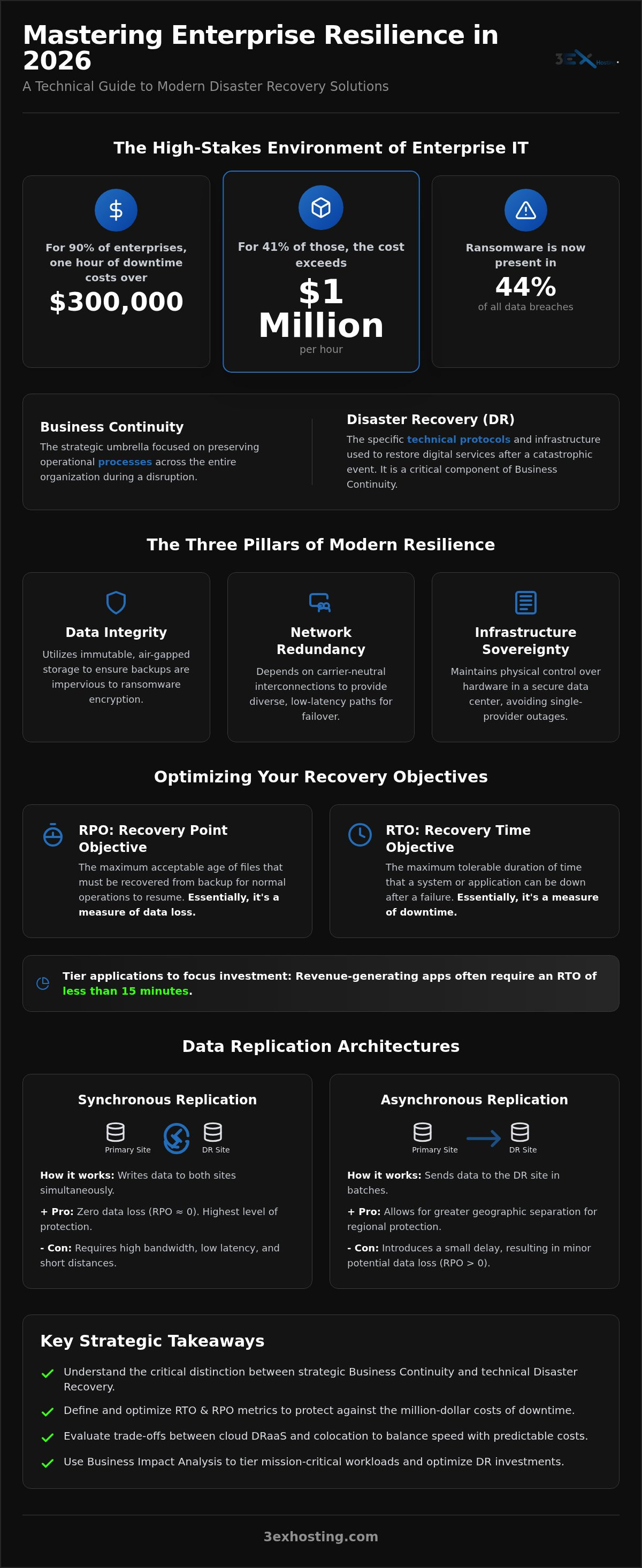
Recovery Time Objective (RTO) measures the duration of downtime your business can tolerate before significant damage occurs. If your RTO is 15 minutes, your systems must be live within that window. Recovery Point Objective (RPO) dictates the age of the files you recover. An RPO of zero means no data loss, requiring real-time mirroring. It’s vital to align these metrics with compliance standards like GDPR or HIPAA. Failure to meet these specific targets often results in legal penalties that exceed the cost of the infrastructure itself.
The True Cost of Downtime in 2026
For a Tier-1 enterprise, the financial impact of an outage is staggering. Industry data from 2025 indicates the average cost of downtime has risen to $9,000 per minute for large-scale operations. This calculation includes lost sales, idle labor, and immediate recovery expenses. Indirect costs are harder to quantify but equally dangerous. Brand reputation takes years to build and seconds to lose during a public-facing outage. Regulatory fines for service interruptions in the financial sector can reach $50,000 per hour. The Downtime Gap represents the critical delta between an enterprise’s current restoration speed and the actual resilience required to survive a 2026 market disruption.
- Financial Impact: Direct revenue loss and SLA credit payouts.
- Reputational Risk: Permanent loss of customer trust and stock price volatility.
- Operational Strain: The “all-hands” cost of diverting engineering resources to crisis management.
The 5 Core Types of Disaster Recovery Architecture
Selecting the right architecture depends on your specific Recovery Time Objective (RTO) and budget. Modern enterprises rarely rely on a single method; instead, they combine several types to create a resilient stack. Effective disaster recovery solutions prioritize data integrity while minimizing the duration of any potential outage. By 2026, the shift toward hybrid models has become the standard for 74% of high-availability organizations.
- Data Center DR: This involves maintaining a secondary physical site with mirrored hardware. It is the most robust option for organizations with strict data sovereignty requirements, offering total control over the environment.
- Cloud-Based DR: Leveraging public cloud resources allows for scalable, pay-as-you-go recovery. It eliminates the need for an idle secondary physical footprint, reducing capital expenditure by an average of 35%.
- Virtualized DR: This uses virtual machine (VM) encapsulation to make restoration hardware-independent, allowing for faster migration between different server brands.
- Disaster Recovery as a Service (DRaaS): A fully managed model where third-party experts handle failover and failback operations.
- Network DR: This focuses on maintaining connectivity. It ensures that if a primary circuit fails, traffic reroutes through redundant lines or SD-WAN configurations immediately.
Virtualized DR: Flexibility and Speed
VM replication allows for near-instantaneous failover to secondary hardware. Because VMs are encapsulated as files, they don’t care about the underlying physical server brand. This removes the complexity of hardware compatibility issues during a crisis. If your primary server fails, the VM starts on a different host in under 120 seconds. Integrating Managed Cloud Hosting into this strategy ensures your virtual environment remains high-performing and secure. Statistics from 2025 show that virtualized environments recover 60% faster than traditional physical restores.
DRaaS: The Managed Approach
DRaaS offloads the operational burden of recovery to expert providers. This is vital for mid-sized enterprises that don’t have 24/7 internal SOC or NOC teams. Instead of your IT staff scrambling during a midnight outage, the provider initiates the failover process. Choosing managed disaster recovery solutions allows internal teams to focus on core business growth rather than infrastructure maintenance. When evaluating providers, look closely at Service Level Agreements (SLAs). A robust SLA should guarantee recovery times, often promising sub-15-minute RTOs. Aligning these technical goals with the National Disaster Recovery Framework ensures your business meets high-level compliance and resilience standards.
When evaluating providers, it’s also wise to consider regional specialists who understand local infrastructure and compliance needs. For a look at how these services are implemented in different markets, you can visit NovaCloud Africa to see an example of a provider focused on business-grade cloud and connectivity solutions.
Connectivity is often the silent killer of recovery plans. Network DR ensures your users can actually reach the recovered data. We often see businesses with perfect data backups but no way to route traffic to them during a primary circuit failure. Implementing redundant paths and automated DNS failover prevents this bottleneck. If you want to ensure your infrastructure is truly resilient, consider exploring our high-tier data center options for maximum uptime and stability.
Colocation vs. Public Cloud: Evaluating Your DR Site Strategy
Choosing between colocation and public cloud isn’t just about server space. It’s a fundamental decision regarding cost predictability and recovery speed. Many enterprises find that a full cabinet colocation environment offers a lower total cost of ownership (TCO) for heavy workloads compared to the cloud. While cloud providers offer low entry costs, the long-term storage and compute fees for a mirror image of your production site can inflate budgets by 30% or more annually. Professional disaster recovery solutions require a balance between immediate availability and sustainable spending.
The “Egress Trap” remains the biggest hidden danger in cloud-based DR. Public cloud providers often charge nothing to ingest your data, but they charge heavily to move it out. During a regional outage or a full-scale recovery event, these egress fees can reach $0.09 per GB. If you’re pulling 500TB of data back to your primary site or a secondary office, you’re looking at a $45,000 bill just for the data transfer. Colocation environments eliminate this risk with flat-rate bandwidth or predictable port speeds. This financial transparency is why 65% of high-compliance firms still rely on private hardware for their core recovery assets.
Performance remains another critical factor. Private cross-connects in a data center provide sub-1ms latency for data replication. This is essential for synchronous replication where every millisecond matters. Highly regulated industries, such as banking or healthcare, often prefer private suites for their DR sites. These suites provide physical isolation and dedicated infrastructure, making it easier to pass audits and maintain strict data sovereignty standards that public cloud environments can’t always guarantee.
The Hybrid DR Model: Best of Both Worlds
You don’t have to choose just one path. Most modern enterprises use a hybrid approach. They keep mission-critical core systems on physical hardware in a colocation facility while using the cloud for non-essential workloads or temporary “burst” capacity during a crisis. You can bridge these two environments using high-performance cross-connect services. This setup allows for rapid failover of your most sensitive databases while keeping costs low for less urgent applications. A well-documented IT Disaster Recovery Plan should clearly define which assets live in each environment based on their Recovery Time Objective (RTO).
Infrastructure Redundancy: N+1 and Beyond
The foundation of any DR plan is the physical reliability of the site itself. We utilize N+1 or 2N redundancy for both power and cooling systems to ensure that a single equipment failure won’t take your backup site offline. Carrier-neutral facilities are vital here. They provide access to multiple fiber providers, ensuring that if one ISP suffers a backbone failure, your disaster recovery solutions stay reachable through diverse network paths. Energy efficiency also plays a role in site selection. Understanding metered power helps you pay only for the electricity your DR gear actually consumes, rather than a flat estimated rate. This technical precision ensures your secondary site is both robust and cost-effective.
Building a Resilient DR Plan: A Step-by-Step Framework
A disaster recovery plan isn’t a static document sitting in a digital drawer. It’s a living protocol that dictates how your business survives the unthinkable. To build a framework that actually works in 2026, you must move beyond generic templates and focus on technical precision. Effective disaster recovery solutions start with a rigorous inventory and audit process. You can’t protect what you don’t track. Your team must identify every critical asset, from customer databases to proprietary algorithms, and map their dependencies. In 2025, research indicated that the average enterprise manages over 15 petabytes of data, yet 40% of that is often unclassified, creating massive gaps in recovery strategies.
Once you’ve mapped your assets, perform a granular risk assessment. Don’t just plan for “a disaster.” Evaluate specific threats including localized hardware failure, regional power outages, and sophisticated ransomware attacks. Assign a probability and impact score to each. This data allows you to prioritize budget and resources where they’re needed most. Following the assessment, draft a clear communication plan. When the ‘red button’ is pushed, there’s no time for debate. Your plan should specify exactly who holds the authority to trigger failover and how stakeholders will receive updates when primary channels are down.
Implementation is the final pillar. This involves setting up real-time replication and automated failover workflows. Modern disaster recovery solutions utilize low-latency pipelines to ensure that your standby environment is a mirror image of production. We recommend using automated scripts that can spin up virtual machines in a specific sequence, ensuring that databases are live before application servers attempt to connect.
The Importance of Regular Testing
A DR plan is useless if it hasn’t been tested in the last six months. Static plans fail because environments change; new patches are applied, and network configurations shift. Quarterly simulations are the only way to verify your RTO and RPO targets. Use isolated VLANs to simulate failover events without disrupting your live production environment. In 2024, enterprises that conducted monthly “fire drills” reduced their actual recovery time by 65% compared to those who only tested annually. Real-world test data provides the evidence you need to refine your strategy and prove compliance to auditors.
Leveraging Remote Hands for Physical Recovery
Physical infrastructure issues require a physical presence. When a crisis prevents your team from reaching the facility, 24/7 Remote Hands Support acts as your on-site tactical team. These technicians handle hardware swaps, cable re-routing, and visual inspections under your direction. You shouldn’t have to wait for a flight or a cleared road to fix a failed switch. By integrating remote support into your emergency response protocols, you ensure that physical hardware failures don’t turn into prolonged business outages. It’s about having expert eyes and hands on the ground when you can’t be there yourself.
Build your infrastructure on a stable foundation that never sleeps. Explore our enterprise-grade data center solutions today.
Enterprise-Grade Disaster Recovery with 3EX Hosting
3EX Hosting provides the technical foundation required for high-performance disaster recovery solutions. We designed our high-density infrastructure to withstand the most demanding mission-critical scenarios. By choosing Private Data Center Suites, your organization secures maximum control over its physical environment. This setup eliminates the risks of shared space while providing a dedicated, secure perimeter for your sensitive data. It’s a professional approach that prioritizes technical stability and speed above all else.
The 3EX advantage centers on our superfast connectivity and 24/7 expert support. We don’t just provide space; we provide a partnership. Our network architecture utilizes redundant 100Gbps uplinks to ensure your data stays synchronized without lag. If a disaster strikes, our on-site specialists are available every second of the day to assist with immediate failover procedures. We focus on the technical details so you can focus on your business operations. Our facility maintains a 99.999% uptime record, ensuring your secondary site is ready the moment your primary site falters.
Scalable Infrastructure for Growing Needs
Growth shouldn’t be a bottleneck for your business continuity plans. We offer modular scaling options ranging from Quarter Cabinets for targeted recovery needs to custom cages for massive enterprise datasets. Our facilities support high-density power configurations, allowing for up to 30kW per rack. This capacity is essential for modern high-performance DR appliances that require significant cooling and energy. Our carrier-neutral connectivity provides access to dozens of Tier 1 providers, future-proofing your network against regional outages and ensuring lightning-fast data transfers at all times.
Getting Started with 3EX Hosting
Your journey to a resilient infrastructure begins with a professional audit. Our specialists conduct a thorough review of your current DR readiness to identify potential single points of failure. We look at your hardware, network paths, and recovery protocols to ensure they meet 2026 industry standards. We help you define realistic Recovery Time Objectives (RTO) and Recovery Point Objectives (RPO) based on your specific hardware capabilities.
Once the plan is set, our team manages the migration and setup of your DR environment. We handle the technical complexities of rack integration, biometric security setup, and network cross-connects. Our goal is to make the transition seamless and transparent. Don’t wait for a system failure to test your limits. Secure your business continuity today by consulting with our infrastructure experts and building a foundation that lasts.
Securing Your Enterprise Legacy in 2026
Modern business continuity requires more than just passive backups. By 2026, top-tier enterprises will prioritize multi-site disaster recovery solutions that can slash recovery time objectives by 85% compared to legacy 2020 standards. Your strategy must balance cloud agility with the physical security of high-density colocation to maintain 99.999% uptime. Waiting for a system failure to test your resilience is a risk that costs mid-sized firms an average of $300,000 per hour of downtime according to recent industry benchmarks.
3EX Hosting provides the technical stability you need to eliminate these risks. Our infrastructure features high-density N+1 power redundancy and carrier-neutral connectivity with high-speed cross-connects to ensure your data stays accessible. With 24/7 on-site remote hands support, our experts manage the complex server-side processes so you don’t have to. It’s time to move your operations to a superfast, stable environment where performance meets uncompromising security.
Build Your Resilient DR Infrastructure with 3EX Hosting
Take the first step toward a worry-free digital future today. Your systems are in safe hands with our expert team.
Frequently Asked Questions
What is the difference between backup and disaster recovery solutions?
Backups provide a copy of your data for file restoration, while disaster recovery solutions ensure your entire IT infrastructure can resume operations after a failure. Think of a backup as a spare tire and DR as a second vehicle waiting to take over. Most enterprise environments require a Recovery Time Objective (RTO) of under 4 hours, which a simple backup won’t achieve alone.
How much does an enterprise disaster recovery solution cost?
Enterprise disaster recovery solutions typically cost between 2% and 10% of a company’s total IT budget. For a firm with a $1 million IT spend, this equates to $20,000 to $100,000 annually. These costs cover licensing, off-site storage, and high-speed NVMe SSD infrastructure needed to maintain a secondary site.
Is DRaaS better than traditional off-site colocation for DR?
DRaaS is superior for modern enterprises because it offers 15 minute failover times and eliminates capital expenditure on hardware. Traditional colocation requires you to manage physical servers at a distant data center, which increases management overhead. 73% of enterprises now prefer DRaaS for its scalability and lower total cost of ownership.
How often should an enterprise test its disaster recovery plan?
You should test your disaster recovery plan at least twice every 12 months. 40% of businesses that fail to test their DRP annually experience data loss during a real event. Regular testing ensures that your RPO and RTO targets remain achievable as your infrastructure evolves. It’s the only way to guarantee your team’s ready for a crisis.
Can disaster recovery solutions protect against ransomware attacks?
Yes, modern disaster recovery solutions protect against ransomware by using immutable storage and 3-2-1-1 backup strategies. This ensures that even if your primary network’s encrypted, an offline or read-only copy of your data remains safe. 2024 security reports show that companies with air-gapped DR sites recover 4 times faster from cyberattacks.
What are the most critical components of a Disaster Recovery Plan (DRP)?
The four most critical components are Recovery Time Objectives (RTO), Recovery Point Objectives (RPO), a clear communication chain, and detailed technical failover procedures. You need to define exactly which 5% of your mission-critical applications must be online first. Without these specific metrics, your team won’t know how to prioritize resources during a crisis.
How do high-speed cross-connects improve disaster recovery performance?
High-speed cross-connects improve DR performance by providing direct, physical links between service providers with latency under 1 millisecond. This stable connection allows for real-time data replication without the bottlenecks of the public internet. It’s essential for maintaining 99.99% uptime during a failover event. You’ll get faster synchronization and better reliability.
What is the difference between Hot, Warm, and Cold DR sites?
A Hot site is a fully functional mirror of your production environment with near-zero recovery time. A Warm site has the hardware ready but requires data restoration, taking 4 to 24 hours to go live. A Cold site is just space and power, requiring days or weeks to set up, which 85% of modern enterprises find insufficient for their needs.