 SUPPORT


 3EX United States
 Blog
A 2023 study by the NRDC found that typical data centers waste up to 90% of the electricity they pull from the utility grid. This inefficiency often forces enterprises into a metered power arrangement that lacks the granular detail needed to identify where that energy actually goes. You’ve likely seen colocation invoices that feel disconnected from your hardware’s real-time performance. It’s frustrating to manage high-density racks when you can’t see exactly where your energy budget is going each month. You deserve a system that rewards efficiency instead of penalizing growth.
We believe that technical excellence requires absolute financial transparency. This guide explains how usage-based billing eliminates the guesswork by charging you only for the kilowatts your servers actually consume. You’ll learn how to leverage granular monitoring to reduce infrastructure overhead and improve your 2024 budget forecasting. We’ll walk through the transition from rigid power caps to a flexible, scalable model that ensures your high-density hardware remains both fast and cost-effective.
Key Takeaways
- Learn how to transition from legacy billing to a precision model where you pay only for the actual kilowatt-hours your equipment consumes.
- Gain insight into how intelligent PDUs and real-time monitoring provide the transparency needed to eliminate rack-level energy waste.
- Determine if metered power is the right fit for your workload by identifying and removing the hidden costs of unused “insurance” capacity.
- Discover technical strategies to optimize power density and minimize “vampire” draw for a more efficient enterprise infrastructure.
- Explore how 3EX Hosting delivers stable, N+1 redundant power and superfast connectivity to guarantee mission-critical reliability.
What is Metered Power in a Data Center Context?
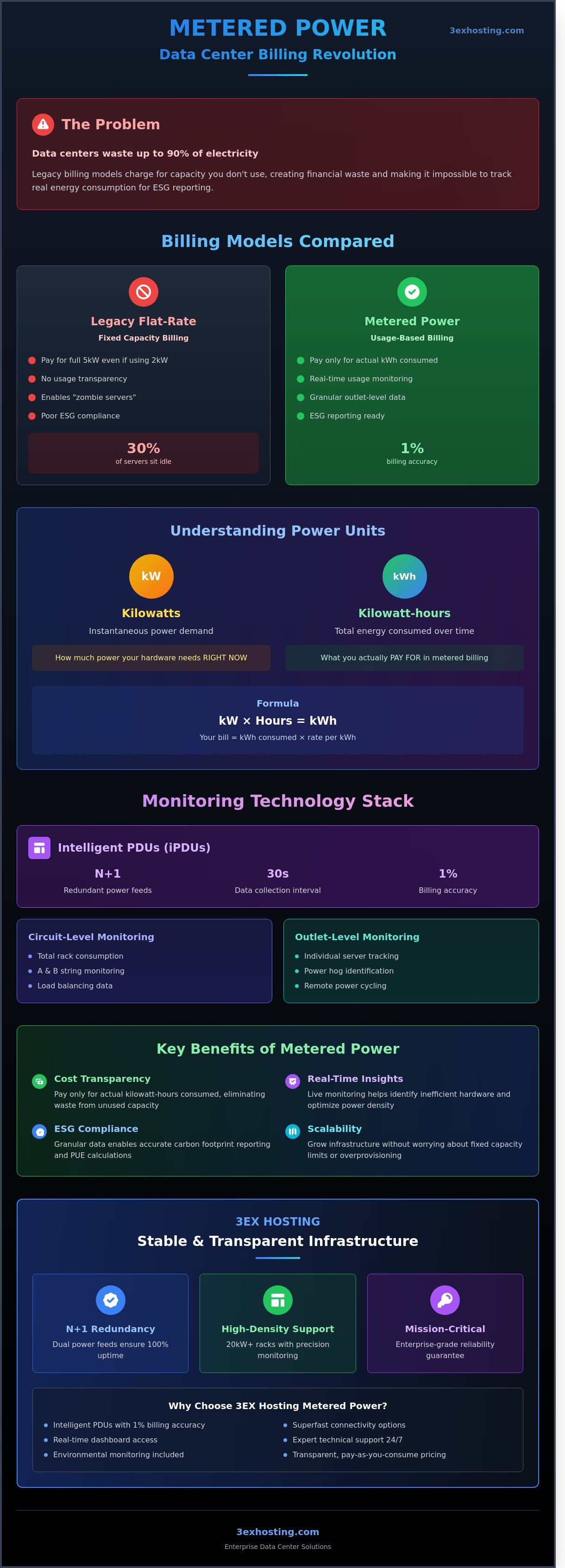
Metered power is a billing model where you pay for the actual kilowatt-hours (kWh) your hardware consumes. It’s a departure from the legacy “all-you-can-eat” approach. In older models, customers paid for a fixed circuit capacity regardless of their actual draw. If you had a 5kW circuit but only used 2kW, you still paid for the full 5kW. This created significant financial waste. Modern enterprise standards now favor precision-based billing because it reflects true operational costs.
Transparency in energy usage is no longer optional. It’s a standard requirement for corporate ESG (Environmental, Social, and Governance) reporting and financial auditing. To accurately report a carbon footprint, you need granular data. Understanding your Power Usage Effectiveness (PUE) starts with knowing your exact consumption. Metered power provides the raw data necessary for these high-level efficiency calculations.
The core difference lies between “Provisioned Power” and “Metered Power.” Provisioned power is your ceiling; it’s the maximum capacity the data center reserves for your rack. Metered power is your floor; it’s the actual energy used by your servers. By 2024, data centers that don’t offer metered billing are often seen as lagging in technical transparency.
The Evolution of Power Billing
Legacy flat-rate billing leads to “zombie servers.” These are inactive units that draw power but perform no useful work. Research indicates that up to 30% of servers in some older facilities sit idle. This wastes your budget and strains the facility. The rise of high-density computing, where a single rack might draw 20kW or more, makes granular data essential. Metered models align your IT incentives with facility efficiency goals, ensuring you only pay for the performance you actually use.
Key Terminology: kW vs. kWh
Understanding your bill requires a clear distinction between two units:
- Kilowatts (kW): This is your instantaneous demand or “capacity.” It represents how much power your hardware needs at any specific moment.
- Kilowatt-hours (kWh): This is the total energy consumed over time. It’s the volume of electricity that flowed through your equipment during the billing cycle.
Your metered power bill is determined by multiplying the instantaneous draw in kW by the total duration of that draw to calculate the consumed kWh.
The Mechanics: How Metered Power is Tracked and Reported
Accurate metered power tracking starts with Intelligent Power Distribution Units (iPDUs) installed directly in the server rack. These aren’t standard power strips. They’re sophisticated networked devices that measure electricity as it flows to your hardware. In a professional colocation environment, we maintain N+1 redundancy. This means two separate power feeds, often called A and B strings, enter your rack. Each feed has its own iPDU. If one circuit fails, the other takes the full load instantly. Your billing remains precise because both units sync data to a central database to ensure every watt is accounted for.
Monitoring happens at two distinct levels. Circuit-level monitoring tracks the total draw of the entire rack. Outlet-level monitoring is more granular. It measures the consumption of each individual plug. This allows us to identify a specific “power hog” server that might be malfunctioning or running inefficient processes. This level of detail is essential for managing high-density metered power environments where every amp counts toward your operational efficiency.
Intelligent PDUs and Hardware Sensors
Basic PDUs only distribute electricity. Monitored units let us see the total load. Switched iPDUs go a step further; they allow for remote rebooting of individual outlets. We use high-precision Current Transducers (CTs) to measure amperage. These sensors provide 1% billing accuracy, ensuring you only pay for what you use. Most modern hardware setups also include environmental sensors. These track temperature and humidity at the rack level. If a server fan fails and heat rises by 5 degrees, the sensors catch it before the hardware throttles.
Reporting and User Dashboards
Data Center Infrastructure Management (DCIM) software pulls metrics from these sensors every 30 seconds. You see this data in your secure portal as real-time graphs. Historical trending is vital for your capacity planning. If your usage grew by 12% over the last quarter, you’ll know exactly when you’ll need to provision more capacity. We set automated alerts at 80% of your provisioned limit. This prevents unexpected overages or tripped breakers during traffic spikes. You can view our infrastructure standards to see how we integrate this hardware for maximum stability.
Metered vs. Unmetered Power: Which is Right for Your Business?
Choosing between these two models depends on your infrastructure’s appetite. Unmetered power often includes a hidden “insurance premium.” Providers bake in a buffer to cover peak usage, meaning you pay for capacity that sits idle 90% of the time. If your rack draws 400W on average but is provisioned for 2kW, you’re subsidizing the provider’s risk. Choosing metered power eliminates this overhead by aligning costs with actual consumption, ensuring you don’t pay for ghost capacity.
Workload Profile Analysis
Analyze your hardware’s behavior. Steady-state systems, like a core SQL database or a high-traffic CDN node, might maintain 85% utilization round-the-clock. In these specific cases, a flat-rate plan offers predictable budgeting. However, 70% of modern dev/test environments and web clusters exhibit “bursty” profiles. They spike during business hours and drop to 10% utilization at night. Metered power favors these fluctuating patterns. The break-even point typically occurs when sustained utilization exceeds 75%. Below that threshold, paying for what you use is the more economical path.
- Steady-state: High-utilization environments where power draw is consistent 24/7.
- Fluctuating: Applications with significant off-peak periods, such as backup servers or staging environments.
- Efficiency: Metered billing allows for a 25-40% reduction in costs for workloads that are not fully utilized.
Transparency and Auditing Benefits
Granular data transforms power from a vague utility into a manageable metric. You can calculate rack-level Power Usage Effectiveness (PUE) by comparing IT load against total facility draw. This precision allows finance teams to implement accurate internal chargebacks. If a specific department’s video rendering server consumes 45% of the monthly power, you have the logs to prove it.
Security teams also benefit from this transparency. An unexpected 150W jump in a baseline idle state often signals “rogue” hardware or unauthorized software running in the background. Detailed power logs turn your monthly bill into a diagnostic tool. You gain visibility that flat-rate billing simply cannot provide. This level of detail ensures your infrastructure remains lean, secure, and cost-effective.
Optimizing Your Infrastructure for High-Density Efficiency
Efficiency isn’t just a buzzword; it’s a financial strategy. When you transition to a metered power model, your infrastructure’s efficiency directly dictates your monthly overhead. High-density environments require a shift in how you view server utilization. Traditional bare-metal setups often see CPU utilization hovering around 15%, which wastes energy on idle cycles. By implementing virtualization or containerization through platforms like Proxmox or Kubernetes, you can push utilization to 65% or higher. This consolidation reduces the number of physical chassis drawing power, effectively doing more work with fewer watts.
High-performance computing (HPC) and AI workloads present unique challenges for modern data centers. These systems often require 15kW to 30kW per cabinet, far exceeding standard 5kW allocations. Managing these loads requires granular visibility. Using metered power data allows you to track consumption spikes during training runs or complex simulations, ensuring your infrastructure stays within safe thermal and electrical limits without overpaying for unused capacity.
Power-Sipping Hardware Selection
The foundation of a lean infrastructure starts with the power supply unit (PSU). You should prioritize 80 Plus Platinum or Titanium rated units. A Titanium PSU offers 96% efficiency at 50% load, whereas older Gold-rated units lose significantly more energy as waste heat. Modern CPUs also play a critical role through improved performance-per-watt ratios. Statistics from 2023 hardware refreshes confirm that latest-gen hardware can reduce idle draw by up to 30% while delivering double the processing throughput of 2018-era silicon.
Thermal Management and Airflow
Heat is the natural enemy of electrical efficiency. Every watt of power consumed by your server generates approximately 3.41 BTUs of heat. If your cooling system isn’t optimized, your fans will spin faster, consuming even more electricity. You can use metered data to identify “hot spots” within a specific cabinet or cage. If one rack consistently draws more power but shows higher ambient temperatures, it’s a clear sign of airflow recycling.
- Containment: Implementing hot or cold aisle containment can reduce cooling costs by 20% to 40% by preventing the mixing of air streams.
- Blanking Panels: These simple tools prevent hot exhaust air from circulating back to the front of the server, maintaining a steady intake temperature.
- Sensor Integration: Link your power metrics with thermal sensors to automate cooling responses based on real-time demand.
By focusing on these technical refinements, you ensure that every dollar spent on electricity goes toward computation rather than wasted heat or idle hardware. It’s about precision and performance.
Ready to scale your high-density workloads with precision? View our professional colocation plans to see how our infrastructure supports your growth.
The 3EX Hosting Approach: Stable and Transparent Infrastructure
3EX Hosting delivers a foundation built on technical excellence and predictable costs. We provide superfast cross-connects that ensure your data moves without bottlenecks. Our power delivery systems are engineered for total stability, utilizing N+1 redundancy to eliminate single points of failure. By choosing metered power, you only pay for the exact wattage your hardware draws, while benefiting from an infrastructure that supports 10Gbps and 40Gbps handoffs. This combination of precision billing and high-performance hardware creates a predictable, scalable environment for your digital assets.
Our 24/7 Remote Hands support acts as a direct extension of your technical team. Whether it’s a simple power cycle or complex cable management, our technicians are on-site to handle physical tasks immediately. This service complements our power model by ensuring your hardware operates at peak efficiency around the clock. We don’t believe in over-provisioning or hidden fees. Instead, we focus on providing the technical depth required to keep your servers running at maximum capacity.
- Redundant N+1 power and cooling systems for 99.999% uptime.
- Direct access to superfast fiber cross-connects.
- On-site technical support available 24/7/365.
- Flexible billing that scales with your actual consumption.
Enterprise-Grade Reliability
We maintain a 99.999% uptime track record, making our facility ideal for enterprise disaster recovery solutions and managed cloud deployments. For clients with high-density requirements, we offer customizable cage solutions that handle 10kW per rack or more. Our technical team monitors the environment every second of the day. This provides the peace of mind that mission-critical systems require. You get the stability of a Tier III data center environment with the responsiveness of a boutique provider.
Getting Started with Your Infrastructure
Transitioning from a single cabinet to a private suite is a seamless process. We customize every colocation plan to match your specific power and space needs. As a premier carrier hotel, we offer access to over 15 fiber providers, ensuring superior connectivity and low latency. You don’t have to guess your future costs or deal with “all-you-can-eat” pricing that wastes your budget. Contact 3EX Hosting today for a transparent colocation quote and see how our metered power model can optimize your infrastructure budget while providing the speed your business demands.
Master Your Data Center Efficiency
Transitioning to a smarter data strategy starts with precise energy management. metered power provides the granular visibility needed to eliminate waste and scale your operations without hidden costs. By tracking actual consumption, businesses can optimize high-density workloads and ensure every watt contributes directly to performance. It’s the most transparent way to manage a growing digital footprint while maintaining strict budget control. You’ll no longer pay for capacity you don’t use, allowing for more aggressive investment in your core technology.
3EX Hosting builds this transparency into every deployment. We provide a rock-solid environment featuring N+1 Power Redundancy to eliminate single points of failure across our power delivery systems. Your hardware stays accessible through our carrier-neutral connectivity, providing the flexibility to choose the best paths for your traffic. Our 24/7 Remote Hands Support ensures technical experts are on-site every minute of the year to handle any hardware needs. We don’t just host your servers; we protect your uptime with professional-grade stability and speed. This level of infrastructure reliability becomes even more critical when implementing comprehensive disaster recovery solutions that require seamless failover capabilities and predictable performance during crisis scenarios.
Ready to upgrade your infrastructure to a more reliable standard? Explore our secure Full Cabinet and Private Suite solutions and start scaling with confidence today.
Frequently Asked Questions
Is metered power more expensive than flat-rate billing?
Metered power isn’t inherently more expensive; it’s often 22% more cost-effective for users with variable workloads. Flat-rate plans force you to pay for a 30% safety margin that you rarely use. By switching to a metered model, you only pay for the exact kWh your hardware draws. This transparency eliminates the hidden tax of unutilized capacity and ensures your budget aligns with actual usage.
Can I monitor my power usage in real-time with 3EX Hosting?
You can monitor your consumption in real-time using our integrated 3EX Hosting dashboard. Our smart PDUs capture data points every 30 seconds with 99.5% accuracy. This level of detail lets you spot efficiency leaks immediately. You’ll see exactly how your superfast NVMe arrays impact your bottom line throughout the day, allowing for precise hardware optimization and cost management.
How much power does a typical 42U server cabinet consume?
A standard 42U cabinet typically consumes between 4kW and 12kW in a modern data center environment. A single 1U rack server might pull 350W under a 70% load. If you populate a full rack with 40 such units, your total draw reaches 14kW. High-performance GPU nodes can push these requirements even higher, often exceeding 35kW per cabinet in specialized high-density zones.
What happens if my hardware exceeds its provisioned power capacity?
If your hardware exceeds the 80% safety threshold of its provisioned capacity, our system triggers an automated alert. We don’t cut power instantly. Instead, our 24/7 technical team contacts you within 10 minutes to discuss load balancing or upgrading your circuit. This proactive approach prevents tripped breakers and ensures your services stay stable while maintaining the integrity of the electrical infrastructure.
Does metered power include cooling and facility overhead costs?
Our metered power pricing includes a transparent Power Usage Effectiveness (PUE) factor of 1.3 to cover facility overhead. This means for every 1.0 kWh your servers consume, we bill for 1.3 kWh to account for cooling and UPS losses. You won’t find hidden facility fees or surprise surcharges on your monthly invoice. Everything is calculated using this simple, verifiable multiplier for total billing clarity.
Is metered power available for both full cabinets and private suites?
Metered billing is available for all dedicated deployments, from individual 42U cabinets to 1,000-square-foot private suites. We use the same industrial-grade metering technology across our entire floor plan. This consistency helps you scale from a single rack to a private cage without changing your accounting workflows. You’ll get the same granular reporting regardless of your physical footprint in the facility.
What is the difference between primary and redundant power feeds?
The primary feed handles your active equipment load, while the redundant feed provides a 2N failover path. We deliver power via independent A and B circuits sourced from separate UPS systems. If the primary circuit drops, the redundant feed maintains your 15kW load without a single millisecond of downtime. This dual-path architecture is essential for maintaining the 99.99% uptime we guarantee for your mission-critical systems.
How does metered power help with corporate sustainability reporting?
Metered power provides the granular kWh data needed for accurate Scope 2 carbon footprint reporting. Most corporations require 100% precise energy data for their annual ESG audits. Because we provide exact consumption figures rather than broad estimates, you can verify your environmental impact with total confidence. This data simplifies compliance with ISO 14001 standards and helps you track the success of your green initiatives.