 SUPPORT


 3EX United States
 Blog
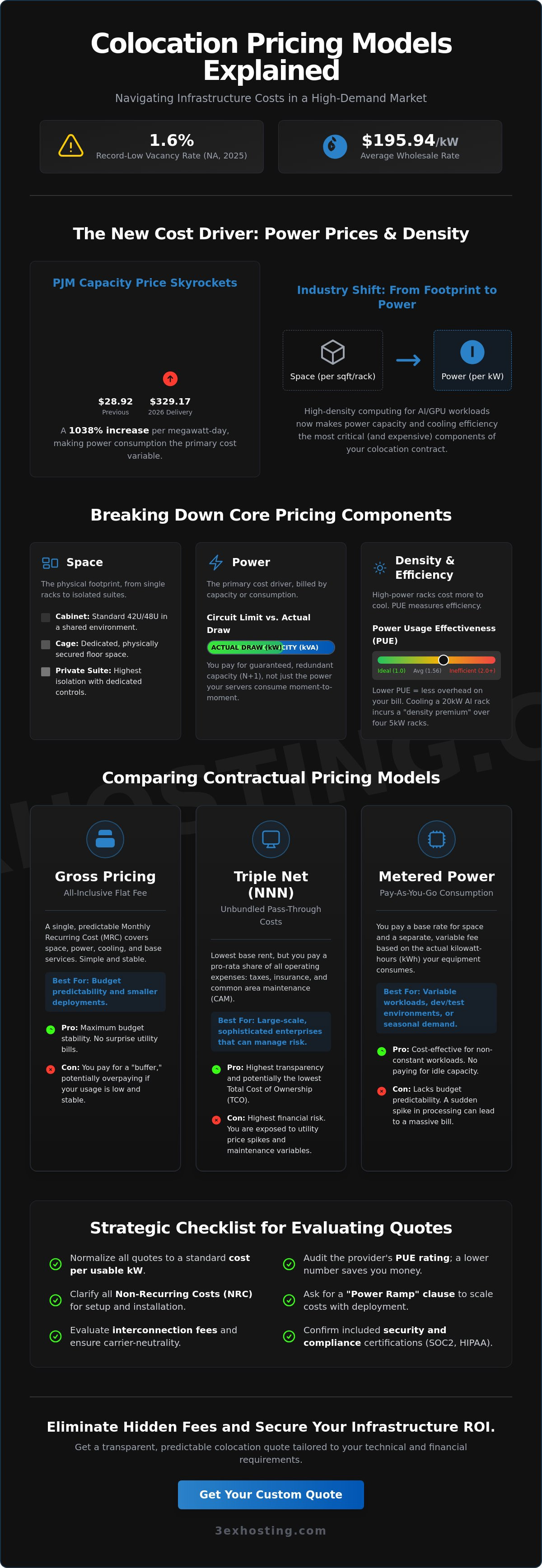
Did you know that primary market vacancy rates for colocation in North America hit a record low of 1.6% in early 2025? This extreme scarcity, combined with PJM capacity prices skyrocketing from $28.92 to $329.17 per megawatt-day for the 2026 delivery year, has made infrastructure budgeting more volatile than ever. This colocation pricing models explained guide cuts through the industry noise to show you why the average wholesale rate of $195.94 per kW is just the starting point of your total cost of ownership.
It’s frustrating when unpredictable monthly power overage charges and hidden non-recurring costs (NRC) during setup disrupt your financial planning. You need technical stability and price transparency, not marketing jargon or vague estimates. We’ll help you master these billing complexities to eliminate hidden fees and optimize your infrastructure ROI. You’ll gain a predictable Monthly Recurring Cost (MRC) framework, clear insight into metered versus flat-rate power logic, and a technical checklist for comparing provider quotes. We’ve designed this guide to ensure your infrastructure remains stable and your costs remain within your control.
Key Takeaways
- Identify the transition from physical footprint to power-centric billing to ensure your infrastructure scales efficiently in high-density environments.
- Navigate the differences between Gross, NNN, and metered billing with our colocation pricing models explained framework to secure a predictable monthly recurring cost.
- Understand the “Power Density” premium and how AI-driven GPU requirements reshape your setup costs and cooling infrastructure needs.
- Evaluate the long-term ROI of interconnection fees and carrier-neutrality to avoid being locked into expensive, non-competitive bandwidth rates.
- Use our strategic checklist to normalize provider quotes by calculating cost per kW and auditing PUE ratings for true financial transparency.
Breaking Down the Core Components of Colocation Pricing
Understanding colocation pricing models explained requires looking past the monthly rent check. You aren’t just paying for square footage; you’re investing in a sophisticated colocation center environment that guarantees uptime through redundant power, cooling, and security. In 2026, these costs are increasingly unbundled. This allows enterprises to pay for exactly what they use while maintaining the flexibility to scale as demand fluctuates. With primary market vacancy rates hitting a record low of 1.6% in 2025, securing these components early is a strategic necessity.
Space: From Racks to Private Suites
Physical space is the foundation of your quote. Most enterprises start with cabinet colocation, which provides a standard 42U or 48U rack in a shared environment. As your footprint grows, graduating to cage colocation offers a physical barrier and dedicated floor space. This is essential for meeting specific compliance audits or housing sensitive hardware. For mission-critical sovereignty, private data center suites provide the highest level of isolation. These suites often include dedicated cooling and security controls, though they carry a price premium compared to shared rows.
The Power Equation: Capacity vs. Consumption
Power is now the primary cost driver in modern data centers. You’ll encounter a gap between your “Circuit Limit” and your actual “Power Draw.” For instance, a 30A 208V circuit provides roughly 5kW of usable power, but you’re often billed based on the provisioned capacity (kVA) rather than what your servers consume. This ensures the facility maintains N+1 redundancy. It means there’s always a backup power source ready. If you use high-density hardware, your power density per rack will be higher. Cooling a 20kW rack is more complex than cooling four 5kW racks, which often triggers a density premium in your contract.
Efficiency metrics like Power Usage Effectiveness (PUE) directly impact your bottom line. The industry average PUE was 1.56 in 2024 according to the Uptime Institute. A lower PUE means the facility spends less on cooling for every watt your hardware consumes. Additionally, physical security and compliance standards like SOC2 or HIPAA are usually baked into the base rate of a professional data center. These certifications aren’t optional extras. They are fundamental requirements that protect your brand and your data. By understanding these core components, you can better analyze how different providers structure their quotes and avoid common billing pitfalls.
Comparing Contractual Pricing Models: Gross vs. NNN vs. Metered
Contract structures dictate how financial risk is shared between you and the data center provider. Choosing the wrong model can lead to a 20% variance in your annual budget. Most enterprises start with a Gross Pricing model. It functions like an all-inclusive lease where you pay one flat fee for space, power, and cooling. This provides maximum predictability but often includes a safety margin that favors the provider’s profit. Having these colocation pricing models explained is essential for long-term budgeting, especially as power costs fluctuate across regions.
For larger footprints, the industry shifts toward transparency. colocation pricing models like Triple Net (NNN) unbundle every cost. In an NNN lease, you are responsible for a pro-rata share of taxes, insurance, and maintenance. As of April 2026, single-tenant net lease cap rates averaged 6.80%. While NNN lease financing rates start as low as 5.92%, this model requires a sophisticated internal team to manage variable utility pass-throughs. It offers the lowest base rent but the highest level of variable risk.
Flat Rate vs. Metered Power Billing
Flat rate billing offers budget stability by charging for the circuit capacity regardless of usage. If your servers idle at 30% load, you’re overpaying for unused electrons. Metered power billing solves this by charging for actual kW consumed. It’s ideal for seasonal workloads or development environments. You should also look for a “Power Ramp” clause. This allows you to pay for power incrementally as you deploy hardware, rather than paying for a full 10kW circuit on day one. This flexibility is a hallmark of a modern, professional provider.
Identifying Hidden Fees in Master Service Agreements
The gap between your initial quote and your first invoice often stems from Non-Recurring Costs (NRC). While Monthly Recurring Costs (MRC) are easy to track, setup fees can be substantial. For example, a full cabinet installation can cost $1,000 upfront. High-density GPU deployments requiring liquid cooling can see setup fees reach £5,000 in certain markets. You must also account for recurring fees that aren’t always highlighted:
- Cross-Connects: These typically cost between £150 and £300 per month per connection.
- Fuel Surcharges: Some providers pass through the cost of testing backup generators.
- Remote Hands: Ensure you have a clear rate card for emergency technical support.
Check your SLA for penalty credits. If a provider fails to meet uptime guarantees, you should receive automatic billing credits. If you need help calculating these setup variables, you can request a detailed quote that breaks down NRC versus MRC clearly. This transparency ensures your infrastructure remains a stable asset rather than a financial burden.
The Impact of High-Density and GPU Requirements on Pricing
AI clusters have fundamentally changed the math of data center budgeting. By 2027, AI is projected to account for 27% of global data center power consumption, a massive jump from 14% just a few years ago. This surge in demand means that standard colocation pricing models explained in previous years are no longer sufficient for enterprise planning. High-density workloads require specialized infrastructure that can handle the extreme thermal and electrical loads of modern hardware. If you’re deploying NVIDIA H100 or B200 clusters, you’re no longer just buying space; you’re buying specialized power management and cooling capacity.
The “Power Density” premium is a critical factor here. Power density is the ratio of kilowatts (kW) provided per rack unit (U). Cooling a single 20kW rack is significantly more complex and expensive than cooling four 5kW racks spread across a room. Concentrated heat requires advanced airflow management or liquid cooling systems. Consequently, providers often charge a premium for high-density configurations to offset the increased infrastructure wear and specialized cooling requirements. In 2024, the industry average PUE was 1.56, but high-density facilities aim much lower to keep operational costs manageable. Understanding Retail vs. wholesale colocation differences is vital when scaling these power-heavy deployments.
Pricing AI Infrastructure and GPU Dedicated Servers
Supporting H100 and B200 GPU clusters involves more than just plugging in servers. Power distribution units (PDUs) become a major cost factor at scale. These high-amperage components are necessary to deliver stable power to GPU-heavy racks without risking circuit trips. You should also account for the physical weight of these systems. A fully loaded AI rack can weigh over 1,300 kg, requiring reinforced flooring that isn’t standard in every facility. To dive deeper into these technical requirements, read our high density GPU colocation guide for a full breakdown of AI-ready infrastructure.
Future-Proofing for 2026 Power Demands
Infrastructure flexibility is the only way to protect your ROI in 2026. Data centers must be evaluated for their ability to provide modular power upgrades without requiring you to move your entire cage. Many enterprises now pay for “Reserved Capacity.” This is a fee to ensure that when you’re ready to add your next GPU cluster, the power and cooling capacity are guaranteed to be available. With primary market vacancy rates at a record low of 1.6% in 2025, waiting until you need the power is a high-risk strategy. Additionally, new regulatory changes, such as the FERC rule expected on April 30, 2026, will standardize how large loads over 20 megawatts interconnect with the grid. This could impact long-term pricing for the largest enterprise deployments. Planning for these shifts now ensures your technical stability remains uncompromised as your AI needs grow.
Understanding Interconnection and Managed Service Fees
Connectivity is the lifeblood of modern infrastructure. While space and power form the foundation, interconnection fees often represent a significant portion of your monthly recurring cost (MRC). These fees cover the physical and logical links that allow your servers to communicate with the outside world. Having these colocation pricing models explained helps you distinguish between the one-time setup fees (NRC) and the ongoing costs of maintaining high-speed data paths. In a market where connectivity demands are surging, understanding these nuances is essential for technical stability.
Cross-connect services are the most common interconnection expense. These are superfast private fiber links between your equipment and a carrier or another tenant. In the UK market, cross-connects typically cost between £150 and £300 per month per connection. This is a recurring fee that ensures low-latency access to your network partners. To keep these costs manageable, look for carrier-neutral facilities. Carrier-neutrality fosters competition between multiple Internet Service Providers (ISPs) within the same building. This competition naturally lowers your bandwidth costs and prevents expensive vendor lock-in.
You also need to choose between Blended IP and Direct Carrier Access. Blended IP combines several carriers into one redundant stream managed by the provider. It’s often the most resilient choice for enterprises that can’t afford a single point of network failure. Direct access is a dedicated pipe from a specific carrier, which can be more cost-effective for massive, single-destination traffic. Both options are valid, but they require different budgeting approaches within your colocation pricing models explained framework.
The ROI of Remote Hands Support
Managed infrastructure support is a powerful tool for reducing internal OpEx. Flying your own engineers to a data center for routine maintenance or emergency hardware swaps is inefficient. remote hands support provides on-site experts who act as your physical presence in the facility. Standard response times are often bundled into service packages, while emergency response tiers carry a premium. This professional support ensures your systems remain stable without the need for a dedicated local team.
Carrier Hotel Benefits and Connectivity Fees
Being located in a “carrier hotel” significantly reduces latency and long-haul circuit costs. These facilities house a high concentration of network providers, making it easier and cheaper to establish connections. You can leverage cross-connect services to build sophisticated multi-cloud strategies. By linking your private hardware directly to hyperscalers, you bypass the public internet, improving both speed and security. If you’re planning a complex deployment, request a quote to see how these connectivity benefits can be integrated into a predictable billing structure.
Strategic Checklist: How to Evaluate and Compare Colocation Quotes
Comparing “all-in” quotes is difficult because every provider uses different billing logic. This colocation pricing models explained checklist ensures you’re comparing apples to apples across various facilities. By normalizing these variables, you can eliminate hidden fees and protect your infrastructure ROI. Don’t settle for a headline price that ignores the long-term impact of utility pass-throughs or setup costs.
- Step 1: Normalize to Cost per kW. Divide the total monthly recurring cost (MRC) by the usable kilowatts. This is the only way to compare a high-density 20kW rack with several low-density 5kW cabinets.
- Step 2: Audit the PUE. A high Power Usage Effectiveness (PUE) rating means you’ll pay more for cooling. Aim for facilities with a PUE below 1.4 to ensure your utility pass-throughs remain manageable.
- Step 3: Calculate 36-Month TCO. Include all non-recurring costs (NRC) like setup and cross-connect installations. A 36-month contract often secures a 10-20% discount compared to a 12-month term.
- Step 4: Verify Remote Hands. Check if basic tasks like power cycles are included or if you’ll be billed an hourly rate for every incident.
- Step 5: Request a Quote. For complex or high-density needs, request a custom quote to get a clear breakdown of all contractual obligations.
Normalizing Power and Space Costs
Comparing quotes based on “Total Amps” is often misleading without voltage context. A 20A circuit at 120V provides only 1.9kW of usable power, while a 20A circuit at 208V provides 3.3kW. Always convert these figures to kW to see the true capacity you’re buying. Efficiency also plays a role in your final bill. PUE is the total facility energy divided by IT equipment energy. The closer this number is to 1.0, the more efficient the data center is at delivering power directly to your hardware.
Evaluating Long-Term Scalability and Flexibility
Infrastructure needs change fast. Ensure your Master Service Agreement (MSA) includes “Expansion Rights” that allow you to reserve adjacent space or power capacity. If you’re planning a significant migration, negotiate move-in assistance to reduce your initial setup burden and ensure a smooth transition. Scaling enterprise loads effectively often requires full cabinet colocation to maintain security and technical stability. By following this structured colocation pricing models explained approach, you can build a predictable financial framework for your 2026 infrastructure strategy.
Securing Your Infrastructure ROI in a High-Density Era
Transitioning your infrastructure to a colocation environment in 2026 requires a data-driven approach to budgeting. We’ve seen how primary market vacancy rates of 1.6% and rising power demands for AI workloads have transformed the industry. This colocation pricing models explained guide has highlighted why normalizing quotes by cost per kW and auditing PUE are essential steps for any enterprise. Whether you’re managing H100 clusters or scaling standard cabinet loads, technical stability depends on a predictable monthly recurring cost framework.
Don’t let hidden fees or unpredictable overages disrupt your technical roadmap. Our high-density GPU ready infrastructure and carrier-neutral connectivity provide the performance your mission-critical applications demand. With 24/7 remote hands support, your systems stay stable while your internal team focuses on growth. Get a transparent colocation quote for your enterprise today to secure your capacity in a tightening market. Your infrastructure success starts with a partner who values transparency as much as performance.
Frequently Asked Questions
What is the difference between NRC and MRC in colocation pricing?
NRC stands for Non-Recurring Cost, which is a one-time setup fee, while MRC is the Monthly Recurring Cost for your ongoing services. NRC typically covers initial cabinet installation or physical cable drops. MRC includes your base rent and power allocation. Understanding these colocation pricing models explained in your contract helps you calculate a true 36-month total cost of ownership without budget surprises.
How much does a full colocation cabinet typically cost per month?
Monthly costs vary significantly based on your region and power density. In the New York Metro area, small spaces cost between $170 and $280. For larger wholesale deployments, the North American average is $195.94 per kW as of H2 2025. Your final price depends on whether you’re in a high-demand market like Singapore or a more affordable region like Atlanta where rates are closer to $160.
Is metered power cheaper than flat-rate power for enterprise servers?
Metered power is generally more cost-effective for workloads that fluctuate throughout the day. You only pay for the actual kW consumed by your hardware. Flat-rate power offers budget predictability but often includes a premium to cover peak usage. If your servers run at a steady 80% load, flat-rate may be simpler for your accounting team to manage without monitoring monthly usage spikes.
What are cross-connect fees and why are they recurring?
Cross-connects are private fiber links between your equipment and a network carrier or another tenant. These carry recurring fees because the provider must maintain the physical infrastructure and patch panel ports. In the UK market, these connections cost between £150 and £300 per month. They are essential for low-latency multi-cloud strategies and avoiding the security risks inherent in the public internet.
How does data center density affect the price of a full cabinet?
High-density configurations increase the cost per cabinet because they require advanced cooling and electrical infrastructure. Cooling a 20kW rack is more complex than managing four 5kW racks. Facilities often charge a density premium to offset the specialized airflow management or liquid-to-chip systems required. As AI drives power consumption toward 27% of global data center usage by 2027, these high-density premiums are becoming the industry standard.
Are there hidden costs when moving hardware into a colocation facility?
Hidden costs often include power overage fees, which can be 1.5 to 2 times your contracted rate. You should also watch for setup fees, which can reach £5,000 for specialized GPU clusters requiring liquid cooling. Other common surprises include fuel surcharges for generator testing and hourly rates for remote hands support if they aren’t bundled into your monthly service agreement.
What is a PUE and why should I care about it for my billing?
Power Usage Effectiveness (PUE) is the ratio of total facility energy to IT equipment energy. You should care because a higher PUE directly increases your utility pass-through costs. The industry average PUE was 1.56 in 2024. Facilities with lower ratings are more efficient, meaning you spend less on cooling for every watt your servers consume, leading to a more predictable budget.
Can I negotiate colocation pricing for multi-year contracts?
Yes, enterprises can secure significant discounts by committing to multi-year terms. A 36-month contract typically offers a 10% to 20% discount compared to a 12-month term. Long-term agreements also give you better leverage to negotiate lower interconnection fees or have initial setup costs waived. Using this colocation pricing models explained insight allows you to stabilize your infrastructure budget while ensuring long-term technical support.