 SUPPORT


 3EX United States
 Blog
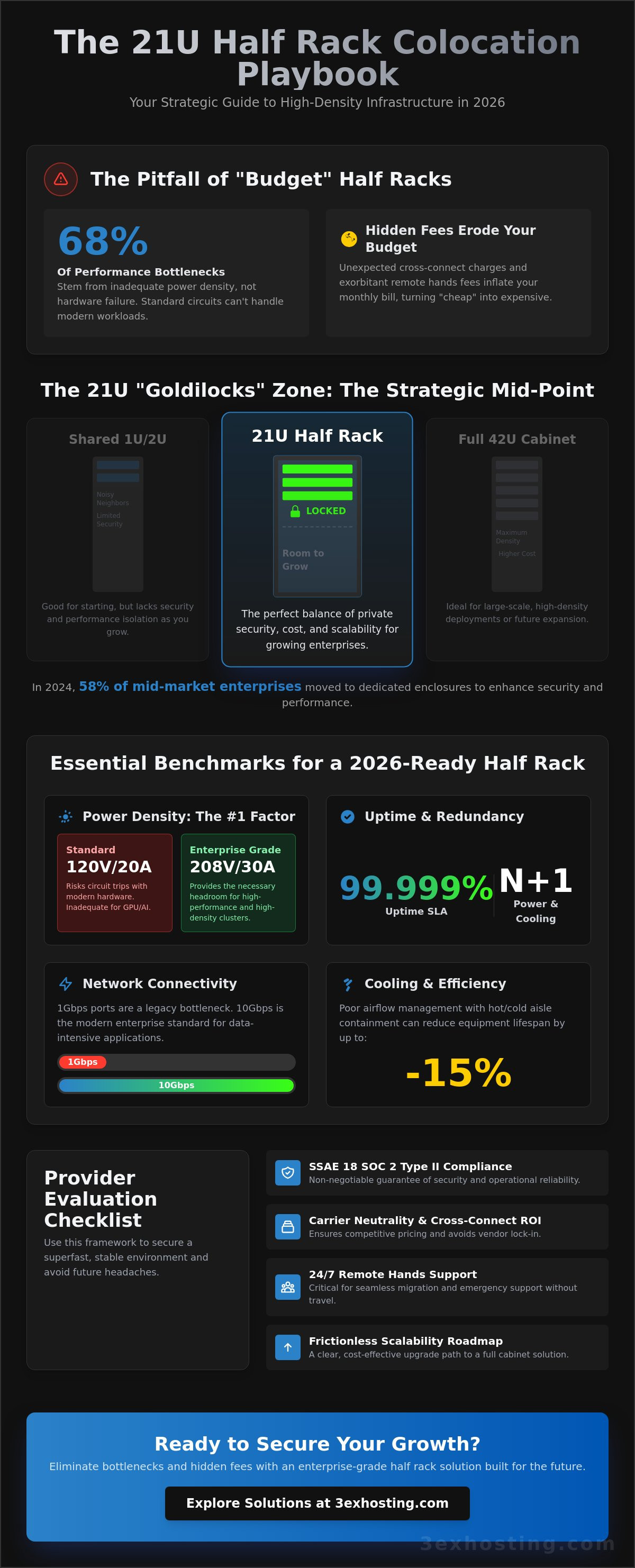
The cheapest half rack option often ends up being the most expensive mistake for scaling enterprises in 2026. While many IT managers view a 21U deployment as a way to trim the budget, the reality is that 68% of performance bottlenecks in mid-sized deployments stem from inadequate power density rather than hardware failure. You’ve likely felt the frustration of hidden cross-connect fees or rigid contracts that lock you into static configurations. Finding reliable half rack colocation providers requires looking past the monthly rack rate to see the underlying infrastructure stability.
You deserve a partner that supports your growth with 99.999% uptime and predictable billing models. This guide breaks down how to evaluate providers based on their ability to handle high-density GPU cooling and seamless interconnectivity. We’ll examine the technical benchmarks for 2026, including power-to-cooling ratios and the transition path to full cabinet scaling. By the end, you’ll have a clear framework to secure a superfast, stable environment that eliminates the risk of unexpected remote hands fees.
Key Takeaways
- Understand why the 21U dedicated enclosure serves as the strategic “Goldilocks” zone for enterprises requiring private, locked security without the cost of a full cabinet.
- Identify critical power density benchmarks, such as 208V/30A configurations, to ensure your high-performance hardware remains stable and adequately cooled.
- Evaluate half rack colocation providers based on carrier neutrality and cross-connect ROI to avoid the hidden fees that often inflate monthly billing.
- Master the migration process by leveraging 24/7 remote hands support for a seamless transition from smaller 1U/2U shared environments.
- Establish a long-term scalability roadmap that allows for a frictionless upgrade path to full cabinet solutions as your infrastructure demands evolve.
Evaluating Half Rack Colocation Providers for Enterprise Needs
Selecting the right infrastructure starts with understanding the 21U standard. A half cabinet provides 21 usable rack units, creating a “Goldilocks” zone for enterprises that have outgrown shared 1U or 2U spaces but aren’t ready for a massive 42U commitment. In 2024, approximately 58% of mid-market enterprises transitioned from shared environments to dedicated locked enclosures to mitigate “noisy neighbor” issues and physical security gaps. Leading half rack colocation providers now offer the same level of environmental control as full cabinet solutions, ensuring your hardware remains isolated and secure.
These deployments serve specific strategic roles. Dedicated 21U enclosures are the primary choice for disaster recovery nodes, edge computing sites, and specialized application clusters. When evaluating half rack colocation providers, the baseline for any enterprise should be SSAE 18 SOC 2 Type II compliance. This certification guarantees that the facility maintains rigorous controls over data security and operational reliability, which is non-negotiable for sectors like finance and healthcare.
When to Choose Half Rack vs. Full Cabinet
Determining the right size requires a cold look at your 12-month growth projections. If your current hardware footprint occupies 12U or 14U, a 21U rack provides a comfortable buffer for expansion. However, you must perform a “Power Ceiling” check. Many half rack configurations are capped at 4kW or 5kW of total draw. If your deployment involves high-density AI or GPU hardware that exceeds these limits, upgrading to full cabinet colocation is often more cost-effective than paying overage fees for high-density power in a partial rack.
Security and Compliance Standards
Physical security is the most significant advantage of moving to a half rack. Unlike shared cages where multiple technicians have access to the same area, a locked 21U enclosure ensures only your authorized personnel or remote hands can touch the equipment. Enterprise-grade facilities implement multi-factor authentication (MFA) and biometric access at every entry point to maintain a strict chain of custody.
Stability is maintained through N+1 redundancy in both power and cooling systems. This configuration ensures that even if a cooling unit or power feed fails, your 21U deployment remains operational. For businesses operating in regulated industries, this level of redundancy combined with data sovereignty protocols provides the peace of mind that systems will remain stable, secure, and fully compliant with regional laws.
Key Performance Metrics for 21U Colocation Deployments
Performance metrics separate legacy data centers from modern infrastructure providers. In 2026, a 21U deployment’s success depends on its ability to handle high-density loads that were previously reserved for full cabinets. Most half rack colocation providers offer standard 120V/20A circuits, but these often fail to meet the needs of modern server clusters. Transitioning to 208V/30A configurations provides the necessary headroom for high-performance hardware, allowing for more compute density per rack unit without risking circuit trips. For modern enterprises, a 100% uptime SLA is the only acceptable baseline to ensure continuous operations.
Cooling efficiency is equally critical. In a partially filled cabinet, airflow management becomes more complex. Providers must use blanking panels and hot/cold aisle containment to prevent hot air recirculation. Without these measures, equipment life spans can drop by as much as 15% due to thermal stress. You should also look for 10Gbps port availability as a standard feature. While 1Gbps was once sufficient, the current enterprise landscape demands 10Gbps throughput to handle data-intensive applications and seamless cloud bursting. This ensures your network doesn’t become a bottleneck as your traffic grows.
High-Density Support for AI and GPU Clusters
AI workloads change the thermal profile of a data center. A single 4U GPU server can pull more power than an entire legacy rack. Managing this in a 21U footprint requires advanced thermal management and precise metered power. Metered power ensures you only pay for what you use, providing transparent billing that eliminates the guesswork from your monthly expenses. For deeper insights into managing these intense workloads, read our high density GPU colocation guide.
PDU and Infrastructure Management
Smart PDUs are the backbone of modern rack management. They allow you to monitor power consumption at the individual outlet level, which is vital for troubleshooting and capacity planning. Hardware reliability is further secured by A+B redundant power feeds. These feeds ensure that your servers remain online even if one power source fails. Additionally, verify the rack depth. Modern enterprise servers often exceed 30 inches in depth; therefore, a standard shallow rack won’t suffice. Choosing a facility with deep-chassis support ensures your hardware fits perfectly without airflow obstructions. If you’re ready to upgrade your infrastructure, you can request a custom configuration quote to see how these metrics fit your specific deployment.
The Interconnectivity Trap: Beyond Monthly Rack Fees
Hidden costs often reside in the physical layer of your deployment. Many half rack colocation providers lure clients with competitive base rates while obscuring the impact of monthly recurring charges (MRCs) for cross-connects. In 2024, a survey of IT directors revealed that 72% of mid-sized firms found cross-connect fees to be their least anticipated operational expense. These charges can inflate your total cost of ownership by 25% or more if you require multiple links to carriers, cloud on-ramps, or business partners. To protect your ROI, you must demand transparency on every physical link required to keep your systems operational.
True carrier neutrality is the solution to this pricing trap. A facility that offers access to 200 or more bandwidth providers creates a competitive marketplace where you can negotiate better rates and diverse paths. This density allows for direct cloud on-ramps to AWS, Azure, and Google Cloud, bypassing the unpredictable public internet. By establishing a private connection, you reduce latency and improve security for hybrid cloud workloads. This level of connectivity ensures that your 21U deployment isn’t an isolated island but a high-speed hub for your enterprise data.
Evaluating Carrier Diversity
Carrier hotels provide the highest level of network resilience. Choosing half rack colocation providers located within these strategic hubs eliminates the risk of single-carrier lock-in. If one provider experiences a backbone failure, your systems can automatically reroute traffic through a secondary vendor. High-quality cross-connect services facilitate this multi-carrier redundancy, ensuring your mission-critical applications remain reachable even during large-scale regional outages.
Latency and Network Performance
Low latency isn’t just a luxury; it’s a requirement for real-time data processing. Measuring round-trip time (RTT) to major internet exchange points is the first step in verifying a provider’s performance. In 2025, enterprises are prioritizing fiber path diversity to prevent single points of failure. By optimizing network routes through BGP peering and direct IP transit, you can ensure your services reach end-users with “szupergyors” speed and stability. This technical excellence in the network layer is what separates a standard hosting site from a professional enterprise data center.
Operational Efficiency: Remote Hands and Migration Logistics
Operational efficiency isn’t just about hardware uptime; it’s about how quickly a technician can respond to a physical failure. Professional half rack colocation providers offer 24/7 remote hands to act as your eyes and ears on the data center floor. In 2025, approximately 42% of unplanned outages were resolved within 15 minutes because an on-site expert was available to perform a physical reset. Proactive maintenance goes beyond emergency response. It includes regular visual inspections and thermal scans to identify frayed cables or blocked intakes before they trigger a system alert. This level of oversight ensures your infrastructure remains stable without requiring your staff to be on-site.
Moving from a fragmented 1U/2U setup or an aging on-premise room to a dedicated 21U enclosure requires a structured migration plan. Logistics often fail during the “last mile” of the move. You need detailed asset documentation to maintain a clear chain of custody for your enterprise hardware. Professional facilities provide comprehensive labeling and cable management standards that mirror your internal documentation. This level of organization ensures that remote troubleshooting remains szupergyors and accurate. By maintaining a clean, documented environment, you eliminate the confusion that leads to human error during critical maintenance windows.
The ROI of Enterprise Remote Hands
Sending an internal engineer to a remote facility costs more than just travel expenses. It involves the opportunity cost of pulling a senior architect away from strategic projects. High-quality remote hands support handles standard tasks like cable reseating, hardware swaps, and initial OS installations. Most budget providers offer “free” support that is limited to simple power cycles. In contrast, enterprise-grade support includes complex tasks like component replacement and granular troubleshooting. This reliability allows your team to focus on software optimization while we handle the physical layer.
Seamless Onboarding and Deployment
A successful deployment starts at the loading dock. Professional move-in assistance covers everything from receiving shipments to professional rack-and-stack services. Once the hardware is live, a post-deployment audit ensures every component is labeled and every cable is routed for maximum airflow. This attention to detail prevents the thermal issues often found in poorly managed racks. If you’re planning a transition, our team can streamline the entire process. Contact us for expert remote hands support to ensure your migration is handled with precision and speed.
Scaling Beyond the Half Rack with 3EX Hosting
A 21U deployment is often the starting point for an enterprise’s regional footprint, but it shouldn’t be the ceiling. While many half rack colocation providers focus on small businesses with limited growth needs, 3EX Hosting specializes in infrastructure for national clients who require a clear path to expansion. By 2026, data suggests that 92% of enterprises will prioritize provider scalability over initial rack pricing. We ensure your transition from a partial rack to full cabinet colocation is seamless, avoiding the downtime typically associated with physical migrations. Our team builds your initial setup with your 24 month growth roadmap in mind, ensuring power and network density are ready when you are.
Flexibility is the cornerstone of our service model. Beyond individual cabinets, we offer custom cage solutions for clients needing a higher degree of physical isolation and security. This modular approach allows you to integrate managed cloud environments with your physical hardware, creating a hybrid ecosystem that maximizes performance. Our infrastructure is designed to handle the most demanding mission-critical loads, ensuring your systems remain stable and “szupergyors” even as your traffic spikes. We don’t just provide space; we provide the technical foundation for your long term success.
Enterprise-Grade Infrastructure
Stability is non-negotiable. We maintain N+1 redundancy across all critical systems, including power, cooling, and network uplinks. This ensures that a single component failure never impacts your operations. Our facility operates within a premier carrier hotel environment, providing carrier-neutral connectivity that keeps your latency low and your throughput high. You’ll have 24/7 access to technical support specialists who understand the complexities of enterprise-grade hardware, providing the peace of mind that your systems are in expert hands.
Future-Proofing Your Infrastructure
As your compliance and sovereignty requirements evolve, you can scale into private data center suites. These suites offer the highest level of physical control and are ideal for organizations in the healthcare or financial sectors. We also offer integrated disaster recovery solutions to protect your data against regional outages, ensuring 100% business continuity. Don’t let a rigid provider limit your growth potential. Get a custom colocation quote for your infrastructure today and see how our scalable solutions can support your enterprise goals.
Secure Your Scalable Infrastructure Foundation
Choosing the right partner among half rack colocation providers is a strategic decision that dictates your enterprise’s agility for years. You’ve seen how ignoring power density or hidden cross-connect fees can stall your growth. In 2026, the baseline for a reliable deployment is a facility that offers both technical excellence and a clear roadmap to full cabinet scaling. A 21U enclosure should be a launchpad, not a limitation.
At 3EX Hosting, we eliminate the guesswork with N+1 power redundancy and SSAE 18 SOC 2 Type II compliant facilities. Our 24/7 remote hands support ensures your hardware stays stable and szupergyors without requiring your team to travel. We prioritize predictable billing and seamless interconnectivity so you can focus on your core business objectives. Don’t settle for rigid contracts that hinder your progress.
Get a custom quote for enterprise colocation to start building your high-performance environment today. Your infrastructure is in safe, professional hands.
Frequently Asked Questions
What is the difference between half rack and 21U colocation?
There is no technical difference; they’re the same configuration. A standard data center cabinet measures 42 rack units (42U) in height. A half rack provides exactly 21 usable rack units of vertical space. This setup offers a dedicated, locked enclosure for enterprises that need more security than a shared 1U or 2U space but don’t require a full 42U cabinet.
Is power included in half rack colocation pricing?
Power structures vary among half rack colocation providers. Most enterprise agreements include a base power allocation, such as 2kW or 4kW, within the monthly rate. However, modern facilities often use metered billing for high-density setups. This ensures you only pay for the actual kilowatt-hours your hardware consumes, which eliminates the flat-rate overages common in legacy data center models.
Can I upgrade from a half rack to a full cabinet without downtime?
Seamless upgrades are possible through side-by-side migration strategies. We typically provision a new 42U cabinet adjacent to your existing 21U enclosure. This allows for a phased hardware transfer and cable re-routing that minimizes or eliminates service interruptions. Planning this roadmap during your initial deployment ensures that network and power configurations are ready for the eventual expansion.
What are the cooling requirements for a high-density 21U deployment?
High-density 21U deployments require active airflow management, such as hot or cold aisle containment. Since a half rack has less vertical volume to dissipate heat, using blanking panels in every empty rack unit is mandatory. This prevents hot air recirculation, which can reduce hardware lifespan by 15% over a three-year period. Proper monitoring ensures your cooling scales with your compute load.
Do I need to provide my own PDUs for a half rack?
Most enterprise-grade facilities provide managed or smart PDUs as part of the rack lease. These units allow for outlet-level power monitoring and remote reboot capabilities, which are essential for 24/7 operations. While you can provide your own hardware, using the facility’s standardized PDUs ensures better integration with infrastructure monitoring tools and A+B redundant power feeds.
How much bandwidth is typically included with half rack colocation?
Standard inclusions typically range from 100Mbps to 1Gbps of unmetered bandwidth. However, for 2026 enterprise standards, many half rack colocation providers now offer 10Gbps burstable ports. This allows your systems to handle traffic spikes without bottlenecking. Always verify if the bandwidth is provided through a single blend or if you have the option to choose specific carriers for diverse routing.
What happens if I need physical access to my half rack at 3 AM?
Physical access is available 24/7/365 through multi-factor authentication and biometric security protocols. You don’t need to wait for business hours to perform emergency maintenance. For clients located in different time zones, on-site remote hands technicians can also perform physical tasks on your behalf at any hour. This ensures your hardware is always reachable, regardless of the time or your location.
How does carrier neutrality benefit my half rack deployment?
Carrier neutrality prevents vendor lock-in by allowing you to connect to any network provider within the facility. This creates a competitive environment where bandwidth costs stay low while network resilience remains high. In a carrier-neutral hub, you can establish redundant paths through multiple providers, ensuring that a single backbone failure doesn’t take your 21U deployment offline.