 SUPPORT


 3EX United States
 Blog
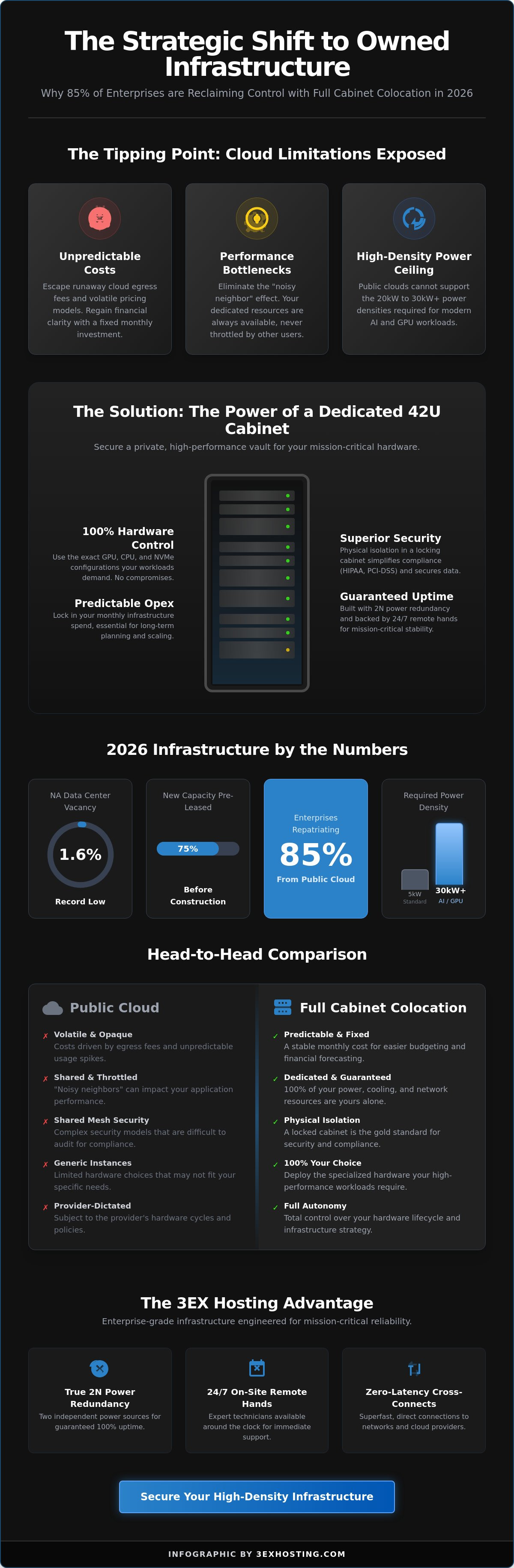
With North American data center vacancy rates hitting a record low of 1.6% in 2025 and 75% of new capacity already pre-leased, securing high-density power is no longer a given. You’ve likely realized that public cloud environments can’t handle the 20kW power density required for modern GPU clusters, or you’re tired of seeing unpredictable egress fees drain your budget. Transitioning to full cabinet colocation for enterprise is the strategic move to regain 100% hardware control while securing a stable, professional environment for your mission-critical workloads.
We’ll show you how to master the shift from volatile cloud spending to a dedicated 42U infrastructure that guarantees 100% uptime and predictable scaling. This guide examines the latest 2026 technical benchmarks, including why average North American rates reached $195.94 per kW and how to navigate the $1,000 setup fees common in European markets. You’ll learn to architect a cloud-smart strategy that leverages zero-latency cross-connects and superfast NVMe storage to outperform shared environments.
Key Takeaways
- Learn why 85% of businesses choose full cabinet colocation for enterprise to eliminate unpredictable cloud egress fees and reclaim total hardware control.
- Understand the engineering requirements for 20kW to 30kW high-density racks that support modern AI and GPU workloads.
- Discover how physical isolation in a dedicated 42U cabinet provides superior security compared to shared mesh environments.
- Master technical deployment strategies for airflow to ensure zero-impedance cooling and maximum hardware longevity.
- See how 24/7 on-site remote hands and 2N power redundancy guarantee the stability your mission-critical systems require.
The Rise of Cloud Repatriation: Why Full Cabinet Colocation is Essential in 2026
The infrastructure landscape has reached a tipping point in 2026. After years of aggressive cloud adoption, 85% of enterprises have moved at least one mission-critical workload back to private hardware. This shift isn’t a retreat; it’s a strategic evolution. Choosing full cabinet colocation for enterprise means securing a dedicated 42U locking rack that provides exclusive access to power, cooling, and network infrastructure. It’s the difference between sharing a crowded public space and owning a private, high-performance vault.
While colocation rates in North America rose by 6.5% in late 2025, they remain far more stable than the volatile pricing models of public cloud providers. The “Cloud Egress” crisis is the primary driver behind this movement. While cloud entry costs look low, the fees to move data out have become a financial burden for data-heavy organizations. In a professional colocation center, your monthly spend becomes predictable. You stop paying for every gigabyte transferred and start investing in your own technical foundation. This financial clarity is essential for long-term infrastructure planning and aggressive scaling.
Breaking the Cycle of Rented Infrastructure
Cloud computing operates on a “rented land” model. You’re subject to the provider’s hardware cycles and performance caps. By moving to full cabinet colocation for enterprise, you secure an “owned foundation.” This eliminates the “noisy neighbor” effect. In shared environments, a spike in another user’s traffic can throttle your processing speed. Dedicated cabinets ensure your CPU and GPU resources are always available. As AI demand drives market growth toward a projected $204.4 billion by 2030, having the right physical environment is the only way to stay competitive. You need specific GPU configurations that generic cloud instances simply don’t offer.
Data Sovereignty and Compliance in 2026
Compliance requirements have become stricter. Physical isolation in a full cabinet significantly simplifies HIPAA and PCI-DSS audits. When your hardware is in a dedicated, locking rack, you satisfy internal corporate security protocols that shared mesh environments can’t meet. You know exactly who has access to your servers. Full Cabinet Colocation is the baseline for enterprise physical security. It provides the literal and figurative walls needed to protect sensitive data from unauthorized physical contact. This setup ensures your hardware remains untouched and your data stays under your direct supervision.
High-Density Power and Cooling: Engineering the Modern 42U Rack
Modern server hardware, particularly AI-driven GPU clusters, has fundamentally changed the power equation. In 2026, a standard 5kW rack is no longer enough for competitive operations. High-density deployments now routinely require 20kW to 30kW per unit. When you invest in full cabinet colocation for enterprise, you aren’t just buying space; you’re securing the electrical capacity to run next-generation silicon at peak performance. This engineering intensity mirrors the unique requirements of federal government data centers, where mission-critical reliability and extreme power density are non-negotiable standards.
To ensure 100% uptime, professional providers utilize 2N power redundancy. This means every rack has two completely independent power sources. If one utility feed or UPS fails, the second feed continues to carry the full load without interruption. This is a significant step above N+1, providing the highest safety margin for your most valuable assets. Metered power adds another layer of efficiency to this setup. By paying only for the electricity your hardware actually consumes, you can optimize your infrastructure spend and gain granular visibility into your operational costs.
Managing 30kW+ Power Requirements
Supporting 30kW+ requires specialized electrical engineering and high-amperage PDUs. Every full cabinet colocation for enterprise deployment at 3EX Hosting includes redundant A+B feeds to protect your business continuity. You can explore our specific Cabinet Colocation technical specifications to see how we handle these extreme loads. We ensure your high-performance clusters have the stable, superfast energy delivery they need to stay online 24/7/365.
Precision Cooling for Enterprise Hardware
Heat is the enemy of hardware longevity. Effective cooling is about precision, not just volume. Cold aisle containment and blanking panels prevent the mixing of hot and cold air, which directly improves your Power Usage Effectiveness (PUE). While the 2024 industry average PUE was 1.56, modern facilities target a lower average of 1.45. Efficient airflow management through cable grooming and liquid cooling readiness extends the lifespan of your servers and reduces failure rates. If you’re planning a high-density deployment, request a custom quote to see how our cooling architecture supports your growth.
Full Cabinet vs. Shared Colocation: A Performance and Security Comparison
Choosing between partial space and full cabinet colocation for enterprise is a pivot point for any scaling organization. While 1/4 or 1/2 racks serve smaller deployments, they introduce shared risks that mission-critical operations can’t afford. In a shared mesh environment, your hardware sits adjacent to equipment owned by other companies. This increases the potential for human error during third-party maintenance or accidental cable disconnects. A dedicated 42U cabinet eliminates these variables. It provides a physically isolated, locking environment where only your authorized staff or our 24/7 remote hands experts interact with your systems.
Performance metrics also diverge sharply between these two models. Shared colocation often relies on shared carrier uplinks, which can lead to congestion during peak traffic periods. Full cabinets allow for dedicated bandwidth ports and direct cross-connects to key carriers. This architecture ensures superfast data transfer speeds and zero-latency performance for your internal networks. When your business relies on high-frequency data exchange, the difference between a shared port and a dedicated connection isn’t just technical; it’s a competitive necessity.
Predicting the Total Cost of Ownership (TCO) over a 3-year enterprise hardware cycle is much simpler with a full cabinet. In shared spaces, you often pay a premium for every small addition of power or connectivity. With a full 42U rack, you’ve already secured the physical footprint. You gain the flexibility to stack high-performance servers and optimize your layout without renegotiating your contract for every minor change. This predictability is vital for securing 100% uptime and managing long-term infrastructure budgets.
The Economics of Scaling Up
The math of infrastructure favors the bold. Full cabinets offer a significantly better price-per-U as your deployment density increases. When you factor in the ROI of dedicated cross-connects, the economic advantage becomes clear. For those managing specialized workloads, our High-Density GPU Colocation guide provides a deeper look at AI-specific scaling strategies. Investing in a full cabinet now prevents the expensive “lift and shift” costs associated with outgrowing a partial rack later.
Security Architecture: Private vs. Shared
Security is both a psychological and a practical requirement. A locking 42U environment offers peace of mind that shared cages simply can’t match. You can customize cabinet-level access control with biometrics or RFID systems to meet strict enterprise compliance standards. For organizations requiring the absolute highest level of isolation, Cage Colocation offers an additional layer of perimeter defense. This multi-tiered approach ensures that your data sovereignty is never compromised by the presence of other tenants.
Strategic Deployment: Optimizing Airflow and Connectivity for AI Workloads
Deploying full cabinet colocation for enterprise in 2026 requires more than just racking hardware; it demands a precise understanding of rack physics and thermal dynamics. High-density GPU clusters often weigh significantly more than standard web servers. To maintain center-of-gravity stability, you must place the heaviest chassis at the bottom of your 42U rack. This prevents structural strain and ensures the rack remains stable during maintenance. Beyond physical balance, cable management is the deciding factor in operational efficiency. Poorly groomed cables create air dams that trap heat, forcing fans to run faster and increasing your power draw. Professional cable management ensures zero-impedance airflow, which is essential for maintaining the 1.45 PUE average seen in modern facilities.
Connectivity is the second pillar of a successful deployment. Leveraging carrier-neutral cross-connects allows your enterprise to establish ultra-low latency interconnections with key providers. By bypassing the public internet, you gain a secure, dedicated path for high-volume data transfers. This architecture is vital for AI training models that require massive data ingestion from external sources. Integration with on-site support ensures that your national hardware management remains seamless, even if your technical team is located in a different city. This hands-on approach minimizes downtime and keeps your infrastructure running at peak performance.
The AI-Ready Rack Configuration
- Step 1: Assess your thermal load and power draw. Modern GPU-heavy nodes can pull 2kW to 3kW each. Ensure your PDU capacity matches your peak load requirements to avoid circuit trips.
- Step 2: Design your network topology for high-speed ingestion. Use top-of-rack (ToR) switches to minimize cable runs and reduce signal latency within the cabinet.
- Step 3: Implement Remote Hands for 24/7 physical monitoring. Our experts can perform hardware swaps or visual inspections in minutes, ensuring your systems stay online without requiring your staff to travel.
Maximizing Network Performance
Carrier hotels play a critical role in providing national network redundancy. By utilizing cross-connect services, your enterprise can bypass the volatile public internet for secure, direct data transfers. This is especially important for financial or healthcare data where compliance and speed are top priorities. Superfast interconnections are the lifeblood of 2026 enterprise apps, providing the throughput necessary for real-time processing and massive AI inference workloads. If you’re ready to optimize your infrastructure for the next generation of performance, explore our full cabinet colocation options to secure your high-performance foundation.
Scaling with Confidence: The 3EX Hosting Advantage for National Enterprises
Selecting a partner for full cabinet colocation for enterprise is a decision that impacts your operational stability for years. 3EX Hosting positions your infrastructure in a premier environment designed for high-density, mission-critical workloads. We don’t just provide space; we provide a technical foundation where speed and reliability are the core metrics. Our facilities are engineered to handle the 30kW power requirements and AI-driven thermal loads discussed in previous sections. You gain the peace of mind that comes from knowing your hardware is in a stable, professional facility with 100% uptime guarantees.
The true value of a colocation partner lies in their responsiveness. Our on-site technical experts are available 24/7/365 to act as your local eyes and ears. Whether it’s a routine hardware check or an emergency component swap, our remote hands service ensures your systems stay online without delay. This level of support is essential for national enterprises that need to manage hardware across different geographic regions without maintaining a massive traveling IT staff. It’s about providing a professional extension of your own team.
Beyond the Physical Rack: Managed Services
3EX Hosting bridges the gap between physical hardware control and cloud-like agility. We offer customizable disaster recovery solutions that integrate directly into your colocation footprint. This hybrid approach allows you to maintain data sovereignty while benefiting from modern redundancy protocols. For a deeper look at optimizing your operations, explore our Remote Hands Support Guide. We ensure your infrastructure is future-proof, allowing you to scale from a single 42U rack to private suites as your data demands grow.
Your Path to Infrastructure Sovereignty
Our commitment to technical excellence is reflected in every cabinet we deploy. We understand the friction often associated with moving large-scale hardware. To solve this, we offer a specialized Move-In Assistance program. This service streamlines the migration process, handling the logistics of enterprise-level deployments so your team can focus on core business objectives. Secure your 2026 infrastructure strategy today. Request a custom quote for your 42U environment and discover how a professional hosting partner can transform your hardware performance.
Securing Your High-Performance Foundation for 2026 and Beyond
The shift toward hardware sovereignty is a strategic necessity for organizations outgrowing the limitations of public cloud. By reclaiming control through full cabinet colocation for enterprise, you eliminate the volatility of egress fees and the performance caps of shared environments. You’ve seen how precision cooling and 30kW power density are essential for modern AI clusters. Now is the time to transition to an environment that supports your technical ambitions with absolute reliability. It’s the only way to ensure your growth remains predictable and secure.
3EX Hosting provides the stability your mission-critical systems require. Our carrier-neutral high-density data center features N+1 power redundancy to ensure 100% uptime for every deployment. You can rely on our 24/7/365 on-site remote hands to maintain your hardware with expert precision. Stop renting limited resources and start building on a dedicated foundation designed for peak performance. Scale your infrastructure with a dedicated 42U cabinet from 3EX Hosting and take command of your digital future today. We’re ready to help you deploy with confidence.
Frequently Asked Questions
What is the standard power density for a 2026 full cabinet colocation?
High-density power requirements have shifted to 20kW to 30kW per rack in 2026 to support modern GPU clusters and AI processing. While older facilities often struggle with 5kW limits, modern infrastructure is designed to handle these intense thermal and electrical loads. This capacity ensures your hardware runs at peak performance without the risk of circuit trips during intensive processing cycles.
How does full cabinet colocation reduce enterprise cloud egress fees?
Choosing full cabinet colocation for enterprise eliminates the per-gigabyte egress fees charged by public cloud providers. Instead of fluctuating costs that punish data movement, you pay a predictable monthly rate for your dedicated bandwidth port. This transparency allows your team to move large datasets without financial penalties, making it the most cost-effective solution for data-intensive applications.
Can I scale from a full cabinet to a private suite or cage later?
Scaling from a single 42U rack to a private suite or cage is a standard growth path that we support. We design our floor plans to allow for adjacent expansion, ensuring your transition is seamless and your hardware remains online. This flexibility protects your initial investment while providing the physical isolation required as your infrastructure footprint grows over time.
What physical security features are standard in 3EX Hosting cabinets?
Every 3EX Hosting cabinet features heavy-duty locking front and rear doors with individual key or digital access control. Our facility is protected by 24/7/365 CCTV surveillance and multi-factor biometric authentication at every entry point. These layers ensure that only authorized personnel can physically interact with your mission-critical hardware, meeting the strictest corporate compliance standards.
How does remote hands support affect my cabinet management strategy?
Remote hands support transforms your strategy by providing on-site technical expertise without requiring your staff to travel to the data center. Our technicians perform hardware swaps, visual inspections, and cable grooming in minutes. This service allows you to manage a national infrastructure footprint from a central office while maintaining superfast response times for physical maintenance tasks.
What is the difference between metered and redundant power in colocation?
Metered power refers to a billing model where you only pay for the actual kilowatts your servers consume each month. Redundant power, specifically 2N or A+B feeds, ensures your equipment has two completely independent electrical sources. While metered power optimizes your monthly spend, redundant feeds guarantee 100% uptime by protecting against utility or UPS failures.
How do cross-connects improve network performance for AI?
Cross-connect services provide direct, private links between your cabinet and key carriers or cloud on-ramps. By bypassing the public internet, you achieve ultra-low latency and superfast throughput for AI training data. This dedicated path ensures that high-volume data ingestion doesn’t suffer from the congestion or jitter common in standard network routes.
Is a full cabinet necessary for disaster recovery sites?
A full cabinet is essential for disaster recovery if your secondary site must mirror the performance and security of your production environment. It provides the dedicated space needed for redundant storage arrays and failover servers. Having 100% hardware control in a DR site ensures that your recovery time objectives aren’t compromised by shared resource limitations.