 SUPPORT


 3EX United States
 Blog
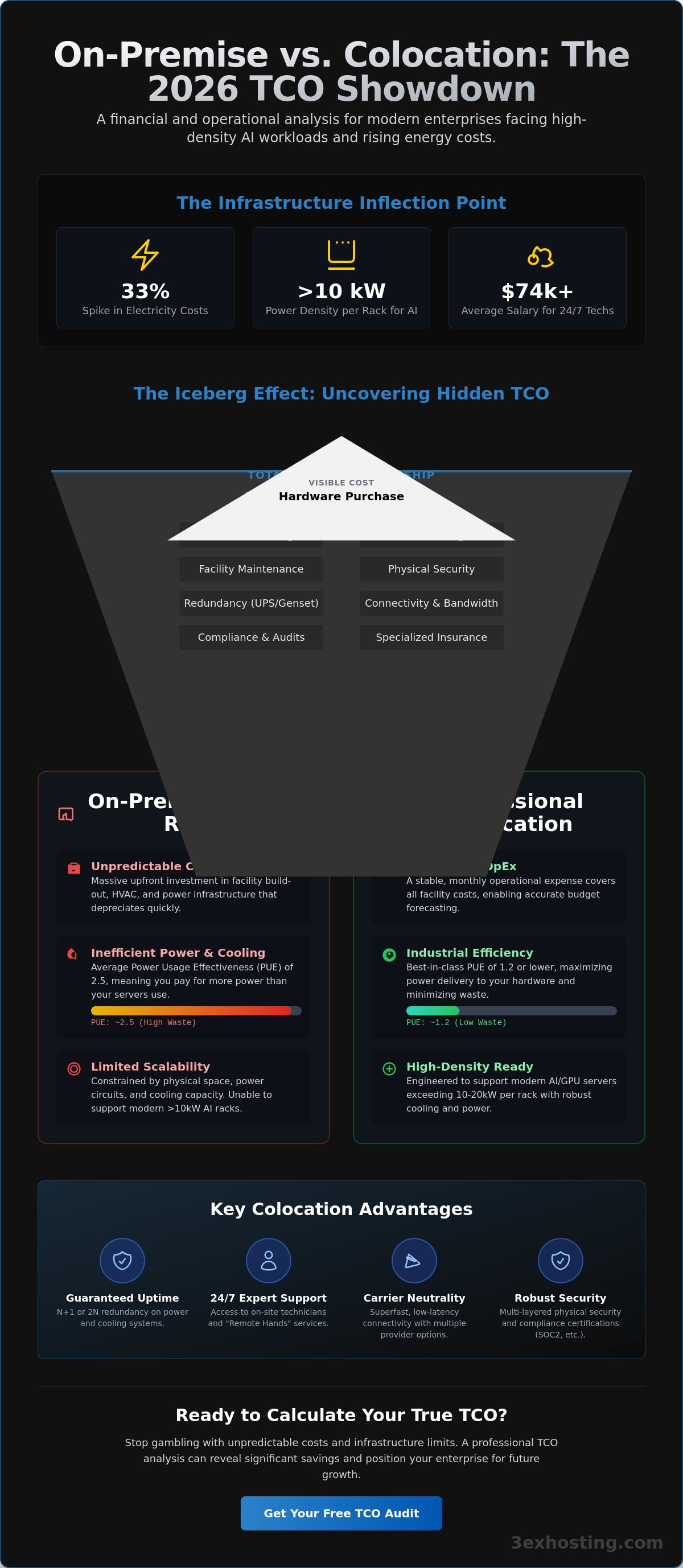
Could your existing server room survive a 33% spike in electricity costs while trying to host a new $500,000 AI GPU server? As commercial rates hit a national average of 14.12¢/kWh in May 2026, performing a rigorous on-premise vs colocation TCO analysis is no longer optional for the modern enterprise. It’s a survival strategy. You likely prefer the total control of keeping hardware within arm’s reach, but the burden of hiring 24/7 technicians at an average salary of $74,388 and meeting new 2026 energy efficiency standards is making “in-house” a liability.
We understand that you need technical stability without the unpredictable overhead of facility maintenance. This guide provides a comprehensive financial and operational framework to determine your true cost of ownership between in-house data centers and professional colocation. We’ll break down the CapEx vs OpEx shift, justify budget allocations to your stakeholders, and show you how to mitigate uptime risks. You’ll gain a clear roadmap for transitioning to a high-density environment that supports modern AI workloads with superfast connectivity and guaranteed reliability.
Key Takeaways
- Understand why 2026 power demands and new energy regulations are making traditional in-house server rooms obsolete for high-density hardware.
- Perform a data-driven on-premise vs colocation TCO analysis to uncover the “iceberg effect” of hidden maintenance, staffing, and cooling expenses.
- Map out a 5-year financial framework that replaces unpredictable CapEx with a stable, scalable OpEx model for better budget justification.
- Evaluate the technical necessity of moving to professional facilities to support AI infrastructure and the 10kW per rack power density barrier.
- Use our professional audit checklist to identify infrastructure vulnerabilities and implement a risk-mitigation strategy for guaranteed uptime.
Defining the Infrastructure Dilemma: On-Premise vs. Colocation in 2026
Deciding where to house your enterprise infrastructure is no longer a simple choice between owning and renting. It’s a strategic decision about technical survival. On-premise infrastructure involves managing hardware within your own physical building, while a Colocation centre provides the specialized industrial environment your hardware needs to perform. In 2026, the gap between these two models has widened. A thorough on-premise vs colocation TCO analysis reveals that traditional “server closets” are failing. They simply can’t handle the 33% increase in electricity costs or the extreme cooling demands of modern AI hardware.
Many organizations now embrace a hybrid reality. They integrate Full Cabinet Colocation for their core physical assets with managed cloud hosting for burstable workloads. This approach ensures you maintain physical control without the burden of facility management. To find the true cost, you must look beyond the hardware purchase price. You have to account for power usage effectiveness (PUE), physical security, and the rising cost of 24/7 facility staffing.
The Evolution of the Enterprise Data Center
Since 2020, high-density computing has forced a radical change in facility design. Modern GPU servers often exceed the 10kW per rack limit that older in-house rooms were built to support. While CIOs prioritize physical sovereignty over data to meet 2026 privacy laws, they’re moving away from building their own sites. Instead, they’re utilizing enterprise data center Miami facilities. These professional hubs act as carrier hotels, providing the ultra-low latency and direct cross-connects that internal office networks can’t match. It’s about moving hardware to where the power and connectivity are most stable.
CapEx vs. OpEx: The CFO Perspective
The choice between these models impacts your balance sheet for years. Building an in-house facility requires massive upfront CapEx that depreciates quickly. Professional colocation shifts this to a predictable OpEx model. You avoid the “hidden” financial traps of upgrading HVAC systems or meeting new 2026 energy efficiency standards. Instead, you pay a flat service fee that includes industrial-grade redundancy and 24/7 Remote Hands Support. This stability allows for much more accurate long-term budget forecasting. Total Cost of Ownership in the data center context is the comprehensive sum of all capital expenditures and operating expenses incurred throughout the infrastructure’s lifecycle, from initial facility build-out to daily power consumption and hardware decommissioning.
The Hidden TCO Variables of In-House Data Centers
Most infrastructure leaders focus on the price tag of the hardware sitting in their racks. It’s an easy number to track, but it’s only the tip of the iceberg. A comprehensive on-premise vs colocation TCO analysis reveals that facility operational costs often outweigh the initial server investment within three years. In-house data centers struggle with the “Iceberg Effect,” where hidden expenses like specialized insurance, physical security audits, and emergency hardware repairs sink the budget. As commercial electricity rates average 14.12¢/kWh in May 2026, the inefficiency of a private server room becomes a massive financial drain.
Power Usage Effectiveness (PUE) is the primary metric where in-house facilities fail. While best-in-class colocation providers achieve a PUE of 1.2 or lower, the average in-house room often hovers near 2.5. You’re essentially paying for two units of power for every one unit your servers actually use. Enterprises often find a lower total cost of ownership by migrating to facilities designed for industrial efficiency. You must also account for the cost of maintaining 24/7 security personnel and meeting 2026 compliance standards like SOC2 or the updated CPRA regulations. These aren’t just administrative hurdles; they require significant capital for biometric access, surveillance, and annual auditing fees.
Facility Maintenance and Redundancy Costs
Maintaining N+1 or 2N redundancy in a private building is prohibitively expensive. You don’t just buy a UPS; you pay for its annual battery testing, capacitor replacements, and the fuel polishing of backup generators. Standard office HVAC systems can’t handle the heat output of 2026 hardware. If you’re deploying a $150,000 GPU server, a typical building AC will fail, leading to thermal throttling or hardware damage. The average data center technician salary has reached $74,388. To maintain 24/7 coverage, you need a team of at least four people, creating a massive payroll burden that colocation eliminates.
Connectivity and Carrier Neutrality
Network costs are often the most overlooked part of an on-premise vs colocation TCO analysis. In a private office, you’re usually locked into whatever fiber providers happen to be on your street. This lack of competition leads to higher monthly recurring costs for bandwidth. Professional facilities offer carrier neutrality, allowing you to choose from dozens of providers. The TCO impact of cross-connect services is substantial; they provide direct, low-latency paths to cloud on-ramps and partners that are impossible to replicate in a standalone building. If you’re concerned about your current network resilience, you can request a custom connectivity audit to see how much a professional facility can save you on monthly transit fees.
Quantitative Analysis: A 5-Year TCO Comparison Framework
A 5-year on-premise vs colocation TCO analysis reveals a stark contrast in how capital is utilized over time. In Year 1, on-premise deployments demand massive CapEx for facility construction, industrial fire suppression, and redundant electrical switchgear. Conversely, colocation replaces these multi-million dollar investments with manageable setup fees and a predictable monthly OpEx. By Years 2 through 4, the focus shifts to operational efficiency. In-house facilities often face escalating maintenance costs, as yearly server maintenance typically reaches 10% of the initial purchase price. Colocation users avoid these facility-side spikes, benefiting from the provider’s industrial economies of scale.
Year 5 marks a critical inflection point: the hardware refresh cycle. For an in-house data center, this often requires expensive facility retrofitting to accommodate newer, hungrier hardware. For example, a high-end GPU server in 2026 can cost up to $500,000 and requires cooling capabilities that traditional 2021-era server rooms simply don’t possess. Moving to a professional facility eliminates this risk. The opportunity cost is perhaps the most significant factor; every hour your IT team spends managing power and cooling is an hour they aren’t spending on high-value AI implementation or revenue-generating software development.
Calculating the Real Cost of Power
The choice between metered and flat-rate power models significantly impacts long-term TCO. Metered power is often more cost-effective for variable workloads, while flat-rate provides budget certainty for high-density AI deployments that run at 100% utilization. With average commercial electricity rates at 14.12¢/kWh as of May 2026, efficiency is no longer a luxury. Power Usage Effectiveness (PUE) acts as a multiplier on your raw energy costs, meaning a PUE of 2.0 effectively doubles the five-year utility bill for every kilowatt consumed by your servers.
Labor and Operational Efficiency
Managing a distributed infrastructure requires a workforce that is both skilled and physically present. You can significantly reduce travel costs and eliminate downtime by utilizing professional remote hands support for routine tasks like cable management or hard drive swaps. For national deployments, the TCO benefit of move-in assistance is substantial, as it prevents the logistical delays that often plague internal IT teams. Comparing internal IT salaries to outsourced infrastructure management usually shows that professional colocation provides superior technical stability at a fraction of the cost of a full-time, 24/7 on-site facility engineering team.
Power Density and the AI Infrastructure Inflection Point
The 10kW per rack barrier has become the “death knell” for traditional in-house server rooms. Most private facilities built before 2022 were designed for an average density of 3kW to 5kW per rack. As of May 2026, high-end GPU servers for AI training can easily push a single rack’s demand over 40kW. If your on-premise vs colocation TCO analysis doesn’t account for the massive CapEx required to retrofit an existing room with liquid cooling or rear-door heat exchangers, you’re missing the largest cost driver of the decade. High-density hardware like NVIDIA Blackwell clusters, which can cost up to $500,000 per unit, will thermally throttle or fail in a standard office-cooled environment.
Power density is now the primary metric for data center selection. It’s no longer about square footage; it’s about how many kilowatts a provider can deliver to a single cabinet. Scaling these workloads requires the flexibility of full cabinet colocation, which allows for rapid AI expansion without the six-month lead times associated with electrical upgrades in a private building. Professional facilities are already equipped with the industrial power feeds and advanced cooling loops necessary to support these intense thermal loads.
Infrastructure for the AI Era
Thermal management for H100 and Blackwell clusters requires more than just cold air. These systems often necessitate direct-to-chip cooling or specialized immersion tanks to maintain stability. The economics of high density GPU colocation are clear: you share the cost of this extreme cooling infrastructure with other enterprise tenants. Attempting this on-premise often leads to facility failure and unplanned downtime, as standard building transformers and backup generators aren’t rated for the continuous, high-draw nature of AI training cycles.
Security and Sovereignty in AI Training
Protecting proprietary models and sensitive datasets is a top priority for CIOs in 2026, especially with new privacy laws in states like Indiana and Kentucky. You can maintain total physical sovereignty over your hardware while using professional infrastructure by utilizing cage solutions. These provide a physical barrier within the data center, ensuring only your cleared staff can touch the equipment. For organizations with the highest compliance needs, private data center suites offer a completely isolated environment. This approach allows you to meet data residency requirements without the TCO burden of managing the underlying power and cooling systems yourself.
Ready to benchmark your AI deployment against industrial standards? Get a high-density colocation quote today and stabilize your infrastructure costs.
Strategic Migration: Why Colocation is the Enterprise Middle Ground
Colocation represents the strategic middle ground for enterprises that require physical sovereignty but can’t justify the escalating infrastructure overhead. It bridges the gap between the total responsibility of on-premise and the lack of physical control in the public cloud. By moving to a professional facility, you gain utility-scale efficiency without sacrificing the ability to manage your own hardware. This model allows you to maintain the “air-gapped” security your proprietary models require while offloading the industrial burdens of power and cooling to specialists. A final on-premise vs colocation TCO analysis usually shows that for any deployment exceeding 10kW per rack, the specialized environment of a data center is the only viable path forward.
Infrastructure leaders should conduct a rigorous TCO audit before committing to another hardware refresh cycle. Use this checklist to evaluate your current posture:
- PUE Audit: Compare your actual Power Usage Effectiveness against the 1.2 industrial standard.
- Labor Burden: Calculate the fully burdened cost of 24/7 on-site facility engineering.
- Connectivity Costs: Benchmark your current single-carrier transit fees against carrier-neutral options.
- Compliance Overhead: Total the annual costs of physical security, biometric access, and SOC2/HIPAA facility audits.
The verdict is clear. Stay on-premise only if you have extreme legacy requirements or a fully depreciated Tier III facility that still meets modern cooling standards. For everyone else, migration is a matter of financial stability.
The 3EX Hosting Advantage
Our carrier hotel status provides a unique TCO advantage by offering direct access to a massive ecosystem of fiber providers. This competition drives down your monthly transit costs and reduces latency for critical applications. You don’t need to fly your best engineers across the country for routine maintenance. Instead, you can leverage our remote hands support to handle everything from cable management to hardware swaps. This service acts as a significant labor-saving variable that most generic TCO models ignore. Whether you need a single cabinet or private suites for total isolation, our infrastructure scales with your technical demands.
Next Steps for Infrastructure Migration
Planning a move requires a phased approach to minimize downtime. We recommend starting with a pilot migration of non-critical workloads to test connectivity and operational flow. This allows your team to acclimate to the remote management model before moving core AI clusters. Future-proofing your infrastructure for the 2030 horizon means choosing a partner that is already investing in liquid cooling and ultra-high-density power feeds. Don’t let your facility be the bottleneck for your company’s growth. You can request a customized TCO analysis and quote to see the exact financial impact of a professional migration on your 5-year budget.
Future-Proofing Your Infrastructure Strategy for 2030
Transitioning away from the legacy server closet model is now a technical necessity for survival. A rigorous on-premise vs colocation TCO analysis demonstrates that professional facilities provide the industrial-grade stability your enterprise requires. You gain access to high-density power configurations reaching 20kW+ per rack, a benchmark that most private buildings cannot support without massive capital investment. By leveraging our Carrier Hotel status, you ensure maximum connectivity and redundant network paths for your most critical workloads.
Our 24/7/365 Remote Hands support eliminates the need for expensive, round-the-clock on-site staffing, allowing your IT team to focus on high-value innovation. Moving to a professional environment doesn’t mean losing control; it means gaining the technical excellence and security your proprietary data deserves. We’re ready to help you stabilize your operational costs and scale your AI infrastructure with confidence. Take the first step toward a more predictable and resilient financial model today.
Get a custom TCO analysis for your enterprise colocation needs
Frequently Asked Questions
Is colocation cheaper than on-premise for small businesses?
Colocation is almost always more cost-effective for small businesses that require high reliability. Building a private facility with N+1 redundancy requires millions in upfront capital that small teams can’t justify. By choosing a professional data center, you access enterprise-grade cooling and 24/7 security without the massive CapEx burden of a custom build-out.
How does colocation TCO compare to hyperscale cloud providers like AWS or Azure?
Colocation offers a significantly lower TCO for steady-state workloads with high data throughput. While hyperscale cloud is excellent for burstable needs, the monthly compute and data egress fees for constant AI training can be 2 to 3 times higher than owning your hardware. Colocation provides the predictability of a fixed monthly bill for power and space.
What are the main hidden costs in a colocation agreement?
Cross-connect fees and “Remote Hands” overages are the primary variables that can impact your budget. While your rack and power costs are usually fixed, monthly recurring charges for fiber connections to different carriers can add up. It’s vital to audit how many physical connections you need and how often you’ll require on-site technician support before signing.
Can I achieve the same level of security in colocation as I have on-premise?
You can often achieve superior physical security in a professional facility compared to a private office. Most colocation centers provide 24/7 armed guards, multi-factor biometric access, and continuous surveillance that meets SOC2 and HIPAA standards. Private offices rarely invest in this level of specialized protection, leaving on-site hardware more vulnerable to unauthorized access.
What happens to my TCO if I need to scale my power density for AI?
Your total cost of ownership remains more stable in a colocation environment because the facility already supports high-density cooling. Retrofitting a private server room for 20kW racks can cost over $1 million in HVAC upgrades alone. In a professional data center, you simply scale into a high-density zone designed for liquid cooling and extreme power draws.
How much can I save on staffing by using remote hands services?
Enterprises can save approximately $74,388 per year by utilizing remote hands instead of hiring a full-time data center technician. This allows your internal IT team to focus on software and strategy rather than physical hardware maintenance. You eliminate the cost of benefits, training, and 24/7 shift coverage by using the facility’s on-site engineering team.
What is the typical breakeven point for moving from on-prem to colocation?
The breakeven point for a comprehensive on-premise vs colocation TCO analysis typically occurs between 18 and 24 months. While initial migration and setup fees create an early spike, the long-term savings from shared cooling costs and eliminated facility maintenance contracts quickly offset the start-up investment. This transition turns unpredictable emergency repairs into a steady OpEx model.
How do carrier-neutral cross-connects impact my long-term TCO?
Carrier neutrality lowers your long-term TCO by fostering a competitive marketplace for bandwidth. When you’re locked into a single provider at a private office, you lack the leverage to negotiate better rates. In a neutral facility, you can switch carriers or blend multiple providers to reduce monthly transit bills by roughly 20% while increasing your network’s overall resilience.