 SUPPORT


 3EX United States
 Blog
Relying on a single Tier 1 provider for your mission-critical workloads in 2026 isn’t just a risk; it’s an architectural bottleneck that ignores the reality of modern network intelligence. You’ve likely experienced the frustration of latency spikes affecting application performance or the persistent anxiety that comes with a carrier-specific outage. Managing multiple BGP sessions internally is a complex task that many IT teams don’t have the bandwidth to handle effectively. Understanding the benefits of blended IP transit is the first step toward moving away from these single points of failure and securing your digital infrastructure.
You need a network that works as hard as your hardware. This article demonstrates how to achieve 100% network uptime through automated path optimization and simplified vendor management. We’ll examine why the 9.19 billion dollar IP transit market is shifting toward high-capacity, multi-carrier blends to support the massive demands of AI GPU hosting and enterprise workloads. You’ll discover how a managed blend provides the stability and speed your business requires to maintain a competitive edge without the operational overhead. Every second of connectivity is vital; we’ll show you how to protect it.
Key Takeaways:
- Understand how multi-carrier upstream solutions leverage BGP for dynamic, automated path selection to maintain constant connectivity.
- Discover the primary benefits of blended IP transit, specifically the removal of single points of failure and the reduction of regional latency spikes.
- Examine the technical architecture where high-performance routers and intelligent weighting optimize traffic flow for mission-critical applications.
- Compare internal network management against managed solutions to streamline billing and reduce operational complexity for your IT team.
- Learn how combining robust transit with professional colocation infrastructure supports the power and cooling needs of demanding AI and GPU workloads.
Understanding Blended IP Transit in Modern Enterprise Networking
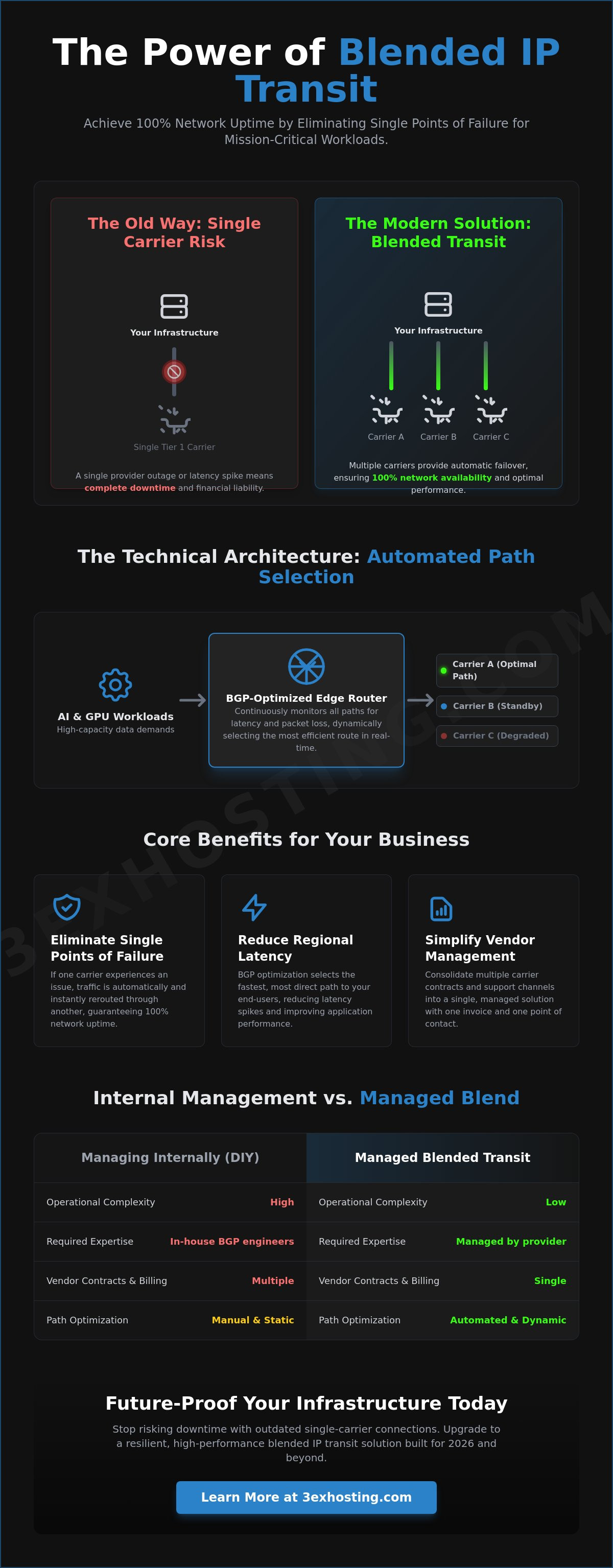
Enterprise networking has moved beyond simple connectivity. In 2026, the digital landscape demands more than just a functional link to the internet. Blended IP transit is a sophisticated multi-carrier upstream solution that combines the strengths of several internet service providers into a single, resilient connection. Instead of relying on one carrier, a blended model uses the Border Gateway Protocol (BGP) to evaluate the health and speed of multiple paths simultaneously. This protocol acts as an automated traffic controller, selecting the most efficient route for your data in real time. One of the primary benefits of blended IP transit is the elimination of the “best effort” service model. It replaces it with a performance-driven architecture designed for mission-critical workloads.
Relying on a single-homed connection is a significant risk for modern businesses. If your sole provider experiences a fiber cut or a routing leak, your entire operation goes dark. In an era where the IP transit market is projected to reach 9.19 billion dollars, downtime isn’t just an inconvenience; it’s a massive financial liability. A blended approach ensures that if one carrier fails, traffic instantly reroutes through another without manual intervention.
The Evolution from Single-Homed to Blended Connectivity
Historically, businesses managed with a single ISP because application demands were lower. The rise of intensive cloud computing and high-density AI infrastructure changed the requirements. Modern workloads can’t tolerate the latency spikes common in single-carrier environments. Understanding Multihoming is essential here, as it provides the foundation for connecting a network to multiple providers. By 2026, the fastest-growing segment of the market is the “Above 10 Gbps” tier. These high-capacity circuits require sub-millisecond routing adjustments to maintain performance. Blended transit provides this agility by constantly testing the latency and packet loss across all available upstreams.
Key Terminology: ASNs, Tier 1 Carriers, and Peering
To understand how a blend functions, you must recognize the hierarchy of the internet. Tier 1 carriers are the backbone providers that own the global infrastructure and reach the entire internet without paying for transit. A high-quality blend typically includes several of these providers to ensure global reach. Each network in this ecosystem is identified by an Autonomous System Number (ASN), which allows BGP to navigate the complex web of interconnected systems. While public peering at internet exchanges helps reduce costs, private transit agreements within a blend provide the service level guarantees that enterprises need. This combination of diversity and direct paths is why the benefits of blended IP transit are so critical for maintaining 100% network uptime in a volatile regulatory and technical environment.
The Technical Architecture: How Multi-Carrier Blending Works
The architecture behind multi-carrier blending relies on a synergy between specialized hardware and intelligent software layers. High-performance edge routers serve as the physical foundation. These units must handle full global routing tables from multiple providers, requiring significant memory and processing power. Physical cross-connect services link these routers directly to Tier 1 carrier backbones within the facility. This direct integration minimizes physical latency and removes the unpredictability of the open internet for the first leg of the data’s journey.
The software layer manages the logic of the blend. BGP weighting allows engineers to prioritize specific carriers based on performance metrics or cost-efficiency. Manual weighting alone isn’t enough for 2026 workloads. Real-time path selection involves continuous monitoring of every available route. If a specific provider’s path to a region in Europe suddenly shows increased packet loss, the system automatically shifts traffic to an alternative carrier. This dynamic response is one of the key benefits of blended IP transit for enterprises that can’t afford even a few seconds of degraded performance.
Automated BGP Optimization vs. Static Routing
Static routing is rigid. It fails to account for mid-path congestion where a carrier is technically active but practically unusable. Automated BGP optimization uses active probes to measure latency, jitter, and packet loss across all upstreams. It’s a proactive approach. To prevent “flapping,” where traffic bounces rapidly between two unstable paths, intelligent route dampening is applied. This ensures stability by only switching paths when a sustained performance improvement is verified. It’s about finding the fastest route, not just any route.
The Role of Carrier-Neutral Facilities in Network Resilience
A true IP blend requires a carrier-neutral environment. These facilities allow you to pull fiber from any provider without being locked into a single vendor’s ecosystem. This neutrality is the foundation of network resilience. Beyond connectivity, these centers provide the physical security and redundant power systems necessary to keep transit hardware operational. For businesses deploying power-hungry hardware, ensuring your cabinet colocation provider has the infrastructure to support these high-density requirements is vital for long-term stability. Choosing a facility that offers a diverse carrier mix ensures you can scale your blend as your bandwidth needs grow.
Core Benefits of Blended IP Transit for Mission-Critical Loads
Operating mission-critical workloads on a single upstream provider is an unnecessary risk in 2026. One of the most immediate benefits of blended IP transit is the insulation it provides against Tier 1 backbone failures. While these massive providers offer global reach, they aren’t immune to fiber cuts or routing errors. A blended network aggregates several carriers, creating a self-healing environment where traffic automatically shifts to the next available pipe. This level of redundancy is the only way to realistically target 100% network uptime SLAs for high-density applications and AI-driven infrastructure.
Performance isn’t just about staying online; it’s about the quality of the connection. Distributing traffic across multiple high-capacity pipes improves overall throughput and prevents any single carrier from becoming a bottleneck during peak usage. This is especially vital as the market for bandwidth above 10 Gbps continues to grow at a rate of 11.2% annually. A managed blend also simplifies your administrative operations. Instead of managing five separate BGP sessions and five different ISP bills, you receive a single, unified invoice and a streamlined point of contact for all network issues.
Unrivaled Redundancy and Uptime Guarantees
Redundancy in a blended model goes beyond simple failover. It provides a “back door” advantage for out-of-band management. Even if a primary carrier experiences a massive regional outage, your engineers can still access core hardware through the alternative paths within the blend. This ensures that your remote hands support teams and internal IT staff never lose visibility of your infrastructure. In the current regulatory landscape, where net neutrality is handled at the state level, having multiple carrier options allows you to bypass regional traffic management constraints that might affect a single provider.
Latency Reduction and Path Optimization
Traditional BGP often selects paths based on the fewest number of network hops, which doesn’t always translate to the fastest route. Automated path optimization identifies the lowest latency route by testing for jitter and packet loss in real-time. This process allows your data to bypass congested Internet Exchange Points (IXPs) that often slow down real-time enterprise applications like VDI or financial trading platforms. Intelligent path optimization reduces global latency by selecting the shortest network distance and avoiding regional congestion points that standard routing protocols typically ignore. If you’re ready to see how a performance-optimized network can transform your operations, you can request a custom network evaluation to find the right blend for your needs.
Strategic Considerations for Implementing Blended Bandwidth
Deciding how to implement a network blend requires an honest assessment of your team’s operational capacity. While the benefits of blended IP transit are clear for uptime and performance, the execution follows two distinct paths. You can either manage your own Autonomous System Number (ASN) and BGP sessions or utilize a managed blend from a provider. This choice impacts your long-term scalability and the daily workload of your engineering staff. In a market growing at 8.5% annually, your infrastructure must absorb traffic spikes without requiring constant manual tuning.
A cost-benefit analysis should focus on more than just transit fees. The real metric is the cost of enterprise downtime. For mission-critical workloads, even a few minutes of disconnection results in significant financial loss. Investing in a robust blend is an insurance policy against the unpredictability of individual carrier backbones. As you scale toward 100 Gbps or 400 Gbps circuits, the complexity of maintaining those connections increases. A scalable solution allows you to add capacity through cross-connects without re-architecting your entire edge layer.
Comparing Managed Blends vs. Self-Managed BGP
Managing global routing tables internally is a resource-intensive commitment. Your routers must process hundreds of thousands of active paths, requiring high-end hardware and specialized expertise. A managed blend removes this burden. It provides the same level of redundancy while centralizing the technical support. If a physical issue arises at the port level, having access to remote hands support ensures that hardware-level troubleshooting happens immediately. This allows your team to focus on application logic rather than BGP dampening and prefix filtering.
Evaluating Carrier Diversity and Network Topology
True diversity isn’t just about having different carrier names on a bill. It requires verifying that those carriers don’t share the same physical fiber paths or “last mile” infrastructure. A single backhoe incident can take out multiple providers if they occupy the same conduit. You should audit your provider’s upstream mix to ensure geographic coverage and diverse entry points into the facility. This physical separation is what makes a blend truly resilient. To ensure your network architecture meets these high-availability standards, you can request a custom infrastructure quote to see how a professional blend fits your specific requirements.
Future-Proofing Infrastructure with 3EX Hosting’s Network Solutions
3EX Hosting provides a technical environment where network performance and physical infrastructure align. One of the primary benefits of blended IP transit in our facility is the native integration with full cabinet colocation. This setup ensures that your high-density hardware has the direct, low-latency paths required for global accessibility. Our infrastructure is engineered to support the high-density power requirements of 2026’s most demanding network-intensive hardware. We ensure that your routers and servers operate at peak efficiency without thermal throttling or power instability. This synergy between the network layer and the physical layer is what allows enterprises to scale with confidence.
Customizing a network blend is a requirement for enterprises with strict compliance needs. We allow for the selection of specific carriers to satisfy data sovereignty or industry-specific regulations. This flexibility ensures that your traffic follows the most secure and compliant paths possible. Whether you’re handling large-scale data ingestion or maintaining a global content delivery network, our blended transit provides the stability needed for long-term growth. It’s a professional solution for organizations that view connectivity as a strategic asset rather than a utility.
High-Density Connectivity for AI and GPU Workloads
AI training and large-scale model deployment require massive data transfer capabilities. Traditional single-carrier connections often struggle with the sustained throughput required for these tasks. High density GPU colocation demands a network that matches its compute power. By leveraging a multi-carrier blend, AI cloud computing platforms can manage massive datasets without the risk of bottlenecking at the edge. This architecture is essential for reducing latency in real-time AI inference. Every millisecond saved in the network path improves the responsiveness of AI-driven applications.
Seamless Integration with Enterprise Private Suites
For organizations requiring maximum isolation, our private suites offer a balance of physical security and network sovereignty. These suites allow you to design a custom network architecture that serves as the backbone for your disaster recovery scenarios. Combining private physical space with a resilient IP blend creates a fortress for your digital assets. It ensures that your most sensitive workloads remain reachable even during large-scale regional outages. If you’re ready to modernize your network and hosting environment, you can request a tailored quote for your enterprise to begin the implementation process.
Securing Your Network’s Future in a High-Density Era
The shift toward high-capacity, multi-carrier networking is no longer optional for enterprises managing AI workloads or mission-critical data. It’s a strategic necessity. By integrating diverse Tier 1 carriers into a single, automated stream, you eliminate the risks associated with single-provider reliance. The core benefits of blended IP transit lie in its ability to maintain 100% network uptime while proactively routing around congestion and outages. This architecture ensures that your infrastructure remains responsive, regardless of regional backbone volatility or state-level regulatory shifts.
Achieving this level of stability requires a foundation built on technical excellence. 3EX Hosting provides the N+1 redundant infrastructure and carrier-neutral interconnectivity necessary to support the most demanding enterprise applications. With our 24/7 Remote Hands Support, your physical and logical network layers are always managed by experts who understand the nuances of high-density hosting. We help you stay focused on your core business while we maintain the integrity of your connection at all times.
Optimize your enterprise network with 3EX Hosting today and build a resilient path for your business growth.
Frequently Asked Questions
What is the main difference between IP transit and blended IP transit?
Standard IP transit relies on a single upstream carrier to connect your network to the internet. Blended IP transit aggregates multiple Tier 1 providers into a single logical connection. This multi-carrier approach is the foundation for the primary benefits of blended IP transit, as it removes the single point of failure inherent in solo-provider contracts. It ensures that your traffic always has a secondary path available without manual reconfiguration.
How does blended IP transit improve my network security?
Blended transit enhances security by providing resilience against network-level events like DDoS attacks that might saturate a single provider’s backbone. By having multiple entry points, your infrastructure remains reachable even if one carrier’s network is compromised or targeted. This diversity also makes traffic interception more difficult because data paths can shift dynamically based on real-time performance and security metrics across the entire blend.
Can I use my own IP addresses with a blended transit service?
You can use your own provider-independent IPv4 or IPv6 address space with a blended transit service. The provider announces your prefixes via their Autonomous System (AS) using BGP. This allows you to maintain network sovereignty and move between data center providers without renumbering your entire infrastructure. It’s a standard requirement for enterprise-level disaster recovery planning and maintaining consistent identity across different facilities.
Is blended IP transit more expensive than a single-provider connection?
While the raw cost per Mbps for a blend might be higher than a single-carrier contract, it’s often more cost-effective when you factor in the price of downtime. A single outage can cost an enterprise significant revenue per minute. Blended transit mitigates this financial risk. Additionally, a managed blend simplifies your billing by consolidating multiple ISP invoices into one, reducing the administrative overhead of managing several vendors.
How does BGP optimization work in a blended environment?
BGP optimization in a blended environment goes beyond standard hop-count logic. It uses active probing to measure real-time metrics like jitter, packet loss, and latency across all available paths. The system then weights these paths to ensure that mission-critical data takes the most efficient route. This proactive management is one of the most significant benefits of blended IP transit for real-time applications like VDI or financial trading.
What happens if one of the carriers in the blend goes down?
If a carrier in the blend experiences an outage, BGP automatically withdraws the routes associated with that provider. Traffic instantly reroutes to the remaining healthy carriers in the mix. This process happens in seconds, often without the application noticing a change. This seamless failover is your primary defense against carrier-specific fiber cuts or regional routing errors that would otherwise take a single-homed business offline.
Do I need special hardware to use a blended IP transit service?
You don’t necessarily need special hardware if you use a managed blended service from your colocation provider. The provider’s edge routers handle the complex BGP tables and optimization logic on your behalf. However, if you choose to manage the blend yourself, you’ll need high-performance routers with enough memory to store multiple full global routing tables. For most enterprises, a managed blend is the more efficient choice.
What are the latency benefits of using a carrier-neutral provider for blended IP?
Using a carrier-neutral provider allows for direct cross-connect services to Tier 1 backbones within the same facility. This reduces latency by eliminating unnecessary intermediate hops and “tromboning” traffic through distant exchange points. By being physically located near the carriers, your data travels the shortest possible distance to the internet backbone. This ensures sub-millisecond response times for local users and improved performance for global workloads.