 SUPPORT


 3EX United States
 Blog
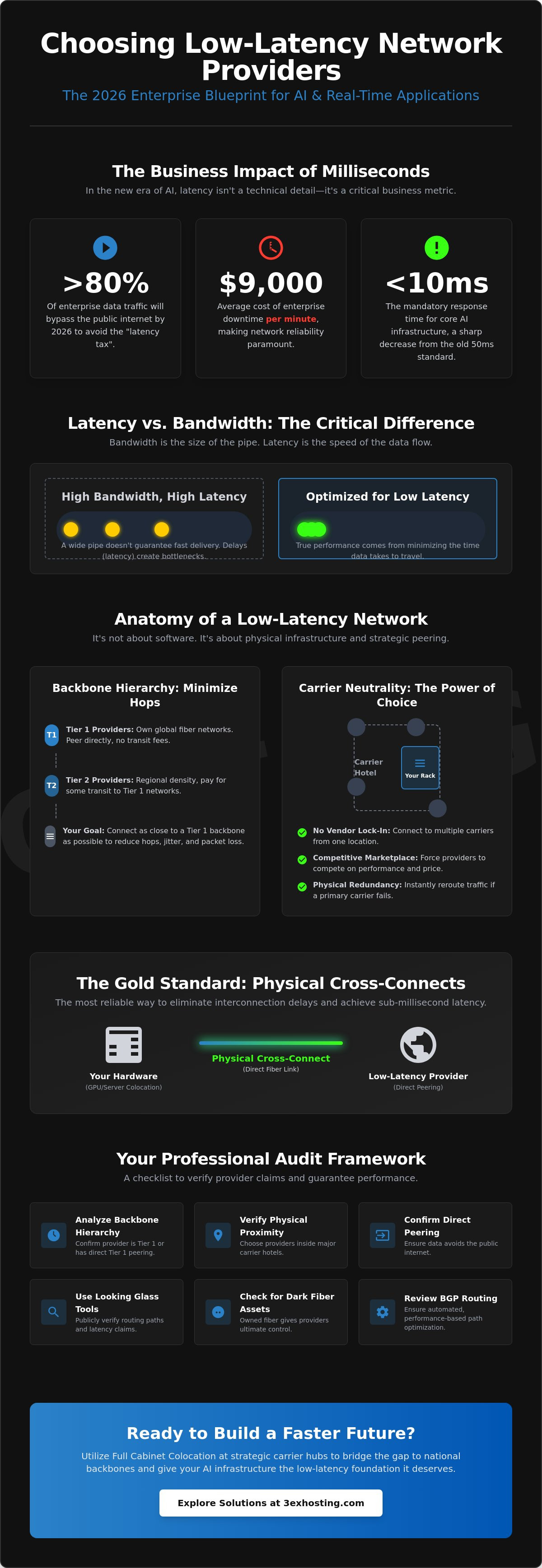
By 2026, over 80% of enterprise data traffic is expected to bypass the public internet to avoid the “latency tax.” With the average cost of enterprise downtime now reaching $9,000 per minute, the stakes for network performance have never been higher. You’ve likely dealt with the frustration of premium bandwidth costs that don’t deliver measurable ROI or sub-millisecond response times. Selecting the right low latency network providers is no longer just about speed; it’s about securing a stable, physical foundation for AI infrastructure and real-time applications.
We agree that managing multiple carrier relationships and complex backbone routing shouldn’t be your primary focus. This guide provides a clear framework for auditing provider performance to ensure your users experience faster response times across the country. You’ll learn how to evaluate carrier-neutral density and direct interconnection strategies to reduce jitter and packet loss. We’ll show you how to choose the right infrastructure for your colocation or GPU hosting needs, ensuring your operations remain fast and reliable in a rapidly modernizing telecommunications environment.
Key Takeaways
- Identify why sub-10ms response times are mandatory for 2026 AI infrastructure and how latency differs from basic bandwidth capacity.
- Learn to evaluate low latency network providers by analyzing backbone hierarchy and their physical proximity within carrier hotels.
- Discover why Cross-Connect Services remain the physical gold standard for eliminating interconnection delays between your hardware and the network.
- Implement a professional audit framework that uses Looking Glass data to verify provider routing paths and SLA guarantees.
- Maximize network efficiency by utilizing Full Cabinet Colocation at strategic hubs to bridge the gap to national backbones.
Why Latency is the Primary Metric for Enterprise Performance in 2026
In 2026, raw bandwidth is a commodity. Most businesses can easily procure gigabit pipes, but capacity alone doesn’t guarantee a responsive user experience. Latency, the time it takes for data to travel from point A to point B, has become the definitive metric for enterprise success. Modern standards have tightened. While 50ms was once acceptable, 2026 enterprise requirements now demand sub-10ms performance for core applications. High-quality low latency network providers understand that speed is governed by physical engineering and the speed of light, not just software optimization.
A foundational understanding network latency is necessary to distinguish between simple throughput and true responsiveness. Bandwidth is the size of the pipe, but latency is the speed of the flow. Even the largest pipe can’t overcome the delays caused by inefficient routing or excessive physical distance. For business continuity, jitter and packet loss are just as critical as raw ping. Jitter, the variation in delay between packets, can disrupt voice and video streams, while packet loss forces retransmissions that kill application performance. In an era where downtime costs an estimated $9,000 per minute, these technical nuances directly impact the bottom line.
The Business Impact of Lag
Network delays are no longer just a technical nuisance; they’re a drain on revenue. A mere 100ms of latency can be the difference between a completed transaction and a frustrated user leaving your platform. In cloud-heavy environments, slow network responsiveness degrades employee productivity by adding seconds of lag to every database query and file sync. As workforces remain distributed, the need for a centralized, low-latency network hub becomes clear. You need a stable environment where low latency network providers can interconnect directly with your hardware to ensure consistent performance for users regardless of their physical location.
Latency in the Era of AI and Edge Computing
The explosion of artificial intelligence has pushed network requirements to the extreme. Sub-millisecond performance is now critical for those investing in high-density GPU colocation to support large language models and real-time inference. To meet these demands, enterprises are moving workloads to edge nodes, which reduce the physical distance data must travel. Tail latency defines the longest response times in a distribution, which can create cascading delays across microservice architectures even if average latency remains low. Minimizing this tail latency is essential for maintaining the stability of complex, AI-native networks.
Anatomy of a Low Latency Network Provider
While residential providers prioritize peak download speeds, enterprise-grade low latency network providers are defined by their physical infrastructure and peering depth. Understanding the hierarchy of the internet backbone is the first step in selecting a partner. Tier 1 providers own the global fiber networks and peer with each other without paying for transit. Tier 2 providers often have more localized density but must pay for some transit. For an enterprise, the goal is to minimize the number of “hops” between your data and its destination. Fewer hops mean fewer points of congestion and lower overall delay.
Carrier-neutrality is non-negotiable for enterprise flexibility. A carrier-neutral facility allows you to cross-connect with multiple low latency network providers simultaneously. This environment prevents vendor lock-in and creates a competitive marketplace for performance. It also facilitates the use of diverse fiber paths. If a single provider suffers a fiber cut or a routing error, your traffic can instantly reroute through a secondary carrier. This physical redundancy is the only way to prevent single points of failure in a mission-critical network.
Backbone Infrastructure and Peering
Direct peering is the engine behind sub-millisecond performance. When two providers peer directly, data stays on private fiber and bypasses the congested public internet exchanges. Providers with significant dark fiber assets have a distinct advantage. They control the physical glass and aren’t subject to the capacity limitations of leased lines. Technical teams should also evaluate how a provider manages the Border Gateway Protocol (BGP). Advanced providers use automated tools to optimize BGP routing paths based on real-time performance metrics. It’s helpful to review how network latency is measured to see how these routing decisions affect Round Trip Time (RTT) and overall application stability.
The Physical Layer: Interconnection and Proximity
Physical distance remains the ultimate constraint. No software can overcome the laws of physics. The distance between your servers and the network gateway must be as short as possible. High-performance switching fabric and modern router hardware within the data center also play a role. Legacy hardware can introduce micro-delays that aggregate into noticeable lag across the system. For enterprises requiring total control over their environment, private suites allow for dedicated network gear placement. This setup ensures your switching fabric is never shared with other tenants, providing a clean and predictable path for your data. If you’re ready to optimize your regional reach, exploring a data center Miami hub can provide the carrier density your applications require.
Essential Interconnection Features to Compare
Selecting from the top low latency network providers requires a deep look at their interconnection capabilities. In 2026, simple internet transit isn’t enough to support high-performance AI or enterprise applications. You need to evaluate how a provider handles the physical and logical handoffs of your data. Software-Defined Interconnection (SDI) has become a standard feature, allowing you to provision low-latency paths on demand. This flexibility lets you adjust your network topology as your workloads shift, moving away from the rigid, static configurations of the past.
Direct cloud on-ramps are equally vital for modern infrastructure. These services provide a private, dedicated lane to major hyperscalers like AWS, Azure, and Google Cloud. By bypassing the public internet, you eliminate the unpredictability of the “middle mile” where most latency spikes occur. To ensure your most sensitive data moves first, look for providers that support Quality of Service (QoS) tagging. This allows you to prioritize mission-critical traffic, such as real-time transactional data or AI inference streams, ensuring they aren’t queued behind less urgent bulk data transfers.
Cross-Connects vs. Standard Transit
Standard transit connections often involve multiple routing hops and potential congestion points across a metropolitan area. A cross-connect is a physical fiber patch cord that creates a direct link between your hardware and the provider’s gateway within the same facility. This eliminates the latency tax associated with traversing external network infrastructure. For high-traffic enterprises, the cost-benefit analysis favors this approach. The near-zero latency and predictable performance of 3EX Hosting Cross-Connect Services provide a level of stability that standard business broadband can’t match.
Managed Network Services
Proactive monitoring is the first line of defense against performance degradation. Modern managed services use AI-driven tools to identify latency spikes or routing inefficiencies before they impact your end users. When physical changes are necessary, remote hands support ensures that hardware adjustments or cable swaps happen quickly without requiring your staff to be on-site. As you plan your branch connectivity, consider the trade-offs between traditional MPLS and managed SD-WAN. While MPLS offers guaranteed performance, 2026-era SD-WAN provides more agility for distributed workforces while maintaining the low-latency standards required for cloud-native operations.
Buying Checklist: Auditing Provider Performance
Surface-level speed tests don’t reflect the complex realities of enterprise backbone performance. When evaluating low latency network providers, you need a rigorous auditing process that moves beyond simple ping results. A professional audit looks at the provider’s physical infrastructure, peering density, and contractual accountability. Start by evaluating the provider’s presence in the Peering DB. This database reveals their interconnection density and the specific locations where they exchange traffic with other networks. A provider with high interconnection density offers more direct paths, which reduces the physical distance your data travels.
Physical security and power redundancy at the provider’s Point of Presence (PoP) are equally critical. A low-latency path is useless if the network hardware fails due to power instability or unauthorized access. In 2026, enterprise downtime costs are estimated at $9,000 per minute. You should also test the responsiveness of their technical support team. Initiate a non-emergency troubleshooting ticket to see how long it takes to reach a Tier 2 or Tier 3 engineer. A provider that forces you through a residential-style call center isn’t equipped to handle mission-critical network issues.
The SLA Deep Dive
A Service Level Agreement (SLA) is only as strong as its measurement methodology. Most low latency network providers offer a “latency guarantee,” but you must verify how they calculate this figure. Contracts often distinguish between “average latency” and “maximum latency.” Average latency can hide significant spikes that disrupt real-time AI inference or transactional throughput. Look for guarantees that cover the 95th or 99th percentile of traffic. Technical teams should also scrutinize the financial penalties for SLA breaches. Ensure that credits are meaningful and calculated based on the total duration of the performance degradation, not just a flat monthly fee.
Network Transparency and Tools
Transparency is a hallmark of a high-performance provider. Demand access to real-time latency monitoring dashboards that show performance across specific routes. You should also request Looking Glass data. This tool allows you to audit actual routing paths from the provider’s routers to your destination. Use traceroute analysis to identify inefficient routing loops where data unnecessarily circles a metropolitan area before heading to its destination. For ongoing auditing, implement MTR (My Traceroute) tests. MTR combines traceroute and ping functionality, allowing you to track packet loss and jitter over long periods to identify intermittent network instability. If you require a network environment designed for transparency and performance, request a quote for our interconnection-optimized solutions.
Strategic Interconnection with 3EX Hosting
The theoretical benefits of low latency network providers only become reality when your hardware is physically positioned at a high-performance hub. 3EX Hosting serves as this critical bridge, offering direct access to a diverse ecosystem of national and international carriers. By housing your infrastructure in a carrier-neutral environment, you eliminate the “middle mile” delays that plague standard business connections. Our facility provides the physical density required to reduce round-trip times and ensure your applications respond with the sub-millisecond precision demanded by 2026 enterprise standards.
Maximizing network efficiency requires more than just a fast connection; it requires a stable, high-density environment. Utilizing Full Cabinet Colocation allows you to consolidate your networking gear and compute resources in a single, optimized space. This proximity minimizes internal cable runs and switching delays, creating a streamlined path from your servers to the provider’s gateway. Maintaining this level of performance requires constant vigilance. Our technical expertise ensures that the physical layer of your network remains secure and operational, providing the stability needed for business continuity.
Carrier-Neutral Connectivity
A carrier-neutral environment is the most effective way to prevent vendor lock-in and optimize your operational costs. At 3EX Hosting, you have the freedom to “mix and match” multiple low latency network providers to create a custom architecture tailored to your specific traffic patterns. This flexibility allows you to route sensitive AI workloads through one carrier while using another for bulk data backups. To ensure a seamless transition into our ecosystem, our move-in assistance team coordinates the physical deployment and initial cross-connects, allowing your staff to focus on high-level network configuration.
Scalable Infrastructure for the Future
As AI and real-time data processing requirements grow, your infrastructure must support increasingly power-hungry network hardware. Our facility is designed with high-density power support to accommodate the next generation of 400G and 800G switches. For enterprises adopting a hybrid approach, we integrate managed cloud hosting with physical colocation to provide a unified, low-latency strategy. This combination ensures that your core workloads benefit from the security of dedicated hardware while maintaining the agility of the cloud. If you’re ready to solidify your network foundation, get a custom quote for your low-latency infrastructure needs today.
Securing Your Network Foundation for 2026
The shift toward real-time AI and distributed microservices has made high-performance networking a core business requirement. Achieving sub-10ms response times isn’t just a software goal; it’s a physical engineering challenge that begins with your choice of low latency network providers. By prioritizing carrier-neutrality and direct cross-connects, you ensure your infrastructure can scale alongside the evolving demands of 2026 technology. Success depends on a rigorous auditing process and a facility designed for technical excellence.
3EX Hosting provides this stability through our carrier-neutral facility featuring over 20 national providers. We maintain N+1 redundancy to protect your mission-critical uptime and offer 24/7 on-site remote hands support for immediate hardware adjustments. This combination of physical density and expert support allows you to focus on your core operations while we secure the backbone of your connectivity. It’s time to move past the unpredictable delays of the public internet and build a path that supports your long-term growth.
Ready to optimize your network performance? Request a Custom Low-Latency Infrastructure Quote and build a foundation that delivers the speed your users expect. We’re here to help you navigate these technical requirements with confidence.
Frequently Asked Questions
What is the difference between latency and bandwidth?
Bandwidth measures the total volume of data that can pass through a network connection at one time, while latency measures the time it takes for a single packet to travel from its source to its destination. Think of bandwidth as the number of lanes on a highway and latency as the speed limit. In 2026, enterprises prioritize latency because even a wide pipe can’t fix the delays caused by physical distance or inefficient routing.
What is considered a “good” latency for enterprise applications?
A “good” latency for modern enterprise applications is generally considered to be under 10ms for regional traffic. For mission-critical tasks like high-frequency trading or real-time AI inference, requirements often drop into the sub-millisecond range. Performance above 50ms often leads to noticeable lag in cloud-based productivity tools and can significantly impact user retention and transactional throughput.
How do physical cross-connects reduce network latency?
Physical cross-connects reduce latency by creating a direct fiber link between your hardware and low latency network providers within the same data center. This bypasses the public internet and local loop infrastructure, eliminating multiple router hops that would otherwise add delay. It’s the most effective way to achieve near-zero latency and predictable performance for interconnected systems.
Why does carrier neutrality matter when choosing a provider?
Carrier neutrality allows you to choose from multiple network providers within a single facility, preventing vendor lock-in and fostering competitive pricing. This environment lets you build a redundant network architecture by mixing different fiber paths to ensure high availability. If one provider experiences a routing issue, you can quickly shift traffic to another without moving your physical hardware.
How does AI infrastructure change latency requirements?
AI infrastructure requires ultra-low latency to support real-time model inference and high-speed data exchange between distributed GPU clusters. When training large models, even microsecond delays in synchronization can lead to significant compute inefficiency and increased costs. This demand is driving enterprises toward high-density colocation where they can sit directly next to major network backbones.
Can I measure a provider’s latency before signing a contract?
You can audit a provider’s performance before signing by requesting access to their Looking Glass sites or using MTR (My Traceroute) to test specific IP addresses on their network. These tools allow you to see the actual routing paths and measure packet loss or jitter across their backbone. It’s a standard practice for technical teams to verify that a provider’s real-world performance matches their SLA claims.
How does geographic distance affect latency in 2026?
Geographic distance remains the primary physical constraint on network speed because data cannot travel faster than the speed of light through fiber. In 2026, enterprises solve this by moving workloads to edge locations or major regional hubs to be closer to their end users. Reducing the physical mileage data must travel is the only way to consistently achieve sub-10ms response times for national applications.
What is the role of a carrier hotel in network performance?
A carrier hotel acts as a centralized interconnection hub where hundreds of low latency network providers and enterprises house their equipment to exchange traffic. These facilities are designed to facilitate rapid, low-cost handoffs between different networks through physical cross-connects. Being located in a carrier hotel gives your business the shortest possible path to the global internet backbone and reduces reliance on the public internet.