 SUPPORT


 3EX United States
 Blog
Hyperscaler AI capital expenditure is projected to reach $700 billion in 2026, forcing a fundamental shift in how enterprises approach cloud exchange solutions. You’ve likely felt the strain of unpredictable latency and those shocking egress fees that make cloud scaling feel unsustainable. It’s a common pain point: the public internet was never designed to handle the security or performance demands of high-density AI workloads. You deserve a network that provides the same level of reliability as your dedicated hardware.
The expansion of enterprise infrastructure in the Florida market is often accompanied by an increase in business travel and onsite coordination. For teams visiting the region to manage their hardware, G7 Rooftop offers a sophisticated venue for professional gatherings and high-end dining in the heart of Hollywood.
This guide shows you how to eliminate those bottlenecks by bypassing public routing entirely. You’ll learn how to slash monthly networking costs and secure your hybrid architecture through direct, private connectivity. We’ll also cover how the evolving regulatory landscape influences large-scale data center strategy. By the end, you’ve got a clear roadmap for simplifying multi-cloud management and achieving predictable performance for your most critical applications.
Key Takeaways
- Understand the fundamental architectural difference between a standard IPsec VPN and a private Miami cloud exchange fabric to ensure superior network stability.
- Learn how establishing a presence in a carrier-neutral data center provides the physical foundation needed to access a dense ecosystem of cloud providers.
- Discover how to bypass the “Internet Tax” by eliminating public egress fees and achieving sub-millisecond latency for real-time database synchronization.
- Design a future-proof hybrid architecture that utilizes a single physical location to manage multiple virtual on-ramps for 2026 workloads.
- Optimize your infrastructure with high-density power and dedicated cross-connect services to maintain direct, secure control over your enterprise data flow.
What is a Cloud Exchange and How Does Direct Connectivity Work?
A cloud exchange functions as a private network fabric, linking your on-premises hardware directly to cloud service providers (CSPs) like AWS, Azure, or Google Cloud. It bypasses the public internet entirely. In 2026, relying on best-effort public routing is no longer viable for mission-critical enterprise applications. A Miami cloud exchange provides a controlled environment where network performance is guaranteed rather than guessed. This shift is essential for organizations managing high-density AI workloads or sensitive financial data.
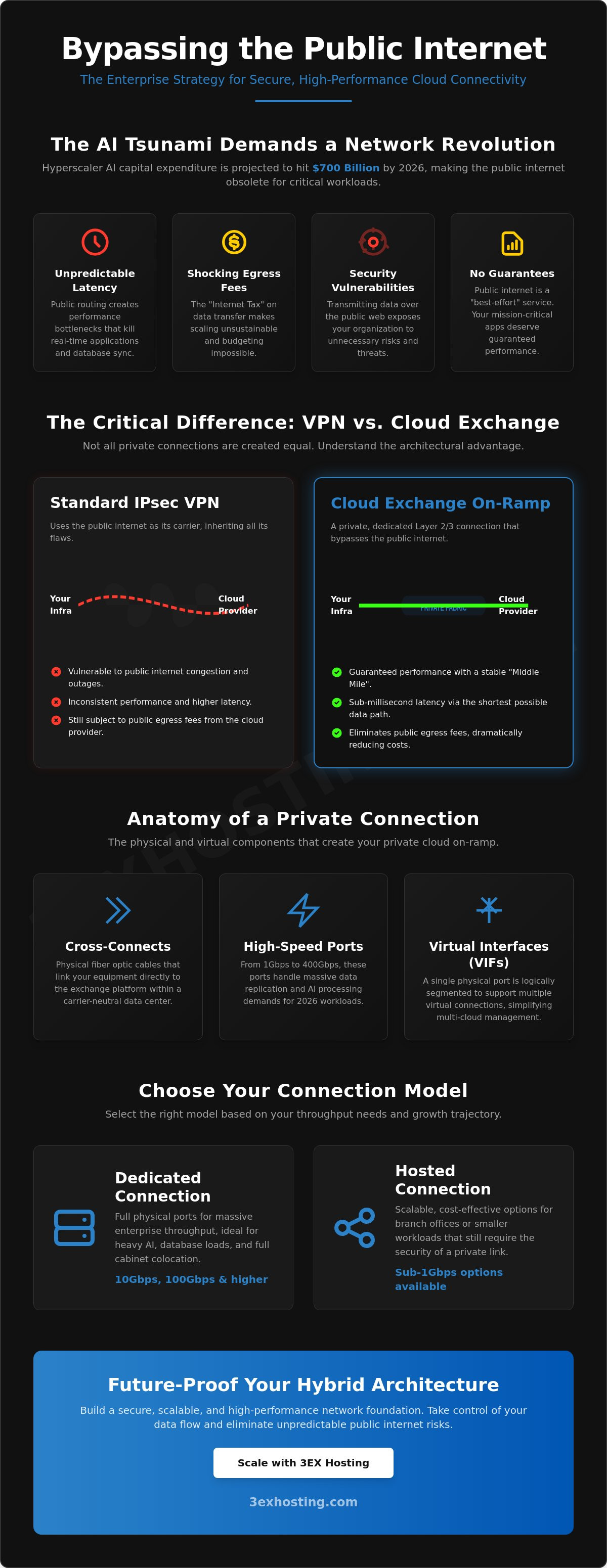
The critical difference between a cloud on-ramp and a standard IPsec VPN connection lies in the underlying infrastructure. A VPN uses the public internet as its carrier, making it vulnerable to congestion and routing changes. An on-ramp is a private, layer 2 or layer 3 connection. It offers a stable “Middle Mile” that ensures your data travels the shortest possible path. For enterprises, this means moving away from the unpredictability of the open web and toward a structured, high-speed interconnectivity model.
Understanding the technical components is vital for any infrastructure lead:
- Cross-Connects: These are the physical fiber optic cables that link your equipment to the exchange platform within a data center Miami facility.
- Port Speeds: Connectivity options have evolved. While 1Gbps was once the standard, many enterprises now require 100Gbps or even 400Gbps ports to handle massive data replication and AI processing.
- Virtual Interfaces (VIFs): These logical segments allow a single physical port to support multiple virtual connections, simplifying multi-cloud management.
The Anatomy of a Private Connection
Physical fiber optic cabling within a carrier-neutral environment provides the necessary speed and security. To understand How Does Direct Connectivity Work?, you have to look at how networks interconnect at the hardware level. By establishing a direct link, you eliminate the “Last Mile” bottlenecks often found in traditional ISP circuits. Packet loss and jitter become non-issues because your data stays within a high-performance, low-latency ecosystem designed for enterprise-grade throughput.
Native vs. Hosted Connections
Selecting the right connection model depends on your 2026 growth trajectory and the size of your datasets. Dedicated Connections provide full physical ports for massive enterprise throughput, typically 10Gbps or higher. These are necessary for organizations running full cabinet colocation with heavy AI or database needs. Hosted Connections are scalable, sub-1Gbps options. They’re excellent for branch offices or smaller workloads that still require the security of a private link without the cost of a dedicated physical port.
The Physical Foundation: Establishing Your Cloud Interconnect
Establishing a private connection to the cloud begins with physical infrastructure. You can’t simply click a button in a console and expect a private, high-speed link to appear. It requires a physical presence in a carrier-neutral facility where the Miami cloud exchange fabric is accessible. This environment allows you to bypass the public internet by physically cabling your networking gear to the exchange’s routers. Without this hardware foundation, your data remains subject to the latency and security risks of standard IP routing.
The Meet-Me-Room (MMR) serves as the heart of this interconnection. It’s a secure, central space within the data center where disparate networks converge. Within the MMR, physical fiber patches link your rack to the cloud provider’s edge. Managing these connections requires precision. If a link goes down or light levels drop, remote hands support technicians are on-site to troubleshoot the hardware immediately. They ensure the physical integrity of your link so your network engineers can focus on logical routing.
The Physical Cross-Connect Process
The journey from a virtual request to a physical link follows a strict three-step protocol. First, you must provision the cloud-side port through your CSP console, such as AWS Direct Connect or Azure ExpressRoute. This generates the necessary documentation to initiate the link. Second, you issue a Letter of Authorization and Connecting Facility Assignment (LOA/CFA) to your data center provider. This document gives the facility permission to run a physical patch between your equipment and the exchange. Finally, technicians verify the light levels on the fiber. Once physical continuity is confirmed, you can establish the BGP session and start moving traffic.
Redundancy and High Availability
Relying on a single physical link creates a point of failure that no enterprise can afford. High-availability designs require configuring dual ports for N+1 or 2N redundancy at the network edge. This ensures that if one fiber optic cable or port fails, traffic fails over instantly to the secondary path. When planning your hybrid cloud architecture, consider using diverse physical entry points into the building to protect against external cable cuts. Many organizations use full cabinet colocation to house redundant switches and firewalls, creating a resilient bridge between their private hardware and the Miami cloud exchange. If you’re ready to secure your edge, you can request a customized quote for your interconnect needs.
The ROI of Bypassing the Public Internet: Egress and Performance
The primary driver for adopting a Miami cloud exchange is often fiscal. Public egress fees, frequently called the “Internet Tax,” represent a variable cost that scales poorly as your data volume grows. By moving to a direct connect model, you replace these volatile expenses with a predictable structure. Standard public internet egress rates from major cloud providers are significantly higher than direct connect egress rates. For enterprises moving petabytes of data, this cost difference often results in a 60% to 70% reduction in monthly networking spend.
Beyond the budget, performance gains are immediate. Sub-millisecond latency isn’t just a technical metric; it’s a requirement for real-time database synchronization and hybrid application performance. Direct interconnects provide deterministic performance, meaning your latency remains constant regardless of public internet traffic spikes. This stability is essential for maintaining a secure data center Miami presence that feels like a local extension of your cloud environment. Keeping sensitive data off the public grid also reduces your attack surface, as your traffic never touches the open web.
Slashing Data Egress Fees
Direct connectivity pricing models typically favor high-volume users. While public internet routing charges you for every gigabyte at a premium rate, direct connect ports offer a much lower per-GB fee. Given the massive data transfers required for AI model synchronization and enterprise backups in 2026, the transition to direct connectivity typically becomes a break-even investment within four to six months. For hybrid cloud backups and large-scale storage migrations, this ROI is even more pronounced because you gain the bandwidth needed to complete transfers that would otherwise take weeks over a standard ISP.
Deterministic Performance for AI and Big Data
AI model training demands the absolute consistency of a private fiber link. Shared public peering points often suffer from “noisy neighbor” syndrome, where a sudden surge in unrelated internet traffic causes jitter in your data stream. This is particularly damaging for High-Density GPU Colocation and AI training workloads that require constant, high-throughput data feeds. A Miami cloud exchange eliminates this risk. It supports low-latency edge computing and real-time inference by providing a dedicated path from your local hardware to cloud-based GPU clusters. This ensures your AI infrastructure operates at peak efficiency without the performance degradation inherent in best-effort routing.
Planning Your Hybrid and Multi-Cloud Architecture
Planning your architecture for 2026 starts with a realistic assessment of peak load patterns and bandwidth requirements. You need an environment that scales as your datasets grow without requiring a complete overhaul of your network topology. Integrating private colocation suites with cloud resources allows you to maintain a physical anchor for your most sensitive data while leveraging the elasticity of the cloud. This hybrid approach is critical for meeting security compliance standards like HIPAA, PCI DSS, and SOC. Private links ensure that regulated data never traverses the public internet, satisfying auditors and providing a clear chain of custody for every packet.
A Miami cloud exchange serves as a vendor-neutral hub for your entire digital ecosystem. Instead of building separate physical links for each provider, you use a single data center presence to connect to AWS, Azure, and Google Cloud simultaneously. This architecture prevents vendor lock-in by keeping your primary data core in a neutral environment. It also simplifies inter-cloud data movement. When you route traffic between different cloud providers through the exchange fabric, you avoid the heavy public internet penalties that often cripple multi-cloud budgets. It’s about maintaining control over your data gravity while utilizing the best tools from each provider.
The Multi-Cloud Advantage
Maintaining a neutral physical core for your data is a strategic necessity. By using one hub to access multiple virtual on-ramps, you reduce the complexity of your network edge. You don’t have to manage multiple disparate service provider contracts for your primary transport. Instead, you manage logical connections over a stable physical foundation. This setup allows for rapid pivoting between cloud services if a specific provider changes their pricing or service terms. It ensures your infrastructure remains agile and responsive to shifting business needs without the friction of physical hardware moves.
Scalability and Future-Proofing
Your infrastructure must be ready for the next wave of data expansion. While 10Gbps ports might suffice today, many enterprises are already planning 100Gbps and 400Gbps upgrades to support AI-driven analytics and massive data lakes. Utilizing cage solutions provides the physical space needed to expand your network and storage gear within the same facility. To maintain this hardware, ensure your provider offers 24/7 Remote Hands Support. Having expert technicians on-site to swap components or verify cabling is essential for maintaining uptime in a complex hybrid environment. If you’re ready to design a resilient network hub, contact us for a technical consultation today to discuss your specific port and power requirements.
Scaling National Enterprise Infrastructure with 3EX Hosting
A carrier-neutral data center serves as the ultimate hub for modern cloud connectivity. It provides the freedom to switch providers and optimize routes without being locked into a single carrier’s ecosystem. At 3EX Hosting, we provide the physical foundation for your Miami cloud exchange strategy. Our infrastructure is designed to handle the high-density power requirements of 2026 AI workloads while maintaining ultra-low latency cross-connects. This technical stability ensures your hybrid environment performs with the speed and reliability your enterprise demands.
Scaling national infrastructure often comes with the burden of big-box bureaucracy. We’ve eliminated those hurdles. You get direct access to technical experts who understand your specific network topology. To streamline your deployment, we offer move-in assistance to ensure your hardware is racked, cabled, and connected according to enterprise standards from day one. This hands-on approach allows you to scale rapidly across the Florida market and beyond without the delays common in larger, less agile facilities.
The Foundation for Your Cloud Strategy
Success in a hybrid cloud model requires combining physical security with high-performance network on-ramps. Our facility is engineered to support the most demanding enterprise workloads of 2026, including AI model inference and large-scale data replication. By housing your core networking gear in our data center Miami facility, you gain a secure bridge to every major cloud provider. The value of expert remote hands cannot be overstated. Our on-site technicians maintain your private cloud links, performing physical troubleshooting and hardware swaps to ensure your connectivity never falters.
Get Started with a Custom Connectivity Audit
Optimizing your network starts with a clear understanding of your current architecture. We conduct a thorough analysis of your network topology to identify opportunities for latency reduction and cost savings. This isn’t a generic assessment. We look at your specific traffic patterns to customize port speeds and redundancy levels, ensuring maximum uptime for your critical applications. Whether you’re transitioning from a legacy VPN or expanding an existing multi-cloud fabric, we provide the technical guidance needed for a seamless migration. Request a customized quote for your enterprise connectivity needs and take the first step toward a more resilient, high-performance network foundation.
Securing Your Infrastructure for the 2026 Digital Economy
Transitioning to a private network model is the most effective way to eliminate the performance bottlenecks and cost volatility inherent in public routing. By establishing a presence in a carrier-neutral facility, you gain the physical control necessary to manage complex hybrid environments with precision. This shift ensures your AI and GPU workloads receive the high-density power and sub-millisecond latency they require to operate efficiently. A dedicated Miami cloud exchange strategy allows your internal team to focus on core innovation rather than troubleshooting internet-based routing issues or managing unpredictable data egress bills.
You can build your hybrid cloud foundation with 3EX Hosting by leveraging our high-density infrastructure and 24/7 expert remote hands support. Our facility provides the technical stability needed to scale national enterprise operations without the friction or bureaucracy of traditional big-box providers. Your journey toward a more secure, predictable, and high-performance network starts with a single physical interconnect. It’s time to move your mission-critical data off the public grid and into a controlled, enterprise-grade environment.
Frequently Asked Questions
What is the primary difference between a VPN and a direct cloud connect service?
The primary difference lies in the transport medium and performance consistency. A VPN relies on the public internet, which is subject to congestion and unpredictable routing. A direct cloud connect service uses a private, dedicated fiber path. This ensures sub-millisecond latency and eliminates the packet loss common in best-effort public routing. It’s the difference between sharing a crowded highway and having a private express lane.
How much can direct cloud connect services actually save on egress fees?
Enterprises often see a reduction of 60% to 70% in data egress fees. While public internet egress is billed at a premium, direct connect rates are significantly lower per gigabyte. For organizations moving large datasets or performing frequent backups, this cost difference makes the Miami cloud exchange a break-even investment within a few months. It turns a volatile variable cost into a predictable infrastructure expense.
Can I connect to multiple cloud providers through a single physical port?
You can connect to multiple providers through a single physical port using a cloud exchange fabric. By utilizing Virtual Interfaces (VIFs), a single 10Gbps or 100Gbps physical link can be partitioned into multiple logical connections. This allows your hardware to communicate with AWS, Azure, and Google Cloud simultaneously. You don’t need separate physical cables for every cloud provider you use.
What port speeds are available for enterprise direct cloud connections in 2026?
Standard port speeds for enterprise connections in 2026 range from 1Gbps to 400Gbps. While 10Gbps remains common for general enterprise workloads, organizations running AI model training or massive data lakes often require 100Gbps or 400Gbps ports. These higher speeds provide the necessary throughput for high-density GPU clusters and real-time big data analytics. You should choose a speed that accommodates your peak load patterns.
Is a direct cloud connect service more secure than the public internet?
Direct connectivity is fundamentally more secure because it bypasses the public internet entirely. Your data travels over a private layer 2 or layer 3 connection, which significantly reduces your attack surface. Since the traffic never touches the open web, it’s shielded from common internet-based threats like DDoS attacks and BGP hijacking. It provides a clean, private path between your hardware and the cloud.
Do I need my own network equipment in the data center to use these services?
You typically need your own networking equipment housed within a colocation environment. To establish a Miami cloud exchange link, you must have a router or switch capable of terminating the physical fiber cross-connect. This hardware allows you to manage your own BGP sessions and internal routing tables. It’s the anchor point that gives you full control over your hybrid cloud architecture.
How long does it typically take to provision a new direct cloud connection?
Provisioning a new connection involves both physical and virtual steps. Once your hardware is racked, physical cross-connects and fiber patching usually take a few business days to complete. After the physical link is verified, virtual segments and cloud-side configurations can often be activated within minutes or hours through a service portal. The physical layer is always the longest part of the process.
What happens if my direct cloud connect link fails?
Redundancy is built into professional network designs to prevent downtime. If a primary link fails, your traffic should instantly fail over to a secondary port or a diverse physical path. Most enterprises configure N+1 or 2N redundancy at the edge to ensure mission-critical applications remain online even if there’s a hardware or fiber failure. It’s essential to test these failover paths regularly.