 SUPPORT


 3EX United States
 Blog
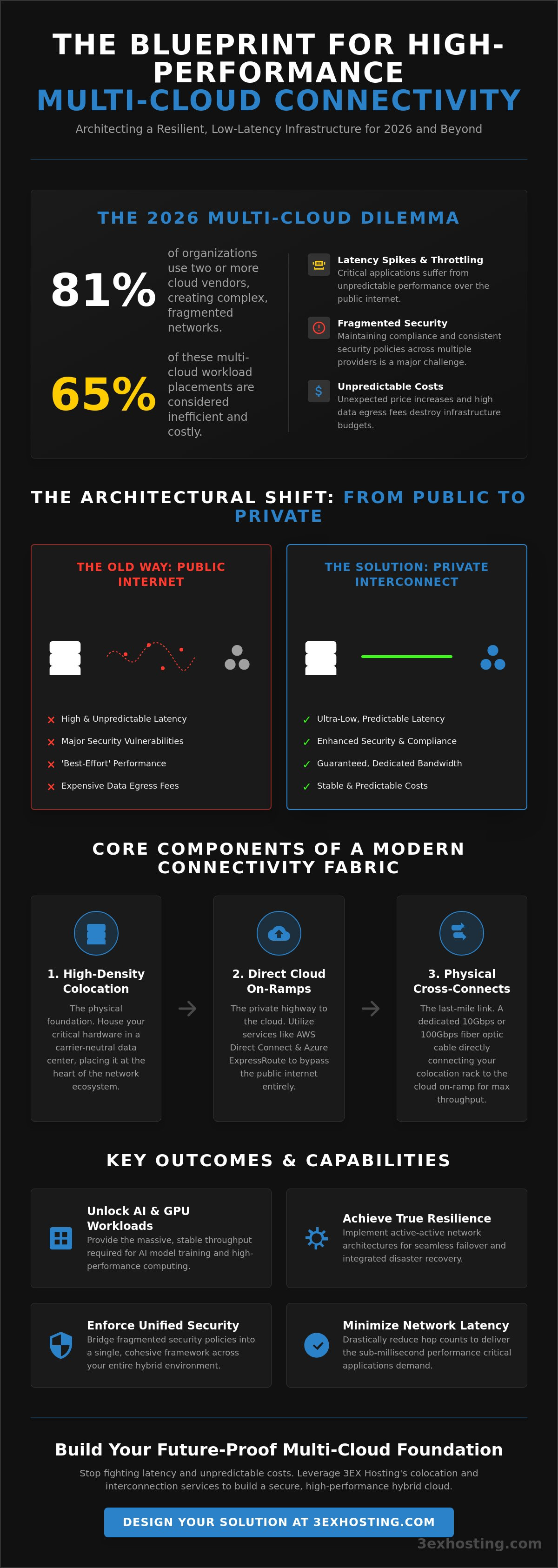
As of early 2026, 81% of public cloud users report working with at least two vendors, yet 65% of those workload placements are already considered inefficient. You’ve likely felt the impact of Google Cloud’s May 2026 price increases or struggled with latency spikes that throttle your most critical applications. It’s a common challenge for enterprise teams trying to maintain security across a fragmented network. True performance isn’t found in software abstraction alone; it requires bridging physical high-density colocation with direct cloud on-ramps.
In this guide, you’ll discover how to architect multi-cloud connectivity solutions that deliver the low-latency, high-bandwidth foundation your hybrid infrastructure needs. We’ll show you how to leverage cross-connect services and private colocation to bypass the public internet and stabilize your data transfer costs. You’ll learn how to build a unified architecture that treats multiple providers as a single, seamless environment. We’ll also cover the technical strategies needed to scale for AI-driven workloads while maintaining strict data sovereignty and compliance.
Key Takeaways
- Learn how physical cross-connects and carrier hotels minimize latency by reducing hop counts between your private hardware and public cloud providers.
- Compare the performance advantages of direct cloud on-ramps against the flexibility of SDCI to find the right balance for your infrastructure budget.
- Discover how to implement resilient multi-cloud connectivity solutions using active-active network architectures and integrated disaster recovery.
- Understand why high-density colocation is essential for scaling AI and GPU-heavy workloads within a modern hybrid environment.
- Find out how to bridge fragmented security policies into a unified network framework that treats multiple clouds as a single, stable ecosystem.
Understanding Multi-Cloud Connectivity Solutions in 2026
Modern enterprise networking has evolved beyond simply signing up for multiple services. To understand What is Multi-Cloud?, you must look past the software and focus on the underlying physical and virtual links. In 2026, multi-cloud connectivity solutions are defined as the integrated framework that bridges private infrastructure with multiple Cloud Service Providers (CSPs). This isn’t just about redundancy. It’s about creating a unified, interoperable fabric where data moves securely between environments without the friction of the public internet.
The year 2026 marks a turning point for the ‘Connected Hybrid’ model. Organizations no longer treat clouds as isolated silos. With 81% of public cloud users now operating across two or more vendors, the focus has shifted to architectural efficiency. New regulations, like the European Data Act, and rising data egress costs make a strategic network mandatory. For instance, Google Cloud’s pricing increase on May 1, 2026, has forced many to rethink their data transfer strategies. You need a setup that ensures data sovereignty while avoiding the high costs of vendor lock-in.
The Core Components of a Connectivity Strategy
A robust strategy relies on three pillars. First, cloud on-ramps like AWS Direct Connect or Azure ExpressRoute provide dedicated paths to your CSP. Second, interconnection hubs serve as carrier-neutral facilities where these networks physically meet. Utilizing cabinet colocation in these hubs allows you to establish direct cross-connects. Finally, the network edge places compute resources closer to your users. This proximity is vital for low-latency performance in real-time applications.
Why Public Internet is No Longer Sufficient for Enterprise
Relying on the public internet for enterprise workloads is a liability. It operates on ‘best-effort’ routing. This means your data takes the path of least resistance, not the fastest one. This unpredictability makes meeting strict SLAs nearly impossible. Security is another major concern. Every hop across the public web is a potential vulnerability. Additionally, internet-based transfers often incur higher egress fees compared to private connections. These costs act as a hidden tax on your growth. Transitioning to a private data center environment provides the stability and cost predictability that modern multi-cloud connectivity solutions require.
The Mechanics of High-Performance Cloud Interconnection
While software manages the workloads, the actual performance of multi-cloud connectivity solutions depends on the physical layer. Carrier hotels serve as the foundation. These are dense, carrier-neutral facilities where hundreds of networks physically meet. By housing your infrastructure in a data center that acts as a carrier hotel, you can use physical cross-connects to reach cloud providers directly. This method reduces hop counts to the absolute minimum. It bypasses the dozens of routers your data would otherwise hit on the public internet, ensuring your packets take the shortest path possible.
Choosing between Layer 2 and Layer 3 connectivity determines your level of control over the traffic. Layer 2 connections provide a transparent “pipe” where you manage the routing yourself. Layer 3 connections handle the IP routing for you but can limit your ability to implement custom multi-cloud network security policies. Most enterprise architectures rely on the Border Gateway Protocol (BGP) to manage these paths. BGP allows your network to automatically reroute traffic if one cloud on-ramp fails, ensuring constant availability across your entire hybrid ecosystem.
Physical Cross-Connects and Low-Latency Links
Direct fiber connections are the gold standard for performance. Unlike virtual links that share bandwidth, a physical cross-connect provides a dedicated 10Gbps or 100Gbps path. This is vital for high-density GPU colocation, where AI model training requires massive data throughput without any delay. Professional facilities offer N+1 redundant paths to prevent a single cable cut from taking down your environment. If you need assistance with physical cabling or hardware deployment, our Remote Hands Support can handle the on-site technical tasks for you.
Software-Defined Cloud Interconnect (SDCI)
SDCI platforms offer a different approach by virtualizing the interconnection process. You can provision a new connection to a cloud provider in minutes through a web portal. This “one-to-many” model is excellent for testing new services or managing smaller workloads across multiple clouds. However, it’s important to balance this flexibility with raw performance. While SDCI is fast to deploy, it often introduces a layer of software abstraction that can add micro-milliseconds of latency compared to a direct, physical fiber link. For mission-critical data transfers, the stability of a physical connection remains the superior choice.
Comparing Connectivity Methods: Performance vs. Cost
Selecting the right foundation for your multi-cloud connectivity solutions requires balancing capital expenditure against long-term operational costs. In 2026, the market has matured to offer four distinct paths. Direct Cloud On-Ramps, such as AWS Direct Connect or Azure ExpressRoute, offer the highest performance and the lowest data egress fees. While they require a higher monthly port fee; for example, a 10 Gbps dedicated AWS port costs approximately $1,642.50 per month; they provide the stability needed for production-grade environments. In contrast, Software-Defined Cloud Interconnect (SDCI) through cloud exchanges provides high flexibility and faster deployment times, often utilizing hourly pricing models like the AWS Interconnect – multicloud rate of $12.33 per hour for 10 Gbps links.
Legacy methods like VPN over the public internet and MPLS still exist, but their enterprise utility is shrinking. A VPN is the cheapest option, yet it relies on best-effort routing, which leads to high latency and security risks. MPLS offers high reliability but remains very expensive and notoriously difficult to scale across multiple cloud providers. As organizations address various multi-cloud challenges and solutions, the shift toward private, direct interconnection has become the standard for those prioritizing uptime and security over simple connectivity.
Egress Fee Optimization: The Financial Argument
The most compelling reason to move away from internet-based connectivity is the “egress tax.” Effective May 1, 2026, Google Cloud increased its data transfer out list prices to $0.08 per GiB in North America and Europe. Compare this to AWS Direct Connect’s US-to-US egress rate of approximately $0.02 per GB. For data-heavy enterprises, this difference is massive. By moving to full cabinet colocation, you can leverage direct cross-connects that bypass these high public internet rates. This shift can reduce your monthly cloud bill by a significant margin, often paying for the physical infrastructure costs within the first year of operation.
Latency Benchmarks for Enterprise Applications
Application performance is directly tied to the physical distance and the number of network hops between your data and the user. For database replication, latency must stay below 20ms to prevent synchronization errors. Real-time AI training and high-frequency analytics require even tighter windows, often demanding sub-10ms connectivity. Latency jitter, defined as the variation in the delay of received packets, is the primary enemy of multi-cloud application stability. Private connections eliminate the volatility of public routing, ensuring that your mission-critical packets arrive in a predictable, rhythmic flow that supports complex, distributed architectures.
Designing a Resilient Multi-Cloud Network Architecture
Resilience in 2026 requires more than a simple backup plan. It demands an ‘Active-Active’ connectivity model where traffic flows across multiple paths simultaneously. This architecture ensures that if one cloud provider or physical link fails, your operations continue without interruption. To achieve this, you must rely on carrier-neutral facilities. These data centers allow you to connect to dozens of different network providers, preventing the single point of failure inherent in proprietary or carrier-locked environments. Integrating Disaster Recovery Solutions directly into your network fabric ensures that your failover processes are as fast as your primary production links.
Scalability is equally important, especially for AI-driven enterprises. A May 2026 report suggests that 65% of workload placements made in 2024 will no longer be optimal by 2029 due to changing technology requirements. Your multi-cloud connectivity solutions must support dynamic bandwidth scaling to handle these evolving needs. Whether it’s a seasonal spike in data processing or a massive AI model training session, your network should grow with your demand. This flexibility allows you to treat your hybrid infrastructure as a single, fluid resource rather than a collection of static hardware. If you’re ready to build a more stable foundation, you can get a quote for a custom interconnection strategy today.
Redundancy and Failover Strategies
Geo-redundant on-ramps are essential for protecting against regional cloud outages. By establishing connections in different geographic zones, you ensure that a localized disaster doesn’t sever your cloud access. Maintaining this physical resilience often requires on-site expertise. Our remote hands support provides the technical assistance needed to manage and troubleshoot physical cabling and hardware without your team needing to be on-site. Automating failover between your public cloud instances and your private infrastructure creates a seamless environment where the end-user never notices a backend disruption.
Security and Compliance in the Multi-Cloud
Securing data in transit across multiple clouds involves both logical and physical safeguards. MACsec and hardware-based encryption provide robust protection against interception at the physical layer. This is particularly relevant given the European Data Act’s requirements for secure data switching and the upcoming 2026 updates to the ISO/IEC 19941 standard for cloud interoperability. Controlling the physical path of your data is the only way to guarantee true data sovereignty. For enterprises with the strictest compliance needs, private suites offer an exclusive physical environment for your multi-cloud hardware, ensuring that your high-density GPU clusters and sensitive datasets are isolated from other tenants.
Optimizing Multi-Cloud Performance with 3EX Hosting
Achieving a seamless hybrid environment requires more than just selecting the right cloud providers. It demands a physical location where these networks converge with your private hardware. 3EX Hosting operates as a carrier-neutral ecosystem, providing direct access to a rich variety of global carriers and cloud on-ramps from a single facility. By centralizing your multi-cloud connectivity solutions within our data center, you eliminate the latency and complexity of managing disparate endpoints. Our infrastructure is designed for high-performance data exchange, ensuring that your private hardware and public cloud instances communicate at the speed of light.
Complex network migrations often stall due to technical bottlenecks or a lack of on-site expertise. We simplify this process by providing 24/7 on-site technical teams ready to address critical connectivity issues the moment they arise. This immediate support is vital for enterprises running mission-critical workloads that can’t afford a single minute of downtime. Our engineers understand the nuances of BGP routing and physical fiber optimization. Our remote hands support handles everything from initial rack-and-stack to complex fiber patching, allowing your team to focus on high-level architecture instead of physical maintenance.
High-Density Infrastructure for AI and Cloud Loads
Modern multi-cloud nodes, particularly those utilized for AI training and GPU-heavy tasks, require significantly more power and cooling than standard web servers. 3EX Hosting provides high-density colocation environments capable of supporting the most demanding GPU clusters. Our flexible cage solutions allow you to scale your physical footprint as your network requirements grow. For organizations requiring complete physical isolation for their AI infrastructure, we offer private data center suites. 3EX Hosting ensures 100% uptime for mission-critical cross-connects through fully redundant physical paths and carrier-neutral infrastructure.
Getting Started with Your Multi-Cloud Migration
The first step toward a high-performance hybrid model is a comprehensive network audit. You must identify existing bottlenecks in your current architecture, such as saturated internet links or inefficient routing paths that increase your data egress costs. Once these are identified, our experts help you select the optimal mix of physical cross-connects and virtual links to balance performance and cost. This strategic approach ensures that your infrastructure is ready for the data-heavy demands of 2026. If you’re ready to modernize your network and reduce latency, you can request a custom connectivity quote tailored to your specific enterprise needs.
Building a Future-Proof Hybrid Network
The transition toward integrated hybrid environments is no longer a luxury for the enterprise; it’s an operational necessity. By prioritizing physical interconnection over best-effort routing, you gain total control over your data movement and eliminate the volatility of public internet egress fees. Implementing robust multi-cloud connectivity solutions allows your team to treat fragmented cloud providers as a single, high-performance ecosystem that scales alongside your AI and data-heavy workloads.
Achieving this level of stability requires a partner that understands the intersection of hardware and networking. 3EX Hosting provides the technical foundation you need, featuring N+1 power redundancy for 100% uptime and direct cross-connects to global carriers. Our 24/7 on-site remote hands support ensures that your physical network resilience is always maintained by experts. Scale your multi-cloud infrastructure with 3EX Hosting and build a network that’s ready for the demands of 2026. Your journey toward a truly unified hybrid architecture starts with a stable, high-speed foundation.
Frequently Asked Questions
What is the difference between multi-cloud and hybrid cloud connectivity?
Hybrid cloud connectivity links a private data center to a single public cloud. In contrast, multi-cloud connectivity solutions bridge your private infrastructure with two or more public cloud providers simultaneously. While hybrid focuses on extending a local environment, multi-cloud focuses on interoperability and redundancy across a diverse vendor landscape. This allows you to distribute workloads based on specific provider strengths.
How much can I save on cloud egress fees with a direct connect solution?
You can reduce egress fees by up to 60% compared to standard internet-based transfers. For example, AWS Direct Connect egress rates in the US are approximately $0.02 per GB. This is significantly lower than the $0.08 per GiB list price Google Cloud implemented in May 2026 for North American data transfer out. Private links bypass the unpredictable internet tax and provide predictable monthly billing.
Is multi-cloud connectivity more secure than the public internet?
Private connectivity is far more secure because it uses dedicated circuits that bypass the public web entirely. This physical isolation removes your data from common internet-based threats like DDoS attacks and packet sniffing at public exchange points. You can also implement hardware-based encryption, such as MACsec, on these private links to maintain strict end-to-end data integrity across your entire hybrid environment.
What is a carrier-neutral data center and why does it matter for multi-cloud?
A carrier-neutral data center is a facility that allows you to connect with any telecommunications provider instead of being locked into one. This matters for multi-cloud because it provides access to dozens of different carriers and cloud on-ramps in one location. This variety enables the physical redundancy required for a resilient architecture and prevents any single provider from becoming a point of failure.
Can I connect my on-premise servers to multiple clouds through one facility?
Yes, you can centralize your connections by placing your hardware in a dense interconnection hub. By utilizing multi-cloud connectivity solutions within a colocation facility, you establish physical cross-connects to various cloud on-ramps from your own rack. This approach simplifies network management and eliminates the need to maintain separate long-haul circuits for every cloud provider you use.
How does latency affect multi-cloud application performance?
Latency determines the speed of data travel between your hardware and the cloud. High latency causes synchronization errors in database replication and slows down real-time processing. For mission-critical tasks like AI training, sub-10ms connectivity is the gold standard. Private connectivity stabilizes this performance by removing the unpredictable routing hops and jitter that are common when using the public internet.
What are the hardware requirements for establishing a multi-cloud on-ramp?
You need an enterprise-grade router that supports the Border Gateway Protocol (BGP) and 802.1Q VLAN tagging. Your hardware must also support the specific port speeds required, typically 10 Gbps or 100 Gbps. In a colocation environment, you’ll also need the correct fiber optic transceivers to bridge your equipment with the facility’s meet-me room where the cloud on-ramps reside.
How do I manage network security across different cloud providers?
You manage security by implementing a unified framework that applies consistent policies across all environments. This usually involves deploying virtual firewalls and centralized management consoles that monitor each cloud instance. Controlling the physical path of your data through private links simplifies this process. It ensures your security protocols remain active and uniform regardless of which cloud provider is hosting the workload.