 SUPPORT


 3EX United States
 Blog
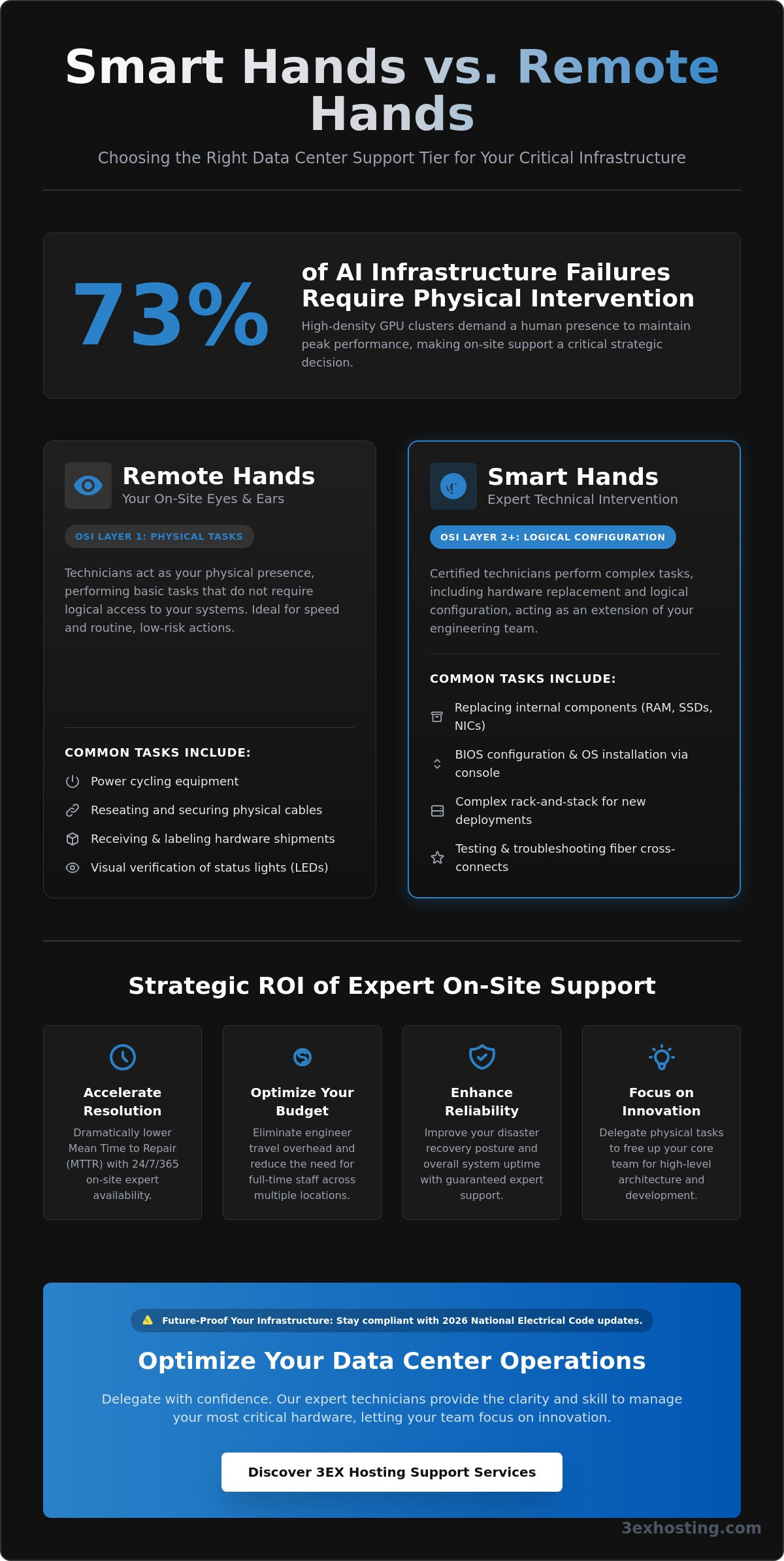
73% of AI infrastructure failures require physical intervention. This means that despite your best remote monitoring tools, high-density GPU clusters still need a human presence to maintain peak performance. Choosing between data center smart hands vs remote hands is no longer just a matter of convenience; it’s a strategic decision that affects your bottom line. You shouldn’t have to lose sleep over whether a technician understands your liquid cooling system or waste hours in traffic for a simple cable swap.
We’ll help you master these critical support tiers to optimize your infrastructure uptime and eliminate billing confusion. This comparison guide clarifies the technical boundaries between basic tasks and complex engineering. You’ll learn how to leverage expert on-site support to lower your Mean Time to Repair while staying compliant with the 2026 National Electrical Code updates. It’s time to delegate physical tasks effectively so your team can focus on high-level architecture and innovation. We provide the technical clarity you need to ensure your systems are handled by experts who understand the stakes of modern enterprise hosting.
Key Takeaways
- Identify the technical boundaries between simple physical tasks and complex logical configurations to ensure your infrastructure receives the appropriate tier of support.
- Learn to evaluate task risk and diagnostic requirements when choosing between data center smart hands vs remote hands to prevent mission-critical downtime.
- Optimize your operational budget by eliminating travel overhead and reducing the need for full-time on-site staffing across multiple colocation facilities.
- Accelerate incident resolution and lower your Mean Time to Repair (MTTR) through the strategic delegation of advanced hardware management.
- Discover how integrating 24/7/365 expert technical support enhances your disaster recovery posture and overall system reliability.
Defining Remote Hands and Smart Hands in Modern Data Centers
Modern infrastructure supporting AI and GPU workloads has reached a level of complexity where simple maintenance is no longer simple. In 2026, the distinction between data center smart hands vs remote hands defines the speed of your incident response and the safety of your hardware. As rack densities climb toward 50 kW, the days of relying on generalist “button pushers” are over. Enterprises require a tiered approach to on-site support to balance cost efficiency with technical depth. Professional support ensures your systems remain stable without requiring your lead engineers to travel for every minor alert.
The Scope of Remote Hands Support
Remote hands services act as your physical presence within the facility. These technicians provide the “eyes and ears” for your off-site IT team, focusing on tasks that don’t require interaction with the operating system or software layers. If a server needs a hard reboot or a cable requires a connectivity check, remote hands support is the most efficient choice. This tier ensures immediate response for emergency power cycles and physical environment monitoring. It’s about speed and basic physical execution. Common tasks include:
- Power cycling equipment and checking port lights.
- Moving cables or securing physical connections.
- Receiving, unboxing, and labeling hardware shipments.
- Basic visual inspections of environment conditions.
The Expertise Behind Smart Hands Services
Smart hands services represent a significant step up in technical autonomy. These technicians possess the expertise to follow complex engineering diagrams and perform logical troubleshooting. Unlike basic support, smart hands personnel can interact with your configuration layers and perform internal hardware replacements. They serve as a high-level proxy for your lead engineers during major deployments or outages. In the discussion of data center smart hands vs remote hands, the “smart” tier involves technicians who understand the nuances of InfiniBand fabric and liquid cooling systems.
The global support services market is projected to reach $15.77 billion by 2033. This growth is driven by the shift from simple maintenance to specialized technical oversight. With the 2026 National Electrical Code updates introducing tighter regulations for cable management and grounding, the skill gap is widening. You need technicians who don’t just follow instructions. You need professionals who understand the regulatory and technical environment they operate in. Key smart hands capabilities include:
- Replacing internal components like RAM, SSDs, or NICs.
- Configuring BIOS settings or performing OS installations via console.
- Managing complex rack-and-stack projects for AI clusters.
- Testing and troubleshooting fiber cross-connects with specialized gear.
Technical stability depends on choosing the right level of intervention. By matching the task complexity to the correct service tier, you reduce the risk of unskilled technicians touching mission-critical hardware. This logical division of labor keeps your operations lean and your uptime guaranteed.
Comparative Analysis: Service Scope and Technical Complexity
The choice between data center smart hands vs remote hands often comes down to the layer of the OSI model the technician needs to touch. Remote hands typically operate at Layer 1, handling the physical infrastructure. Smart hands move into Layer 2 and beyond, interacting with the logical environment. Since 73% of AI infrastructure failures require physical intervention, knowing which tier to dispatch can mean the difference between a five-minute fix and a five-hour outage. You don’t want an entry-level technician attempting to troubleshoot a complex InfiniBand fabric in a high-density GPU cluster.
Standard Remote Hands Task List
Remote hands services are designed for speed and physical execution. These tasks are straightforward and don’t require the technician to have prior knowledge of your specific software stack. They’re the most cost-effective option for routine maintenance. Common deliverables include:
- Performing hard reboots and basic power cycling.
- Visual verification of LED status lights to confirm port activity or hardware alerts.
- Reseating loose cables or “pushing” physical buttons as directed.
- Labeling cables and organizing basic patch panels.
For routine physical maintenance, leveraging remote hands support ensures your team avoids unnecessary travel without compromising on response speed.
Advanced Smart Hands Deliverables
Smart hands services provide a higher level of technical autonomy. These technicians act as an extension of your engineering team. They possess the skills to handle sensitive hardware, including the high-density components found in cabinet colocation environments. Their work often involves logical interaction with the hardware. Key deliverables include:
- Full hardware installations and decommissioning, often called “Rack and Stack.”
- Complex cable management and cross-connect patching based on engineering diagrams.
- Firmware updates and BIOS configurations performed under remote direction.
- Component-level replacements, such as swapping out failed RAM modules or SSDs.
The complexity also extends to inventory management and emergency response. In a remote hands scenario, a technician might perform a quick visual check to see if a server is in the rack. A smart hands technician will perform a detailed audit, logging serial numbers and generating a comprehensive report for your compliance team. During a power emergency, a remote hands tech will cycle the PDU. A smart hands expert will test the circuit, verify failover protocols, and ensure the redundant power supply is functioning correctly. This level of expertise is critical for maintaining the technical stability of mission-critical AI and GPU hosting environments where every second of downtime carries a high financial penalty.
The Strategic ROI of Outsourced Data Center Support
Calculating the return on investment for on-site support requires looking beyond the hourly rate. While some competitors focus solely on the immediate invoice, a true enterprise analysis accounts for travel expenses, engineer downtime, and the financial impact of extended outages. When comparing data center smart hands vs remote hands, the real value lies in the sharp reduction of Mean Time to Repair (MTTR). Having an expert already on-site eliminates the hours your internal team would spend in transit. This immediate availability is vital for maintaining high density GPU colocation environments, where hardware failure can stall critical AI training cycles and result in massive lost revenue.
Operational Efficiency and Latency
On-site technical teams act as a force multiplier for remote IT departments. They handle the physical layer while your engineers manage the logical architecture from headquarters. This synergy ensures 24/7/365 availability without the burden of round-the-clock internal staffing. Quick intervention for cross-connect services and patching prevents minor connectivity issues from escalating into site-wide latency problems. It’s about maintaining technical stability through speed. Every minute saved during a hardware swap or a port reconfiguration directly protects your operational continuity. You don’t want your network performance to suffer because a technician is two hours away.
Staffing Optimization and Resource Allocation
Your high-value engineers shouldn’t spend their time unboxing servers or tracing cables. Outsourcing these tasks allows your team to focus on strategic projects like network optimization and security posture. Using “as-needed” technical expertise is far more efficient than maintaining a fixed headcount at every facility. This model provides the flexibility to scale support based on deployment cycles or unexpected incidents. It also ensures consistency in hardware handling across full cabinet colocation setups. By utilizing professionals who are already familiar with the facility power and cooling infrastructure, you minimize the risk of human error during physical maintenance. The decision between data center smart hands vs remote hands isn’t just a technical choice; it’s a financial strategy to keep your overhead low and your uptime high. This approach guarantees that your mission-critical infrastructure remains in expert hands without inflating your payroll or sacrificing response time.
Selection Criteria: When to Deploy Smart Hands vs. Remote Hands
Choosing the correct tier in the data center smart hands vs remote hands debate requires a clear understanding of your hardware’s logical environment. You must identify the “point of no return” where a task evolves from a simple physical action to a complex technical intervention. If a task requires the technician to make independent decisions or use specialized diagnostic gear, it falls into the smart hands category. Routine physical tasks are low risk and best handled by remote hands to keep costs down. However, once a technician needs to interact with the BIOS or swap internal components in private colocation suites, the risk profile shifts significantly.
The Complexity Threshold
AI and GPU clusters are the primary drivers for smart hands deployment in 2026. These systems involve intricate liquid cooling loops and InfiniBand fabrics that demand more than basic cable reseating. If you’re currently planning a cage solutions datacenter layout, you need technicians who can interpret engineering blueprints and manage high-density power distributions. Remote hands are ideal for one-off power cycles or visual status checks. Smart hands are necessary for multi-day deployments where the technician acts as your on-site project manager, ensuring every rack is balanced and every cross-connect is tested for signal integrity.
Security and Compliance Considerations
Compliance is a major trigger point for selecting advanced support. Technicians must follow strict SOC2 or HIPAA protocols when handling hardware that contains sensitive enterprise data. Professional managed support provides the detailed audit trails and ticket documentation required for your regulatory filings. This level of expertise is also essential when integrating on-site support with your disaster recovery solutions. During a rapid restoration event, you need a technician who understands failover verification and circuit testing, not just someone to cycle a PDU. The stability of your restoration depends on the technician’s ability to follow complex recovery scripts without constant supervision.
Project duration and technical autonomy are the final deciding factors. Remote hands are built for the quick fix, while smart hands are designed for the long haul. For enterprises running mission-critical workloads, the cost of an unskilled touch is simply too high to ignore. You need a partner who understands these boundaries and provides the right level of expertise for every ticket. Request a customized support quote to ensure your Miami infrastructure is managed by professionals who can handle the complexities of 2026 hardware standards.
Optimizing Infrastructure with 3EX Hosting Support Services
Technical stability depends on a partner who understands the nuance of data center smart hands vs remote hands. At 3EX Hosting, we provide the technical foundation your enterprise needs to scale without friction. Our support services integrate directly with your operational workflow. You gain immediate access to 24/7/365 on-site technical expertise for incident resolution. This eliminates the burden of maintaining a local presence while ensuring your mission-critical AI and GPU workloads remain online and optimized. We combine carrier-neutral connectivity with expert hands to protect your infrastructure investment and guarantee the highest levels of availability.
High-density environments require specialized knowledge. Our customized support plans are designed to meet the unique demands of AI and enterprise workloads. This includes managing complex cooling systems and ensuring high-speed interconnects remain stable under heavy loads. By choosing 3EX, you aren’t just hiring a technician. You’re gaining a partner who understands the technical requirements of the 2026 data center landscape. We ensure your hardware is handled according to the latest regulatory standards and manufacturer specifications, giving you total peace of mind.
Comprehensive Hardware Lifecycle Management
We manage the entire physical journey of your equipment within our facility. This process begins with professional move-in assistance to ensure your initial deployment follows strict standards for airflow and power distribution. Our technicians execute precise rack-and-stack services, facilitating seamless enterprise scalability as your data needs expand. For full cabinet colocation clients, this means peak performance is maintained through consistent hardware handling and proactive monitoring. When hardware reaches end-of-life, we handle the decommissioning process with technical precision and security in mind, ensuring no data or equipment is left vulnerable.
Getting Started with Managed Support
Reliability is built on clear expectations and robust service structures. We collaborate with your team to establish Service Level Agreements (SLAs) that align with your specific uptime targets. Determining the right balance of data center smart hands vs remote hands is essential for your operational budget. Whether you require basic remote hands support for routine reboots or advanced engineering for logical configurations, our tiered approach provides the exact level of intervention needed. We eliminate confusion over service boundaries and billing through transparent reporting and dedicated account management.
Our team makes complex infrastructure feel simple and predictable. We focus on the technical details so you can focus on your core business growth. It’s time to secure your technical stability with a partner who prioritizes speed and reliability. Request a managed support quote for your next deployment and leverage our on-site expertise to keep your systems running at peak efficiency.
Future-Proof Your Infrastructure with Tiered Technical Support
Understanding the technical boundaries in the data center smart hands vs remote hands debate is the first step toward operational excellence. You’ve learned how to categorize tasks by risk and complexity. This ensures that mission-critical hardware is always handled by qualified experts who understand the stakes. By delegating physical layer maintenance, your team can finally focus on high-level architecture and strategic innovation without the distraction of routine hardware fixes. It’s about maximizing efficiency while maintaining technical stability.
Technical stability is a strategic choice. Our 24/7/365 on-site technical expertise and carrier-neutral carrier hotel connectivity provide the stable foundation your enterprise needs to thrive. We offer specialized support for high-density AI infrastructure, ensuring your GPU clusters operate at peak efficiency around the clock. Maximize your uptime with 3EX Hosting Remote Hands Support and gain the peace of mind that comes with professional oversight. Your systems are in expert hands, and we’re here to help you scale your infrastructure with confidence and speed.
Frequently Asked Questions
What is the primary difference between remote hands and smart hands?
The primary difference lies in the level of technical autonomy and the layer of the OSI model involved. Remote hands technicians handle Layer 1 physical tasks like power cycles and cable reseating under your direct instructions. In contrast, smart hands involve complex troubleshooting and logical configurations such as BIOS settings or component replacements. The choice between data center smart hands vs remote hands usually depends on whether the technician needs to interact with software or make independent engineering decisions.
Is smart hands support worth the extra cost?
Yes, smart hands support provides a high return on investment by mitigating the extreme costs of extended downtime. It eliminates travel expenses for your internal team and reduces the risk of human error during complex interventions. When mission-critical AI workloads fail, having an expert on-site immediately is far more cost-effective than waiting for a remote engineer to arrive. This service level protects your high-density hardware while significantly lowering your Mean Time to Repair.
Can remote hands technicians perform OS installations?
No, OS installations are typically categorized as a smart hands or managed service task. This process requires interacting with the logical layer of the server and navigating configuration menus, which exceeds the scope of basic physical support. Remote hands are strictly for physical assistance that doesn’t involve software interaction. If you need a full operating system deployment or firmware update, you’ll need smart hands support to ensure the task is completed by a qualified professional.
How quickly can I expect a response for remote hands services?
Response times vary by provider, but a 24/7 on-site presence allows for sub-hour intervention in most cases. Professional facilities aim for immediate incident resolution to maintain enterprise-grade uptime. Without on-site technicians, you might face significant delays while a contractor travels to the facility. Fast response is critical for urgent tasks like emergency power cycles or verifying port activity during a network outage. Speed and technical stability are the main benefits of on-site support.
Do I need smart hands for a simple server reboot?
No, a simple server reboot is the ideal task for remote hands. It’s a low-risk physical action that doesn’t require technical troubleshooting or logical access. Using remote hands for basic power cycles is the most efficient way to manage your infrastructure budget. You only need to escalate to smart hands if the reboot fails and requires deeper hardware diagnostics or BIOS level intervention. Keeping routine tasks in the lower tier keeps your operational overhead manageable.
What tools should a smart hands technician be expected to have?
A qualified smart hands technician arrives with a comprehensive toolset including console cables, laptop-based diagnostic software, and fiber optic testers. They also carry professional labeling tools, cable testers, and basic hardware replacement kits for internal components. These tools allow them to perform advanced troubleshooting and logical configurations that go beyond the basic visual checks provided by remote support. Having the right gear on hand ensures that complex repairs are completed correctly the first time.
How does remote support impact my data center compliance?
Professional support services enhance your compliance posture by providing detailed audit trails and documented access logs. Every interaction with your hardware is recorded in a centralized ticketing system, which is essential for SOC2 or HIPAA audits. This documentation proves that only authorized personnel handled your equipment and that all tasks followed your established security protocols. Managed support ensures that physical intervention doesn’t create a gap in your security or regulatory documentation.
Can smart hands help with data center migration?
Yes, smart hands technicians play a vital role in decommissioning and re-racking equipment during a migration. They follow complex engineering diagrams to ensure that every server and switch is installed correctly in the new environment. Their expertise in cable management and logical verification minimizes the risk of connectivity issues after the move. This support is essential for scaling enterprise operations without overwhelming your internal IT staff during a high-stakes transition.