 SUPPORT


 3EX United States
 Blog
With worldwide cloud infrastructure spending hitting $129 billion in early 2026, the real bottleneck isn’t the cloud itself; it’s the unpredictable public internet connecting you to it. Relying on standard connections often leads to volatile latency and skyrocketing egress fees that drain your IT budget. You’ve likely felt the frustration of mission-critical applications lagging during peak hours or the anxiety of routing sensitive data through the same pipes as consumer traffic. Implementing direct cloud connect services isn’t just a performance upgrade; it’s a strategic move to reclaim control over your hybrid infrastructure.
We understand your priority is a stable, secure, and cost-effective network. This guide shows you how to master the technical advantages of dedicated private on-ramps to bypass the public internet. You’ll learn how these connections deliver sub-millisecond latency and enhanced data sovereignty. We’ll also cover how private links reduce your total cost of ownership. From comparing provider connectivity options to optimizing physical cross-connects in the data center, this is your roadmap to a high-performance hybrid ecosystem.
Key Takeaways
- Learn how to establish a private, physical link to major cloud providers through carrier hotels and BGP peering to ensure your traffic never touches the public internet.
- Discover how implementing direct cloud connect services can eliminate unpredictable egress fees and reduce network latency from 50ms+ to under 2ms.
- Understand why high-density AI and GPU hosting workloads require dedicated on-ramps to synchronize on-premise training with cloud-based inference seamlessly.
- Compare the security and long-term ROI of private interconnection against standard VPNs to secure your data sovereignty and compliance.
- Identify the critical role of 24/7 remote hands and proximity to cloud points-of-presence when selecting a colocation partner for your hybrid infrastructure.
What are Direct Cloud Connect Services?
A direct cloud connect service is a dedicated, private network link that establishes a physical connection between your on-premise infrastructure and a public cloud provider. Unlike standard internet connections, this architecture bypasses the public internet entirely. It creates a “closed-loop” environment where data travels over a private line, significantly reducing the variables that typically affect network performance. In 2026, enterprises are increasingly moving away from traditional VPNs for core workloads because the public internet has become too congested and unpredictable for mission-critical AI and database synchronization.
The technical foundation of direct cloud connect services relies on Layer 2 (Ethernet) or Layer 3 (IP) connectivity. Layer 2 connections provide a direct data link layer interface, often using VLANs to segregate traffic. Layer 3 connections use BGP (Border Gateway Protocol) to handle routing between your network and the cloud. While a VPN creates a virtual tunnel over a shared public path, a direct connection uses a physical cross-connect. This is a literal fiber optic cable running between your equipment and the cloud provider’s equipment within a carrier-neutral facility.
The Core Components of a Direct Connection
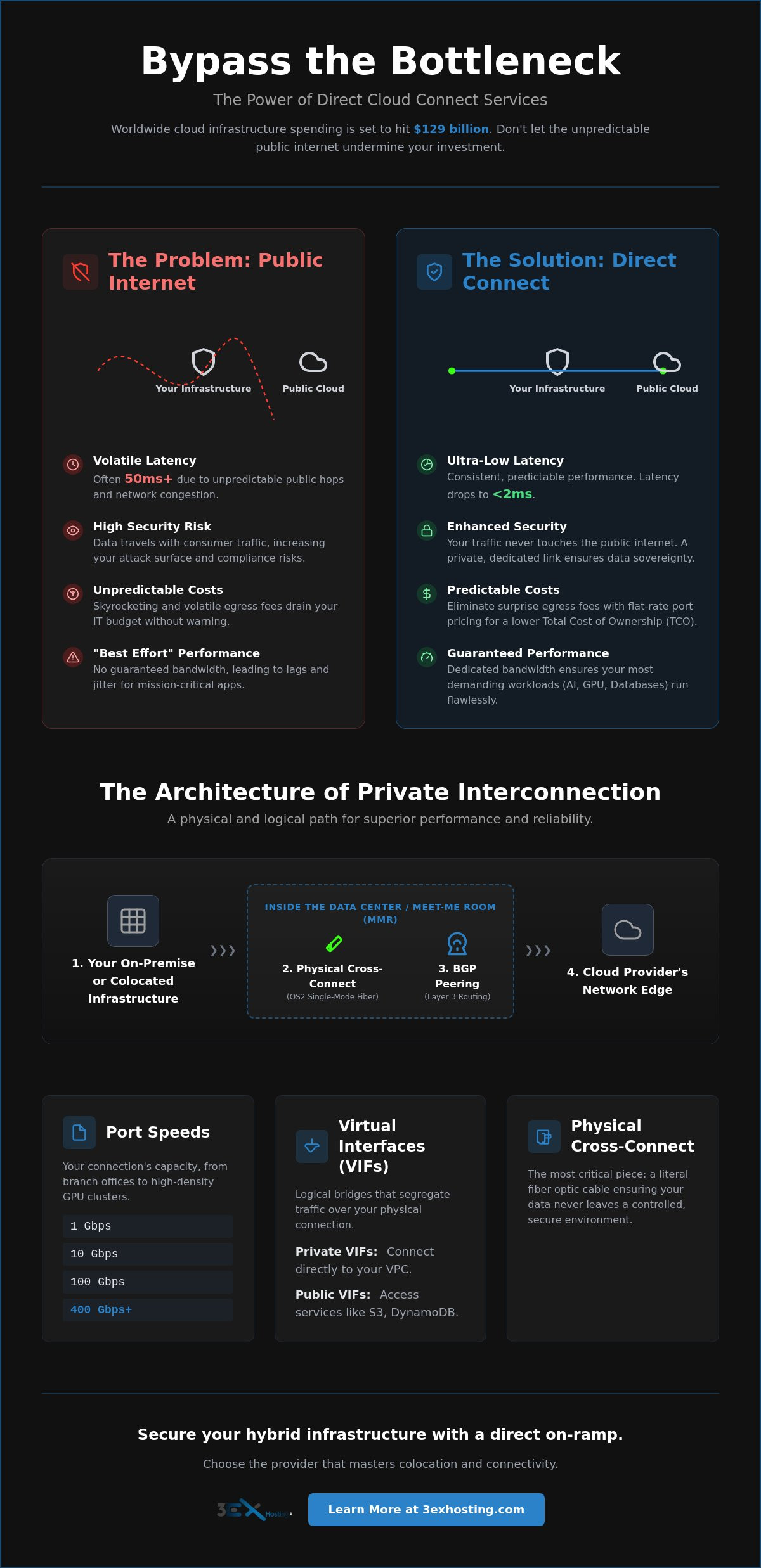
To build a reliable on-ramp, you must understand three physical and logical elements. First, port speeds define your capacity. Current standards range from 1 Gbps for smaller branch offices to 100 Gbps or even 400 Gbps for high-density GPU clusters. Second, the Virtual Interface (VIF) acts as the logical bridge. Private VIFs connect to your VPC, while public VIFs access services like S3 or DynamoDB. Finally, the physical cross-connect is the most critical piece. It’s the patch cable inside the data center that ensures your data never leaves a controlled environment.
Cloud On-Ramps vs. Standard ISP Connections
Standard ISP connections rely on “best effort” delivery. Your data hops through multiple third-party routers, each adding potential latency and security risks. Direct on-ramps provide a deterministic path. This means your latency is fixed and predictable, often dropping from 50ms over the internet to less than 2ms. Bypassing these “public hops” also reduces your attack surface. Since your data isn’t visible on the public web, it’s significantly harder for external actors to intercept or disrupt your traffic. Using a carrier-neutral data center environment gives you the flexibility to switch providers or scale your bandwidth without re-architecting your entire physical setup.
The Architecture of Private Interconnection: How it Works
The physical and logical architecture of direct cloud connect services relies on proximity and precision. It begins with a Point of Presence (PoP) located within a carrier hotel. This is where your infrastructure meets the cloud provider’s network edge. Instead of routing traffic across the open internet, the connection stays within the data center’s walls. This setup provides a controlled environment where bandwidth is guaranteed and latency is minimized. By establishing a direct handoff, you eliminate the dozens of third-party hops that usually introduce jitter and packet loss.
Reliability is built into the configuration through specific redundancy models. Enterprises typically choose between Active/Active or Active/Passive setups. In an Active/Active configuration, traffic balances across two separate physical links to maximize throughput and provide instant failover. If one link fails, the other carries the full load without dropping the session. To manage multiple services over a single physical port, engineers use 802.1Q VLAN tags. This allows you to segment your production traffic, development environments, and storage backups into separate logical paths while maintaining the security of a single dedicated line.
The Physical Layer: Cross-Connects and Meet-Me Rooms
The Meet-Me Room (MMR) is the central hub of a carrier-neutral facility. Fiber optic cables route from your cabinet colocation space directly to the provider’s patch panel. In 2026, the standard for high-performance environments is OS2 single-mode fiber with LC/UPC connectors to ensure minimal signal loss. These low-latency cables are essential for maintaining the sub-2ms performance that defines enterprise-grade connectivity. Every cross-connect must undergo rigorous light level testing. Even microscopic dust on a fiber tip can introduce jitter that degrades application performance. If you need assistance with the physical setup, our remote hands support can manage the cabling and verification for you.
The Logical Layer: Virtual Circuits and Peering
Once the physical link is established, the logical layer takes over. Border Gateway Protocol (BGP) is the standard for dynamic routing. Your routers and the cloud provider’s routers exchange routing information privately. This creates a private routing table that exists entirely outside the global internet’s routing environment. You’ll need an Autonomous System Number (ASN) to identify your network during this process. For modern agility, Software Defined Interconnection (SDI) allows for rapid provisioning. Instead of waiting days for manual configuration, SDI platforms let you spin up or scale virtual circuits in minutes. This logical flexibility ensures your direct cloud connect services adapt to changing workload demands without requiring new hardware upgrades.
Direct Connect vs. VPN: Evaluating Security and ROI
VPNs are a reliable solution for remote workers, but they weren’t designed for the heavy lifting of enterprise hybrid clouds. The public internet operates on a best-effort basis, meaning your data competes with consumer traffic. When you implement direct cloud connect services, you trade this variability for a dedicated, deterministic path. This move effectively eliminates the “cloud egress tax.” Transferring large datasets out of a public cloud over the internet is notoriously expensive. Private links typically offer significantly lower per-GB transfer rates, which can lead to substantial savings for data-heavy organizations.
Security compliance often dictates the shift from virtual tunnels to physical ones. For industries governed by HIPAA or SOC2 standards, routing sensitive data over the public web, even when encrypted, presents an unnecessary risk. A direct connection ensures your traffic stays within a private ecosystem. Performance benchmarks also show a massive gap between the two methods. While a standard VPN often suffers from latency of 50ms or higher, a direct connection consistently stays below 2ms. This stability is vital for real-time AI inference and VoIP systems where even minor jitter or packet loss can cause application failure.
Calculating the Total Cost of Ownership (TCO)
Total Cost of Ownership for data center interconnections includes the combined expenses of monthly port fees, physical cross-connect maintenance, and data egress rates compared against the hidden costs of network downtime. While a VPN has lower upfront costs, the variable nature of internet egress fees makes budgeting difficult. A direct connection provides predictable monthly port fees. This financial clarity, combined with the ROI of improved application uptime and user productivity, makes it the more sustainable choice for scaling enterprises. High-performance teams don’t just look at the monthly bill; they look at the cost of every millisecond of delay.
Security Beyond Encryption
Encryption is the first line of defense, but physical isolation is the ultimate firewall. By removing public endpoints from your network gateway, you drastically reduce your DDoS attack surface. There’s simply no public IP for an attacker to target at the handoff point. Organizations requiring the highest level of protection often choose private data center suites to house their interconnection hardware. This adds a layer of physical security to the logical isolation provided by direct cloud connect services. It ensures that your critical infrastructure is protected from both digital threats and unauthorized physical access.
Strategic Implementation: Integrating Connectivity with Colocation
Successful hybrid cloud strategies in 2026 depend on more than just bandwidth. They require a physical anchor. Integrating direct cloud connect services within a colocation framework allows enterprises to place their most data-intensive hardware right next to the cloud’s doorstep. This proximity is the only way to achieve the deterministic performance required for modern workloads. When your physical servers and your cloud on-ramps exist in the same facility, you eliminate the latency introduced by long-haul carrier circuits. It’s the difference between a network that merely functions and one that drives competitive advantage.
Powering AI with High-Density Colocation and Direct Connect
AI infrastructure is a primary driver for this integration. Training a large language model or a computer vision system requires massive datasets that are often too large to live permanently in the cloud due to storage costs. By using high density GPU colocation, you can keep your training clusters on private hardware while using direct connect to push the resulting models to cloud-based inference engines. This split-architecture approach optimizes costs while maintaining the sub-millisecond response times AI applications demand. Managed cloud hosting providers can then bridge the gap, handling the orchestration between your on-premise GPUs and your cloud-native services. You don’t have to choose between the power of bare metal and the flexibility of the cloud; you can have both through a single private fabric.
Multi-Cloud and Vendor Neutrality
Vendor lock-in remains a significant risk for the modern enterprise. A carrier-neutral facility acts as a neutral ground where you can establish cross-connects to AWS, Azure, and GCP simultaneously. This multi-cloud fabric allows you to move workloads between providers based on cost or feature availability without changing your physical networking. Standardizing your cabinet colocation around a central interconnection hub simplifies your management stack. It gives your team a single point of control for physical and virtual networking. You can leverage direct cloud connect services to create a “best-of-breed” strategy, using one cloud for its AI tools and another for its database capabilities, all while keeping your core data secure in your private cage.
If your current network architecture is struggling to keep up with your AI or multi-cloud demands, it’s time to re-evaluate your physical footprint. Request a customized connectivity audit to see how private on-ramps can streamline your hybrid operations.
Selecting a Direct Cloud Connect Provider: Why 3EX Hosting?
Choosing a provider for direct cloud connect services is a decision that impacts your infrastructure’s long-term stability and performance. At 3EX Hosting, we operate within a carrier hotel environment. This provides a distinct advantage for enterprises requiring sub-millisecond connectivity. Being physically located where the world’s major networks converge means your data travels the shortest possible distance. We eliminate the latency issues that plague off-site data centers. Our facility is designed for high-performance workloads, offering the power density and cooling required for modern AI and GPU clusters.
We offer scalability that grows with your business needs. Whether you start with a single cabinet or require private data center suites, our infrastructure adapts to your requirements. You get the same level of precision and security regardless of your footprint. We focus on the technical details so your team can focus on innovation. Our goal is to provide a stable foundation that makes complex networking feel magisterial and effortless.
Enterprise-Grade Infrastructure and Support
Managing a hybrid network involves complex physical and logical components. 3EX Hosting simplifies this by managing the entire physical cross-connect lifecycle. We ensure every fiber link is tested and verified for peak performance before it goes live. Our remote hands support acts as an extension of your IT team. If a link requires troubleshooting or a hardware component needs a reboot, our on-site technicians are available to assist immediately. This physical support is crucial for maintaining the uptime of your interconnection hardware. For organizations with high compliance needs, we provide custom cage solutions. These ensure your network gateways are physically isolated and protected from unauthorized access.
Ready to Optimize Your Hybrid Cloud?
Transitioning to a new facility doesn’t have to be a bottleneck for your operations. We streamline your deployment through our dedicated move-in assistance. Our team helps coordinate the logistics of enterprise-scale deployments, ensuring your hardware is racked and connected efficiently. You can also consult with our engineers to design a private cloud on-ramp tailored to your specific traffic patterns. We’ll help you select the right port speeds and redundancy models to maximize your ROI. Don’t let public internet limitations hold back your mission-critical applications. Take the next step toward a more secure and predictable network. Get a custom quote for your direct cloud connect needs and see how our infrastructure supports your 2026 growth strategy.
Future-Proof Your Hybrid Infrastructure with Private Interconnection
The transition from virtual tunnels to physical interconnection is a fundamental shift in how modern enterprises manage data. By implementing direct cloud connect services, you eliminate the volatility of the public internet and secure a deterministic path for your most critical AI and database workloads. Private on-ramps reduce latency to sub-millisecond levels while providing a predictable cost structure that avoids the unpredictable egress fees of standard connections. This architecture is the backbone of a high-performance hybrid ecosystem.
3EX Hosting provides the technical foundation you need to scale with confidence. Our carrier-neutral interconnection hub, backed by N+1 redundant infrastructure, ensures your links remain stable and resilient. With 24/7/365 Remote Hands Support, our technicians are always on-site to maintain your physical cross-connects and troubleshoot hardware issues. It’s time to move beyond the limitations of standard networking and build a private gateway that supports your long-term growth. Request a Custom Interconnection Quote today to optimize your hybrid cloud performance. Your infrastructure is in expert hands.
Frequently Asked Questions
Is Direct Cloud Connect more secure than a VPN?
Direct cloud connect is inherently more secure than a VPN because it eliminates the public internet as a transport medium. While a VPN relies on encryption to protect data crossing public routers, a direct link provides physical isolation. This removes your data from the visibility of public-facing scanners and reduces the risk of DDoS attacks. It’s the difference between a locked car on a public highway and a private armored transport on a dedicated road.
How long does it take to provision a direct cloud connection?
Provisioning times vary based on the interconnection model you choose. A physical cross-connect in a carrier hotel typically takes 2 to 5 business days for cable routing and light testing. However, once the physical port is active, logical virtual circuits can often be provisioned in minutes through software-defined platforms. Planning for a one-week window ensures all physical and logical components are properly verified before production traffic begins.
Can I connect to multiple cloud providers over a single physical port?
Yes, you can reach multiple cloud providers through a single physical port using 802.1Q VLAN tagging. This allows you to segment your direct cloud connect services into separate logical paths for AWS, Azure, and Google Cloud. Each provider receives a unique VLAN ID, ensuring traffic remains isolated while sharing the same high-speed fiber link. This multi-cloud architecture reduces your hardware footprint and simplifies overall network management.
What is the difference between a hosted connection and a dedicated connection?
A dedicated connection provides a physical port assigned exclusively to your organization, supporting speeds up to 100 Gbps or 400 Gbps. A hosted connection is provisioned through a network partner who shares their physical port capacity with multiple customers. Hosted options are ideal for lower bandwidth requirements, while dedicated ports offer maximum control and higher throughput for data-intensive AI workloads.
Do I need my own ASN (Autonomous System Number) for direct connect?
You generally need a public or private Autonomous System Number (ASN) to establish Border Gateway Protocol (BGP) peering. A public ASN is required if you’re announcing your own IP ranges to the public cloud. If you don’t have a registered ASN, many direct cloud connect services allow the use of private ASNs for internal routing between your data center and the cloud VPC.
How does direct connect affect my cloud egress billing?
Implementing a direct connection significantly reduces your data transfer out (DTO) costs. For example, AWS Direct Connect egress rates in the US East region are verified at $0.02 per GB, which is substantially lower than standard internet egress fees. These savings often offset the monthly port fees for organizations transferring more than a few terabytes of data monthly, making the return on investment clear for data-heavy hybrid environments.
What happens if the physical fiber link for my direct connect fails?
If a single physical fiber link fails, your connection will drop unless you’ve configured a redundant path. We recommend an Active/Active setup where traffic is balanced across two separate physical cross-connects on diverse hardware. If one link is severed, the BGP session automatically reroutes all traffic to the remaining link. This N+1 redundancy is essential for mission-critical applications that cannot tolerate even a few seconds of downtime.
Is direct cloud connect available for small businesses or just enterprises?
While often associated with large corporations, these services are available and beneficial for any business with strict latency or security requirements. Small businesses using hosted connections can access private on-ramps at lower bandwidth tiers without the cost of a full dedicated port. If your operations rely on real-time data synchronization or sensitive client information, the stability and security of a private link often outweigh the initial setup costs.