 SUPPORT


 3EX United States
 Blog
Can your enterprise infrastructure truly scale when your data is forced to take the long way around? For many growing companies, the primary bottleneck isn’t the server hardware; it’s the physical distance between their applications and the global network fabric. Understanding the benefits of a carrier hotel is the first step toward eliminating high public IP transit costs and the unpredictable latency that degrades application performance.
You likely recognize that relying on a single network provider limits your flexibility and leaves you vulnerable to price hikes. This article shows how these specialized facilities transform your network from a cost center into a high-speed engine for growth. You’ll discover how carrier neutrality and dense interconnection ecosystems provide the low-latency performance and cost-efficiency essential for modern enterprise scaling. We will explore the technical advantages of meet-me rooms and why moving closer to the network core is the most effective way to future-proof your digital operations.
Key Takeaways
- Learn how the Meet-Me-Room (MMR) functions as the central hub for global network interconnection and carrier neutrality.
- Understand how physical proximity to network backbones eliminates unnecessary hops to ensure sub-millisecond latency for real-time applications.
- Discover the primary economic benefits of a carrier hotel, including the elimination of last-mile loop charges through direct cross-connect services.
- Identify the critical N+1 and 2N power redundancy protocols that guarantee maximum uptime for enterprise-grade infrastructure.
- Evaluate whether full cabinet colocation or private suites provide the necessary density and security for your specific scaling requirements.
What is a Carrier Hotel? The Nexus of Global Connectivity
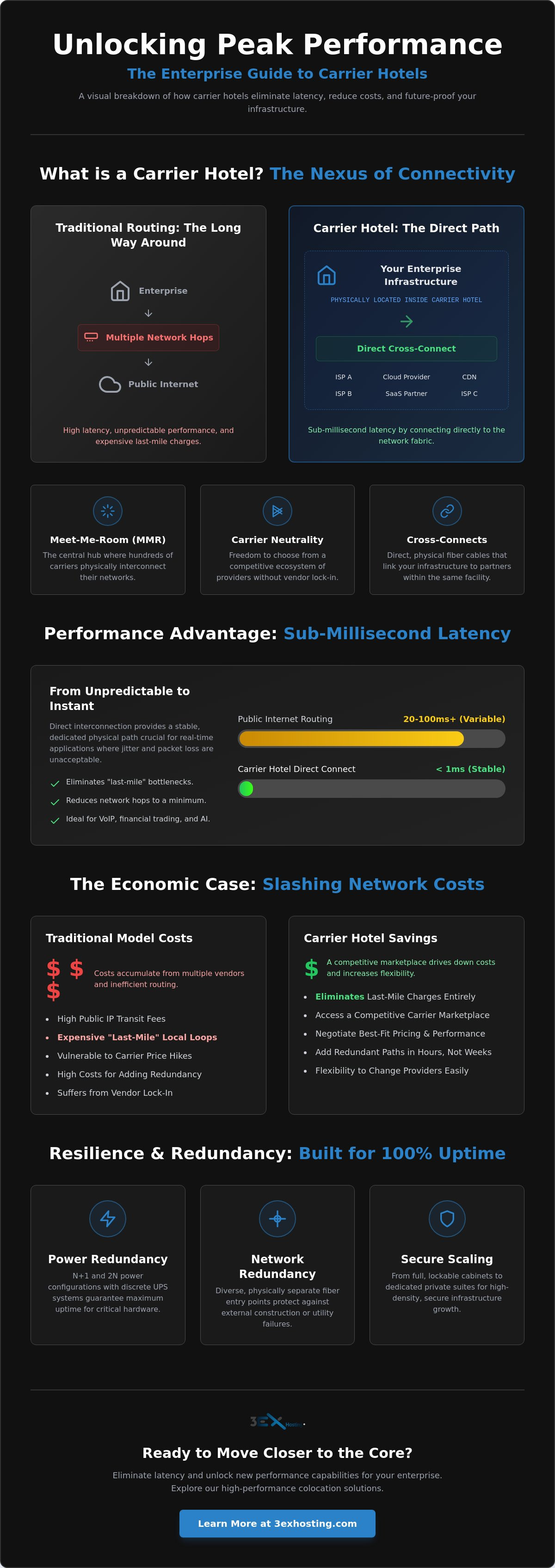
A carrier hotel is a specialized colocation center designed specifically to facilitate the physical interconnection of hundreds of telecommunications carriers. While a standard data center focuses primarily on server storage and power, a carrier hotel prioritizes the network fabric. It functions as a neutral ground where ISPs, content delivery networks (CDNs), and global enterprises meet to exchange traffic. One of the primary benefits of a carrier hotel is the ability to bypass the public internet for critical data transfers, moving traffic directly between networks via physical cabling.
At the core of this facility sits the Meet-Me-Room (MMR). This is a highly secure, managed space where different network operators terminate their fiber optic lines. Within the MMR, a simple cross-connect cable replaces miles of public infrastructure. This direct physical link eliminates the “last mile” latency and high costs associated with traditional local loops. Carrier neutrality is the foundational requirement here. It ensures the facility owner doesn’t favor one provider over another, giving you the freedom to negotiate the best rates and performance profiles for your specific needs.
The Anatomy of an Interconnection Hub
Physically, these facilities are built for extreme network density. They feature high-capacity cable trays and specialized fiber distribution frames designed to manage thousands of individual connections. Unlike a standard enterprise facility, a carrier hotel utilizes diverse fiber entry points. These are separate physical paths where cables enter the building from the street. This design ensures that a single construction accident or utility failure won’t sever your entire network connection. For companies requiring dedicated, secure space within this environment, full cabinet colocation provides the necessary power and cooling to support high-performance networking hardware.
The Power of the Provider Ecosystem
The value of a carrier hotel grows as more providers join the facility. This creates a network effect where the sheer volume of available carriers drives down costs and increases performance options. A carrier hotel is a high-density facility where providers peer to exchange traffic directly. By placing infrastructure in a private colocation suite within this ecosystem, enterprises gain instant access to hundreds of potential partners. This density is critical for modern scaling. It prevents vendor lock-in and allows you to switch carriers or add redundant paths in hours rather than weeks. The strategic benefits of a carrier hotel lie in this flexibility; you choose the best provider for every specific route or region your business touches.
Performance Advantages: Minimizing Latency for Mission-Critical Loads
Speed is a physical constraint. Data cannot travel faster than the speed of light, and every router it passes through adds delay. One of the primary benefits of a carrier hotel is the reduction of these “hops” by placing your hardware directly at the source of the network backbones. Each hop represents a router that must inspect a packet, decrement its time-to-live, and perform a routing table lookup. By eliminating several of these intermediate steps, you shave off precious milliseconds. This proximity ensures that mission-critical loads, such as financial trading platforms or VoIP services, maintain the highest possible quality of service without the lag inherent in standard colocation.
Low latency isn’t just about raw speed; it’s about consistency. Public internet routing is often unpredictable. Packets might take different paths depending on external congestion or BGP shifts. In a carrier hotel, direct cross-connects provide a dedicated physical path. This stability is vital for real-time applications where jitter or packet loss can cause immediate service interruptions. Understanding the benefits of a carrier hotel helps engineers design more resilient architectures that don’t rely on the “best effort” nature of public transit. Direct interconnection allows for better control over the routing path, enabling engineers to select routes based on performance rather than just the lowest cost.
Connectivity for High-Density GPU Hosting
Modern AI training and large-scale data processing require massive throughput and specialized power profiles. These workloads generate immense amounts of data that must move between storage and compute nodes without delay. Standard data centers often lack the network density and the high-kilowatt power cooling required to support these high-bandwidth requirements. Utilizing full cabinet colocation within a carrier hotel environment allows you to leverage direct cloud on-ramps. This setup eliminates bottlenecks, ensuring your GPU clusters remain fully utilized rather than waiting for data to arrive over a congested link. It’s a strategic move for companies scaling AI infrastructure who need to avoid the performance penalties of the public internet.
Direct Interconnection vs. Public Transit
The technical difference between peering via a cross-connect and routing over the open internet is night and day. Public transit involves multiple third-party networks, each adding its own latency and potential points of failure. In contrast, a cross-connect is a direct fiber link within the same building. This physical connection drastically reduces jitter, which is the variation in packet arrival times that causes “choppy” audio in VoIP or lag in streaming. In high-frequency data environments, a 1-millisecond reduction in latency can determine the success or failure of thousands of automated trades during peak market volatility. If you are ready to optimize your network path, consider exploring a data center Miami location to anchor your infrastructure.
The Economic Case: Reducing Costs through Cross-Connect Services
Traditional enterprise networking often involves high recurring costs for “last mile” connectivity. This refers to the physical link between your office or a remote data center and the nearest carrier point of presence. These local loop charges represent a significant portion of many IT budgets. By placing your infrastructure in a facility where carriers already reside, you eliminate these middleman fees entirely. This direct access is among the most tangible financial benefits of a carrier hotel, as it replaces expensive leased lines with simple, cost-effective physical cables within the same building.
The presence of dozens, or even hundreds, of providers in a single space creates a hyper-competitive marketplace. When multiple carriers compete for your traffic, pricing becomes transparent and aggressive. You aren’t beholden to the rates of a single incumbent provider. Instead, you can leverage this density to negotiate better transit rates and peering agreements. The long-term ROI of this strategy is clear. While public bandwidth costs often scale linearly with usage, the cost of a cross-connect remains relatively flat. This allows you to grow your data throughput without a corresponding spike in your monthly bill.
Understanding Cross-Connect Services
At its simplest level, cross-connect services are the physical fiber or copper links between your hardware and a provider’s network port. Because these connections happen within the facility’s meet-me room, they bypass the congestion and unpredictability of the open internet. This private peering offers a much lower cost-per-megabit than standard IP transit. To identify potential savings, enterprises should audit their current transit costs and identify high-traffic routes. Often, shifting just 20% of your most intensive traffic to a direct cross-connect can pay for the entire colocation footprint within a matter of months.
Carrier Neutrality as a Financial Lever
Vendor lock-in is a common trap. If you rely on a facility owned by a specific carrier, moving to a competitor often requires a full physical relocation of your hardware. Carrier-neutral facilities remove this barrier. You have the power of choice. If a provider’s service quality drops or their prices rise, you simply request a new cross-connect to a different carrier in the same room. This flexibility is one of the core benefits of a carrier hotel, ensuring your infrastructure stays agile. You can scale bandwidth rapidly to meet seasonal demands or new project requirements without waiting for external infrastructure overhauls or construction. This ability to switch providers without moving hardware is the ultimate hedge against rising connectivity costs.
Redundancy and Resilience in Enterprise Data Centers
Infrastructure uptime isn’t a luxury; it’s a baseline requirement for modern enterprise operations. Carrier hotels are engineered with N+1 or 2N power redundancy as a standard. This means every critical component has at least one backup, and in 2N configurations, the entire power path is mirrored from the utility feed to the rack. If a primary power source fails, uninterruptible power supplies (UPS) and onsite generators engage immediately. One of the key benefits of a carrier hotel is this inherent reliability that standard office buildings or smaller private data centers simply can’t replicate without massive capital expenditure.
Network resilience is equally robust due to the physical diversity of the facility. In a typical office, a single fiber cut in the street can take your entire business offline for days. Within a carrier hotel, your infrastructure is connected to a diverse ecosystem of providers entering the building through multiple physical points. If one carrier experiences an outage, your systems can failover to a secondary provider instantly. This multi-homed approach ensures your applications remain accessible even during major regional network events or provider-specific technical failures. The strategic benefits of a carrier hotel include this level of disaster recovery readiness that is built directly into the floor plan.
Environmental Controls and Infrastructure Stability
High-density enterprise racks generate concentrated heat that standard air conditioning units can’t dissipate. Carrier hotels utilize precision cooling systems that maintain constant temperature and humidity levels, which significantly extends the lifespan of your hardware. These facilities also feature advanced fire suppression systems, such as Very Early Smoke Detection Apparatus (VESDA), which identifies potential issues before they become catastrophic. Aligning your hardware with managed IT infrastructure strategies ensures your cooling and power requirements are always met as your compute needs grow.
The Role of Remote Hands Support
Maintaining 100% uptime often requires physical intervention, but your engineering team shouldn’t have to travel for every routine task. Professional remote hands support acts as an extension of your staff, providing 24/7 assistance for hardware troubleshooting, cable management, and server reboots. This service is backed by rigorous physical security protocols. Access to your equipment is protected by multiple layers, including biometric scanners, man-traps, and continuous video monitoring. These documented security measures help your business maintain compliance with SOC2 or HIPAA requirements without the overhead of managing your own secure facility. If you need a stable environment for your mission-critical loads, request a quote for our Miami colocation services today.
Implementation: Moving to a High-Performance Carrier Hotel
Transitioning your core infrastructure into a carrier-neutral environment requires more than just moving hardware. It’s a strategic shift. Successful implementation begins with a comprehensive audit of your current network footprint and a realistic projection of your growth over the next 24 to 36 months. One of the primary benefits of a carrier hotel is its ability to scale alongside your business, but this scalability is only effective if your initial deployment handles your power and cooling requirements from day one. Proper planning ensures that your migration provides the performance gains you expect without mid-project delays.
Enterprises typically choose between full cabinet colocation for standard production environments or private colocation suites for deployments requiring higher levels of physical isolation. To minimize migration downtime, leveraging professional move-in assistance is essential. These specialists manage the logistics of hardware transport and rack installation, allowing your internal engineers to focus on logical configuration and network peering. Developing a cross-connect strategy before the move ensures that your connections to ISPs and cloud providers are pre-provisioned and ready for testing immediately upon hardware installation.
Evaluating Colocation Options
For organizations with strict compliance or security requirements, cage solutions offer enhanced physical sovereignty within the shared data center floor. This setup provides a dedicated, fenced area that prevents unauthorized physical access to your racks. As you plan your deployment, consider how your physical hardware will integrate with managed cloud services. A hybrid approach allows you to keep latency-sensitive data on-site while offloading elastic workloads to the cloud. Always verify that your chosen space can support high-density power requirements, especially if you’re deploying AI-focused GPU clusters that demand specialized cooling and power distribution.
Next Steps for Enterprise Scaling
The final phase of implementation involves verifying the facility’s ecosystem. Conduct a site audit or a virtual tour to inspect the meet-me room and the diversity of fiber entry points. Request a detailed interconnection map to confirm that your preferred carriers are present and available for cross-connects. This transparency is one of the enduring benefits of a carrier hotel, providing the choice and flexibility needed for long-term stability. If you’re ready to optimize your network performance and reduce transit costs, get a custom colocation quote tailored to your enterprise infrastructure needs today.
Scaling Your Infrastructure at the Speed of the Network
Modern enterprise growth depends on a network that can keep pace with increasing data demands and shrinking latency tolerances. By positioning your hardware within a carrier-neutral ecosystem, you gain the agility to switch providers and scale bandwidth without physical relocation. This strategic placement eliminates last-mile bottlenecks and high transit fees, transforming your connectivity into a competitive asset rather than a recurring overhead cost.
The operational benefits of a carrier hotel extend beyond raw speed. You gain peace of mind through N+1 power redundancy and the expertise of 24/7/365 remote hands support, ensuring your mission-critical systems remain online regardless of external conditions. This combination of technical stability and network choice provides the foundational resilience needed for future-proof scaling. Don’t let physical distance or limited provider options slow your digital progress. It’s time to move your infrastructure to the core of the global network fabric.
Secure your high-performance infrastructure with a custom colocation quote today and build your future on a foundation of reliability and expert support.
Frequently Asked Questions
What is the difference between a carrier hotel and a standard data center?
A carrier hotel functions as a specialized interconnection hub where network density is the primary focus, whereas a standard data center often prioritizes server storage and power distribution. The main distinction lies in the Meet-Me-Room (MMR), which allows for direct physical peering between hundreds of different service providers. This architecture is designed specifically to facilitate low-latency traffic exchange and massive network diversity.
How does a carrier hotel reduce my monthly internet and transit costs?
Carrier hotels reduce costs by eliminating expensive “last mile” local loop charges from traditional telecommunication providers. By connecting directly to a carrier via a cross-connect within the facility, you bypass the fees associated with bringing a circuit into your building. This direct access is one of the primary benefits of a carrier hotel, as it replaces high recurring transit costs with flat-rate physical connections.
Is a carrier hotel more secure than an on-premise server room?
Yes, these facilities offer significantly higher security than most on-premise server rooms through multi-layered physical protocols. Carrier hotels utilize biometric access, man-traps, and 24/7/365 video surveillance to protect the infrastructure. Additionally, the N+1 or 2N power redundancy ensures that your systems remain operational during utility failures, a level of resilience that is difficult and costly to maintain in-house.
What are cross-connects and why are they important in a carrier hotel?
Cross-connects are dedicated physical cables, usually fiber or copper, that link your hardware directly to a service provider’s network in the Meet-Me-Room. They are important because they provide a private, high-speed path that bypasses the public internet. This direct link results in lower latency, reduced jitter, and improved security for mission-critical data transfers between your enterprise and your partners.
Can I choose any provider I want in a carrier-neutral facility?
In a carrier-neutral facility, you have the absolute freedom to select any provider that has a presence in the building. This neutrality prevents vendor lock-in and allows you to negotiate competitive rates based on your specific performance requirements. If a provider’s service quality declines, you simply request a new cross-connect to a different carrier without the need to physically move your servers.
What happens if one carrier in the hotel goes down?
If a single carrier experiences an outage, your infrastructure can failover to a secondary provider instantly through a multi-homed network configuration. Carrier hotels host hundreds of ISPs and backbones, making it easy to maintain redundant paths. This high level of network resilience ensures your applications stay online even if a major global provider faces technical difficulties or a physical fiber cut.
Are carrier hotels suitable for small businesses or just large enterprises?
While large enterprises often use them, carrier hotels are highly suitable for small businesses with high-performance or scaling requirements. Options like full cabinet colocation allow smaller organizations to access the same global network fabric and redundancy as major corporations. This professional environment provides a stable foundation for growth, ensuring that connectivity issues don’t hinder the user experience as the business expands.
How do I migrate my existing hardware into a carrier hotel facility?
Migration begins with a thorough audit of your current network requirements and power needs. You should then choose the appropriate colocation model, such as a private suite or cabinet, and utilize professional move-in assistance to handle the physical logistics. Pre-provisioning your cross-connect services before the actual move ensures that your network is ready for testing the moment your hardware is installed in the rack.