 SUPPORT


 3EX United States
 Blog
With US data center vacancy rates hitting a record low of 1.4% and next-generation AI racks demanding up to 370kW, finding the right facility in South Florida is no longer just about floor space. It’s about securing a specialized enterprise data center Miami that can handle the massive thermal loads of GPU clusters without compromising on safety. You know that bridging the gap to Latin American markets requires more than just a local presence; it demands a strategic interconnection point that can withstand a Category 5 hurricane while maintaining 100% uptime.
We understand the complexity of balancing high-density power requirements with the strict new standards of Florida’s SB 484 regulations. This guide will teach you how to evaluate liquid cooling readiness, global connectivity fabrics, and disaster recovery protocols for 2026. We’ll walk through the technical specifications needed to achieve sub-millisecond latency for international traffic and future-proof your infrastructure for large-scale AI deployment. You’ll gain a clear roadmap for selecting a partner that offers the technical stability and speed your mission-critical workloads require.
Key Takeaways
- Understand how Miami’s access to over 40 subsea cables creates a low-latency gateway for global traffic.
- Identify the power specifications an enterprise data center Miami must meet to support high-density 20kW to 50kW AI configurations.
- Compare the economic benefits of carrier-neutral facilities and how cross-connect services reduce latency by bypassing local loops.
- Verify essential disaster recovery standards, including Category 5 wind ratings and fuel autonomy, to ensure 100% uptime during storm seasons.
- Learn how modular infrastructure and private suites provide the flexibility needed to scale your hardware as demand grows.
Defining the Strategic Role of an Enterprise Data Center in Miami
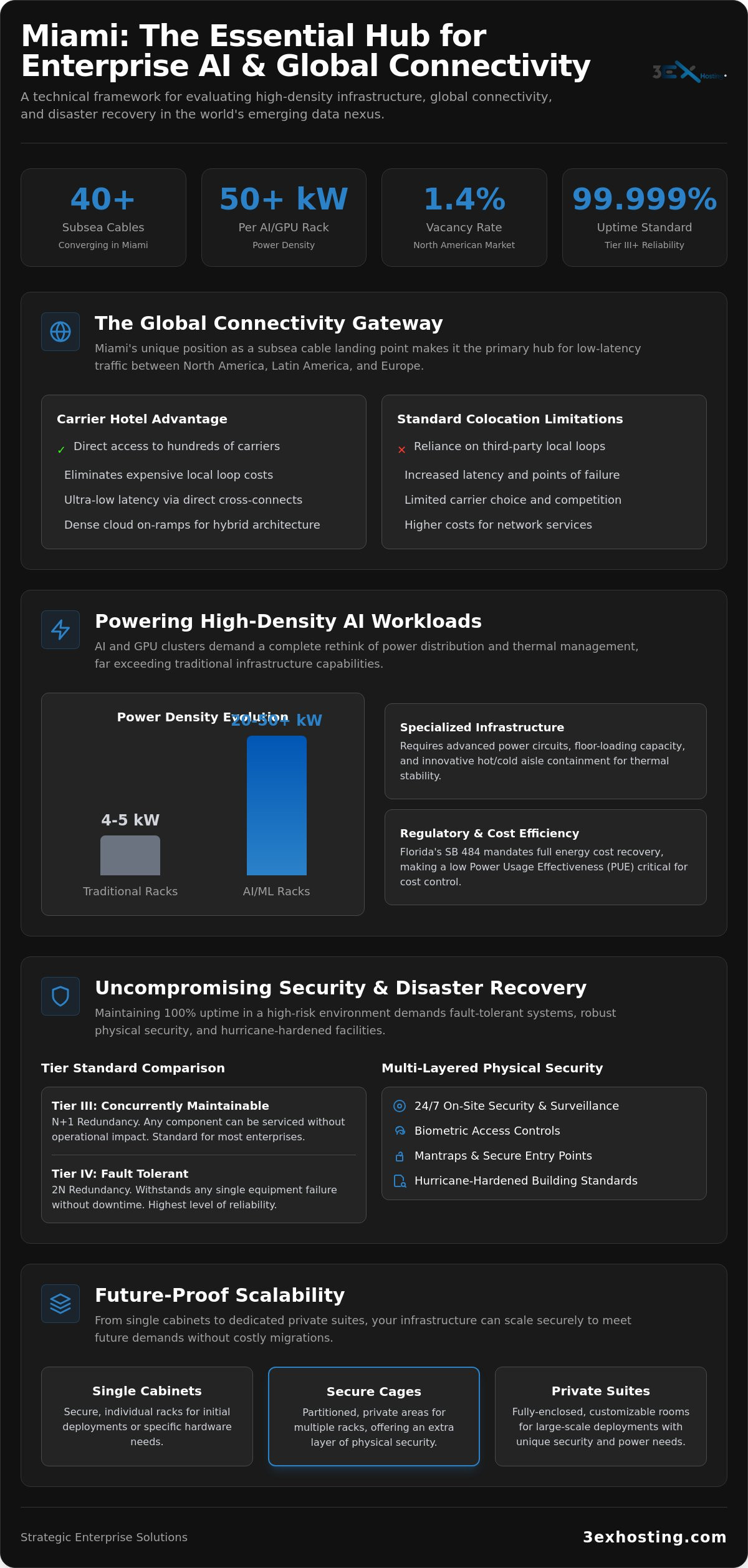
Miami serves as the primary digital gateway for the Western Hemisphere. An enterprise data center Miami acts as a high-security hub for mission-critical IT infrastructure, bridging the gap between North American markets and Latin America. This region is a landing point for over 40 subsea cables. These cables ensure that data traveling between continents finds the shortest path possible. This geographic advantage has transformed the city; it’s no longer just a transit point, but a global nexus for AI, finance, and high-end digital media. To see how local companies leverage this infrastructure for professional events, learn more about Miami Video Production and their livestreaming capabilities.
Enterprises often distinguish between “Carrier Hotels” and standalone facilities. A carrier hotel is a facility where a high concentration of network providers meet; it’s the core of national network architecture. Standalone facilities might offer more privacy but often rely on these hotels for global reach. Modern infrastructure requires more than just floor space. It requires a resilient data center environment designed for the complexities of 2026. You need a partner that understands the shift toward high-density workloads and global interconnection.
The Gateway Effect: Why National Enterprises Choose Miami
National enterprises choose Miami to slash latency for North-South trade routes. If your digital services target Brazil, Colombia, or Mexico, hosting in Miami is the only way to achieve the lowest possible round-trip times. It’s also a strategic location for disaster recovery. Companies on the Northeast or West Coast use Florida as a geographically distinct site to ensure continuity during regional outages. You get direct access to a dense ecosystem of cloud on-ramps. This means your private infrastructure connects directly to major public clouds, which bypasses the public internet and improves security.
Tier III vs. Tier IV Standards for Enterprise Reliability
Reliability is measured by Tier standards. A Tier III facility offers concurrent maintainability. This means any component can be removed for service without shutting down the system. Tier IV takes this further with fault tolerance. The system remains active even during a major technical failure. For most enterprises, 99.999% uptime is the non-negotiable baseline for digital operations.
Redundancy must be at least N+1 for power and cooling. This ensures that if one unit fails, another is ready to take the load immediately. Physical security is equally critical. Look for protocols that include biometric scanners, mantraps, and 24/7 on-site surveillance. Whether you’re looking at private data center suites or cage solutions, these standards protect your hardware from both digital and physical threats. It’s about peace of mind.
High-Density Power and Cooling Requirements for AI Workloads
Standard data centers were built for 4kW to 5kW racks. That reality is gone. Modern AI and machine learning workloads now push power requirements toward 20kW to 50kW per rack. Selecting an enterprise data center Miami requires a deep dive into the facility’s ability to provide this density without sacrificing stability. You cannot run next-generation hardware on legacy power grids. It’s a technical bottleneck that stops scaling before it begins.
Power Usage Effectiveness (PUE) is the standard metric for measuring this efficiency. In the humid climate of South Florida, a low PUE indicates a facility that manages cooling with precision. This is not just about sustainability; it’s about operational cost and hardware longevity. High-density environments often utilize hot and cold aisle containment to prevent air mixing. For the most demanding GPU clusters, liquid cooling is becoming the standard. Direct-to-chip or immersion solutions handle the thermal output of chips like the H100 or the new B200 Blackwell clusters far more effectively than traditional air cooling.
Redundancy remains the cornerstone of reliability. A robust facility provides a multi-layered power architecture. This includes Uninterruptible Power Supply (UPS) systems for immediate backup and heavy-duty diesel generators for long-term outages. Large-scale fuel reserves are essential for maintaining uptime during extended utility failures. Integrating these systems into your IT disaster recovery plan ensures that even during peak storm seasons, your data remains accessible. Reliable power is the heartbeat of your digital operation.
Supporting GPU Hosting and AI Infrastructure
Deploying high density GPU colocation involves more than just plugging in servers. These racks are significantly heavier than standard hardware. You must verify floor weight capacities and specialized power distribution units (PDUs). Integrating these dedicated GPU servers with legacy enterprise databases requires high-bandwidth, low-latency internal networking. Managing the extreme thermal loads of modern AI clusters is a technical challenge that requires precision engineering and constant monitoring.
Scalability Through Full Cabinet Colocation
Choosing full cabinet colocation gives you total control over airflow management and physical hardware security. It’s the most effective way to implement custom containment strategies. Many enterprises now prefer metered power. It’s a transparent model where you pay for actual consumption instead of a fixed cap. This flexibility is vital for “Day 2” growth. You can add adjacent cabinets as your AI projects scale without needing to re-architect your entire network. If you need to evaluate your current power needs, you can get a quote to see how these high-density solutions fit your technical roadmap.
Connectivity Ecosystems: The Carrier Hotel vs. Standard Colocation
Choosing between a carrier hotel and standard colocation depends on your specific traffic requirements. A carrier hotel acts as a central nervous system where numerous network providers converge. For an enterprise data center Miami, being carrier-neutral is a significant economic advantage. It prevents carrier lock-in; this allows you to switch providers based on performance and price. You aren’t forced into one vendor’s ecosystem. This flexibility is vital for maintaining a competitive edge in a fast-moving digital market.
Meet-Me-Rooms (MMR) are where these connections happen. A high-quality facility will offer MMR diversity. This means having multiple physical rooms for network interconnection. If one room experiences a failure, your traffic remains active through the other. Internet Exchange Points (IXPs) also play a role. They allow national enterprises to peer with other networks directly. This optimizes routing and lowers costs by keeping traffic local. While network performance is the focus here, compliance remains the foundation. The Florida statute on disaster recovery establishes strict expectations for business continuity and plan testing. This legal framework ensures that the connectivity you rely on is backed by verified recovery protocols.
The Strategic Value of Cross-Connect Services
Cross-connect services are direct physical links between two points within the same facility. They eliminate the need for expensive local loops. For real-time AI inference or high-frequency trading, every millisecond counts. Cross-connects reduce latency to the absolute minimum. They also provide direct cloud on-ramps. You can connect your private racks to AWS, Azure, or Google Cloud without using the public internet. This improves both speed and security. Compared to traditional telco circuits, cross-connects are significantly cheaper and easier to manage. If you need to assess your network options, look into data center services that prioritize carrier diversity.
Carrier Neutrality and Network Redundancy
Avoiding carrier lock-in is essential for long-term flexibility. If a provider raises prices or their performance drops, you can easily migrate your traffic to a competitor. To maximize this, implement Border Gateway Protocol (BGP). BGP allows for automated failover across multiple carriers. If one network goes down, your traffic automatically reroutes through another active path. Diverse fiber entry points are also critical. You need fiber coming into the building from different physical directions. This protects your connectivity from accidental line cuts during construction or street work. It’s a simple step that prevents massive downtime.
Compliance and Disaster Recovery in High-Risk Environments
Operating an enterprise data center Miami requires more than just high-density power; it demands a rigorous approach to risk mitigation. Regulatory compliance is the foundation of any enterprise deployment. Frameworks such as SOC 2 Type II, HIPAA, and PCI DSS are non-negotiable for financial, healthcare, and federal sectors. These certifications verify that a facility maintains strict controls over data access and physical security. In Florida, the regulatory landscape also includes SB 484, which as of July 2026, imposes new requirements on large-scale data centers regarding infrastructure costs and foreign ownership restrictions. For organizations that also manage local logistics or transportation fleets, coordinating with a Miami CDL/DOT Physical Exam Center ensures that personnel meet FMCSA health and safety standards. Staying compliant means choosing a partner that understands these legal shifts and maintains transparent auditing processes.
Hurricane hardening is the most critical physical requirement in South Florida. You must evaluate a facility based on its ability to withstand Category 5 wind speeds and its elevation relative to storm surge projections. High-tier facilities are built with reinforced concrete and specialized roofing systems designed for extreme weather. Fuel autonomy is equally vital. Top-tier providers maintain on-site diesel reserves capable of powering the entire facility for several days during a total grid failure. This autonomy ensures that your mission-critical apps remain online even when the surrounding region is dark. Implementing immutable backups and air-gapped storage within your environment adds a final layer of protection against both natural disasters and ransomware attacks.
Maintaining Business Continuity During Regional Events
You need to choose a risk profile that matches your application’s criticality. N+1 redundancy offers concurrent maintainability, while 2N redundancy provides two entirely independent power and cooling systems. For mission-critical workloads, 2N is the gold standard. Leading facilities also manage a prioritized fuel supply chain, ensuring they receive deliveries even during state-wide emergencies. Utilizing disaster recovery solutions integrated directly into the data center fabric allows for seamless failover between primary and secondary sites. This regional resilience is a cornerstone of a national infrastructure strategy.
Data Sovereignty and Private Colocation
For sensitive enterprise data, private suites offer the highest level of sovereignty. These suites provide physical separation from other tenants, which is often a requirement for strict federal or financial audits. Unlike shared cage environments, a private suite allows for custom access control systems and dedicated surveillance. If a full suite exceeds your current needs, custom cage solutions still provide hardware-level security and restricted access. These options ensure that your physical infrastructure is as secure as your digital perimeter. If your current disaster recovery plan lacks these safeguards, you can request a technical audit to secure your mission-critical assets.
Scaling Infrastructure with 3EX Hosting Solutions
3EX Hosting stands as a premier carrier hotel and high-density colocation specialist. When selecting an enterprise data center Miami, you aren’t just buying floor space; you’re investing in a technical partnership. We provide customizable infrastructure that scales alongside your growth. This ranges from single cabinet deployments to expansive private data center suites. Each solution is specifically engineered to handle the high-density power requirements and thermal loads of modern AI clusters. You get the stability of a Tier III environment with the flexibility of a carrier-neutral facility.
Managing off-site hardware is a significant logistical challenge for national IT teams. The ROI of remote hands support becomes clear when you calculate the cost of flying a senior engineer to Miami for a hardware reset or cable swap. Our on-site technicians act as your eyes and ears on the ground. They handle everything from basic power cycles to complex hardware troubleshooting and component replacements. This service ensures your team stays focused on high-level strategy while we maintain the physical layer. Migration is also simplified through our move-in assistance, which covers hardware deployment and initial rack-and-stack setup.
Managed Infrastructure and 24/7 Technical Support
You can leverage our expert technicians for cabling, labeling, and hardware troubleshooting around the clock. This provides peace of mind, knowing that 24/7 on-site security and engineering teams are monitoring the facility. We don’t just provide space; we provide a secure environment where your systems are protected from both physical and digital threats. For organizations pursuing a hybrid IT strategy, our managed cloud hosting can augment your physical colocation. This creates a seamless bridge between your legacy databases and modern, cloud-native applications.
Future-Proofing Your Enterprise Footprint
Building a scalable foundation is essential for AI, big data, and global interconnection. You need a partner that understands the nuances of the Florida infrastructure landscape and the strict requirements of SB 484. We ensure your footprint is ready for the next generation of hardware without needing a total network re-architecture. As your data needs grow, our facility provides the power density and cooling capacity to keep pace. Your next step is to define your technical requirements and see how our infrastructure fits your roadmap. Get a custom quote for your enterprise deployment today and secure your position in the Miami gateway.
Securing Your Digital Gateway in South Florida
Selecting the right enterprise data center Miami is a strategic decision that impacts your global latency and AI scaling capabilities for years to come. You’ve seen how the shift toward 50kW rack densities requires specialized cooling and how carrier neutrality prevents expensive vendor lock-in. Success in this region depends on a facility that balances high-performance connectivity with the physical resilience needed for hurricane season. It’s about ensuring your mission-critical infrastructure remains stable while your traffic moves at the speed of light.
3EX Hosting provides the technical foundation you need to thrive in this complex environment. Our carrier-neutral facility offers direct access to 100+ providers and features N+1 power and cooling redundancy for maximum uptime. With 24/7 on-site remote hands and security teams, your hardware is always in expert hands; even when your primary IT team is across the country. You don’t have to compromise on speed or safety. Request a custom enterprise colocation quote today to begin your deployment. We’re ready to help you build a resilient, future-proof footprint in the heart of Miami’s digital hub.
Frequently Asked Questions
What is the difference between a standard data center and a carrier hotel in Miami?
A carrier hotel is a specialized interconnection hub where a high concentration of network providers converge to exchange traffic. While a standard data center provides rack space and cooling, a carrier hotel offers superior access to global subsea cables and hundreds of carriers. This density makes carrier hotels the core of Miami’s digital infrastructure, providing lower latency and more competitive bandwidth pricing for international enterprises.
How does an enterprise data center in Miami support AI and GPU-intensive workloads?
High-density support is achieved through specialized power distribution and cooling systems designed for 20kW to 50kW per rack. An enterprise data center Miami must utilize hot and cold aisle containment or direct-to-chip liquid cooling to manage the extreme thermal output of GPU clusters. These facilities also provide the reinforced floor weight capacity required for heavy AI hardware stacks and high-performance networking fabrics.
What compliance certifications should I look for in a colocation provider?
You should prioritize facilities that maintain SOC 2 Type II, HIPAA, and PCI DSS certifications as a baseline for security. These audits verify that the provider maintains strict physical and logical controls over your infrastructure and data handling processes. Additionally, ensure the provider complies with local Florida regulations like SB 484, which governs data center infrastructure costs and foreign ownership restrictions for certain entities.
How does 3EX Hosting ensure uptime during hurricane season?
Uptime is maintained through a combination of Category 5 hurricane-rated building structures and N+1 power redundancy. The facility features massive on-site diesel fuel reserves and prioritized supply contracts to ensure generators run indefinitely during utility grid failures. Critical infrastructure, including generators and cooling systems, is positioned at elevations designed to remain well above projected storm surge and flood levels.
What are Remote Hands services, and why are they important for national enterprises?
Remote Hands are on-site technical services where data center engineers perform physical tasks on your equipment at your direction. This is vital for national enterprises because it eliminates the need to fly internal staff to Miami for routine maintenance or emergency repairs. Technicians are available 24/7 to handle tasks such as power cycles, cabling, hardware troubleshooting, and component replacements, ensuring your systems stay online.
Can I integrate my existing cloud environment (AWS/Azure) with 3EX colocation?
Yes, you can integrate public cloud environments through direct cross-connects and dedicated cloud on-ramps. This creates a hybrid IT architecture where your private, high-security hardware communicates with AWS, Azure, or Google Cloud over a private, low-latency link. It bypasses the public internet entirely; this improves both network performance and data security while reducing egress costs for large data transfers.
What is the typical lead time for deploying a new private suite or custom cage?
Lead times vary based on the complexity of your power and cooling requirements, but standard cage deployments typically take 30 to 60 days. Custom suites that require specialized security protocols or liquid cooling infrastructure may require a longer planning phase. Our engineering team coordinates with your staff during the design process to ensure the environment is ready for immediate hardware installation upon arrival.
Is it possible to scale from a single cabinet to a full private suite within the same facility?
Scaling within the same facility is a standard feature of our modular infrastructure design. You can start with a single cabinet and add adjacent racks or migrate to a private cage as your hardware footprint expands. This growth path ensures you don’t need to re-architect your network or move equipment to a different floor, providing a seamless transition as your enterprise data needs grow.