 SUPPORT


 3EX United States
 Blog
What if your multi-year colocation agreement becomes the single biggest bottleneck for your 2026 AI roadmap? With AI-optimized servers projected to account for 31% of all data center power consumption this year, the gap between legacy facilities and modern infrastructure has never been wider. It’s natural to feel anxious about power density limits or hidden remote hands fees that erode your budget. You need more than just floor space. You need a partner that supports high-density GPU hosting and offers a clear path to scalability. This comprehensive data center provider evaluation checklist gives you the framework to audit infrastructure, connectivity, and operational resilience for enterprise-grade colocation.
We agree that selecting a provider is a high-stakes decision where a single oversight leads to vendor lock-in or catastrophic downtime. Unplanned outages now cost organizations an average of $14,056 per minute. This makes operational stability your top priority. This article promises to deliver a defensible audit trail you can present to stakeholders to prove your due diligence. You’ll learn how to verify liquid cooling capabilities, evaluate carrier hotel connectivity, and identify hidden costs buried in complex contracts. We’ll examine the technical non-negotiables that ensure your business continuity remains unshakable through 2026 and beyond.
Key Takeaways
- Audit power redundancy and cabinet density to ensure your infrastructure can handle the high-power demands of AI and GPU hosting.
- Prioritize carrier-neutral facilities with robust Meet-Me-Room ecosystems to eliminate vendor lock-in and minimize network latency.
- Use this data center provider evaluation checklist to verify multi-factor authentication and 24/7 on-site security protocols for maximum asset protection.
- Evaluate the technical expertise and response times of remote hands teams to guarantee rapid hardware support and operational uptime.
- Assess structural integrity and disaster recovery office availability to protect your enterprise against regional environmental risks.
Strategic Infrastructure: Auditing Power and High-Density Capability
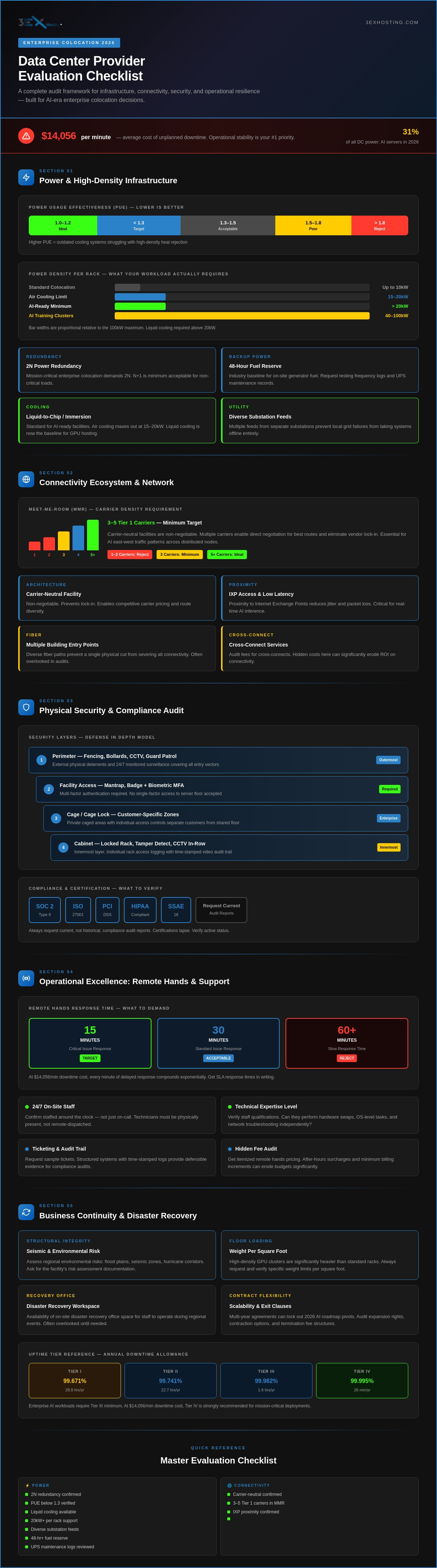
Selecting a data center in 2026 isn’t just about finding floor space; it’s about securing a power profile that won’t choke under modern AI workloads. Your data center provider evaluation checklist must prioritize infrastructure that supports the massive energy draw of current hardware. Standard facilities often fail when asked to deliver more than 10kW per rack. You need to verify N+1 or 2N redundancy for every critical power path to ensure that a single component failure doesn’t result in an outage. With unplanned downtime costs reaching $14,056 per minute, anything less than 2N redundancy for mission-critical enterprise colocation is a risk you can’t afford.
Power Usage Effectiveness (PUE) ratings are no longer just a green marketing metric. They’re a direct indicator of operational efficiency and long-term cost management. Aim for a PUE below 1.3. Higher ratings often suggest outdated cooling systems that struggle with high-density heat rejection. Evaluate whether the facility uses high-efficiency air cooling or has already transitioned to liquid cooling. Liquid-to-chip or immersion cooling is becoming the standard for any facility claiming AI readiness, as traditional air cooling often hits a physical limit at 15kW to 20kW per rack.
High-Density GPU Colocation Readiness
Verify the facility supports power loads exceeding 20kW per rack. AI training clusters often require 40kW to 100kW per rack, making traditional setups obsolete. You should also evaluate floor loading capacity. High-density clusters are significantly heavier than standard server racks. Ask for specific weight limits per square foot to ensure the structural integrity of the raised floor. If your roadmap includes massive compute power, look for specialized high density GPU colocation support to ensure the infrastructure can handle the thermal and electrical stress without throttling performance.
Redundancy and Power Distribution
Reliability starts at the utility feed. Confirm the facility has diverse feeds from separate substations. This prevents a local grid failure from taking your systems offline. Inspect the backup generator testing frequency and fuel reserves; a 48-hour minimum on-site supply is the industry baseline. Verify the UPS (Uninterruptible Power Supply) topology and request maintenance logs to ensure batteries and capacitors are replaced before they fail. A transparent provider will share these logs as part of your data center provider evaluation checklist audit to prove their commitment to uptime.
Connectivity Ecosystem: Evaluating Network and Latency
Connectivity in 2026 is no longer a commodity; it’s a strategic asset for any enterprise. When using a data center provider evaluation checklist, you must look beyond simple bandwidth and focus on the architecture of the network ecosystem. A carrier-neutral facility is non-negotiable for modern operations. It prevents vendor lock-in and allows you to negotiate directly with multiple providers for the best routes. You should audit the Meet-Me-Room (MMR) to confirm the presence of at least three to five Tier 1 carriers. This density ensures your infrastructure can handle the massive “east-west” traffic patterns required by AI clusters communicating across distributed nodes.
Latency is the enemy of performance. Proximity to major Internet Exchange Points (IXPs) is a critical metric you cannot overlook. Every millisecond counts when your GPUs are processing real-time inference or training large models. If the facility is located far from these hubs, your data travels longer distances. This increases the risk of jitter and packet loss. High-performance enterprises often seek out regional carrier hotels because these buildings act as massive interconnection hubs. If you’re looking for world-class connectivity with ultra-low latency, choosing a Miami colocation provider can offer the high-speed access to global markets your applications demand.
Cross-Connect Services and Latency
Fiber path diversity inside the building is often overlooked. Ensure the facility has multiple entry points to prevent a single backhoe from severing all your connections. A robust data center provider evaluation checklist must also scrutinize the provisioning speed for cross-connect services. In a market where 400G and 800G deployments are accelerating, waiting weeks for a port is unacceptable. Ask for an SLA that guarantees turnaround within 48 hours for new connections.
Carrier Hotel Advantages
A regional carrier hotel offers unique scalability via blended IP bandwidth. This combines multiple carriers into a single handoff, which is ideal for businesses needing immediate scalability without managing complex BGP sessions. Security is paramount. According to Data Center Security Standards, access to interconnection areas must be strictly controlled via multi-factor authentication. Audit the fiber entry points and ensure all cabling is housed in secure, overhead conduits.
Physical Security and Compliance Audit
Physical security in a modern facility must go beyond a simple perimeter fence. It requires a multi-layered defense-in-depth strategy that protects your hardware from both intentional and accidental threats. Your data center provider evaluation checklist should prioritize facilities that treat physical security with the same rigor as digital cybersecurity. Confirm that multi-factor authentication (MFA) is required for all facility entry points. This typically involves a combination of a secure badge and biometric verification, such as iris or fingerprint scanners. 24/7/365 on-site security personnel are non-negotiable for immediate incident response and perimeter control. CCTV coverage must be comprehensive. It should cover every aisle in the white space, all Meet-Me-Rooms, and every loading dock with high-definition recording and long-term storage.
Compliance isn’t just a badge on a website; it’s a rigorous, ongoing audit process. You need to verify that the provider maintains current SOC 2 Type II, HIPAA, and PCI-DSS certifications. These reports provide documented evidence that the facility follows strict protocols for data handling and physical safety. For enterprises managing sensitive data or proprietary AI models, the physical separation of private colocation suites and cages provides an essential buffer. This isolation ensures your hardware isn’t in a shared environment where other customers or third-party contractors might have proximity to your racks.
Access Control and Monitoring
Review the visitor management system in detail. It should require government-issued ID and pre-approval for every guest. Biometric scanners at the man-trap and individual cabinet levels are critical to prevent “tailgating” and unauthorized rack access. Environmental monitoring is just as vital as cameras. Real-time visibility into temperature, humidity, and leak detection protects your physical assets from infrastructure failure. Ask to see the monitoring dashboard your team will use to track these environmental metrics remotely.
Compliance and Regulatory Alignment
Request the most recent independent audit reports before finalizing your decision. A provider’s ability to support industry-specific regulations is a key differentiator for high-stakes enterprise projects. For high-compliance workloads, the physical security of a cage solutions datacenter is often the superior choice. These environments allow for custom security layers, including dedicated cameras and specialized sensors, tailored to your specific regulatory requirements. This ensures your audit trail remains clean and defensible for stakeholders.
Operational Excellence: Remote Hands and Managed Support
Operational stability depends on the skill of the technicians standing in the cold aisle when your internal team is miles away. Your data center provider evaluation checklist must treat on-site support as a core pillar of your infrastructure strategy. Verify that the facility employs full-time, highly trained technicians rather than relying on rotating third-party contractors. This distinction is critical for maintaining consistency in troubleshooting and hardware handling. Emergency hardware swaps require immediate action. If a server component fails at 3:00 AM, you need a technician capable of executing a precise swap within minutes. This speed is what prevents a minor hardware glitch from escalating into a prolonged service interruption.
Check the ticketing system for response time SLAs. A professional enterprise facility should guarantee a response to critical tickets within 15 to 30 minutes. Ask for a demonstration of the client portal. It should offer real-time tracking and clear communication channels with the on-site team. You don’t want to be left wondering if your request has been seen during a high-pressure outage. Deployment support is equally important. Verify the availability of move-in assistance to streamline the physical installation of your racks and cabling. This ensures your environment is set up correctly from day one.
The Scope of Remote Hands Support
Don’t assume all support offerings are equal. Verify if remote hands support includes meticulous cable management and recurring inventory audits. Technicians should be capable of performing complex troubleshooting under your direction. This includes power cycling, physical port testing, and basic OS commands. Large-scale migrations are high-risk events. Determine if the provider offers move-in assistance to handle the heavy lifting of rack-and-stack operations. This allows your engineers to focus on the logical configuration rather than physical logistics.
Service Level Agreements (SLAs)
Audit the provider’s historical uptime record for the last 5 years. This is the most honest indicator of operational health. Look for a “five nines” (99.999%) availability guarantee. Use your data center provider evaluation checklist to verify the financial penalties or credits associated with any SLA breaches. These credits should be substantial enough to reflect the provider’s accountability for your business continuity. Transparency is a hallmark of a reliable partner. The facility should provide an incident reporting process that is clear and proactive. If you require a partner that prioritizes uptime and expert on-site intervention, explore our remote hands services to keep your systems running at peak performance.
Business Continuity: Disaster Recovery and Future Growth
A final, critical pillar of your data center provider evaluation checklist is the long-term resilience of the physical facility. Beyond the technical specs of the server racks, you must evaluate the building’s structural integrity against regional environmental risks. In regions like Florida, this means verifying wind-rating specifications for Category 5 hurricanes and flood-plain elevations. It’s not enough to have redundant power if the physical shell cannot withstand local climate events. With the global disaster recovery market projected to reach $15.912 billion by 2033, the focus on business continuity is a primary driver for enterprise colocation. You should also assess the availability of dedicated disaster recovery office space. If a regional emergency occurs, your IT personnel need a secure, powered location with high-speed connectivity to maintain operations.
Scalability is often hampered by the physical layout and the current supply chain. Research shows that half of the data centers planned for 2026 have been delayed or canceled due to equipment shortages. This makes it vital to verify your provider’s current inventory and their specific roadmap for growth. Ask if they can guarantee contiguous space for your future needs. Moving equipment across a facility to a non-adjacent row increases cable management complexity and can impact performance. Flexibility in contract terms is also essential. Your agreement should allow for seamless upgrades to power circuits as your hardware density increases without triggering punitive administrative fees.
Disaster Recovery Solutions
Verify the presence of managed cloud hosting options that can serve as an immediate failover target for your most critical workloads. A resilient provider demonstrates “island mode” capability. This is the ability to run entirely independent of the local utility grid for at least 48 hours during a widespread outage. Review the provider’s own business continuity plan. You need to know how they handle staffing and logistics when roads are closed or local services are disrupted. Their ability to remain operational during a crisis is the foundation of your own uptime.
Scalability and Full Cabinet Options
Determine the immediate availability of full cabinet colocation for your next expansion phase. It’s vital to evaluate how easily you can upgrade power density within your existing footprint. As AI workloads grow, you might need to jump from 10kW to 30kW per rack suddenly. Request a custom quote to benchmark these long-term scaling costs early. This ensures your 2026 infrastructure remains both technically viable and financially predictable as your enterprise evolves. This proactive approach is the core of a successful data center provider evaluation checklist implementation.
Future-Proof Your Infrastructure for 2026
Building a resilient IT foundation requires moving beyond traditional metrics to prioritize high-density power and carrier-neutral connectivity. This data center provider evaluation checklist provides the framework to audit these critical pillars; it ensures your infrastructure can scale alongside AI and GPU-intensive workloads without hitting physical limits. By verifying operational transparency and physical security protocols today, you avoid the high costs of downtime and the frustration of vendor lock-in tomorrow. Strategic planning is the only way to guarantee business continuity in an increasingly compute-heavy market.
A stable technical foundation remains the key to enterprise growth. We offer high-density power configurations up to 30kW+ and a carrier-neutral facility with Tier 1 connectivity to support your most demanding applications. Our 24/7/365 expert remote hands support ensures your hardware is always in professional hands, regardless of the hour. Secure your infrastructure with 3EX Hosting—Request a Quote Today. Your systems deserve the highest level of stability and expertise. We’re ready to help you build a defensible, scalable environment for the future.
Frequently Asked Questions
What is the most important factor in a data center evaluation?
The most important factor is operational resilience combined with the facility’s ability to scale alongside your technical requirements. You aren’t just buying floor space; you’re securing a foundation for your business continuity. Use a data center provider evaluation checklist to audit power redundancy, cooling efficiency, and physical security layers. These elements ensure your hardware remains stable even during regional utility failures or rapid growth phases.
How do I verify a data center’s carrier neutrality?
You can verify carrier neutrality by requesting a comprehensive list of on-site network providers and auditing the Meet-Me-Room (MMR). A truly neutral facility doesn’t favor one specific provider and allows you to establish cross-connects with any carrier present. This flexibility prevents vendor lock-in and lets you negotiate the best routing for your specific latency needs. Ensure the facility hosts at least three to five Tier 1 carriers.
What is the difference between N+1 and 2N redundancy?
The difference between N+1 and 2N redundancy lies in the level of fault tolerance provided for critical systems. N+1 means the facility has one extra component, such as a generator or UPS, beyond what is required for full load. In contrast, 2N redundancy provides a completely mirrored second system. This ensures that even a total failure of one entire power path doesn’t impact your operations, providing the highest level of stability.
Why is power density critical for AI and GPU hosting in 2026?
Power density is critical because modern AI accelerators require significantly more energy and generate more heat than traditional servers. While older racks might only pull 5kW to 10kW, an AI training cluster often demands 30kW or more per cabinet. If a facility can’t support these high-density configurations, your hardware will throttle or fail due to insufficient cooling and power delivery. It’s a physical limit you can’t ignore.
What should be included in a remote hands service agreement?
A remote hands service agreement should include a precise scope of technical tasks, guaranteed response times, and the expertise level of the on-site technicians. It’s vital to confirm that the service covers hardware swaps, cable management, and basic troubleshooting under your direction. Your data center provider evaluation checklist must also verify that support is available 24/7/365 to handle emergency interventions during off-peak hours without delay.
How does a carrier hotel improve network performance?
A carrier hotel improves network performance by acting as a massive interconnection hub where hundreds of networks meet in a single physical location. This proximity reduces latency by shortening the fiber path between your servers and your end users or cloud providers. Facilities located within or directly connected to these hubs offer superior speed and more diverse routing options compared to isolated data centers located far from network backbones.
What compliance certifications are mandatory for enterprise colocation?
Mandatory compliance certifications for enterprise colocation typically include SOC 2 Type II, HIPAA, and PCI-DSS. SOC 2 Type II is particularly important because it proves the facility has maintained strict security and availability standards over a specific period. Depending on your industry, you may also require ISO 27001 for information security management or specialized federal certifications to meet high-security data handling requirements for sensitive workloads.
How often should a data center provider test their backup generators?
Data center providers should perform basic start-up tests on backup generators weekly and conduct full-load bank testing at least once a month. Full-load tests ensure the system can handle the actual power draw of the facility during a real utility failure. You should request maintenance logs to verify these tests are performed consistently and that fuel reserves are maintained for at least 48 hours of continuous operation during a crisis.