 SUPPORT


 3EX United States
 Blog
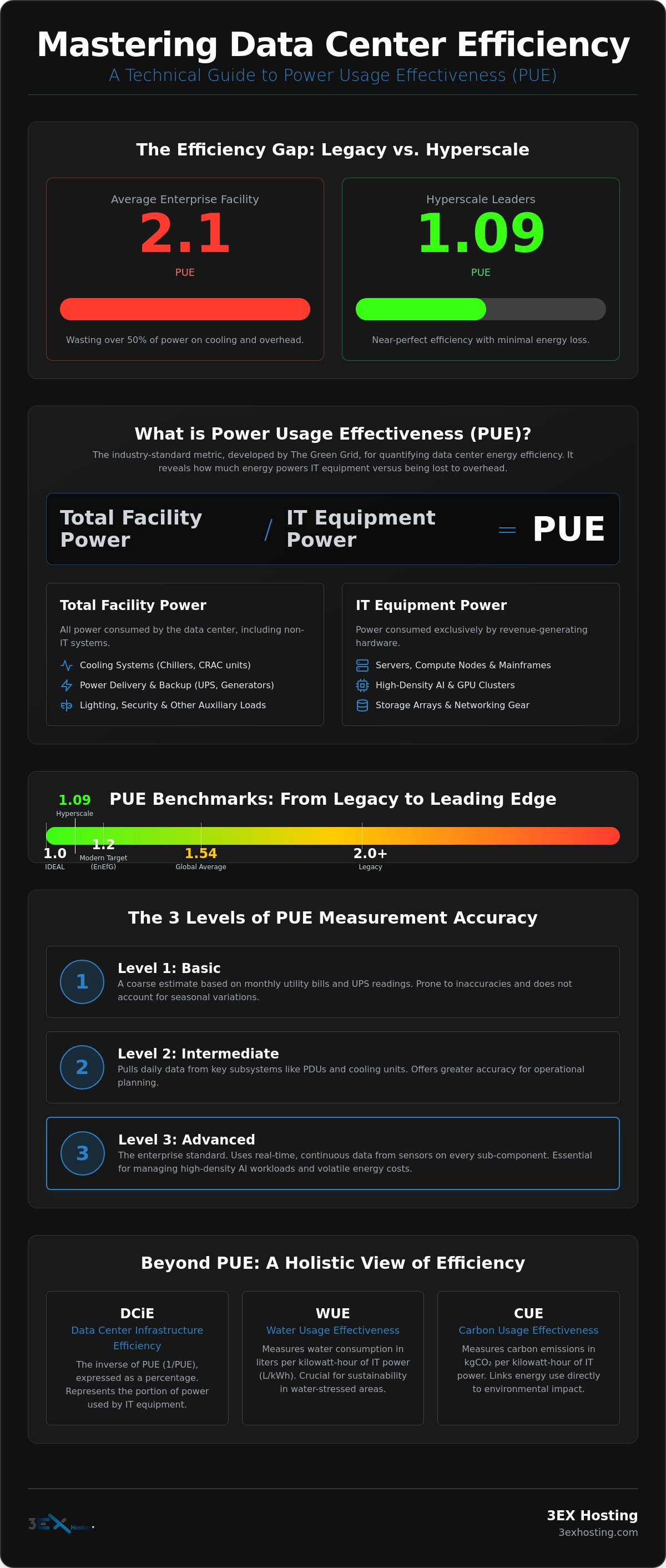
While hyperscale leaders operate at a PUE of 1.09, the average enterprise facility still lags at 2.1, effectively wasting over half of its power on non-IT overhead. You’ve likely noticed rising energy costs eating into your IT budget while struggling to cool high-density GPU racks for AI. It’s a common technical hurdle, but in 2026, transparency in data center power usage effectiveness (PUE) is a requirement for operational stability and cost control.
This guide provides the technical clarity you need to master PUE mechanics, optimize your infrastructure costs, and achieve enterprise-grade efficiency. You’ll learn how to audit provider claims, identify how efficiency impacts your rack density, and align your hardware with new sustainability regulations. We examine the specific strategies that bridge the gap between legacy overhead and modern, high-performance computing environments to ensure your systems remain fast, reliable, and cost-effective.
Key Takeaways
- Understand the industry-standard ratio that separates IT load from facility overhead to accurately audit your provider’s efficiency.
- Identify why real-time monitoring at the rack PDU level is essential for managing volatile energy costs in 2026.
- Learn how high-density AI GPU hosting is forcing a shift from traditional air cooling to more efficient liquid-cooling technologies.
- Master the mechanics of data center power usage effectiveness (PUE) to lower pass-through power expenses and increase hardware lifespan.
- Discover how modern infrastructure design supports high-density workloads without compromising your corporate sustainability targets.
What is Data Center Power Usage Effectiveness (PUE)?
Energy efficiency isn’t just a green initiative anymore. It’s a financial imperative. The industry relies on Power Usage Effectiveness (PUE) to quantify how much energy actually reaches your servers versus how much is lost to overhead. Developed by The Green Grid, this metric has become the standard for auditing infrastructure performance. It’s a simple ratio. You divide the total facility power by the power used specifically by IT equipment. Every enterprise leader should understand this calculation to avoid overpaying for wasted electricity.
An ideal score is 1.0. This represents a perfect environment where every watt of electricity powers a CPU, GPU, or storage drive. In reality, no facility reaches 1.0 because cooling systems, lighting, and power distribution units always consume some energy. As we move through 2026, transparency is shifting from a luxury to a regulatory requirement. Recent mandates, such as Germany’s Energy Efficiency Act (EnEfG), now require new facilities to aim for a PUE of 1.2 within two years of commissioning. Understanding data center power usage effectiveness (PUE) helps you identify which providers are prepared for these tightening standards.
Breaking Down the PUE Ratio
Understanding the ratio requires looking at the “overhead” components. Total Facility Power includes everything from the massive chillers and CRAC units to the backup generators and office lights. IT Equipment Power is strictly what your hardware pulls from the rack. The Uptime Institute’s 2025 survey reports a global average PUE of 1.54. If your provider operates at this average, you’re paying for 54% more electricity than your hardware actually needs. These costs scale quickly as you deploy high-density AI clusters.
Modern vs. Legacy PUE Benchmarks
Legacy data centers often struggle with efficiency. Many older facilities operate with PUEs above 2.0 because they rely on outdated cooling architectures and inefficient power delivery systems. They weren’t designed for the heat loads of 2026. Modern facilities leverage ASHRAE thermal guidelines and advanced containment to drive these numbers down. 3EX Hosting aligns with these modern benchmarks by utilizing high-efficiency cooling and N+1 power redundancy. This design ensures that enterprise clients don’t subsidize the waste of a legacy building. Choosing a facility with a lower PUE is about maximizing your compute per dollar.
How to Calculate PUE: Measuring Facility Efficiency
Calculating data center power usage effectiveness (PUE) seems straightforward on paper. You divide total facility energy by IT equipment energy. However, the accuracy of that ratio depends entirely on where you place your sensors. Measuring at the utility meter provides the total facility load, but measuring IT power at the UPS output instead of the rack PDU can mask significant distribution losses. To get a true reading, you must measure as close to the server as possible. This precision prevents “efficiency leakage” where power lost in transformers or cables is incorrectly attributed to IT work.
Real-time monitoring is now the industry standard. Annual snapshots are often misleading because they don’t account for seasonal shifts. External temperatures directly impact cooling requirements; a facility might boast a 1.2 PUE in January but spike to 1.5 in July. The U.S. Department of Energy emphasizes Data center energy efficiency as a national priority, and their guidelines suggest that continuous data is the only way to capture these fluctuations. Don’t fall into the common pitfall of ignoring auxiliary loads. Lighting, security systems, and office spaces must be included in the “total facility” side of the equation to maintain reporting integrity.
The Three Levels of PUE Measurement
The Green Grid defines three distinct levels of measurement depth. Level 1 is the basic entry point, relying on monthly utility bills and UPS readings. It’s a coarse estimate. Level 2 moves to intermediate accuracy by pulling daily data from PDUs and cooling sub-systems. Level 3 represents the advanced tier. It uses real-time, continuous data from every sub-component in the building. For enterprises running mission-critical AI workloads, Level 3 is the only way to ensure your cooling capacity scales alongside your compute demand.
Secondary Metrics You Should Know
PUE is the primary metric, but it doesn’t tell the whole story. You should also track Data Center Infrastructure Efficiency (DCiE), which is simply the inverse of PUE expressed as a percentage. Additionally, Water Usage Effectiveness (WUE) is becoming vital in water-stressed regions, measuring how many liters are consumed per kWh of IT power. Finally, Carbon Usage Effectiveness (CUE) links your energy consumption directly to greenhouse gas emissions. These metrics work together to provide a 360-degree view of your operational footprint.
Auditing these numbers across a complex infrastructure can be difficult. If you’re unsure about your current rack-level metrics, our Remote Hands Support can help you audit your specific power draw and identify areas for optimization. This ensures your deployment remains lean and high-performing.
The Impact of AI and High-Density Loads on PUE
Artificial intelligence is fundamentally rewriting the rules of infrastructure design. Traditional enterprise racks typically pull between 5kW and 10kW. In contrast, modern AI clusters featuring the latest H100 or B200 GPUs can easily exceed 50kW per rack, with some high-density deployments reaching 100kW. This massive concentration of heat puts immense pressure on data center power usage effectiveness (PUE). When cooling systems have to work exponentially harder to move heat from these dense clusters, the PUE often spikes. This leads to unsustainable operational costs and potential thermal throttling of your hardware.
Hitting a PUE target of 1.2 or lower is significantly more challenging when managing 50kW+ racks with legacy air-cooling methods. Air is an inefficient medium for heat transfer at these densities. To maintain stability and efficiency, facilities are shifting toward liquid-cooling architectures that can handle the thermal output of high density GPU colocation. These specialized environments ensure that the “overhead” power used for cooling doesn’t spiral out of control as compute demand increases.
Cooling the AI Revolution
The transition from air to liquid is no longer optional for high-density environments. Direct-to-chip cooling and rear-door heat exchangers (RDHx) are becoming the standard for managing AI-driven heat. Liquid cooling can remove heat up to 4,000 times more effectively than air. By bringing the cooling medium directly to the processor, facilities can achieve PUE ratings as low as 1.04 to 1.1. This efficiency allows for greater rack density without the massive energy penalty associated with traditional CRAC units and raised-floor air distribution.
Power Distribution for AI Clusters
Efficiency also depends on the power path. Every time electricity is converted from AC to DC or stepped down in voltage, energy is lost as heat. AI clusters require massive amounts of clean, stable power. Utilizing high-voltage DC distribution within the facility helps minimize these conversion losses, directly improving the PUE. Modern AI infrastructure hosting relies on intelligent PDUs to monitor power spikes in real-time. These spikes are common during large-scale model training. Precise monitoring ensures that power distribution remains balanced and that every watt is accounted for, preventing the “invisible” waste that often plagues less sophisticated deployments.
Beyond the Number: Why Low PUE Matters for Enterprise ROI
Efficiency isn’t just about meeting a technical benchmark; it’s about the financial health of your IT operations. A high data center power usage effectiveness (PUE) represents a direct drain on your capital. When you pay for power that never reaches your servers, you’re subsidizing facility waste instead of driving business value. Low PUE infrastructure reverses this trend by ensuring that the vast majority of your energy spend goes toward active compute. This efficiency also extends the life of your hardware. Systems running in optimized thermal environments experience less stress, which significantly reduces hardware failure rates and maintenance overhead.
Future-proofing is another critical factor. Legacy facilities with high PUE ratings will likely become obsolete by 2030. Rising energy prices and tightening environmental regulations make these older buildings too expensive to operate. By choosing a high-efficiency provider now, you avoid the disruptive and costly process of migrating hardware later when legacy sites can no longer meet modern standards. It’s a strategic move that protects your long-term infrastructure investment.
The Economics of Efficiency
The math behind efficiency is stark. Consider a 100kW IT load. At a modern PUE of 1.2, your total facility draw is 120kW. In contrast, at a legacy PUE of 1.8, that same load pulls 180kW. You’re effectively paying for 60kW of wasted power every hour, totaling over 525,000 kWh of unnecessary expense annually. In 2026, PUE serves as the primary multiplier for operational expenditure, where every decimal point reduction directly lowers the long-term total cost of ownership for high-density hardware. These savings allow you to reallocate your budget toward high-value services like managed cloud hosting or specialized AI development.
Sustainability and Compliance
Corporate sustainability is no longer a marketing elective. Most enterprises now face strict ESG (Environmental, Social, and Governance) goals that require detailed reporting of Scope 2 and Scope 3 emissions. Using a facility with transparent data center power usage effectiveness (PUE) reporting makes these audits simple. It provides the verified data needed for regulatory compliance while enhancing your brand reputation with investors and customers who prioritize green operations. Efficient infrastructure is the fastest way to align your technical footprint with corporate responsibility mandates without sacrificing performance.
Ready to optimize your infrastructure costs? Get a customized quote to see how our low PUE design can lower your monthly pass-through expenses.
Optimizing Infrastructure with 3EX Hosting
3EX Hosting builds for performance. Our enterprise data center design prioritizes data center power usage effectiveness (PUE) by integrating N+1 power redundancy and advanced thermal management from the ground up. We don’t just provide space; we provide a high-efficiency environment specifically engineered for the power-hungry demands of 2026. Our full cabinet colocation solutions use hot and cold aisle containment to ensure that every watt of cooling is used effectively. This prevents the thermal bleed common in less specialized facilities and keeps your operational costs predictable.
Optimizing a deployment requires more than just high-end hardware. It requires active, expert management. We offer remote hands support to help you optimize your specific hardware configurations for maximum efficiency. Our technicians act as an extension of your team, assisting with rack-level optimizations that can lower your pass-through power costs. This hands-on approach ensures that your data center power usage effectiveness (PUE) remains low even as your compute needs scale into high-density territory.
Tailored High-Density Solutions
Every AI workload is unique. We design cage solutions that maximize airflow for traditional air-cooled setups while providing the necessary floor-loading and piping infrastructure for liquid-cooled GPU clusters. If your project requires massive scale, our private data center suites can be customized to your exact power and cooling specifications. This flexibility allows you to deploy the most modern hardware without worrying about the limitations of a legacy building. Our team provides expert consultation on power density and rack layout to prevent hotspots and ensure your AI training environments remain stable during peak loads.
Get Started with Efficient Infrastructure
Transitioning to a high-efficiency facility shouldn’t be a logistical burden. We provide comprehensive move-in assistance to streamline your hardware migration and ensure your systems are online and optimized quickly. Our onboarding process includes a full audit of your power requirements to match you with the most efficient cabinet or suite configuration available. We believe that the right infrastructure is the foundation of your success. Optimize your infrastructure ROI—get a quote today.
Future-Proof Your Compute Strategy
Efficiency in 2026 isn’t just a metric; it’s the foundation of a scalable enterprise. As we’ve discussed, mastering data center power usage effectiveness (PUE) is essential for managing the thermal and financial demands of high-density AI clusters. By choosing infrastructure designed for modern workloads, you don’t just lower your monthly pass-through costs. You also ensure your hardware runs in a stable, reliable environment that meets increasing regulatory standards.
3EX Hosting provides the technical stability your mission-critical applications require. Our facilities feature N+1 power redundancy and carrier neutral connectivity, ensuring your systems remain fast and available. Whether you’re deploying liquid-cooled GPU racks or traditional enterprise cabinets, we’re high-density GPU ready and focused on your operational ROI. Don’t let legacy overhead limit your growth potential.
Scale your infrastructure efficiently; Contact 3EX Hosting
We’re ready to help you build a leaner, more powerful technical future.
Frequently Asked Questions
What is a ‘good’ PUE for a data center in 2026?
A PUE of 1.2 or lower is considered excellent for most commercial data centers in 2026. While the global average remains approximately 1.58, modern facilities and specialized AI clusters are pushing boundaries between 1.04 and 1.1. New regulations, such as Germany’s Energy Efficiency Act, now mandate that new facilities achieve a 1.2 rating within two years of opening.
How does PUE affect my monthly colocation bill?
It serves as a multiplier for your pass-through energy costs. If your hardware pulls 10kW and the facility operates at a 1.5 PUE, you’re billed for 15kW to cover cooling and distribution overhead. Lowering the data center power usage effectiveness (PUE) directly reduces your monthly expenses, allowing more of your budget to go toward actual compute power rather than facility waste.
Can a data center have a PUE of 1.0?
A PUE of 1.0 is the theoretical perfect score where every watt of energy reaches the IT equipment. While no facility is perfectly efficient due to unavoidable losses in power distribution and lighting, liquid-cooled clusters are approaching this limit with scores as low as 1.04. Achieving a true 1.0 would require a facility to operate with zero energy dedicated to cooling or support systems.
Is PUE the only metric I should look at for efficiency?
No, you should also evaluate Water Usage Effectiveness (WUE) and Carbon Usage Effectiveness (CUE) for a complete view. PUE only measures electricity ratios and doesn’t account for the water consumed by evaporative cooling or the carbon intensity of the energy source. A holistic approach ensures your infrastructure is truly sustainable and compliant with modern corporate ESG goals.
How does liquid cooling impact PUE calculations?
Liquid cooling significantly improves PUE by reducing the energy needed for massive fans and air conditioning units. Because liquid is more efficient at heat transfer than air, the overhead power required for thermal management drops. This technology can lower a facility’s total power consumption by up to 40%, directly resulting in a leaner and more efficient ratio.
Why do legacy data centers have higher PUE scores?
Older facilities often rely on outdated cooling architectures like raised-floor air distribution that were not designed for modern hardware densities. Many legacy enterprise sites average a PUE of 2.1 because they lack the containment systems and high-efficiency UPS units found in newer builds. These inefficiencies mean you pay for twice the power your servers actually consume.
Does high-density GPU hosting always lead to a worse PUE?
Not if the facility is designed for high-density loads. While GPUs generate intense heat, using modern data center power usage effectiveness (PUE) strategies like direct-to-chip cooling can keep the ratio very low. High-density hosting only hurts efficiency when hardware is forced into legacy environments that must overwork their cooling systems to prevent thermal failure.
How often should a data center report its PUE?
Real-time reporting is the gold standard, though annual reporting is often the legal minimum. Under the EU Energy Efficiency Directive, facilities with an IT power demand of 500 kW or more must report sustainability metrics annually. Continuous monitoring is essential for your internal audits because it captures how seasonal temperature changes affect your cooling costs throughout the year.