 SUPPORT


 3EX United States
 Blog
If a Category 5 hurricane makes landfall in South Florida this season, will your proprietary hardware be just another insurance claim? For most IT directors, the fear of storm-related downtime is only matched by the anxiety of unauthorized physical access to sensitive servers. You already know that maintaining enterprise-grade Miami data center security isn’t just a checklist item; it’s a fundamental requirement for operational sovereignty. You’ve worked hard to build your digital assets, and you shouldn’t have to worry about whether a third-party facility can survive a major weather event or meet rigorous HIPAA and SOC2 compliance standards.
This article details the multi-layered security protocols that define world-class colocation in the Miami gateway for 2026. You’ll discover how hurricane-hardened shells and multi-factor biometric access points create a fortress for your hardware. We will break down the technical realities of N+1 redundancy and provide a clear framework for evaluating a facility’s ability to withstand extreme weather while maintaining high-density AI infrastructure. You’ll gain the technical clarity needed to ensure your systems remain online and protected, giving you total confidence in your infrastructure’s physical and logical stability.
Key Takeaways
- Learn how multi-factor biometric access and six defined layers of physical protection secure your hardware from the facility perimeter to the individual server rack.
- Understand why Miami data center security relies on hurricane-hardened infrastructure and strategic carrier hotel placement to maintain uptime during extreme weather events.
- Evaluate the critical role of 24/7 on-site Remote Hands in mitigating insider threats and providing immediate expert response to infrastructure issues.
- Identify the specific thermal and power security protocols required to protect high-density GPU clusters and enterprise AI infrastructure from operational failure.
- Establish a framework for selecting colocation providers that combine physical sovereignty with secure, low-latency connectivity to Latin American markets.
The Strategic Importance of Security in a Miami Carrier Hotel
Miami serves as the primary subsea cable landing point for traffic moving between North America and Latin America. In this environment, a carrier hotel isn’t just a building; it’s a strategic nexus where hundreds of global networks physically meet. For enterprise leaders, this proximity translates directly into a security advantage. By housing infrastructure within a carrier hotel, you reduce the number of network hops your data takes across the public internet. Each hop represents a potential point of failure or interception. Reducing this distance minimizes the attack surface for your most sensitive data. This localized density is a core component of modern Miami data center security.
Adhering to current data center security standards in 2026 requires a focus on both physical and logical integrity. As of July 1, 2026, Florida Senate Bill 484 has introduced stricter oversight regarding data center ownership and utility cost allocation. This legislation reinforces Miami’s position as a secure, regulated hub for national data sovereignty. It’s no longer enough to have a fast connection. You need a facility that understands these evolving compliance landscapes to ensure your operations remain legally and technically stable.
Network Interconnection as a Security Layer
Traditional data transit relies on the public internet, which is inherently vulnerable to BGP hijacking and man-in-the-middle attacks. Within a Miami carrier hotel, you can utilize cross-connect services to establish direct, physical links between your hardware and your service providers. This bypasses the public web entirely. It ensures your data handoffs occur in a controlled, monitored environment. A carrier-neutral facility allows you to build redundant network paths across different providers. If one carrier experiences a breach or outage, your traffic reroutes instantly through a separate, secure path. This level of logical redundancy is a cornerstone of robust Miami data center security.
Geographic Resilience: Beyond Hurricane Resistance
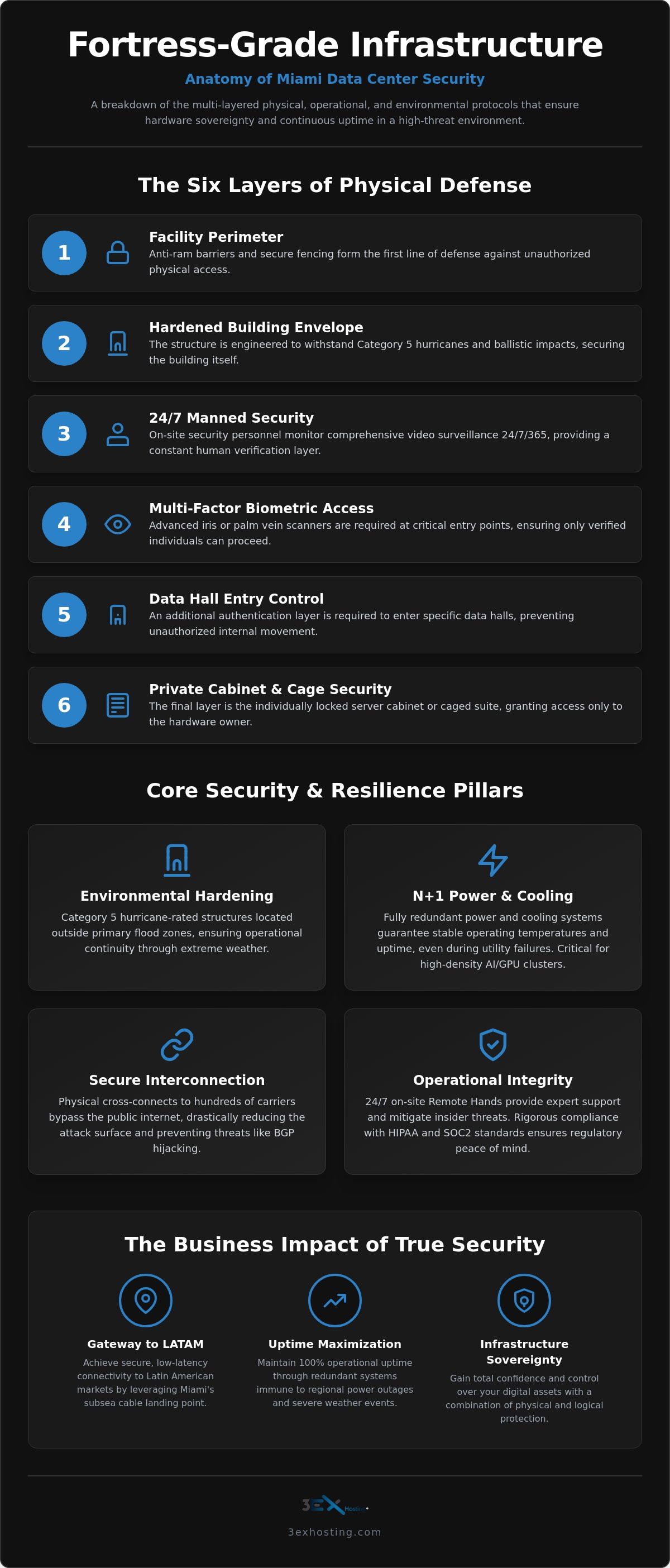
Physical security in Miami starts with the foundation. In 2026, being Category 5 ready is the baseline requirement for any enterprise-grade site. However, true resilience considers flood zone elevation and structural reinforcement against ballistic impacts. Secure facilities are often positioned outside primary flood zones or built with elevated equipment rooms to prevent water damage. Grid stability also plays a vital role. Miami’s utility infrastructure is hardened for storm protection, but your facility must have N+1 power redundancy to bridge the gap during local utility failures. This combination of structural strength and power autonomy ensures that your security systems, from cameras to biometric scanners, remain operational regardless of external conditions.
Multi-Layered Physical Security: Beyond the Perimeter
Physical protection in an enterprise environment follows a defense-in-depth methodology. This isn’t just a marketing term; it’s a structural reality. To reach your hardware, an individual must pass through six distinct layers. These start at the street level with anti-ram barriers and move through the perimeter fence, the building envelope, and the manned security desk. Only after passing these can a visitor reach the specific data hall and, finally, your locked cabinet or suite. Each transition point requires multi-factor authentication. In 2026, standard proximity cards aren’t enough. High-security facilities utilize biometric scanners, such as iris or palm vein recognition, to ensure the person holding the badge is who they claim to be. This rigorous approach is what defines modern Miami data center security.
Continuous 24/7/365 on-site security personnel provide a human layer of verification that automated systems cannot replicate. They monitor real-time video surveillance that covers every square foot of the facility. Beyond human threats, environmental security protects your uptime. Advanced Very Early Smoke Detection Apparatus (VESDA) and clean-agent fire suppression systems extinguish threats without damaging sensitive electronics. Understanding the Strategic Importance of Security at the physical level helps IT leaders sleep better during Miami’s unpredictable weather cycles. Every sensor and camera is a part of a unified defense strategy designed to prevent unauthorized access before it reaches the rack.
Private Suites vs. Custom Cages
Enterprise clients often require more than a shared row of cabinets. Private data center suites offer a dedicated room with floor-to-ceiling walls, providing total sovereignty over your environment. For those with smaller footprints, cage solutions provide physical isolation within a shared data hall. Both options include detailed audit trails. You get a log of every door opening and every authorized entry, ensuring you always know who interacted with your hardware. If you need to scale quickly while maintaining these standards, you can request a custom configuration quote to see which setup fits your compliance needs.
Infrastructure Redundancy: N+1 and Beyond
Power redundancy is a vital security feature. An abrupt power loss can lead to data corruption or hardware failure, leaving systems vulnerable. N+1 power ensures that even if a primary component fails, a backup is already online. During hurricane season, fuel reserves become critical. Secure facilities maintain enough on-site diesel to run generators for days without a delivery. Regular generator testing under load is a mandatory protocol. Cooling redundancy is equally important. High-density servers generate immense heat; a cooling failure is a physical threat. Redundant HVAC systems prevent thermal-induced shutdowns, keeping your GPU clusters stable and secure. This infrastructure is a core pillar of Miami data center security.
Operational Security: The Role of 24/7 Remote Hands
While the physical layers discussed previously form a hard perimeter, the human element inside the facility dictates the daily reality of Miami data center security. Operational security bridges the gap between physical locks and digital defense. In 2026, the most significant risk to enterprise hardware often comes from unvetted external contractors or improper handling during maintenance. Relying on on-site technical experts rather than dispatching your own team or hiring third-party vendors is a strategic security decision. On-site staff are already vetted, trained on the facility’s specific protocols, and held to strict Standard Operating Procedures (SOPs).
Immediate physical intervention is critical during an emergency. Whether it’s a failing power supply or a cable that needs reseating, having a technician feet away from your rack eliminates the security risks associated with delayed response times. This holistic approach aligns with the CISA guidelines on security convergence, which emphasize that physical and cybersecurity must be managed as a single, integrated strategy. Organizations often explore Managed IT Services to bridge this gap, ensuring that remote monitoring and management protocols are as robust as the physical facility’s access controls. By utilizing on-site experts, you reduce the “insider threat” profile of your infrastructure. You ensure that every person touching your hardware is an authorized, documented professional acting under a clear mandate.
Secure Hardware Management
Deploying and maintaining servers from a distance requires a high level of trust. Professional remote hands support allows you to manage complex deployments without the security risks of travel or temporary badge access for your staff. Technicians follow a strict chain of custody for every piece of equipment that enters or leaves your suite. This includes detailed inventory management and visual verification of hardware status. Proper cable management isn’t just about aesthetics; it’s a security best practice that prevents accidental disconnections and makes it easier to spot unauthorized physical tampering during routine inspections. This level of oversight is a fundamental component of Miami data center security.
Compliance and Auditing
Operational rigor is the backbone of HIPAA, PCI-DSS, and SOC2 compliance. It isn’t enough to claim a facility is secure; you must prove it through independent verification. Annual SSAE 18 audits provide this proof by examining the data center’s internal controls and security processes. These audits ensure that the facility’s claims about uptime, access control, and environmental monitoring are accurate and consistently applied. Remote hands facilitate compliance audits by providing documented proof of authorized physical interactions and maintaining a strict chain of custody for all hardware movements. This documentation creates a transparent record that satisfies even the most stringent enterprise regulatory requirements.
High-Density & AI Security: Protecting GPU Infrastructure
High-density AI clusters introduce a specific set of risks that traditional colocation setups aren’t equipped to handle. When you’re running GPU-intensive workloads, Miami data center security must extend deep into the thermal and electrical domains. A single rack in 2026 can pull over 20kW of power. This creates an extreme concentration of heat. Without precise thermal management, you risk “hot spots” that lead to hardware throttling or permanent silicon damage. High-value GPU components require more than just a locked door; they need an environment where every watt of heat is accounted for and neutralized in real-time. Maintaining this environmental stability is as much a security requirement as physical access control.
Power density is another critical security frontier. Managing massive electrical loads without risking circuit trips is essential for maintaining AI training uptime. Standard power distribution often fails under the fluctuating demands of large language model training. Secure facilities use intelligent power distribution units and N+1 electrical redundancy to ensure that spikes in demand don’t compromise the entire row. This level of technical oversight prevents the operational “blackouts” that can derail months of computational work. Because a single AI rack can hold millions of dollars in specialized hardware, physical monitoring must be granular, with dedicated sensors and cameras tracking the integrity of every high-density cabinet.
Redundancy for High-Performance Computing (HPC)
Tailoring power distribution for full cabinet colocation is non-negotiable for HPC. Specialized cooling solutions, such as rear-door heat exchangers or advanced hot-aisle containment, are required to keep AI hardware within safe operating temperatures. For a deeper look at these technical requirements, read our sibling article on High-Density GPU Colocation: The Enterprise Guide to AI Infrastructure in 2026. These systems ensure that your high-performance clusters remain online even during peak utilization, protecting your investment from thermal-induced failure.
Scalability and Future-Proofing
Rapid scaling in a carrier hotel requires a modular approach to security. As your AI footprint grows, your physical and logical security must expand in parallel. Managing the physical footprint of massive datasets involves securing the storage arrays and the high-speed interconnects that link them. Modular security designs allow you to add capacity without compromising the integrity of your existing clusters. If you’re ready to deploy next-generation hardware in a facility built for power density, contact 3EX Hosting today to discuss our high-density infrastructure solutions. We provide the stability needed for rapid growth without the risk of infrastructure bottlenecks.
Maximizing Uptime with 3EX Hosting’s Miami Infrastructure
Choosing a colocation provider in South Florida requires balancing high-speed connectivity with uncompromising Miami data center security. 3EX Hosting occupies a strategic position as a carrier hotel, offering the network density required for global operations while serving as a secure gateway to Latin American markets. We integrate our hurricane-hardened facility with managed disaster recovery solutions, ensuring that your data remains accessible even when the local environment is under stress. This synergy between network performance and structural resilience is why enterprise leaders trust us with their most critical AI and GPU workloads. Efficiency is our baseline, but reliability is our promise.
The 3EX advantage lies in the fusion of elite connectivity and our on-site technical team. While many providers offer space, we offer a secure partnership. Our 24/7 technical staff acts as a direct extension of your IT department, providing the eyes and ears needed to maintain a high-security environment. This eliminates the risks of unvetted third-party access and ensures that every interaction with your infrastructure follows our rigorous internal protocols. Securing your enterprise infrastructure in 2026 isn’t just about building walls; it’s about choosing a partner that understands the technical demands of modern, high-density computing. We don’t just house your servers; we protect your operational sovereignty.
Seamless Migration and Setup
Transitioning hardware into a new facility is a high-risk period for physical security. We mitigate this through professional move-in assistance, managing the logistics of your deployment from the loading dock to the rack. Every new cabinet deployment undergoes an initial security audit to verify that locks, sensors, and power distribution units are functioning correctly. You can customize your security profile within our facility, choosing between standard cage solutions or private suites that offer an additional layer of isolation. Our setup process includes:
- Supervised equipment receiving and unboxing in a secure staging area.
- Physical integrity checks for all incoming server chassis and storage arrays.
- Verification of biometric access permissions for your authorized personnel.
- Configuration of environmental monitoring sensors at the rack level.
Contact 3EX Hosting for a Secure Quote
Every enterprise has unique compliance and operational needs. Whether you’re managing HIPAA-sensitive healthcare data or scaling a massive AI training cluster, our infrastructure is built to support your specific requirements. We offer security consultations to help you design a colocation package that satisfies your auditors while maximizing your technical performance. Don’t leave your infrastructure’s safety to chance in an unpredictable market. You can get a custom colocation quote for your enterprise today and start building a more resilient digital foundation in Miami. We provide the stability you need to grow with confidence.
Securing Your Infrastructure for a Resilient Future
Maintaining enterprise sovereignty in 2026 requires more than just a locked door. It demands a holistic integration of hurricane-hardened physical shells, carrier hotel connectivity, and vetted operational protocols. You’ve seen how six layers of physical defense and N+1 power redundancy form a foundation that withstands both environmental threats and unauthorized access. By prioritizing Miami data center security, you ensure that your high-density GPU clusters and sensitive datasets remain protected and compliant regardless of external volatility. This multi-layered approach is the only way to guarantee uptime in a high-stakes digital economy.
The technical landscape is evolving fast, but your infrastructure’s stability shouldn’t be a variable. Professional on-site support and direct cross-connect services provide the control you need to scale without introducing new vulnerabilities. You can secure your enterprise infrastructure at 3EX Hosting and leverage our 24/7 on-site Remote Hands, N+1 power redundancy, and elite carrier hotel connectivity. We’re here to provide the stable foundation your business needs to thrive in the Miami gateway. Your digital assets are in expert hands, and we’re ready to help you build for the future.
Frequently Asked Questions
What is a carrier hotel and why is it more secure?
A carrier hotel is a specialized facility where multiple network providers physically interconnect their infrastructure. It’s more secure because it allows you to establish direct cross-connects between your hardware and service providers. This architecture bypasses the public internet entirely, reducing the number of network “hops” and significantly minimizing the risk of man-in-the-middle attacks or data interception during transit.
How does a Miami data center handle Category 5 hurricanes?
Enterprise facilities in Miami are engineered with reinforced concrete shells and impact-resistant materials designed to withstand extreme wind speeds. These sites are typically positioned outside primary flood zones or feature elevated equipment rooms to prevent water damage. To maintain Miami data center security during a storm, facilities keep multi-day fuel reserves on-site to power industrial-grade generators if the local utility grid fails.
What are the physical security layers at 3EX Hosting?
3EX Hosting utilizes a six-layer defense-in-depth strategy to protect your infrastructure. This starts with perimeter fencing and anti-ram barriers at the street level, moving through a 24/7 manned security desk and high-definition video surveillance. The final layers include multi-factor biometric authentication points, such as iris or palm vein scanners, which control access to specific data halls and individual server racks or private suites.
Is 24/7 Remote Hands support included in colocation services?
24/7 Remote Hands is a standard managed service available to our colocation clients. This service provides on-site technical experts who can perform physical tasks like hardware reboots, cable reseating, or visual inspections at any time. Utilizing on-site staff is a security imperative, as it eliminates the need for you to dispatch your own team or hire unvetted third-party contractors to enter the facility.
Can I get a private suite for my enterprise hardware?
Yes, we offer private colocation suites for enterprises that require complete physical sovereignty over their hardware environment. These suites feature floor-to-ceiling walls and dedicated access controls that are independent of the main data hall. This setup ensures that your infrastructure is physically isolated from other tenants, providing an additional layer of privacy and security for highly sensitive proprietary hardware.
How does N+1 redundancy impact my data security?
N+1 redundancy ensures that every critical power and cooling component has at least one backup unit ready to activate instantly. This redundancy is a vital component of Miami data center security because it prevents data corruption and hardware damage caused by sudden power losses or thermal spikes. By maintaining a stable environment, N+1 architecture protects the physical and logical integrity of your enterprise data.
Does 3EX Hosting support high-density GPU hosting for AI?
3EX Hosting specializes in high-density GPU colocation designed for the extreme demands of AI training and inference. Our infrastructure is engineered to manage power loads exceeding 20kW per rack while providing the specialized cooling necessary to prevent hardware throttling. This ensures that your high-value GPU clusters remain online and operational under heavy computational loads without risking thermal-induced failures.
What compliance standards does the Miami data center meet?
Our facility is designed to meet the rigorous requirements of global enterprise standards, including HIPAA, SOC2, and PCI-DSS. We undergo regular SSAE 18 audits to independently verify that our physical and operational security controls are functioning as intended. These certifications provide the documented proof your auditors need to confirm that your hardware is housed in a facility that meets the highest security protocols.