 SUPPORT


 3EX United States
 Blog
How much of your mission-critical hardware’s security are you willing to leave to chance in a shared row environment? With North American data center vacancy rates hitting a record low of 1.4% in 2026, finding the right space is no longer just about availability; it’s about physical sovereignty. You’ve likely reached the point where individual cabinets don’t offer enough protection, yet a full suite feels like an unnecessary expense. Deciding between a colocation cage vs private suite is the most significant infrastructure choice you’ll make this year.
It’s difficult to manage high-density GPU clusters when you’re worried about unauthorized physical access or meeting strict SOC2 and PCI DSS v4.x standards. We understand that you need a clear roadmap for scaling power and space without compromising on compliance. This guide navigates the critical differences between these two options to help you secure the ideal balance of physical security, power density, and hardware scalability. We’ll compare cost efficiencies, cooling configurations, and how to future-proof your AI infrastructure effectively.
Key Takeaways
- Understand the role of colocation cages as a secure infrastructure bridge for hardware requiring more than standard cabinet protection.
- Evaluate the critical differences of colocation cage vs private suite to determine the most cost-effective path for physical isolation and power density.
- Identify how dedicated cage solutions streamline compliance for SOC2 and PCI DSS through localized security perimeters and detailed access logging.
- Explore specialized configurations for high-density AI and GPU hosting that allow for rapid scaling within a managed cage environment.
- Learn how to leverage remote hands support and custom cage layouts to maintain high availability for mission-critical enterprise hardware.
What is a Colocation Cage? Defining the Secure Infrastructure Bridge
A colocation cage is a customizable, multi-rack environment with restricted physical access that provides a dedicated perimeter for your hardware. It serves as a secure area within a shared data center floor, offering a significant upgrade over standard rack-level hosting. For many organizations, these cages provide the ideal middle ground between full cabinet colocation and more expansive private suites. By utilizing floor-to-ceiling wire mesh partitions, a cage isolates your equipment from other tenants while maintaining the benefits of the facility’s shared cooling and power infrastructure.
When evaluating a colocation cage vs private suite, the decision often centers on the required level of physical isolation and budget. A cage offers a distinct perimeter that prevents unauthorized personnel from touching or even approaching your servers. This setup is essential for businesses that have outgrown individual racks but aren’t yet ready for the overhead of a fully walled-off room. Within a modern colocation centre, cages are the standard for high-density deployments that require both security and rapid scalability. They allow for a degree of customization in layout and power density that isn’t possible in a shared row.
The Anatomy of a Data Center Cage
The physical construction of a cage is engineered for both security and environmental efficiency. Most facilities use specific components to ensure your hardware remains safe and cool:
- Physical partitions: Floor-to-ceiling woven or welded wire mesh partitions provide a clear boundary while allowing for optimal airflow and visibility for security monitoring.
- Access control: Entry points are often secured with biometric scanners, keycard readers, and dual-authentication locks to prevent unauthorized entry.
- Dedicated power: Cages allow for custom electrical circuit configurations, enabling you to manage high-density power requirements for specific clusters.
Why Enterprises Move Beyond Individual Racks
Scalability and organization are the main reasons businesses upgrade. A cage environment offers several strategic advantages over maintaining scattered cabinets:
- Growth management: You can expand your footprint by adding racks within your existing perimeter without the logistical headache of relocating hardware.
- Asset organization: Keeping storage, networking, and compute hardware in one unified space simplifies management, cabling, and internal auditing.
- Enhanced privacy: The perimeter prevents other tenants or competitors from viewing your hardware configurations or proprietary cabling strategies.
Security and Compliance Advantages of Dedicated Cages
Beyond the facility’s main security desk, a dedicated cage provides a localized layer of protection that’s entirely under your control. This secondary perimeter ensures that even if someone gains access to the general data center floor, your hardware remains behind a locked, monitored barrier. When comparing a colocation cage vs private suite, both offer significant security upgrades over shared racks, but the cage provides a more cost-efficient way to achieve strict physical isolation. These environments are designed to align with rigorous federal and enterprise standards, such as those outlined in NIST SP 800-53, which mandates specific physical and environmental protection controls.
Audit trails are perhaps the most valuable asset for compliance officers during an audit. Every time someone enters your cage, the system generates a digital, time-stamped log of the event. These logs simplify the reporting process by providing undeniable proof of who accessed the hardware and when, reducing the burden on your internal IT staff. If you need to hide proprietary hardware configurations or specialized GPU clusters, you can opt for high-density mesh or opaque panels. This visual privacy prevents competitors or other tenants from identifying your server models, port configurations, or cabling architecture. Dedicated cages help organizations meet SOC 2 and HIPAA physical safeguard requirements by providing a verifiable, isolated environment for sensitive data storage.
Access Control and Monitoring
Modern cages utilize individualized biometric entry systems, such as fingerprint or iris scanners, to ensure only authorized personnel can cross the threshold. While the data center provider monitors the general floor, you have the option to install internal CCTV cameras for 24/7 visual oversight of your specific racks. These systems often integrate directly with your enterprise security platform, allowing your internal security team to manage access permissions and view footage from a centralized dashboard. If you’re ready to enhance your hardware’s protection, you can explore our Cage Solutions datacenter options to find a fit for your security needs.
Meeting Regulatory Compliance Standards
Compliance isn’t just about software firewalls; it starts with where the physical hardware sits. For financial institutions, PCI-DSS requirements demand strict physical isolation for servers processing sensitive cardholder data. Similarly, healthcare providers rely on cages to meet the HIPAA ‘Physical Safeguards’ rule for protected health information (PHI). In the public sector, dedicated cages play a vital role in FISMA and FedRAMP hosting strategies by providing the necessary physical separation to handle government-level data. This setup ensures your infrastructure remains compliant while staying agile, proving that in the debate of colocation cage vs private suite, the cage is often the most balanced choice for regulatory needs.
Comparing Cabinets, Cages, and Private Colocation Suites
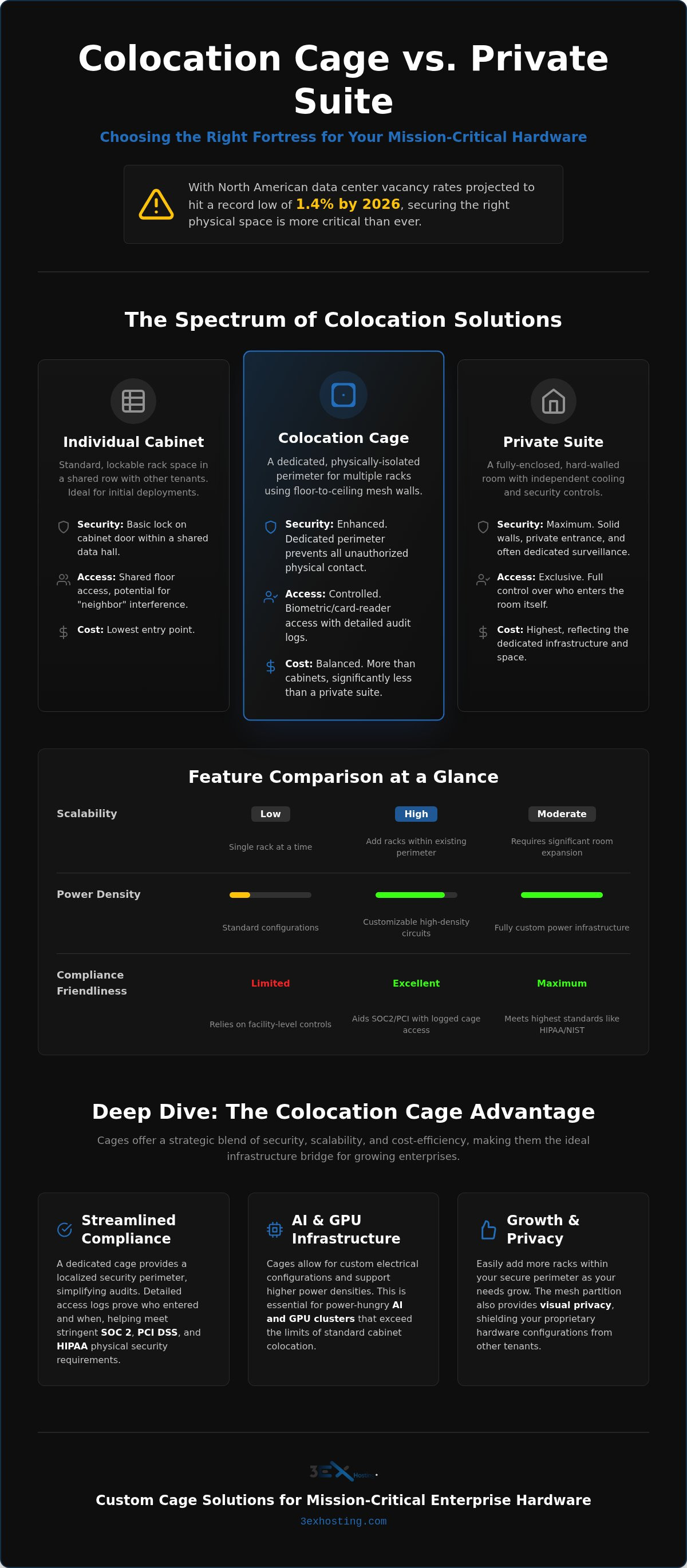
Selecting the right infrastructure model depends on your rack count, power requirements, and the level of physical sovereignty your industry demands. While individual cabinets are sufficient for standard workloads, larger enterprises require the technical customization found in dedicated spaces. Understanding the technical nuances of a colocation cage vs private suite helps determine the most efficient deployment model for your specific hardware density. Each option offers a different balance of capital expenditure and operational control.
| Feature | Full Cabinet | Colocation Cage | Private Suite |
|---|---|---|---|
| Rack Capacity | 1-5 Racks | 5-20 Racks | 20+ Racks |
| Security Level | Standard Shared Floor | Dedicated Perimeter | Complete Isolation |
| Cost Efficiency | High (Per Rack) | Moderate (Per Sq. Ft.) | Premium (Custom Build) |
| Power Density | Standard Circuits | Custom High-Density | Dedicated Infrastructure |
For organizations with massive scaling requirements, Private Suites offer the ultimate tier of data center sovereignty. According to Colocation Cage/ Private Suite specifications, these environments often include dedicated, non-shared downstream equipment such as UPS systems and cooling units. This level of isolation is crucial for enterprises that cannot share any part of their infrastructure with other tenants due to extreme security or performance protocols.
When to Scale: The Transition Points
The move from individual cabinets to a cage typically occurs when you reach the 4 to 10 rack threshold. At this stage, managing disparate cabinets across different rows becomes logistically complex and expensive. A cage unifies your infrastructure within a single perimeter, allowing for streamlined cabling and internal networking. This transition also marks the ‘compliance threshold’ where industry regulations may mandate a dedicated physical barrier. If your IT strategy involves specialized high-density cooling or proprietary cabling layouts, a cage provides the necessary floor space to implement these custom configurations without interference from neighboring tenants.
The Economics of Data Center Space
Pricing models shift as you move from cabinets to cages. While cabinets are usually billed at a flat rate per rack unit, cages are often priced based on square footage and total power allocation. This shift can reduce long-term operational costs by allowing you to consolidate power circuits and optimize rack placement for maximum airflow efficiency. Smart planning involves reserving ‘growth space’ within your cage perimeter. By securing a larger footprint than you currently occupy, you ensure that future hardware expansions don’t require expensive and time-consuming physical migrations to new areas of the facility.
Designing for High-Density and AI Infrastructure
Modern AI workloads require more than just a secure perimeter; they demand an electrical and thermal architecture that standard racks cannot support. The rise of high-density GPU colocation within cage environments has changed how enterprises plan their deployments. When deciding between a colocation cage vs private suite for AI training, the cage often provides the necessary flexibility to implement specialized cooling without the extreme cost of a private room. These environments facilitate advanced hot and cold aisle containment systems or liquid-to-chip cooling configurations that are essential for maintaining hardware longevity. High-performance computing clusters necessitate N+1 power redundancy to ensure that a single component failure doesn’t result in catastrophic downtime for weeks of training data.
Cages allow for a level of density customization that shared rows simply can’t match. You can specify the exact placement of perforated floor tiles and the orientation of your racks to maximize the Delta T (temperature difference) across your equipment. This technical control is vital when running clusters that generate massive amounts of heat. In a cage environment, you aren’t fighting for airflow with a neighbor’s low-density storage array. Instead, you’re operating in a space engineered specifically for the high-kilowatt loads required by modern GPU-accelerated computing.
Power Density Requirements for 2026
Calculating the correct kilowatt (kW) load per rack is the first step in designing an AI-ready cage. Modern GPU-accelerated servers can easily exceed 30kW per rack, requiring specialized power distribution units (PDUs) and redundant A and B power feeds. A dedicated cage allows you to aggregate these high-kilowatt loads more effectively than individual cabinets. Managing heat dissipation is equally critical. We help you design layouts that optimize airflow, ensuring that your most power-hungry nodes receive the highest volumes of chilled air. This precision prevents thermal throttling and keeps your AI models training at peak performance.
Connectivity and Low-Latency Cross-Connects
AI data ingestion relies on speed. Leveraging carrier-neutral interconnections within your cage ensures that your training sets move between storage and compute with minimal latency. Dedicated cages simplify the management of complex fiber cross-connects by providing a central point for all your networking terminations. You can also establish direct cloud on-ramps to hyperscale providers, creating a hybrid environment that scales as your models grow. This connectivity is a major factor in the colocation cage vs private suite debate, as cages offer the same low-latency access at a more agile price point. If you’re ready to deploy your next cluster, request a custom infrastructure quote to see how our high-density solutions fit your roadmap.
Transitioning to 3EX Hosting Custom Cage Solutions
Moving your infrastructure into a professional environment requires more than just floor space. It requires a partner that understands the technical stability and speed your enterprise demands. At 3EX Hosting, we specialize in bridging the gap between standard rack hosting and full data center sovereignty. Our team provides the high-density expertise needed to manage complex AI and GPU clusters while ensuring your hardware remains secure and accessible. When finalizing your choice between a colocation cage vs private suite, our engineers work alongside you to design a solution that matches your exact growth projections and power requirements.
The transition process is designed to be seamless. We utilize professional move-in assistance to minimize downtime and ensure your hardware is rack-mounted and cabled according to your specifications. This hands-on approach differentiates us from providers who simply hand over a key and leave the logistics to your team. By focusing on the physical move-in process, we allow your IT staff to stay focused on high-level strategy rather than the heavy lifting of a migration.
The Onboarding and Design Process
Our onboarding process starts with a direct consultation with our infrastructure engineers. We don’t use generic templates. Instead, we determine the precise square footage and power allocation your hardware requires for optimal performance. You’ll review and approve custom layouts that prioritize technician access and efficient airflow. This stage also includes finalized security protocols. We establish your biometric access lists and dual-authentication requirements to ensure that your cage perimeter remains uncompromised from day one.
24/7 Managed Infrastructure Support
Once your hardware is live, our remote hands support acts as an extension of your own team. Whether you need a hardware swap, cable reorganization, or a physical power cycle, our technicians are available 24/7 to perform these tasks inside your cage. This level of support is critical for maintaining mission-critical uptime. Proactive monitoring ensures that environmental factors like temperature and humidity remain within peak operating ranges. This comprehensive support model often simplifies the colocation cage vs private suite decision, as it provides suite-level management within a more agile cage footprint. If you’re ready to secure your hardware in a high-performance environment, get a custom quote for your colocation cage today.
Securing Your Enterprise Hardware Roadmap
Choosing between a colocation cage vs private suite is a strategic decision that defines your hardware’s security and scalability for years to come. Cages provide the essential physical isolation needed for strict compliance while allowing for the rapid expansion of high-density clusters. By centralizing your assets within a dedicated perimeter, you gain complete control over airflow and power distribution without the overhead of a fully private room. It’s the most efficient way to future-proof your infrastructure in a tightening data center market.
At 3EX Hosting, we support your growth with enterprise high-density GPU expertise and carrier-neutral connectivity. Our 24/7 Remote Hands Support ensures that your hardware is always managed by experienced professionals, giving you peace of mind. We don’t just provide space; we provide the technical stability your mission-critical systems require. Your infrastructure is the foundation of your success, and we’re committed to keeping it stable and secure. Secure your high-density infrastructure with a custom 3EX Hosting cage today.
Frequently Asked Questions
What is the difference between a colocation cage and a private suite?
A colocation cage uses floor-to-ceiling wire mesh to isolate your hardware on a shared data center floor, while a private suite is a fully enclosed room with solid walls. When comparing a colocation cage vs private suite, the main trade-off is between cost and absolute sovereignty. Suites offer dedicated cooling and lighting, whereas cages share the facility’s ambient environmental systems. This makes cages a more cost-efficient option for most high-density deployments.
How many racks can fit in a standard colocation cage?
Standard cages typically accommodate between 5 and 20 racks, depending on the facility’s floor grid. However, these spaces are highly customizable and can be scaled to fit much larger footprints if your IT strategy requires it. We design layouts that optimize for both rack density and technician access. This flexibility allows you to reserve growth space within your perimeter to avoid future hardware migrations as your compute needs expand.
Can I customize the power density within my colocation cage?
Yes, customization of power density is a primary benefit of a dedicated cage environment. You can specify high-kilowatt circuits to support GPU-accelerated clusters that exceed 30kW per rack. We work with your engineers to install specialized power distribution units (PDUs) and redundant A and B feeds tailored to your specific hardware. This ensures your high-performance computing nodes receive the stable, high-capacity power required for intensive AI training workloads.
How does a colocation cage improve my compliance posture?
A cage improves your compliance posture by providing a verifiable physical security perimeter required by standards like SOC2, HIPAA, and PCI DSS. It ensures that only authorized personnel can cross the threshold to touch your hardware. The system generates detailed access logs and digital audit trails for every entry. These logs provide the undeniable proof of physical safeguards that compliance officers look for during annual audits and regulatory reviews.
What security measures are typically included in a data center cage?
Standard security features include floor-to-ceiling woven wire mesh partitions and dual-authentication access controls, such as biometric scanners and keycards. Many enterprises also opt for internal CCTV monitoring within the cage for 24/7 visual oversight of their specific racks. These localized layers of protection sit behind the data center’s main perimeter security. You can even add opaque panels to the mesh if you require visual privacy for proprietary hardware configurations.
Is remote hands support available for hardware inside a cage?
Yes, remote hands support is fully available and often more efficient within a cage environment. Our technicians can perform hardware swaps, cable management, and physical power cycles on your behalf at any hour. Since the equipment is consolidated within a single perimeter, it’s easier for support teams to navigate and maintain your infrastructure. This 24/7 availability ensures that mission-critical issues are resolved quickly without requiring your internal staff to travel to the facility.
What are the cooling requirements for high-density GPU cages?
High-density GPU cages require precise airflow management to handle extreme heat loads. This often involves hot or cold aisle containment systems that prevent the mixing of air streams. We use perforated floor tiles and specific rack orientations to maximize the volume of chilled air reaching your GPU nodes. For the most intensive 2026 deployments, we can also discuss liquid-to-chip cooling configurations that provide the thermal stability needed for continuous AI model training.
How long does it take to deploy a custom colocation cage?
Deployment timelines vary based on the complexity of your power and cooling requirements, but most custom cages are ready within two to four weeks. This period includes the engineering consultation, mesh installation, and finalized electrical circuit testing. We prioritize speed and technical stability to ensure your hardware is live as quickly as possible. Utilizing our move-in assistance can further accelerate the process by streamlining the physical rack mounting and cabling of your equipment.