 SUPPORT


 3EX United States
 Blog
Sending your lead engineers across the country to swap a transceiver or cable a new GPU cluster isn’t just an operational headache. It’s a drain on your budget that limits your ability to scale. You likely recognize that maintaining 99.999% uptime for high-density AI workloads requires constant vigilance. However, the logistics of managing remote hardware often lead to spiraling travel costs and latency issues. If you’re struggling to balance the need for high-performance hardware with the reality of a distributed team, your current strategy needs an update.
This guide explains how to leverage 3EX Hosting’s professional colocation with remote hands to scale your infrastructure without the burden of on-site staffing. We’ll show you how to utilize facilities designed for robust global connectivity and high-speed data transit, ensuring your reach to critical markets. You’ll learn how to deploy 30kW+ high-density racks for AI and enterprise workloads while relying on 24/7/365 expert technicians to handle the physical layer. This overview provides a clear roadmap for reducing operational overhead while securing a stable, high-speed foundation for your global data transit.
Key Takeaways
- Understand why Miami’s status as a global carrier hotel makes it the ideal gateway for low-latency transit to Latin America and Europe.
- Discover how colocation with remote hands Miami eliminates the need for on-site IT travel while maintaining 99.999% uptime for your hardware.
- Learn the technical requirements for scaling AI and GPU workloads, including transitioning to high-density racks capable of supporting 30kW+.
- Evaluate the economic benefits of using cross-connect services within a carrier-neutral facility to reduce international data transit costs.
- Identify the critical criteria for selecting a managed provider, focusing on on-site technician response times and specialized infrastructure expertise.
What is Managed Colocation in Miami and Why Does it Matter?
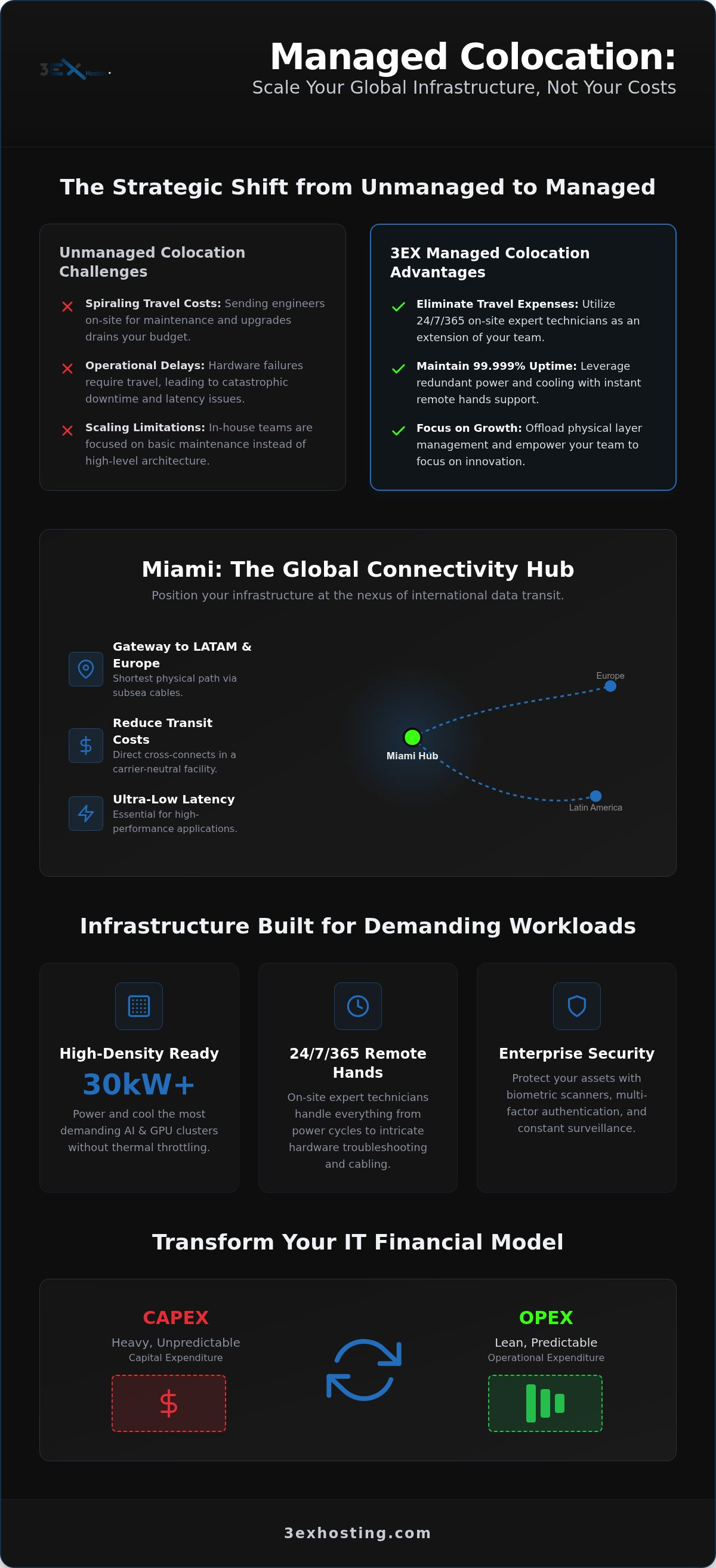
Managed colocation is the strategic pairing of enterprise-grade Colocation centre infrastructure with specialized on-site technical expertise. This model moves the burden of hardware maintenance from your internal team to dedicated professionals. It transforms heavy capital expenditure (CAPEX) into predictable operational costs (OPEX). Businesses don’t need to build and maintain their own cooling systems or power backups. Instead, they gain access to high-density environments designed for modern demands like AI GPU hosting and complex enterprise workloads.
Miami serves as a global “Carrier Hotel” and a vital transit hub for international data. Its status means the facility acts as a central nervous system for connectivity between continents. By placing your infrastructure here, you’re positioning your business at the intersection of major fiber routes. It’s about more than just rack space; it’s about the speed and reliability of your global reach. This setup ensures your hardware stays online and performs at peak levels without requiring your staff to be physically present.
The Strategic Advantage of the Miami Gateway
Miami’s role as a global transit hub is defined by its density of subsea cable landings. These cables provide the shortest physical path to Latin American and Caribbean markets. For enterprises, this means ultra-low latency for North-South data transit. In 2026, this geographic advantage is non-negotiable for high-performance applications. Utilizing colocation with remote hands Miami allows you to maintain this proximity without the logistical nightmare of managing a distant site. You get direct access to major carriers without the latency penalties of backhauling traffic to inland facilities.
Managed vs. Unmanaged Colocation: A Critical Comparison
Unmanaged colocation often leads to unexpected operational friction. When hardware fails, the delay in getting a technician on-site can be catastrophic for your uptime. Managed services solve this by providing remote hands support as a standard extension of your team. On-site professionals handle the physical layer, from simple power cycles to intricate hardware troubleshooting. This proactive approach ensures that your internal IT staff remains focused on high-level architecture rather than basic maintenance. Key enterprise benefits of this managed approach include:
- 99.999% uptime through redundant power grids and advanced cooling.
- Reduced travel expenses by eliminating the need for IT staff to visit the site.
- Specialized power density supporting 30kW+ per rack for AI and GPU clusters.
- Direct market access to Latin American and European transit points.
Choosing the right level of support depends on your internal team’s capacity. If you lack local staff in Florida, colocation with remote hands Miami becomes an essential insurance policy for your infrastructure’s stability.
Maximizing ROI with 24/7 Remote Hands and Operational Support
Outsourcing hardware maintenance to on-site experts is a calculated financial move. It eliminates the high cost of emergency travel and the overhead of maintaining local staff in every region. By choosing colocation with remote hands Miami, you’re essentially adding a tier-3 technical team to your roster without the associated recruitment and training costs. This model ensures that your physical infrastructure is managed by specialists who understand the specific nuances of high-density cabinets and GPU clusters. Sending engineers to Miami isn’t just expensive; it’s inefficient.
Security and environmental health are the pillars of this operational support. Facilities utilize biometric scanners, multi-factor authentication, and constant surveillance to protect your assets. Beyond physical access, real-time environmental monitoring provides visibility into power consumption and cooling efficiency. This transparency allows you to optimize your footprint and prevent thermal issues before they impact performance. You can request a custom infrastructure assessment to see how these efficiencies apply to your specific deployment.
24/7 Remote Hands: Beyond Simple Reboots
A professional Remote Hands Service handles much more than standard power cycles. Technicians perform complex tasks like full rack-and-stack deployments, intricate cabling, and internal component replacements. They also manage on-site inventory and logistics for new hardware arrivals. For a deeper look at these technical workflows, read our remote hands support guide. This level of service ensures that your deployment is handled with the same precision your own engineers would provide. It’s about technical stability and peace of mind.
Business Continuity and Redundancy Standards
Mission-critical workloads in 2026 demand rigorous redundancy standards. Most enterprise facilities operate on N+1 or 2N power architectures to ensure continuous operation during maintenance or utility failures. These standards are what make the “five nines” (99.999%) uptime benchmark possible. High-density AI operations can’t afford even a few minutes of downtime. Leveraging remote hands for rapid disaster recovery execution means that if a hardware failure occurs, a technician is already on-site to swap parts. This immediate response is the difference between a minor blip and a prolonged outage. It provides the technological optimism needed to scale globally with confidence.
High-Density Infrastructure: Powering AI and GPU Workloads
The 2026 infrastructure landscape is defined by a massive shift in power requirements. Traditional enterprise deployments once peaked at 5kW per rack. Modern AI GPU clusters now regularly exceed 30kW. This evolution requires data center environments that can handle intense thermal loads while maintaining stability. Utilizing full cabinet colocation provides the necessary physical foundation for these high-performance environments. Deploying colocation with remote hands Miami ensures that your high-density hardware is monitored by experts who understand the specific power draw of next-generation chips. Florida’s extended sales tax exemption through June 2027 makes this a financially sound window for significant infrastructure investment. It’s a strategic move for businesses looking to lock in high-performance capacity before power availability becomes a bottleneck across the region.
Specialized Cooling for GPU Server Hosting
Miami’s subtropical humidity presents unique challenges for thermal management. Standard air cooling often fails to dissipate the heat generated by 15kW to 50kW racks. Facilities must implement advanced air containment or liquid cooling solutions to prevent hardware throttling. Under Florida Senate Bill 484, data centers must now manage their energy and water consumption with greater transparency. This regulation makes efficient cooling systems even more critical for long-term viability. Power distribution units (PDUs) also require higher amperage and specialized phase balancing to support modern GPU servers. For a detailed technical breakdown, see our deep dive on high density GPU colocation. These systems ensure your hardware operates within safe thermal ranges, even during peak processing cycles.
Scalability: From Cages to Private Suites
Enterprise needs evolve quickly in the AI sector. You might start with a few racks but soon require physical isolation for security or compliance. Transitioning from shared space to custom cage solutions offers enhanced hardware isolation without the cost of a full suite. As your footprint grows, private data center suites provide the ultimate level of control over your environment. This scalability is essential for future-proofing your operations against upcoming hardware refresh cycles. Expert technicians on-site facilitate these migrations. They ensure that your transition from a single cabinet to a private suite is handled without disrupting your active workloads. Choosing colocation with remote hands Miami means you have the logistical support to expand your footprint the moment your compute requirements increase.
Network Interconnectivity: The Carrier Hotel Advantage
A carrier hotel is a specialized facility where dozens or even hundreds of network service providers converge to exchange traffic. Miami is home to one of the world’s most significant carrier hotels, the NAP of the Americas, which hosts 160 network carriers and connects over 150 countries. This concentration of providers defines the city’s network ecosystem. For enterprises, this density means you aren’t tied to a single ISP. Carrier-neutrality allows you to choose the best-performing provider for specific geographic regions, avoiding vendor lock-in and ensuring competitive pricing for your transit. Utilizing colocation with remote hands Miami gives you the physical proximity needed to manage these connections without maintaining a local network engineering team.
The role of cross-connect services within these facilities is vital for reducing latency. A cross-connect is a direct physical fiber link between two tenants or a tenant and a carrier. It bypasses the public internet entirely. This results in more predictable performance and lower transit costs. Peering opportunities at the Miami Internet Exchange (IX) further enhance this advantage by allowing you to exchange traffic directly with other networks. This ecosystem ensures that your data takes the shortest possible path to its destination, which is essential for real-time applications and high-frequency data processing.
Optimizing Cross-Connect Services
Direct fiber interconnections are the most efficient way to link your infrastructure to carriers and cloud providers. Reducing network hops is the primary goal here. Every hop your data takes across the public internet introduces potential latency and security risks. By establishing a direct cross-connect, you gain a dedicated, private path. This is significantly more reliable than relying on public internet transit, especially for high-bandwidth AI or enterprise workloads. It’s a cost-effective strategy that pays for itself through improved application response times and lower egress fees from cloud providers.
The Global Bridge: LatAm and European Gateway
Miami is ranked as one of the top five most-connected cities globally. It acts as a low-latency bridge for multinational operations, particularly those serving Latin America and Europe. From a Miami data center, you can access major cloud on-ramps for AWS, Azure, and Google Cloud Platform (GCP). This proximity ensures that your hybrid cloud architecture performs as if your on-premise hardware and cloud instances were in the same room. Redundant network paths are built into the facility’s design, providing the infrastructure needed for 100% global availability. Colocation with remote hands Miami ensures that if a physical patch cable fails or a new circuit needs to be provisioned, a technician is ready to act immediately.
Ready to optimize your global connectivity? Get a connectivity quote to see how our carrier-neutral cross-connects can reduce your transit costs.
Selecting Your Managed Colocation Partner in Miami
Choosing a data center partner requires looking beyond raw square footage. While many providers offer vast floors, the true differentiator in 2026 is the technical expertise of the on-site team. You need a partner that understands the physical requirements of high-density AI clusters and complex network interconnections. Evaluating colocation with remote hands Miami means prioritizing facilities where technicians are available 24/7/365 with guaranteed response times. If a critical component fails at 3:00 AM, the speed of on-site intervention determines your actual uptime. Rigid, one-size-fits-all plans often fail enterprise clients because they don’t account for unique hardware configurations or specific power draw profiles.
Compliance remains a non-negotiable factor for enterprise infrastructure. Your partner must maintain rigorous auditing standards, including SOC 2, HIPAA, and PCI DSS. These certifications ensure that the facility adheres to the highest levels of data security and operational integrity. In a managed environment, these protocols extend to how the remote hands team handles your hardware. Every interaction must be logged and monitored to maintain the chain of custody for your data. This level of oversight provides the security and peace of mind necessary for scaling sensitive workloads in a third-party facility.
The 3EX Hosting Difference
3EX Hosting provides a personalized approach that massive global aggregators often lack. We focus on high-touch support from a team that truly understands enterprise architecture and mission-critical continuity. Our facility is designed for high-density deployments that require specialized cooling and power management for modern GPU clusters. We don’t just provide rack space; we provide a stable, scalable foundation for your global operations. Ready to scale? Get a custom quote for your deployment today.
Next Steps for Infrastructure Migration
A successful migration begins with a thorough site audit and power density analysis. You must ensure your target environment can support your specific GPU or server requirements without thermal throttling. Utilizing move-in assistance helps eliminate deployment friction, allowing your team to focus on high-level architecture rather than the logistics of racking hardware. Finally, finalize your disaster recovery and network failover strategy to ensure 100% availability from day one. Securing colocation with remote hands Miami means you have a local team ready to execute these strategies the moment you go live. This proactive planning is the key to a seamless transition.
Future-Proofing Your Enterprise Infrastructure
Miami’s unique position as a global carrier hotel provides enterprises with an unparalleled gateway to international markets. By integrating high-density infrastructure with professional colocation with remote hands Miami, you eliminate the logistical friction of managing distant hardware. It’s a strategic shift that reduces operational overhead and travel costs. This allows your internal team to focus on high-level innovation rather than physical maintenance. You don’t have to worry about the physical layer when specialists are already on-site to handle the heavy lifting.
Our carrier-neutral carrier hotel facility offers N+1 redundant power and cooling systems designed for the most demanding 2026 workloads. With 24/7/365 on-site remote hands expertise, your systems remain in expert hands at all times. This combination of technical stability and strategic location is the key to maintaining a competitive edge. It provides the speed and reliability your global users expect without the traditional headaches of remote site management. You’re securing a foundation that grows with your compute needs.
Secure your high-density managed colocation in Miami today and build your infrastructure on a foundation of reliability. We’re ready to help you scale your most intensive workloads with confidence.
Frequently Asked Questions
What is the difference between managed and unmanaged colocation in Miami?
Managed colocation includes on-site technical oversight and proactive hardware support. Unmanaged colocation provides only the raw space, power, and cooling. Choosing colocation with remote hands Miami ensures that expert technicians handle your physical hardware tasks, which reduces the need for your own staff to visit the facility. This model shifts your operational focus from basic maintenance to high-level architecture while maintaining superior uptime.
How does Miami colocation improve latency for Latin American users?
Miami acts as the primary exchange point for major subsea cables connecting North and South America. By hosting your infrastructure here, your data follows the shortest physical path to markets in Brazil, Colombia, and the Caribbean. This proximity reduces network hops and minimizes transit delays. It’s a strategic necessity for real-time applications and financial services that require ultra-low latency for a global user base.
Can 3EX Hosting support high-density GPU racks for AI training?
Yes, our facility is specifically engineered to handle the intense requirements of high-density GPU hosting. We support power densities of 30kW+ per rack, which is essential for modern AI training clusters. Our advanced cooling systems and N+1 redundant power architectures ensure that your GPU servers operate at peak performance without thermal throttling. This specialized infrastructure is built to handle the intense power draws of next-generation hardware.
What tasks are included in 24/7 remote hands support?
Remote hands technicians perform a wide range of physical hardware tasks 24/7/365. These include power cycling equipment, cable management, rack-and-stack deployments, and swapping failed components like transceivers or hard drives. They also assist with inventory audits and receiving new hardware shipments. This availability ensures that physical layer issues are resolved immediately, regardless of where your primary IT team is located, maintaining your 99.999% uptime guarantee.
Is the Miami data center protected against hurricanes and power outages?
Our Miami data center features hurricane-resistant architecture and multi-layered power redundancy. We utilize N+1 redundant power grids and on-site fuel reserves to keep systems online during utility failures. The facility is located outside of primary flood zones and features reinforced structural designs. These safeguards are critical for maintaining enterprise stability in Florida’s subtropical climate, ensuring your data remains secure and accessible during extreme weather events.
What are the benefits of a carrier-neutral data center?
A carrier-neutral facility allows you to connect with any network provider rather than being locked into a single ISP. This creates a competitive environment that lowers transit costs and increases network reliability. You can choose different carriers for specific geographic routes to optimize performance for Latin America or Europe. It provides the flexibility to build a redundant network architecture that survives provider-specific outages and keeps your global applications online.
How quickly can I scale from a single cabinet to a private suite?
Scaling depends on your specific power and space requirements, but we facilitate rapid transitions through our cage solutions and private suites. Our on-site team manages the logistics of migration to minimize downtime during the move. Because we specialize in high-density environments, we can often accommodate power increases within your existing footprint before requiring a full suite move. This flexibility allows your infrastructure to grow at the speed of your business.
Does 3EX Hosting provide compliance certifications for healthcare or finance?
We maintain a rigorous compliance framework that supports the strict needs of healthcare and financial institutions. Our facility undergoes regular audits to ensure adherence to SOC 2, HIPAA, and PCI DSS standards. These certifications verify that our physical security, data handling protocols, and operational processes meet high regulatory requirements. We provide the documentation your auditors need to confirm that your hosted infrastructure is fully compliant and secure.