 SUPPORT


 3EX United States
 Blog
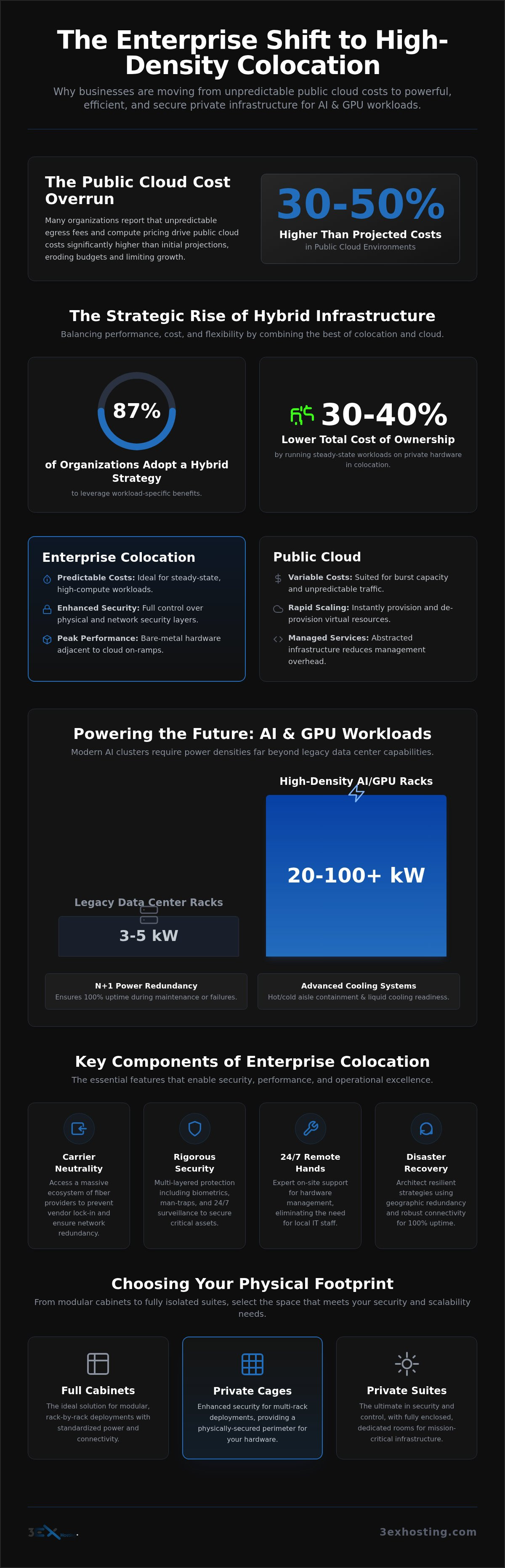
Did you know that many organizations now report their public cloud costs are 30% to 50% higher than projected because of data egress fees and unpredictable compute pricing? As of mid-2026, the shift toward hybrid infrastructure is a necessity for maintaining a competitive edge. Securing the right enterprise colocation solutions is no longer just about finding floor space. It’s about securing the power density required for AI and the network performance of a dedicated carrier hotel. You need a technical foundation that supports high-density GPU clusters without the massive capital expense of building a private facility.
We recognize the frustration of hitting power ceilings in legacy data centers or struggling to manage hardware across national sites without local staff. You need a guarantee of 100% uptime for mission-critical applications and a lower total cost of ownership. This guide will show you how to architect a high-density, resilient infrastructure that balances security and efficiency. We’ll explore the transition from full cabinets to private suites, the importance of 24/7 remote hands support, and how to integrate managed cloud services for a truly scalable national operation.
Key Takeaways
- Understand how enterprise colocation solutions differ from retail models by focusing on massive scale, high power density, and professional managed support.
- Learn the specific infrastructure requirements for high-density GPU clusters to ensure your AI and machine learning workloads remain stable and performant.
- Identify the optimal physical footprint for your deployment, whether you require the modularity of full cabinets or the enhanced security of private suites.
- Discover how remote hands support eliminates the need for local IT staff by providing expert hardware management and troubleshooting at any hour.
- Architect a resilient disaster recovery strategy that leverages carrier-neutral connectivity and geographic redundancy for 100% application uptime.
What are Enterprise Colocation Solutions?
An enterprise colocation solution is a strategic IT model where a business deploys its private hardware within a third-party, high-security facility. Unlike retail colocation, which often focuses on small-scale space rental, What is a colocation center? in an enterprise context is defined by scale, extreme power density, and sophisticated managed support. These facilities function as a “Carrier Hotel,” acting as a central hub for network performance and providing direct access to a massive ecosystem of fiber providers and cloud on-ramps.
In 2026, we’re seeing a significant shift in infrastructure strategy. Many organizations are repatriating workloads from the public cloud back to physical hardware. Research shows that pure cloud costs can be 30% to 50% higher than projected due to data egress fees and unpredictable compute pricing. By utilizing enterprise colocation solutions, companies regain control over their total cost of ownership while maintaining the agility of a modern data center environment.
The Core Components of Enterprise-Grade Facilities
Modern enterprise needs have evolved far beyond the standard 3-5kW rack. To support AI and high-performance computing, facilities must now provide power densities ranging from 20kW to 100kW per rack. This requires specialized cooling and power redundancy. Carrier neutrality is another non-negotiable requirement. It ensures you have access to multiple fiber providers, preventing vendor lock-in and providing the redundancy needed for 100% uptime. Security protocols must also be rigorous, incorporating biometrics, man-traps, and 24/7 surveillance to protect your mission-critical assets.
Hybrid Cloud vs. Pure Colocation
The most effective strategy in 2026 is often a hybrid approach. A recent study found that 87% of organizations have adopted a hybrid infrastructure strategy to balance performance and flexibility. By integrating managed cloud hosting with your physical deployment, you can bridge the gap between virtual resources and bare-metal hardware. Placing your private servers adjacent to cloud on-ramps reduces latency significantly. This allows you to run steady-state, high-compute workloads on your own hardware for a 30% to 40% lower TCO while using the cloud for burst capacity and rapid scaling.
Architecting for High-Density GPU and AI Workloads
The 2026 AI boom has fundamentally changed infrastructure requirements. Standard data center racks, typically designed for 3-5kW, are failing to meet the massive power demands of modern GPU clusters. High-performance AI training environments now require 20kW to 100kW per rack. To support these workloads, businesses need specialized high density GPU colocation. This isn’t just about raw power; it’s about heat management. Modern facilities utilize hot and cold aisle containment and are increasingly prepared for liquid cooling deployments to ensure hardware longevity and performance stability.
Reliability is paramount. Mission-critical AI applications can’t afford downtime. This makes N+1 power redundancy a baseline requirement for any serious enterprise deployment. You need a technical foundation where power, cooling, and connectivity are always available, even during maintenance or component failure. Many organizations are prioritizing these robust environments to support their disaster recovery and global connectivity goals, ensuring that AI models remain accessible across national sites.
Power Management for GPU Clusters
Calculating the power draw for AI dedicated servers requires precision. A single high-performance cluster can draw as much power as a small office building. We recommend utilizing metered power configurations for your enterprise colocation solutions. This provides transparent billing based on actual usage rather than estimated capacity. To prevent catastrophic failure, your architecture must include redundant power feeds and industrial-grade UPS systems. These layers of protection ensure that even a primary grid failure won’t interrupt your training cycles.
Connectivity for Distributed AI Training
AI training often happens across distributed systems, making low-latency communication essential. High-performance cross-connect services allow your clusters to communicate at wire speed. This is critical for multi-site AI deployments where data must move rapidly between private suites and cloud on-ramps. As your projects grow, your infrastructure should scale naturally. You might start with a single rack and expand into custom cage solutions as your hardware requirements increase. If you’re planning an AI expansion, you can request a technical consultation to review your specific power and cooling needs.
Comparing Space Configurations: Cabinets, Cages, and Suites
Selecting the right configuration of enterprise colocation solutions is a balance between current hardware density and future expansion needs. This framework helps you choose a physical footprint that matches your server count and security mandates. Modularity is essential for national operations. You need to deploy resources quickly without the overhead of building a private facility. Whether you are standardizing a few racks or requiring a high-security room, the choice of configuration dictates your long-term operational efficiency.
Full Cabinet Colocation for Rapid Scaling
Standardizing on full cabinet colocation is the most efficient way to manage predictable growth. Each cabinet acts as a self-contained environment with dedicated power and cooling for your specific hardware stack. It’s the ideal choice for branch office hubs and mid-sized application deployments. Proper airflow management and structured cabling within the rack ensure your equipment runs at peak performance. This setup allows for rapid scaling, as additional cabinets can be added to your environment as your compute needs evolve.
When to Upgrade to Private Suites or Cages
As your infrastructure grows, physical segregation becomes a priority. Cage solutions provide a fenced area within the shared data center floor. This is often a requirement for compliance standards like PCI-DSS or HIPAA, which mandate restricted physical access to hardware. Cages allow you to customize your cooling and security protocols while still benefiting from the facility’s shared power and connectivity. It’s a cost-effective way to achieve physical isolation without the expense of a full room.
For large-scale deployments, private colocation suites offer the highest level of sovereignty. A private suite is a fully enclosed room with its own biometric access and environment controls. This configuration is perfect for enterprises that need complete autonomy over their data center footprint. It provides the space needed for custom hardware configurations, including high-density AI clusters or extensive disaster recovery setups. Moving from a cabinet to a suite is a natural progression as your national footprint expands and your security requirements become more stringent. Using enterprise colocation solutions that offer this path ensures you never outgrow your infrastructure provider.
Operational Excellence: Remote Hands and Managed Support
Deploying hardware across multiple national sites presents a significant logistical hurdle. You can’t have your senior engineers on a plane every time a server needs a hard reset or a drive swap. This is where the managed component of enterprise colocation solutions becomes critical. By leveraging on-site technical expertise, you maintain high availability without the overhead of local staffing. This professional layer of support ensures that your infrastructure remains resilient, even when your core team is thousands of miles away.
Remote hands support provides immediate access to skilled technicians who act on your behalf. Their scope ranges from simple power cycles and cable checks to complex component replacements and firmware updates. This presence is vital for meeting strict SLA requirements for 24/7/365 infrastructure. Having experts already on the data center floor drastically reduces your Mean Time To Repair (MTTR). You solve problems in minutes rather than waiting hours for a technician to arrive on-site. It’s about maintaining a constant state of readiness.
The ROI of Remote Hands for National Teams
The financial benefits of these services are immediate. You eliminate the travel expenses and lost productivity associated with sending internal IT staff to remote facilities. It allows your core team to focus on high-level architecture while the facility handles the physical maintenance. Remote Hands is the physical extension of your IT team for 24/7 uptime. This model supports rapid national expansion. You can deploy in any strategic market knowing you have consistent, professional support levels from day one. This consistency is the foundation of a scalable national operation.
Onboarding and Move-In Assistance
The initial deployment phase is often the most resource-intensive part of the lifecycle. Professional move-in assistance streamlines this transition by managing the heavy lifting of logistics. Technicians handle the receiving of shipments, inventory logging, and the physical racking and stacking of your equipment. This removes the strain from your internal resources. During the setup, the team performs rigorous verification of connectivity and power redundancy. This ensures your environment is stable before the first workload goes live. If you need a partner to handle your next deployment, explore our managed support options to see how we can assist your team.
Strategic Continuity: Disaster Recovery and Global Connectivity
Strategic continuity requires more than just local backups. It demands an architecture that survives regional outages and network failures. Integrating disaster recovery solutions into your primary infrastructure plan ensures that mission-critical applications remain available regardless of external events. Geographic redundancy is the standard for 2026. By utilizing multiple carrier-neutral sites, you can establish automated failover protocols. This approach uses high-performance cross-connect services for rapid data replication. It keeps your secondary site synchronized with your production environment in real-time. This level of synchronization is essential for maintaining bare-metal performance while ensuring data integrity across a national footprint.
Network Redundancy in Carrier Hotels
A carrier hotel provides the highest level of network performance for enterprise colocation solutions. You can bypass the public internet entirely by using direct cross-connects. This reduces latency and increases security for data moving between your private suites and other service providers. Leveraging peering exchanges further improves global reach. It allows your traffic to hop directly between networks at the shortest possible path. Network diversity is essential. You must ensure your facility provides multiple entry points for fiber. This eliminates single points of failure in your connectivity stack. Redundant paths from separate carriers ensure that even a major street-level fiber cut won’t take your systems offline.
Implementing a 3-2-1 Strategy with Colocation
The 3-2-1 backup strategy remains the gold standard for data protection. You keep three copies of your data on two different types of media, with one copy stored off-site. Colocation facilities provide the ideal “gold copy” environment. This is the secure, physical hardware that serves as your ultimate source of truth. You can combine this with managed cloud hosting for a versatile hybrid model. This setup allows you to store backups in a separate geographic region while maintaining high-speed access to your primary hardware. Designing your infrastructure this way future-proofs your operations against technology shifts and evolving security threats. It provides the flexibility to adapt to new hardware standards without rebuilding your entire network. If you’re ready to architect a more resilient foundation, you can get a custom quote for your enterprise colocation needs to begin the process.
Building a Technical Foundation for the Next Era of Growth
Success in 2026 depends on your ability to pivot between physical performance and cloud agility. By choosing the right enterprise colocation solutions, you secure a technical foundation that supports high-density AI clusters while maintaining complete cost control. We’ve explored how carrier-neutral connectivity and geographic redundancy eliminate single points of failure. Offloading physical maintenance to experts allows your team to focus on innovation rather than hardware swaps. 3EX Hosting provides the high-density AI infrastructure expertise and high-speed cross-connects needed for modern national operations.
Reliability isn’t just about power; it’s about having 24/7/365 on-site remote hands support ready to act at a moment’s notice. Your infrastructure should be a catalyst for growth, not a bottleneck. Whether you’re deploying a single cabinet or a private suite, the right environment ensures your mission-critical applications remain online and performant. It’s time to move beyond legacy limitations and embrace a scalable, resilient future. Secure Your Enterprise Infrastructure with 3EX Hosting today. Your systems are in expert hands.
Frequently Asked Questions
What is the difference between retail and enterprise colocation?
Retail colocation typically focuses on small-scale space rentals for small businesses. Enterprise colocation solutions are built for massive scale, offering high-density power and private suites. These facilities prioritize carrier-neutral connectivity and professional managed support to handle national infrastructure needs. While retail users might only need a few rack units, enterprise clients require dedicated cages or rooms with custom security protocols and N+1 redundancy for mission-critical applications.
How do high-density colocation solutions support AI and GPU hardware?
AI and GPU clusters require significantly more power and cooling than standard server racks. High-density facilities provide power ranging from 20kW to 100kW per rack, compared to the 3-5kW found in legacy data centers. They also utilize advanced cooling technologies like hot and cold aisle containment or liquid cooling readiness. These environments ensure that power-hungry hardware stays within safe thermal limits, preventing thermal throttling and maintaining peak compute performance.
What are the benefits of using a carrier-neutral data center?
A carrier-neutral facility allows you to connect with multiple fiber providers rather than being locked into a single ISP. This creates network diversity and eliminates single points of failure. You can negotiate better rates and performance levels by choosing the provider that best fits your specific geographic needs. This flexibility is essential for national enterprises that require redundant paths for disaster recovery and low-latency global connectivity across different regions.
How does remote hands support improve data center efficiency?
Remote hands support acts as a physical extension of your IT team, eliminating the need to send staff to the data center for routine tasks. Technicians on-site can perform reboots, cable swaps, and hardware replacements immediately. This drastically reduces your Mean Time To Repair (MTTR) and ensures 24/7/365 availability. By offloading physical maintenance to the facility staff, your senior engineers can focus on higher-level architecture and strategic software initiatives.
What security certifications should an enterprise colocation provider have?
Look for providers that maintain rigorous compliance standards to protect your data. Common certifications include SOC 2 Type II for operational security and HIPAA or PCI-DSS for industries handling sensitive health or financial information. These standards ensure the facility uses biometric access, 24/7 surveillance, and strict visitor logging protocols. Verifying these certifications is a critical step in risk management when deploying mission-critical hardware in a third-party, high-security environment.
Can I integrate managed cloud hosting with my colocation cabinet?
Yes, integrating managed cloud hosting with your physical hardware is a standard hybrid strategy. Many enterprise colocation solutions provide direct on-ramps to major cloud providers through high-speed cross-connects. This allows you to run steady-state workloads on your private bare-metal servers while using the cloud for burst capacity. This hybrid model balances the performance and security of physical infrastructure with the flexibility and rapid scalability of virtual resources.
What are the typical power density limits for modern enterprise racks?
Modern enterprise racks have evolved to support much higher densities than in previous years. While 5kW was once the standard, today’s high-performance environments frequently support 20kW to 30kW per rack. Specialized AI and GPU clusters can even exceed 50kW or 100kW in facilities designed for liquid cooling. Understanding these limits is vital for planning your hardware deployment and ensuring your facility’s cooling system can handle the resulting thermal load without hardware damage.
How do cross-connect services reduce network latency and costs?
Cross-connect services provide direct, physical links between your equipment and other providers within the same facility. By bypassing the public internet, you achieve wire-speed communication with significantly lower latency. This direct path also eliminates data egress fees associated with transit providers, leading to substantial cost savings for high-bandwidth applications. It’s an essential feature for rapid data replication between sites and for connecting directly to peering exchanges or cloud on-ramps.