 SUPPORT


 3EX United States
 Blog
In 2026, a standard 5kW server rack isn’t just outdated; it’s a liability that can stall an entire enterprise AI roadmap. You’ve likely experienced the frustration of thermal throttling or the anxiety of a facility that simply cannot support the 20kW plus densities required by modern GPU clusters. It’s a common struggle for technical teams trying to balance massive compute requirements with the physical limitations of legacy infrastructure.
Finding a reliable data center Miami AI hub that handles these extreme power and cooling demands is now a strategic necessity. We understand that your priority is keeping your hardware running at peak performance without the fear of power failures or connectivity bottlenecks. This guide shows you how to scale high-density GPU workloads using specialized colocation strategies designed for the specific demands of modern artificial intelligence. We will cover how to maximize your GPU uptime; reduce your total cost of ownership through efficient liquid cooling; and ensure low-latency connectivity to global carrier hotels. By the end, you’ll have a clear path to building a stable, high-performance foundation for your most intensive AI pipelines.
Key Takeaways
- Understand why modern GPU hosting requires a transition from legacy power densities to high-performance configurations exceeding 20kW per rack.
- Learn how specialized thermal management and airflow containment prevent thermal throttling to keep your AI clusters running at maximum efficiency.
- Analyze the cost-benefits of colocation versus cloud for persistent training workloads while maintaining full control over your proprietary datasets.
- Evaluate the strategic advantage of a data center Miami AI facility for low-latency access to global carrier hotels and international markets.
- See how 24/7 on-site support and private suites provide the operational stability needed to scale enterprise AI infrastructure without downtime.
What defines an AI-ready data center in 2026?
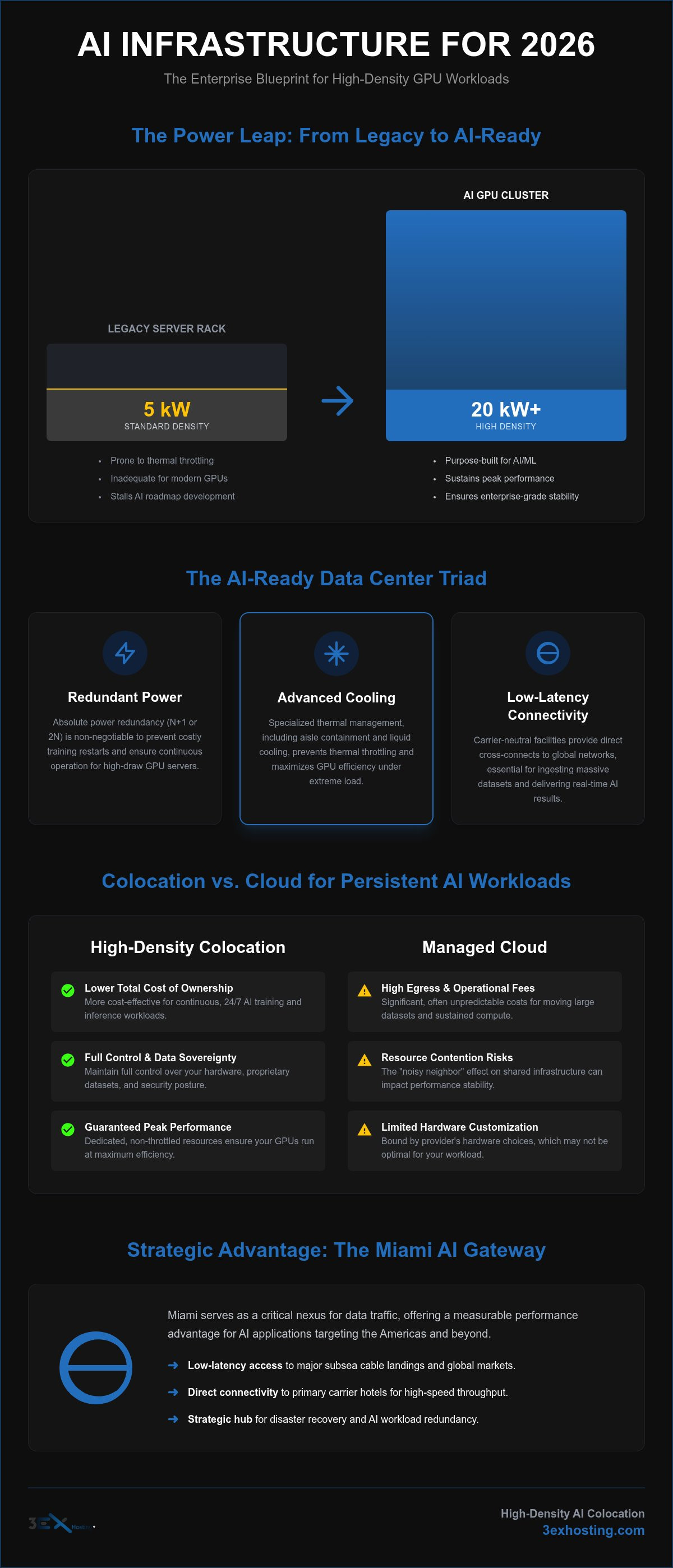
An AI-ready facility in 2026 is defined by its ability to sustain continuous, high-draw compute cycles without thermal failure. Traditional data center designs, built for standard enterprise applications, typically support 3kW to 5kW per rack. Modern artificial intelligence requires a massive leap in engineering. A single rack housing high-end GPU clusters can easily exceed 20kW. This shift forces a complete rethink of floor loading, power distribution, and heat dissipation. It’s no longer enough to have empty floor space; you need specialized infrastructure that’s purpose-built for the electrical and thermal load of dense GPU arrays.
Choosing a data center Miami AI hub provides a strategic advantage for enterprises managing these workloads. It’s about more than just square footage. It’s about access to specialized power circuits and industrial-grade cooling that can handle the intense heat signatures of modern hardware. Facilities that haven’t upgraded their power delivery systems often face frequent circuit trips or thermal throttling, which directly impacts your training timelines and operational costs.
The AI Infrastructure Triad: Power, Cooling, Connectivity
Success in AI deployment rests on three pillars: power, cooling, and connectivity. Power redundancy must be absolute. GPU dedicated servers draw significant current; even a minor fluctuation can lead to costly training restarts. Specialized high density GPU colocation has become the industry standard because it provides the robust electrical infrastructure these chips demand. You need N+1 or 2N redundancy at the rack level to ensure that your compute clusters never go dark.
Connectivity is the final piece of the triad. Carrier-neutral facilities enable direct cross-connect services to multiple providers. This is essential for ingesting massive datasets from various sources and delivering low-latency inference results to global users. In a multi-cloud architecture, these cross-connects allow your AI infrastructure to communicate directly with other cloud environments, bypassing the public internet to reduce latency and improve security.
Strategic Location: The Miami Gateway as a National Asset
Miami serves as a critical nexus for both national and international data traffic. For enterprises, a data center Miami AI deployment offers proximity to major subsea cable landings and primary carrier hotels. This location reduces the physical distance data must travel, which is vital for real-time AI applications that require millisecond response times. If your AI model is performing real-time inference for users across the Americas, being located at this gateway is a measurable performance advantage.
Florida-based hubs have also become a primary choice for disaster recovery and AI redundancy. Large-scale organizations use these facilities to ensure their AI pipelines remain operational if a primary site fails. Being situated within a major carrier hotel ensures that even during peak traffic, your infrastructure maintains high-speed access to the global internet backbone. This level of connectivity is non-negotiable for data-heavy training sessions that involve petabytes of information moving between disparate storage and compute nodes.
Solving the Thermal Challenge: Cooling Strategies for AI Clusters
The physics of high-density computing creates a concentrated heat signature that standard air conditioning cannot mitigate. Traditional Computer Room Air Conditioning (CRAC) units are designed for lower-density environments where heat is distributed evenly across many racks. In a data center Miami AI deployment, a single cabinet might generate as much heat as an entire row of legacy servers. This concentration leads to hot spots and rapid thermal throttling if the airflow isn’t surgically managed. Relying solely on ambient room cooling is no longer a viable strategy for 20kW+ workloads.
Efficiency in 2026 is measured by how well a facility isolates cold supply air from hot exhaust. Hot aisle and cold aisle containment systems have evolved into mandatory requirements. By physically sealing one side of the rack row, you ensure that cold air is forced through the high-performance heat sinks of your GPUs rather than bypassing them. Research into advanced management software shows it’s possible to cut cooling energy use significantly by dynamically adjusting airflow to match real-time compute loads. This precision directly impacts your Power Usage Effectiveness (PUE) rating, keeping operational costs manageable even as power draw climbs.
Passive vs. Active Cooling for High-Density Racks
Passive cooling relies on the server’s internal fans to move air, but this reaches its limit around 15kW per rack. Beyond this point, you must transition to active containment or rear-door heat exchangers. These units use chilled water loops to neutralize heat before it ever enters the room. Containment efficiency in 20kW+ racks is defined as the percentage of exhaust air successfully captured and cooled before it can recirculate into the cold aisle. Maintaining this balance is critical for hardware longevity. High temperatures don’t just slow down processing; they accelerate component degradation and lead to unpredictable hardware failures.
Integrating Liquid Cooling in Colocation Environments
Liquid-to-chip cooling is the gold standard for the most demanding AI clusters in 2026. While many facilities struggle to support liquid infrastructure, specialized cage solutions datacenter options provide the physical flexibility needed for custom plumbing and coolant distribution units (CDUs). This setup allows enterprises to bring their own liquid-cooled hardware into a shared environment without compromising the facility’s existing systems. If you’re planning a massive GPU rollout, requesting a technical consultation can help determine which cooling architecture fits your specific density requirements.
Colocation vs. Managed Cloud for AI Training Workloads
Many enterprises begin their AI development in the public cloud for the sake of convenience. However, as training cycles move from experimental phases to full production, the cost of “always-on” GPU instances becomes a significant drain on capital. Renting high-end GPUs like the NVIDIA H100 can cost between $1.49 and $6.98 per hour depending on the provider. When you’re running 24/7 training pipelines, these fees quickly surpass the cost of purchasing and housing your own hardware. A data center Miami AI strategy allows you to own the asset, control the lifecycle of your hardware, and realize a much higher long-term ROI through predictable monthly infrastructure costs.
The decision to move from a rental model to a colocation model isn’t just about the hardware purchase price. It’s about the total cost of ownership over a three to five-year period. Owning your GPU clusters allows for custom configurations that aren’t available in standardized cloud instances. You can optimize your memory-to-core ratios and storage throughput specifically for your model’s architecture. This level of customization ensures that your hardware is working at maximum efficiency, which shortens training times and reduces the energy required for each epoch.
Privacy and Compliance in AI Infrastructure
Regulated industries, such as finance and healthcare, face strict data sovereignty requirements that are difficult to satisfy in a multi-tenant cloud environment. Storing proprietary training data on shared platforms introduces risks that many compliance officers won’t accept. This is where private suites become essential. They offer physical and network isolation, ensuring your datasets never touch shared infrastructure. You maintain full control over the physical access to the hardware and the data, effectively addressing the primary security concerns associated with proprietary Large Language Models (LLMs).
Network Performance and Cross-Connect Economics
Moving massive datasets in and out of the public cloud often incurs heavy egress fees that can cripple a project’s budget. By using a hybrid model, you can link your physical GPU clusters with managed cloud hosting using direct cross-connects. This setup eliminates public internet latency and bypasses expensive data transfer fees. In a carrier-neutral environment, these interconnections accelerate inference response times by providing direct paths to major cloud on-ramps. It gives you the flexibility to burst into the cloud for specific, short-term tasks while keeping your heavy-duty training in a stable, cost-effective colocation environment. This strategic placement in a data center Miami AI hub ensures you have the fastest possible path to both domestic and international traffic hubs.
Operational Excellence: Remote Hands for High-Density AI
High-density AI infrastructure requires a hands-on approach that goes beyond simple server reboots. When you’re dealing with specialized hardware, every minute of downtime translates to lost compute cycles and delayed training results. Utilizing a data center Miami AI facility with 24/7 on-site support ensures that physical hardware issues are addressed immediately without waiting for your internal team to travel. This level of responsiveness is non-negotiable for mission-critical clusters where a single hardware failure can stall multi-million dollar projects for days.
The ROI of remote hands support is measurable in both reduced travel expenses and minimized downtime. Instead of flying engineers across the country for routine maintenance, you leverage local experts who understand the nuances of high-performance computing. These technicians handle complex tasks such as GPU card swaps and the intricate cable management required for high-speed InfiniBand fabrics. Proper cable routing is essential in dense environments to maintain airflow and prevent signal degradation in the data fabric. Even small obstructions in a 20kW rack can lead to localized heat pockets that trigger thermal throttling.
The Role of Expert Remote Hands in AI Uptime
Technical infrastructure support differs significantly from basic remote assistance. It involves deep familiarity with liquid cooling loops, high-density power distribution units, and the physical architecture of GPU-heavy racks. These technicians act as a seamless extension of your national IT team, following precise protocols to ensure system integrity during upgrades or repairs. Enterprise-grade remote hands typically operate under a service level agreement that guarantees a response time of 15 to 30 minutes for critical incidents. This ensures your data center Miami AI deployment remains stable regardless of where your primary engineering team is located.
Disaster Recovery and Business Continuity for AI
Maintaining AI availability during power grid fluctuations or extreme weather events requires a robust strategy. Modern disaster recovery solutions integrate directly with your high-density colocation footprint to provide automated failover and data redundancy. Planning for failover in distributed AI training environments ensures that if one node or facility faces an outage, the workload can migrate to a secondary site without losing progress. This level of planning protects the massive investment you’ve made in data ingestion and model training. If you’re planning a new deployment, leveraging move-in assistance can streamline the initial installation and configuration of your AI clusters to ensure they are built for long-term stability.
Scaling Your AI Infrastructure with 3EX Hosting
3EX Hosting provides the physical foundation for scaling enterprise intelligence. Whether you need a single full cabinet colocation unit or an entire private suite, our infrastructure adapts to your specific GPU requirements. We’ve engineered our facility to support 20kW plus per rack, ensuring you can deploy the latest H100 or B200 clusters without power constraints. Choosing our data center Miami AI hub means your infrastructure is positioned at the intersection of high-speed fiber routes and industrial-grade power distribution. We don’t just offer space; we provide an environment where high-density hardware can thrive at peak utilization.
The strategic advantage of our carrier-neutral facility lies in its connectivity. We provide direct access to major subsea cables and international carrier hotels, which is vital for reducing latency in real-time inference. Accelerating the transit of massive training datasets across global networks requires more than just bandwidth. It requires the low-latency cross-connects that only a premier Miami hub can provide. This ensures your models stay synchronized across distributed environments while keeping data transfer costs predictable and manageable.
Future-proofing your investment is a core part of our mission. Our infrastructure is designed to grow with next-generation GPU iterations that will inevitably demand even higher power and cooling thresholds. To simplify your transition, our team provides expert move-in assistance. We handle the physical logistics of getting your high-value hardware from the loading dock to a fully cabled and cooled state. This allows your engineering team to focus on model architecture rather than rack mounting and cable dressing.
Tailored Infrastructure for National Enterprises
National enterprises require a partner that understands the scale of global AI operations. Our Florida-based hub acts as a strategic gateway, offering the stability and redundancy needed for complex, distributed AI architectures. We maintain a national service perspective, ensuring that your data center Miami AI deployment meets the same rigorous standards as any Tier IV facility in the country. You can initiate a technical consultation to map out your specific floor loading and power distribution needs long before your first rack arrives. This proactive planning ensures a seamless deployment that matches your exact technical specifications.
Getting Started with 3EX AI Hosting
Starting your deployment begins with a comprehensive audit of your current and projected GPU power and cooling needs. We analyze your hardware specifications to ensure the thermal management system is perfectly aligned with your compute load. This precision prevents future bottlenecks and optimizes your total cost of ownership. Once the audit is complete, we provide a detailed plan for your high-density environment, including custom cage or suite configurations. Ready to scale your compute capacity? Get a Quote for Your AI Infrastructure and secure your place in a facility built for the future of intelligence.
Securing Your AI Roadmap for 2026 and Beyond
Scaling AI infrastructure requires more than just raw compute power; it demands a facility engineered for the extreme thermal and electrical loads of 2026. You’ve seen how specialized cooling and high-density power distribution are essential for maintaining GPU uptime and reducing total cost of ownership. By moving beyond the public cloud and leveraging private suites, you gain the security and hardware control necessary for proprietary model training.
Choosing a data center Miami AI hub places your infrastructure at a critical nexus of global connectivity. 3EX Hosting provides the stability your enterprise needs through enterprise-grade power redundancy and a strategic carrier hotel location. Our 24/7 on-site remote hands support ensures that your mission-critical clusters are managed by experts who understand high-performance fabrics and liquid cooling loops.
Don’t let legacy infrastructure stall your innovation. When you’re ready to build a reliable, high-performance foundation for your intelligence workloads, we’re here to help you scale. Request a High-Density Colocation Quote to secure your infrastructure today.
Frequently Asked Questions
What is the maximum power density per rack supported for AI workloads?
3EX Hosting supports high-density cabinet configurations up to 20kW+ per rack. This capacity is specifically engineered to handle the intense electrical draw of modern GPU clusters used in AI training and inference. Unlike legacy facilities that cap power at 5kW, our infrastructure ensures that your high-performance hardware operates without the risk of circuit trips or power starvation. This level of density is a prerequisite for scaling enterprise-grade artificial intelligence models efficiently.
How does high-density GPU colocation differ from standard server hosting?
High-density GPU colocation differs from standard hosting primarily through its specialized power delivery and thermal management systems. Standard hosting is designed for general-purpose servers with low power requirements. In contrast, a data center Miami AI environment provides the robust cooling and electrical infrastructure needed to dissipate the massive heat generated by dense GPU arrays. This specialized environment prevents thermal throttling and hardware degradation, ensuring your AI workloads maintain peak performance and reliability.
Why is Miami considered a strategic hub for AI data center infrastructure?
Miami serves as a primary connectivity gateway between North America, Latin America, and the Caribbean. Its status as a major carrier hotel hub makes it a strategic location for enterprises targeting these global markets. By deploying in a data center Miami AI facility, you gain low-latency access to subsea cable landings and international fiber routes. This geographic advantage is critical for real-time AI applications that require millisecond response times and high-speed data ingestion from diverse global sources.
Can 3EX Hosting support liquid cooling for high-performance GPU clusters?
Yes, we support liquid cooling for high-performance GPU clusters through our customizable Cage Solutions. These environments provide the physical flexibility required to install non-traditional thermal management systems, such as rear-door heat exchangers or liquid-to-chip cooling loops. Our facility is engineered to accommodate the specialized plumbing and coolant distribution units necessary for next-generation hardware. This allows you to bring your own liquid-cooled infrastructure into a secure, enterprise-grade colocation environment without compromising performance or facility safety.
What are the benefits of carrier-neutral connectivity for AI inference?
Carrier-neutral connectivity allows you to establish direct cross-connect services to multiple network providers and cloud on-ramps. For AI inference, this means you can choose the fastest, most cost-effective path for your data, significantly reducing latency compared to the public internet. It also helps eliminate expensive egress fees by creating direct links to your managed cloud environments. This flexibility ensures your AI stack remains agile, secure, and capable of scaling across multi-cloud architectures without connectivity bottlenecks.
How do Remote Hands services assist in managing AI hardware?
Our 24/7 on-site Remote Hands services provide technical infrastructure support for complex AI hardware tasks. Technicians handle physical GPU card swaps, intricate InfiniBand cable management, and initial cluster deployments. They act as a local extension of your IT team, ensuring your hardware stays operational without requiring your staff to travel. This support is essential for maintaining uptime in high-density environments where physical issues must be addressed immediately to prevent project delays and hardware failures.
What security measures are in place for Private Colocation Suites?
Private Colocation Suites offer the highest level of physical and network isolation for sensitive AI workloads. These suites provide dedicated floor space with restricted access controls, ensuring your proprietary hardware and training data never touch shared infrastructure. You maintain full control over the physical environment, including custom surveillance and biometric access if required. This isolation is a critical requirement for regulated industries like finance and healthcare that must meet strict data sovereignty and compliance standards.
Is there a minimum commitment for Full Cabinet Colocation?
We offer flexible infrastructure solutions tailored to the needs of national enterprises, ranging from full cabinets to private suites. While specific contract terms vary based on your power requirements and custom configuration needs, we focus on providing long-term stability for your AI roadmap. We recommend initiating a technical consultation to discuss your specific cluster requirements and deployment timelines. Our team will then provide a custom quote that aligns with your operational goals and infrastructure demands.