 SUPPORT


 3EX United States
 Blog
Can your current infrastructure sustain 20kW per rack without triggering a thermal shutdown by mid-afternoon? As AI and GPU workloads intensify, the gap between standard facilities and specialized high density colocation Miami centers is widening quickly. You shouldn’t have to choose between raw processing power and long-term system stability. Most enterprise IT managers already know that traditional cooling methods are failing under the weight of 2026 hardware demands; leading to performance bottlenecks that stall critical projects.
We understand the frustration of thermal throttling and the hidden costs that often lurk within metered power pricing. You need more than just floor space; you need a thermal environment engineered for high-performance computing. This guide provides a clear roadmap for scaling your enterprise infrastructure without compromise. You’ll discover how to secure stable 20kW+ power delivery, achieve sub-millisecond cross-connects to major carriers, and utilize 24/7 remote hands as a force multiplier for your technical team. We will explore the specific engineering required to turn Miami’s premier carrier hotels into a high-speed, reliable gateway for the Americas.
Key Takeaways
- Understand why 2026 AI and GPU workloads require high density colocation Miami facilities capable of delivering stable 20kW+ power per rack.
- Learn to implement advanced airflow management and hot/cold aisle containment to eliminate thermal bottlenecks in high-performance computing environments.
- Explore the latency benefits of carrier-neutral meet-me rooms and sub-millisecond cross-connects for reaching Latin American and national markets.
- Follow a technical checklist for auditing hardware power consumption and optimizing rack dimensions for efficient cable routing and airflow.
- Discover how 24/7 remote hands support and N+1 power redundancy provide a secure, scalable foundation for mission-critical enterprise infrastructure.
Defining High-Density Colocation in the Miami Market
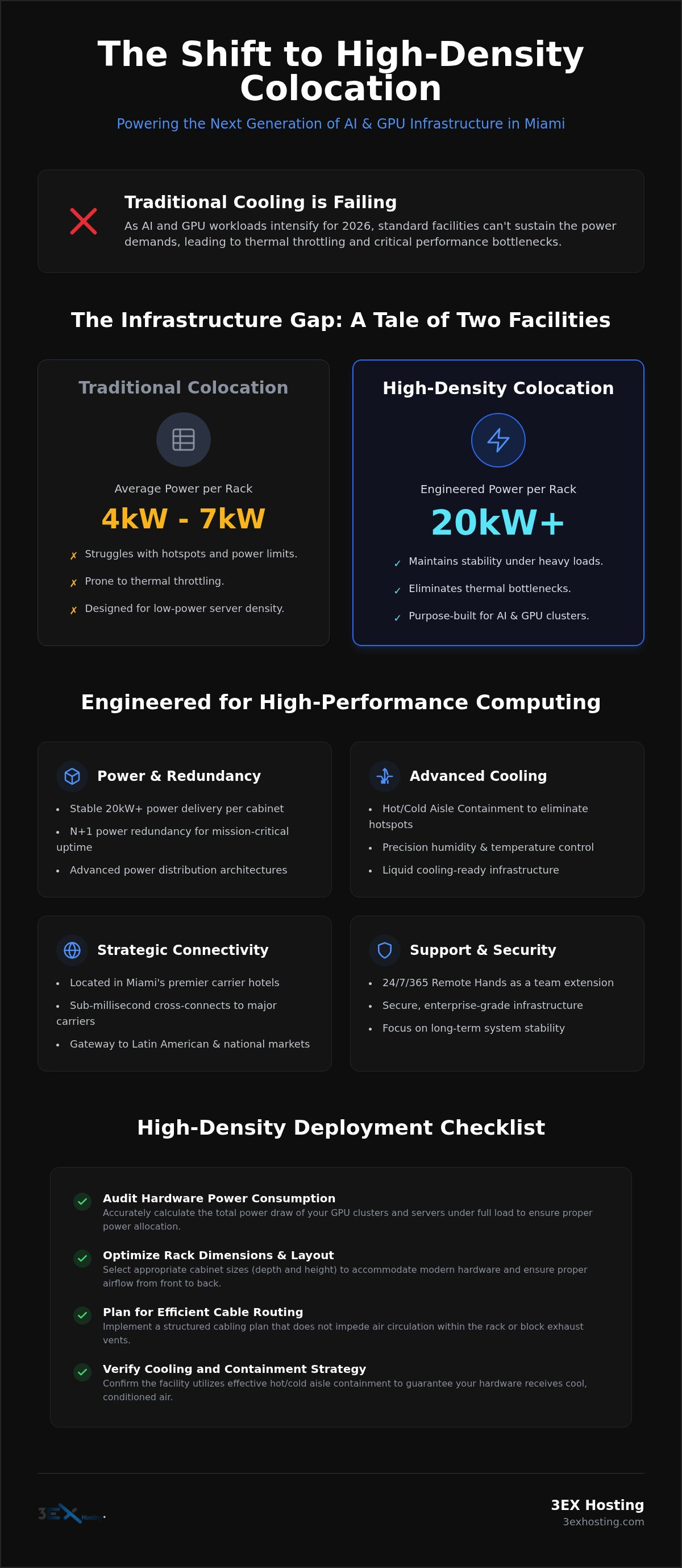
High-density colocation represents a fundamental shift in infrastructure design. While traditional facilities manage average loads of 4kW to 7kW per cabinet, high density colocation Miami environments are purpose-built for power draws exceeding 15kW to 20kW. This isn’t just a minor upgrade. It’s a total re-engineering of how a data center manages power delivery and heat rejection. Standard facilities often struggle with hotspots or power limitations when racks are fully populated with modern compute nodes. High-density specialists, however, utilize advanced power distribution and cooling architectures to maintain stability under constant, heavy loads.
The transition from traditional web hosting to AI-driven infrastructure has redefined the requirements for modern facilities. In the past, data centers focused on maximizing floor space for thousands of low-power servers. Today, the priority is supporting fewer, more powerful racks that consume massive amounts of energy. For enterprises in 2026, high density colocation Miami is no longer a luxury but a requirement for running competitive AI models and complex simulations. This shift demands a facility that can provide N+1 power redundancy and specialized thermal management at the rack level.
The Rise of GPU-Intensive Workloads
The explosion of AI training and Large Language Models (LLMs) has forced a rethink of rack density. Hardware like the NVIDIA H100 requires massive amounts of power and generates intense heat that traditional cooling systems cannot dissipate. These GPU clusters run hot and stay hot, meaning any fluctuation in cooling can lead to immediate performance degradation. 3EX Hosting’s Miami facility addresses this by providing the specific electrical and thermal headroom these clusters demand. We focus on technical stability so your GPUs can run at peak performance without the risk of thermal throttling or power-related downtime.
Miami as a Strategic National Interconnection Point
Miami’s geographic position makes it a critical hub for high-performance computing. As a premier carrier hotel, our facility provides sub-millisecond access to major network providers and global backbones. Miami acts as the primary landing point for subsea cables connecting North America to Latin American markets. This connectivity is essential for enterprise clients who need to distribute AI-processed data across continents instantly. Choosing the right 3EX Hosting Data Center location ensures your high-density hardware remains connected to the global backbone with minimal latency and maximum reliability. This infrastructure creates a gateway for national clients looking to expand their reach while maintaining a stable, high-power environment for their most demanding hardware.
Power and Cooling: Solving Thermal Challenges for AI Racks
Managing 20kW or more per rack requires a departure from standard cooling logic. At these densities, the volume of air needed to remove heat exceeds what traditional raised-floor systems can deliver without assistance. Specialized high density colocation Miami facilities must utilize advanced airflow management to prevent thermal recycling. The U.S. Department of Energy highlights the need for efficient cooling solutions for data centers to manage these intensifying thermal loads. By implementing hot and cold aisle containment, we physically separate the intake air from the exhaust. This ensures every watt of cooling power is directed where it matters most, lowering your Power Usage Effectiveness (PUE) and reducing your total cost of ownership.
Advanced Cooling for High-Performance Computing
Miami’s high humidity adds a layer of complexity to thermal management. Precision cooling systems must dehumidify air without causing static or over-cooling. While many facilities still rely on air, the next generation of AI hardware is moving toward liquid cooling. A facility that is liquid-cooling ready provides the infrastructure to support direct-to-chip or immersion setups. This capability is vital during South Florida’s peak summer months when external temperatures test the limits of standard heat exchangers. We maintain strict environmental controls to ensure your hardware operates within its optimal thermal window year-round.
Power Redundancy and Mission-Critical Continuity
AI training clusters represent a significant investment and can’t tolerate power interruptions. We utilize N+1 redundancy architectures to ensure that if a single power component fails, the load is instantly transferred without a reboot. High-density loads also require specialized intelligent PDUs that can handle high amperage without overheating. This infrastructure is backed by industrial-grade UPS systems and diesel generators, ensuring your hardware remains online regardless of external grid conditions. For those deploying mission-critical AI nodes, our Full Cabinet Colocation solutions provide the robust electrical foundation required for 2026 hardware.
Managed Power vs. Metered Power Models
Billing structures significantly impact your monthly OpEx. Metered power is a billing model where you pay only for the actual electricity your hardware consumes, providing the most transparency for high-density users. This contrasts with managed power, which often includes flat fees that don’t account for idle periods. If you’re scaling a GPU cluster, metered pricing prevents you from paying for capacity you aren’t using. It’s a more predictable way to manage costs as your compute requirements fluctuate. Avoiding “power overhead” fees requires a provider that understands the specific draw patterns of high-density high density colocation Miami deployments.
The Strategic Advantage of Miami Carrier Hotels
Miami’s status as a top-tier interconnection hub is a primary driver for high density colocation Miami deployments. A carrier hotel provides direct access to a dense ecosystem of network providers, ISPs, and cloud on-ramps within a single building. For enterprise clients, this proximity eliminates the need for expensive local loops and reduces the number of hops data must take. When you’re running AI clusters that generate massive datasets, the network often becomes the bottleneck. Being inside a carrier-neutral environment allows for rapid scaling of bandwidth to match your increasing compute power without the usual logistical delays.
This infrastructure supports national scalability for industries like finance and tech that require instantaneous data processing. Miami acts as a bridge, offering unique advantages for companies that need to balance domestic performance with international reach. By centralizing your high-density hardware in a carrier-dense facility, you gain the flexibility to switch providers or add capacity with minimal overhead. It’s a strategic move that ensures your infrastructure is as agile as the software running on it.
Cross-Connect Services and Low Latency
Cross-connects are physical fiber optic cables that link your equipment directly to another provider’s network within the same facility. This bypasses the public internet entirely. It results in a more secure and predictable connection with significantly lower latency. In high-frequency trading or real-time AI inference, every millisecond counts. Miami’s unique position as a primary subsea cable landing site offers sub-millisecond latency to local hubs and highly competitive routes to both South America and the Northeast U.S. These direct interconnections ensure that your high-density workloads remain responsive and highly available for global users.
Remote Hands: Your On-Site Engineering Team
Managing hardware from another state shouldn’t be a logistical hurdle for those utilizing high density colocation Miami services. Our Remote Hands Support provides national enterprises with a professional on-site presence 24/7. This service acts as a force multiplier for your internal IT staff. Instead of flying engineers to Miami for routine maintenance, you can rely on our experts for complex tasks. We handle everything from initial rack-and-stack and cable management to hardware reboots and component swaps. It’s about providing peace of mind and operational efficiency. As many of our clients have found, ‘Remote hands support acts as a 24/7 extension of your internal IT department.’ This allows your team to focus on high-level architecture while we handle the physical layer with precision.
Checklist: Planning Your High-Density Deployment
Transitioning to a high density colocation Miami environment demands a precise hardware audit. Unlike standard web servers, AI-focused hardware exhibits a massive delta between idle and peak power consumption. Failing to account for this can lead to tripped breakers during intense training cycles. You must evaluate your hardware’s maximum draw under full load rather than relying on manufacturer averages. This ensures the electrical infrastructure can sustain your most intensive compute periods without interruption.
Physical space is about more than just the vertical “U” count. High-density racks require extra width and depth to accommodate massive cable bundles and ensure unobstructed airflow. If cables block the exhaust path, your hardware will experience localized hotspots even in a cold room. Selecting the right rack dimensions is a foundational step in maintaining the thermal stability we discussed in previous sections. It’s the difference between a system that runs at peak efficiency and one that constantly throttles due to poor air circulation.
Step 1: Power and Thermal Profiling
To calculate your total heat output in BTUs, use the general formula: Watts x 3.41. A single 20kW rack produces roughly 68,200 BTUs per hour. This heat must be removed constantly to prevent damage. You also need to ensure your hardware is compatible with high-voltage PDUs, often 208V or 415V, which are standard in specialized high-density facilities. These higher voltages improve electrical efficiency and reduce the amperage per circuit, allowing for more equipment in a single cabinet. Always plan for future growth by leaving 15-20% headroom in your initial power drop to avoid costly mid-cycle upgrades.
Step 2: Connectivity and Security Planning
Map out your cross-connect requirements before your hardware arrives at the facility. High-density clusters often require multiple 100G handoffs to manage data ingest and egress. For physical security, you should choose between Cage Solutions for shared floor isolation or Private Suites for total sovereignty over your environment. These options are essential for meeting strict compliance standards like HIPAA, PCI, or SOC2. Physical isolation ensures that your high-value GPU assets are only accessible by authorized personnel, providing an extra layer of protection for your proprietary models and data.
Coordinating the physical arrival of high-performance clusters is a complex logistical task. You can simplify this process by utilizing specialized Move-in Assistance to manage the shipping, unboxing, and professional rack-mounting of your assets. This ensures your deployment starts with clean cable management and optimal airflow from day one. If you’re ready to scale your infrastructure, request a custom quote to see how our Miami facility can support your specific high-density requirements.
Enterprise Infrastructure: Why 3EX Hosting Leads in Miami
3EX Hosting operates as a strategically located carrier hotel, providing a high-speed gateway to the Americas. We don’t just provide floor space; we offer a technical foundation optimized for high density colocation Miami requirements. Our infrastructure supports full cabinet configurations and specialized GPU clusters, ensuring that mission-critical hardware remains stable under the most demanding workloads. Being a privately held firm allows us to maintain the agility that larger, bureaucratic providers lack. This means faster response times and more direct access to senior engineering support when your team needs it most.
Our facility is engineered to support the next generation of enterprise demands, including:
- High-performance AI and GPU cluster hosting
- Comprehensive disaster recovery and business continuity solutions
- Seamless integration with managed cloud hosting environments
- Direct, low-latency interconnection to global subsea cables
The 3EX Difference: Technical Expertise and Support
Enterprise clients select 3EX because we bridge the gap between physical hardware and high-level technical management. We understand that high-density infrastructure isn’t a standalone requirement; it’s often part of a broader strategy involving managed cloud and disaster recovery. For a deeper dive into specialized hardware requirements, see our sibling guide on High-Density GPU Colocation: The Enterprise Guide to AI Infrastructure in 2026. This integrated approach ensures that your data remains secure and accessible, regardless of your specific hardware configuration. We prioritize technical stability over marketing trends, focusing on the metrics that actually drive your uptime.
Customizable Solutions for Scaling Firms
Your infrastructure should grow with your business. We support every stage of the journey, from a single high density colocation Miami cabinet to fully enclosed private suites and custom cages. This scalability is backed by our 24/7 on-site technical team, providing remote hands support that functions as a true extension of your IT department. Whether you’re deploying a new AI training node or scaling a global finance application, our facility provides the N+1 redundancy and sub-millisecond connectivity required for success. We focus on the physical and electrical complexities so you can focus on your core business objectives. Ready to secure your high-performance compute environment? Get a custom quote for your high-density needs. Our team will work with you to design a solution that meets your power, thermal, and connectivity requirements for 2026 and beyond.
Securing Your High-Performance Infrastructure for 2026
Scaling AI and GPU workloads requires more than just floor space. It’s a deep engineering commitment to thermal stability and network performance. We’ve explored how specialized airflow management and high-voltage power distribution solve the 20kW+ rack challenge. By leveraging Miami’s unique position as a carrier-neutral connectivity hub, your enterprise can achieve the sub-millisecond latency required for global compute demands. Choosing the right partner ensures your hardware remains a high-performing asset rather than a thermal bottleneck.
3EX Hosting provides the specialized high density colocation Miami infrastructure necessary to turn these technical requirements into operational reality. Our facility ensures mission-critical uptime through N+1 power redundancy and supports your team with 24/7 remote hands support. We handle the physical and electrical complexities so you can focus on developing your next breakthrough. Your next phase of scaling starts with a stable, high-density foundation engineered for the future. We’re ready to help you deploy your most demanding clusters with confidence and precision.
Get an Enterprise Colocation Quote
Frequently Asked Questions
What is considered high-density colocation in 2026?
In 2026, high-density colocation refers to power draws exceeding 15 to 20kW per rack. While traditional cabinets often average 4 to 7kW, modern AI and GPU workloads require significantly more energy and specialized thermal management. This density requires a data center engineered with advanced airflow containment or liquid cooling capabilities to prevent hardware degradation and ensure long-term system stability.
How does Miami’s climate affect data center cooling for high-density racks?
Miami’s high humidity and peak summer temperatures create a challenging thermal environment for high-density hardware. Specialized facilities use precision cooling systems that manage both temperature and moisture levels simultaneously. By employing hot and cold aisle containment, these centers can maintain stable 20kW+ loads without letting external environmental factors impact internal rack stability or triggering performance-limiting thermal throttling.
What are the benefits of using a carrier hotel in Miami?
A carrier hotel provides direct physical access to a dense ecosystem of network providers and subsea cable landing points within a single facility. This proximity reduces the number of hops your data takes, which is critical for low-latency applications. It allows for rapid bandwidth scaling and provides a carrier-neutral environment where you can interconnect with multiple global backbones securely.
Can I host GPU clusters for AI training at 3EX Hosting?
Yes, 3EX Hosting specializes in high-density GPU and AI infrastructure hosting. Our Miami facility is engineered to support the intense power and thermal requirements of clusters like the NVIDIA H100. We provide the N+1 power redundancy and specialized electrical distribution units needed to ensure your AI training cycles run uninterrupted at peak performance levels without electrical bottlenecks.
How does metered power billing work for enterprise cabinets?
Metered power billing is a transparent model where you pay only for the electricity your hardware actually consumes. Unlike flat-rate managed power, which often includes high overhead fees, metered billing uses intelligent PDUs to track real-time usage. This is particularly beneficial for high density colocation Miami deployments where compute loads fluctuate between intense training phases and lower-power idle periods.
What is the typical latency for cross-connects in a Miami data center?
Cross-connects within a premier Miami data center typically deliver sub-millisecond latency. Because these are direct fiber interconnections between hardware in the same facility, they bypass the congestion and security risks of the public internet. This creates a secure, high-speed path for data transfer, which is essential for real-time AI inference and financial applications requiring instantaneous data processing.
Do I need to be on-site to manage my hardware in Miami?
You don’t need to be on-site to manage your infrastructure. We provide 24/7 remote hands support that functions as a professional extension of your internal IT department. Our engineers handle everything from initial rack-and-stack and cable management to complex hardware reboots and component swaps. This allows national enterprises to manage their high density colocation Miami assets with complete confidence from any location.