 SUPPORT


 3EX United States
 Blog
In 2026, enterprise cloud bills are frequently exceeding forecasts by 30% to 40% because of data access charges rather than storage volume growth. This hidden “egress tax” has forced IT leaders to rethink how they deploy offsite data backup services. While the public cloud offers convenience, the lack of control over physical data location and slow recovery times during critical failures can threaten your operations. You need a strategy that prioritizes speed and sovereignty over mere storage space.
We understand the pressure to maintain 100% business continuity while navigating the enforcement phase of the NIS2 Directive and updated HIPAA security rules. You’ve likely realized that a backup is only as good as your ability to restore it instantly. This guide provides the technical framework to help you select an infrastructure that delivers predictable expenses and guaranteed RPO/RTO. We will explore how to combine high-performance connectivity with secure colocation to ensure your critical systems remain resilient and fully compliant with 2026 sovereignty regulations.
Key Takeaways
- Learn how to evaluate offsite data backup services by balancing recovery speed against physical data sovereignty requirements.
- Understand the critical differences between public cloud and managed colocation to choose the right infrastructure for your specific workload density.
- Define precise Recovery Time Objectives (RTO) and Recovery Point Objectives (RPO) to minimize data loss and eliminate operational downtime.
- Implement a tiered backup strategy through comprehensive data audits that align with 2026 compliance and data residency regulations.
- Discover how disaster recovery solutions within carrier-neutral facilities provide the low-latency synchronization needed for enterprise-grade business continuity.
What are Offsite Data Backup Services in 2026?
Modern enterprise infrastructure depends on more than just local redundancy. In its simplest form, offsite data backup services involve the secure storage of critical data at a facility physically distant from your primary production site. This separation ensures that even a total site loss, whether from a localized hardware failure or a regional disaster, doesn’t result in permanent data destruction. Physical distance is the only true hedge against events that take down entire power grids or metropolitan connectivity hubs.
The industry has moved far beyond the era of rotating physical tapes. While Off-site data protection once meant shipping magnetic media to a secure vault, 2026 standards prioritize real-time asynchronous replication. This shift allows for near-zero data loss, transforming backup from a static insurance policy into a dynamic component of active infrastructure. The 3-2-1 rule, three copies of data on two different media types with one copy offsite, remains the gold standard. However, modern implementations now include immutability to protect against ransomware that specifically targets backup chains.
The Core Components of Enterprise Offsite Backup
Enterprise-grade systems rely on AES-256 encryption for data at rest and in transit. This ensures that even if a network path is intercepted, the information remains useless to unauthorized parties. Organizations must choose between automated scheduling and continuous data protection (CDP). CDP offers the highest level of resilience by capturing every change in real-time. To maintain this flow, redundant network paths are essential. Without multiple carrier-neutral connections, a single fiber cut can stall your backup window and leave your most recent data vulnerable.
Why ‘Cloud’ Isn’t Always the Answer
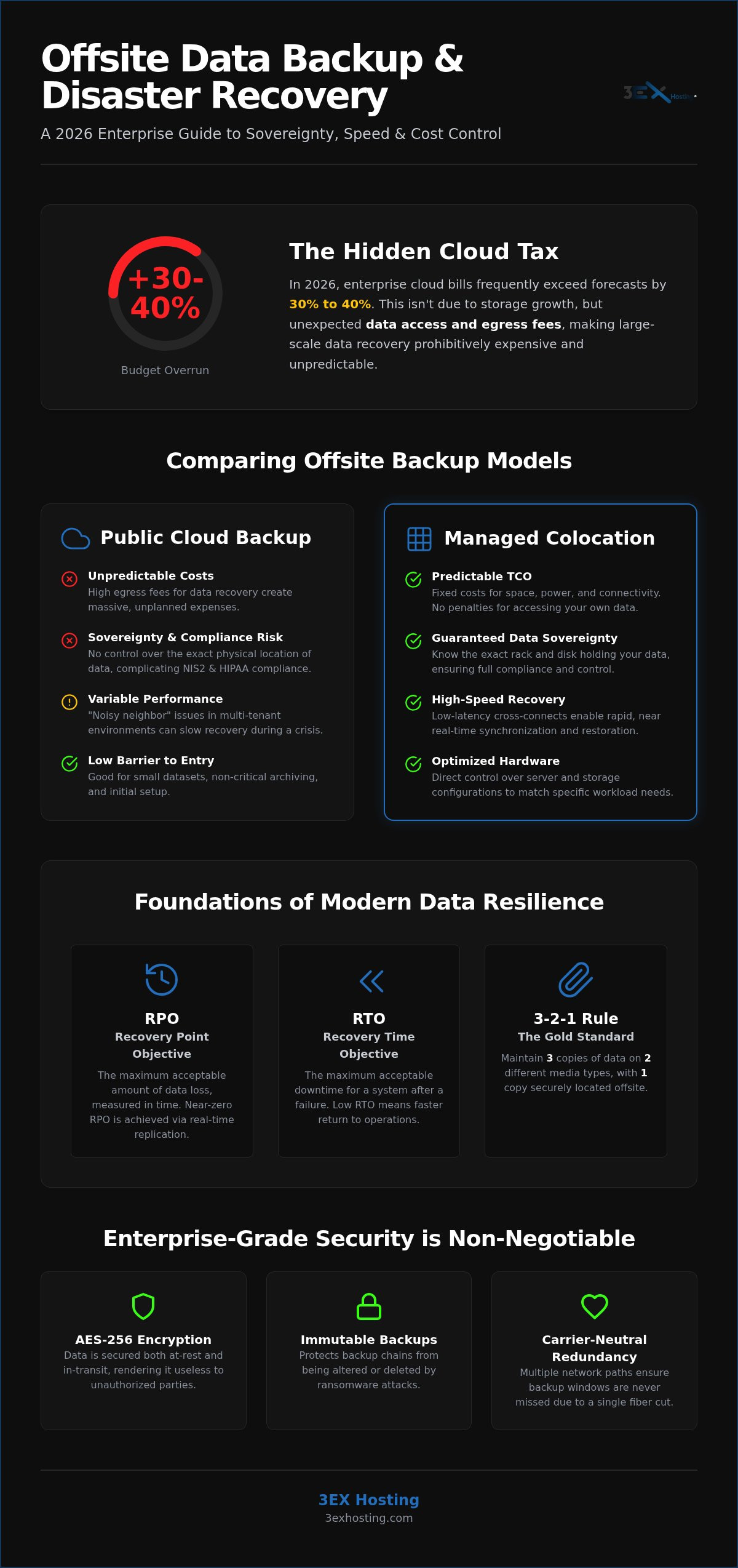
Many IT teams default to public cloud providers without calculating the long-term impact on the bottom line. Research indicates that 2026 cloud bills frequently exceed forecasts by 30% to 40% because of data access charges. These egress fees make large-scale restoration events prohibitively expensive and unpredictable. Beyond costs, data sovereignty is a major concern. Using managed data center infrastructure allows you to know exactly which physical rack and disk hold your information. This level of control is vital for meeting strict compliance standards and avoiding the performance bottlenecks common in multi-tenant public cloud environments during a crisis.
Comparing Offsite Backup Models: Cloud vs. Colocation
Selecting the right infrastructure for offsite data backup services requires a clear understanding of your data’s lifecycle. Public cloud platforms are excellent for small datasets and non-critical archiving. They offer a low barrier to entry for businesses that don’t yet have massive storage requirements. However, as your data footprint expands, the financial and technical trade-offs become more apparent. When you analyze Colocation vs. Cloud for an enterprise environment, the focus must shift to performance and cost predictability.
Managed colocation is the preferred choice for mission-critical disaster recovery and high-density workloads. It provides a level of technical stability that public clouds struggle to match during large-scale restoration events. Many organizations now adopt hybrid models to capture the best of both worlds. They use cloud flexibility for bursty, ephemeral data while relying on the performance of dedicated hardware for their core databases. This approach balances the need for speed with the necessity of physical data sovereignty.
A critical factor in this decision is the Total Cost of Ownership (TCO) over a 3-year cycle. While cloud storage might look cheaper on a monthly subscription basis, the 2026 landscape is defined by unpredictable egress costs. Research indicates that data access charges are frequently pushing cloud bills 30% to 40% beyond initial forecasts. In contrast, colocation offers a predictable cost structure. You pay for the space, power, and connectivity rather than being penalized every time you need to access your own data for a restore test or emergency recovery.
Colocation-Based Backup Advantages
Colocation gives you direct control over your hardware specifications and storage density. You can optimize your server configurations for specific backup software requirements rather than fitting into a provider’s pre-defined instance types. By leveraging low-latency cross-connect services, you can achieve rapid, near-real-time synchronization between your sites. This physical isolation also simplifies compliance. Knowing exactly where your disks are located and who has access to them is essential for meeting SOC2 and HIPAA standards. If your security needs are particularly high, full cabinet colocation offers the dedicated environment required for total control.
Managed Cloud Backup Benefits
Cloud backup models are built for rapid scalability. If your data growth spikes, you don’t have to wait for hardware procurement or installation. This significantly reduces initial capital expenditure (CapEx) because the provider handles the underlying infrastructure. These services also integrate seamlessly with modern containerized workloads using Kubernetes or OpenStack. For businesses that prioritize agility and have highly variable data loads, the cloud provides a convenient, off-the-shelf solution for secondary storage.
Key Evaluation Criteria for Backup Providers
Choosing offsite data backup services requires a shift from “storage capacity” thinking to “recovery performance” thinking. The most critical metrics are your Recovery Time Objective (RTO) and Recovery Point Objective (RPO). RTO defines how quickly your systems must be operational after a failure. If your business loses significant revenue for every hour of downtime, a low RTO isn’t a luxury; it’s a requirement. RPO determines how much data loss is tolerable. A 15-minute RPO ensures you’ll never lose more than a quarter-hour of transactional data, which is vital for financial or database-heavy environments.
Network throughput is the often-ignored bottleneck in disaster recovery planning. You must calculate your “backup window” based on the volume of changed data. If you’re moving multi-terabyte sets, a standard internet connection won’t suffice. You need high-performance cross-connects to ensure data reaches the offsite facility before the next backup cycle begins. Security protocols must also evolve to meet 2026 threats. This includes immutable backups that can’t be altered or deleted, even with administrative credentials. Air-gapped storage provides the final layer of defense by physically disconnecting backup media from the network when not in use.
Uptime and Redundancy Standards
Don’t settle for vague promises of reliability. Evaluate the facility’s N+1 power and cooling configurations to ensure that a single component failure doesn’t compromise your data availability. Carrier-neutral facilities are vital for resilience. They allow you to leverage multiple network providers, ensuring that a carrier-specific outage doesn’t block your recovery path. Always verify the SLA guarantees. A robust agreement should specify not just facility uptime, but the immediate availability of the backup target itself during a restoration event.
Scalability for High-Density Workloads
The rise of AI and machine learning has fundamentally changed the data landscape. These workloads generate massive, high-density datasets that traditional backup infrastructures often struggle to ingest. Future-proofing your strategy means looking for providers that offer high density GPU colocation. This specialized environment supports the intense power and cooling requirements of GPU-heavy arrays. As your storage needs grow, flexible cabinet colocation options allow you to scale your physical footprint without migrating to a new facility. This ensures your backup infrastructure grows seamlessly alongside your primary production environment.
Implementing a Robust Offsite Backup Strategy
Deploying a resilient strategy for offsite data backup services moves beyond simple file copying. It requires a structured, phased approach to ensure that your recovery infrastructure is ready when a primary site failure occurs. Following a logical sequence allows you to eliminate single points of failure while maintaining budget control.
- Step 1: Data Audit and Classification. Begin by cataloging every data asset. Not all data is created equal. Grouping information into tiers allows you to allocate resources efficiently, ensuring your most sensitive databases receive the highest level of protection.
- Step 2: Define Tiered RTO/RPO. Assign specific recovery targets to each tier. Your customer-facing transactional database might require a five-minute RPO, while internal documentation archives can tolerate twenty-four hours.
- Step 3: Select Infrastructure. Choose between Managed Cloud for rapid scaling or cabinet colocation for environments requiring total physical control and predictable costs.
- Step 4: Establish Connectivity. Secure, low-latency paths are the backbone of offsite replication. Use high-speed cross-connects to bridge your primary and secondary sites.
- Step 5: Failover Drills. Conduct regular testing. A backup strategy is only theoretical until you’ve successfully completed a full failover and failback cycle under simulated stress.
Maintenance and Operational Support
Managing physical hardware at a distance is a common hurdle for IT teams. Utilizing remote hands support allows your team to handle hardware resets, cable management, and equipment swaps without traveling to the facility. This significantly improves operational efficiency by reducing the time your infrastructure remains offline during a component failure. Combine this with automated monitoring tools that alert you instantly to backup job failures. Storage hardware has a finite lifespan, so your operational plan must include a lifecycle management schedule to replace aging disks before they reach their failure threshold.
Compliance and Auditing
Your offsite strategy must align with industry-specific regulations like HIPAA or the NIS2 Directive. Document every procedure, from encryption key management to physical access logs, to satisfy insurance requirements and stakeholder reviews. Data immutability is a security feature that prevents data from being modified or deleted for a set period, providing a critical last line of defense against ransomware attacks. Maintaining these records ensures that you can prove your recovery capabilities during an external audit.
To ensure your infrastructure meets these rigorous standards, request a custom quote for a disaster recovery solution built on high-performance colocation.
Leveraging 3EX Hosting for Disaster Recovery Excellence
3EX Hosting provides the technical foundation for enterprises seeking resilient offsite data backup services. While previous sections detailed the strategic need for geographic separation and data sovereignty, your physical site choice determines your ultimate recovery speed. We operate from premier carrier hotels, ensuring your backup infrastructure has direct access to a vast ecosystem of network providers. This placement eliminates the latency issues common with standard internet-based replication. It allows for the near-real-time synchronization required for mission-critical databases and high-volume transactional logs.
Our infrastructure is engineered for high-density workloads, including modern AI and GPU-driven environments. With N+1 power redundancy and advanced cooling systems, we maintain the stability needed for continuous data protection. You gain a partner that understands the technical nuances of hardware management, backed by 24/7 technical expertise and proactive support. This ensures your secondary site isn’t just a passive storage vault, but a functional extension of your production environment. Our team handles the physical complexities so your IT staff can focus on high-level architecture and data integrity.
Custom Infrastructure Solutions
Every enterprise has unique security and space requirements. We offer everything from private colocation suites to custom cage solutions, providing the physical isolation needed for strict compliance. To simplify your deployment, our move-in assistance ensures that your hardware is staged and connected correctly from day one. Direct cross-connects to major carriers and cloud providers allow you to build a true hybrid architecture. You can move data between environments without the performance penalties or unpredictable costs associated with the public internet.
Why Enterprises Trust 3EX Hosting
Reliability is built into our operational DNA. We focus on technical stability and high availability, ensuring your offsite assets remain secure and accessible. By choosing a provider with a proven track record in managing mission-critical infrastructure, you reduce the risk of recovery failure. We provide the specialized disaster recovery solutions that modern enterprises demand. If you’re ready to secure your data with a professional, hardware-first approach, request a custom quote today. We’ll help you design a backup infrastructure that guarantees continuity and compliance.
Future-Proofing Your Enterprise Data Resilience
Building a robust strategy for offsite data backup services is no longer just about storage volume. It’s about achieving technical stability and physical data sovereignty in a modern regulatory environment. By prioritizing high-performance connectivity and precise RTO/RPO metrics, you ensure that your business remains operational regardless of regional failures or cyber threats. A hybrid approach that combines the flexibility of the cloud with the security of dedicated colocation provides the most reliable path to 100% business continuity.
The right infrastructure partner should offer more than just rack space. You need a foundation built on N+1 power redundancy and enterprise-grade security protocols to meet 2026 compliance standards. With 24/7 remote hands support, your team can manage complex hardware deployments without leaving the office. Take the next step toward a more resilient infrastructure today.
Secure your enterprise data with 3EX Hosting’s Disaster Recovery Solutions and gain the technical peace of mind your organization requires.
Frequently Asked Questions
What is the difference between offsite backup and disaster recovery?
Offsite backup focuses on the secure storage of data copies in a remote location to prevent permanent loss. Disaster recovery is a broader framework that includes the infrastructure, orchestration, and processes required to resume business operations after a failure. While backups provide the raw data, disaster recovery solutions ensure you have the compute power and network connectivity to actually use that data during a crisis.
How much bandwidth is required for offsite data backup services?
Bandwidth requirements for offsite data backup services depend entirely on your daily data change rate and the duration of your backup window. For multi-terabyte datasets, a standard internet connection is often insufficient. Enterprises should utilize high-performance cross-connects within a carrier-neutral facility to ensure data transfers complete before the next cycle begins. This prevents synchronization lag and ensures your most recent data is always protected offsite.
What is an immutable backup, and why is it important for ransomware protection?
An immutable backup uses a write-once, read-many architecture that prevents data from being modified or deleted for a specific period. This is a critical defense against modern ransomware, which often attempts to encrypt or delete backups before locking primary systems. By maintaining an immutable copy, you ensure that a clean, uninfected version of your data is always available for restoration, regardless of the attacker’s administrative access level.
How often should an enterprise test its offsite backup restoration process?
Enterprises should conduct full restoration tests at least quarterly, though mission-critical applications often require monthly validation. Testing isn’t just a best practice; it’s a requirement under 2026 regulations like the NIS2 Directive, which mandates regular risk management testing. Automated failover drills help identify bottlenecks in your recovery path, ensuring that your RTO and RPO targets remain achievable as your data infrastructure evolves and grows.
Can colocation-based backups be more cost-effective than public cloud storage?
Colocation-based backups are frequently more cost-effective for enterprises with large, high-density datasets. Public cloud storage often carries unpredictable egress fees that can increase your monthly bill by 30% to 40% when you access or move data. With a fixed-cost colocation model, you pay for physical space and power rather than data transfer volume. This predictability is essential for long-term budget planning and large-scale disaster recovery events.
What are the security risks of using offsite backup services?
The primary security risks include data interception during transit and unauthorized physical or logical access at the remote facility. To mitigate these, you must implement AES-256 encryption for all data at rest and in transit. Additionally, look for facilities with strict SOC2 or HIPAA compliance standards. Using private colocation suites or custom cages adds a physical layer of security that multi-tenant cloud environments cannot provide.
How does geographic location impact offsite backup performance?
Geographic location determines both your latency and your protection against regional disasters. While placing offsite data backup services too close to your primary site increases restoration speed, it leaves you vulnerable to the same power grid or weather events. A distance of at least 100 miles is often recommended. This balance ensures your data is far enough to survive a regional catastrophe but close enough to maintain acceptable synchronization performance.
What should be included in an offsite backup Service Level Agreement (SLA)?
A robust SLA must define specific uptime guarantees for both power and network connectivity. It should also outline the provider’s response times for 24/7 remote hands support and hardware assistance. For disaster recovery, ensure the agreement includes measurable RTO and RPO targets. These technical benchmarks move the conversation from vague promises of reliability to contractually binding performance metrics that protect your business continuity.