 SUPPORT


 3EX United States
 Blog
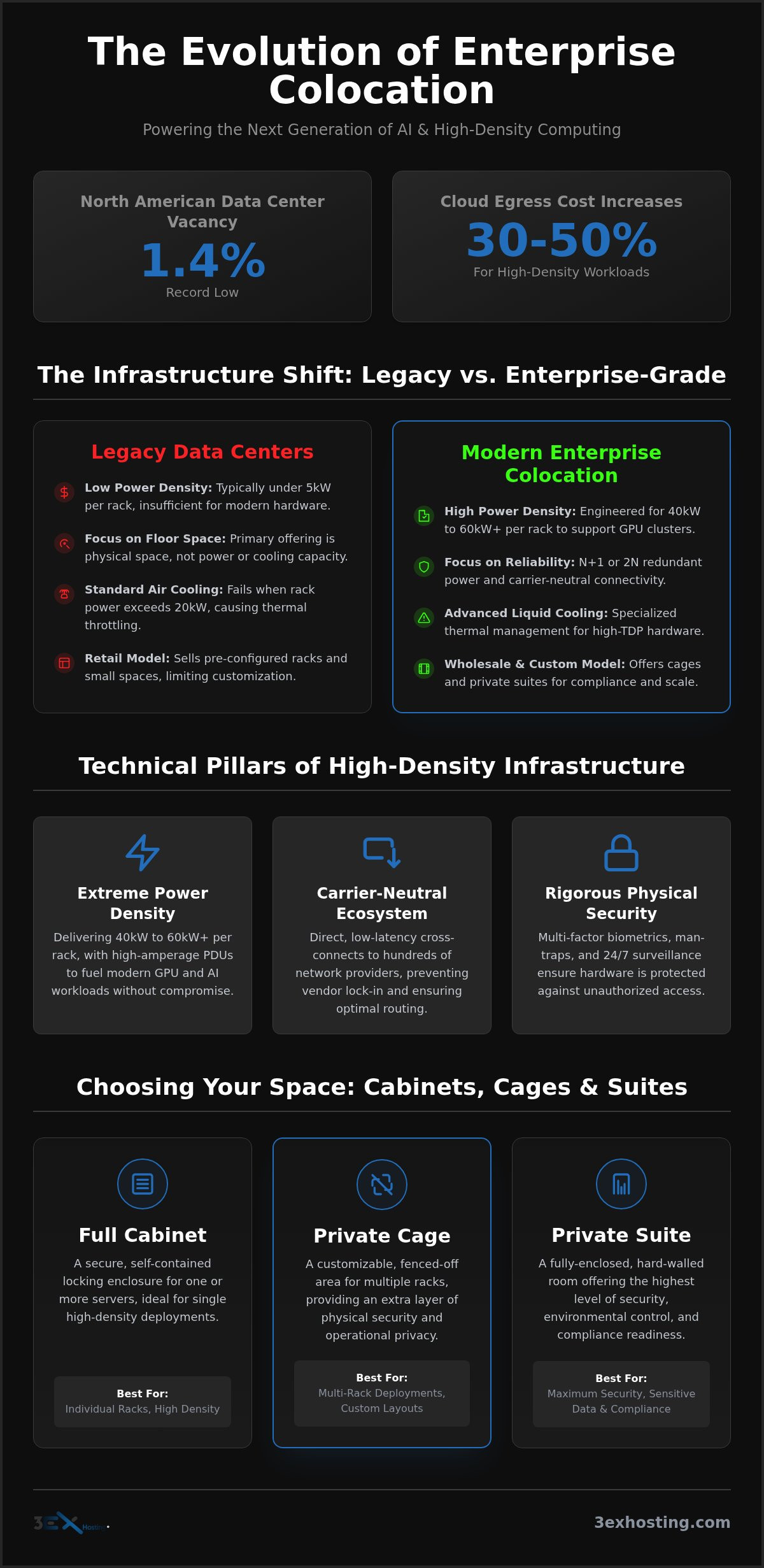
With North American data center vacancy rates hitting a record low of 1.4%, the race for power has become a critical technical bottleneck. You’ve likely seen your cloud egress costs spiral by 30% to 50% while your legacy racks struggle to cool the latest GPU clusters. It’s frustrating to manage high-density workloads when your infrastructure wasn’t built for the 2026 AI boom. Finding the right enterprise colocation solutions is now about securing power density and connectivity rather than just floor space.
We understand the pressure of deploying mission-critical hardware without on-site staff to manage the racks. This guide provides the strategic framework you need to select, deploy, and scale high-density infrastructure that handles up to 60 kW per rack without compromising on reliability. You’ll learn how to navigate power-based pricing, leverage carrier-neutral connectivity, and utilize expert remote hands to maintain global business continuity. We’ll show you how to move from a reactive hardware stance to a proactive strategy that supports AI and hybrid cloud growth for years to come.
Key Takeaways
- Learn how to differentiate between standard rack space and high-density enterprise colocation solutions built for 2026 mission-critical reliability.
- Discover the technical requirements for scaling AI and GPU workloads that demand power densities between 40kW and 60kW per rack.
- Evaluate the specific security and compliance advantages of utilizing private suites and custom cage solutions for sensitive data.
- Master a strategic framework for selecting carrier-neutral partners that provide 24/7 expert remote hands support.
- Minimize operational risk during hardware transitions by leveraging professional move-in assistance and structured migration workflows.
Defining Modern Enterprise Colocation Solutions
Modern enterprise colocation solutions represent a shift from simple rack rentals to sophisticated, high-density environments designed for mission-critical hardware. Unlike a standard colocation centre that might host small-scale web servers, enterprise-grade facilities provide the power and cooling required for AI training clusters and global financial systems. By 2026, the global market is projected to reach over $104 billion as companies move away from building their own data centers. This shift from CAPEX to OPEX allows businesses to scale rapidly while maintaining technical stability.
The distinction between retail and enterprise models lies in scale and customization. Retail colocation often involves pre-configured racks for smaller businesses. In contrast, enterprise colocation solutions focus on wholesale space or bespoke private data center suites that meet specific compliance and density requirements. Central to this is the “Carrier Hotel” concept. These facilities are carrier-neutral, meaning they offer direct access to hundreds of network providers. Neutrality is the lifeblood of enterprise networking; it prevents vendor lock-in and ensures the lowest possible latency for global operations.
The Core Components of Enterprise-Grade Facilities
Reliability in these facilities depends on redundant power architectures. Most enterprise sites utilize N+1 or 2N configurations to guarantee uptime during equipment failure. As AI workloads increase, specialized thermal management has become mandatory. Standard air cooling often fails when racks exceed 20kW, requiring facilities to implement advanced liquid cooling or containment systems. Physical security is equally rigorous. Access is controlled via multi-factor biometrics and man-traps, backed by 24/7 surveillance to ensure hardware remains untouched by unauthorized personnel.
Why Enterprises are Moving Away from On-Premise
Many organizations are hitting the “power wall” in their corporate offices. Standard buildings simply can’t provide the 40kW to 60kW per rack that modern GPUs demand. Connectivity is another hurdle. The cost of bringing high-capacity fiber into a local office is high compared to the instant scalability of full cabinet colocation within a carrier-dense facility. Finally, staffing a 24/7 on-site technical team is increasingly difficult. By outsourcing infrastructure, enterprises gain access to specialized remote hands support, ensuring experts are always available to handle hardware swaps or troubleshooting.
The Technical Pillars of High-Density and AI Infrastructure
Scaling AI isn’t just a software challenge; it’s a physical infrastructure hurdle. Modern AI training and inference clusters demand power levels that legacy data centers weren’t built to handle. These workloads require enterprise colocation solutions that can deliver consistent, high-amperage power without thermal throttling. Standard office environments or low-tier facilities often hit a “power wall” long before the hardware reaches peak performance. Deploying AI at scale requires a foundation that accounts for both extreme energy draw and the resulting heat signature.
Power Density: Beyond the 5kW Rack
The industry is rapidly transitioning from the traditional 5kW rack to configurations supporting 15kW, 30kW, and even 50kW+ per cabinet. When you audit a facility for GPU readiness, you must verify the PDU capacity and the specific cooling methodology used to prevent hot spots. High power density is the primary lever for reducing the total cost of ownership by maximizing compute per square foot. Implementing high density GPU colocation ensures your infrastructure remains viable as hardware requirements evolve over the next five years. Without this density, you’re forced to spread hardware across more racks, which increases cabling complexity and management costs.
Network Performance and Cross-Connect Services
For financial and AI services, every millisecond of latency translates to lost revenue or degraded model performance. Utilizing cross-connect services is superior to the public internet because it provides a direct, physical layer of peering between providers. This ecosystem allows for predictable economics and extreme reliability. Much like University IT colocation services, enterprise facilities prioritize carrier-neutrality to ensure you aren’t locked into a single bandwidth provider. This flexibility allows your network architects to optimize paths for speed and cost dynamically.
Beyond power and networking, physical engineering plays a critical role. A fully populated GPU rack can weigh significantly more than standard server hardware, making floor load capacity a vital safety metric. You must ensure the facility can support at least 250 to 300 pounds per square foot to avoid structural risks. Additionally, metered power is essential for controlling operational costs. It replaces flat-rate billing with a pay-for-use model, providing the transparency needed for accurate budget forecasting. If you’re ready to audit your current power needs, you can request a technical assessment to see how your hardware fits into a high-density environment.
Comparing Full Cabinets, Cages, and Private Suites
Selecting the right footprint is a pivotal step in designing effective enterprise colocation solutions. It isn’t just about renting floor space; it’s about matching your physical environment to your operational risk profile and growth trajectory. According to Gartner’s Market Guide for Data Center Colocation, infrastructure agility and physical security are now primary drivers for enterprise buyers. You need to evaluate your needs based on rack count, power density requirements, and compliance mandates to avoid the technical debt of a premature migration.
Full Cabinets: The Building Block of Scale
For many organizations, full cabinet colocation serves as the standard starting point for mission-critical deployments. It’s the logical choice when you’ve outgrown shared environments and need dedicated 42U to 48U of space for your hardware. These cabinets feature individual locking doors and specialized airflow management to maintain thermal stability. Hot and cold aisle containment ensures that high-density servers don’t recirculate exhaust air, which is vital for equipment longevity. It’s a modular model that allows you to add adjacent cabinets as your compute needs expand without re-architecting your entire network.
Cages and Suites: Maximum Security and Sovereignty
If your industry faces strict regulatory oversight, a cage solutions datacenter provides an essential layer of physical separation. Cages use floor-to-ceiling steel mesh to isolate your hardware from other tenants on a shared data center floor. This setup is often a prerequisite for SOC2, HIPAA, or PCI-DSS compliance, as it allows you to restrict and log physical access to your specific infrastructure. Cages offer the flexibility to organize your racks and cabling according to your own internal standards while benefiting from the facility’s shared cooling and power redundancy.
For maximum sovereignty, private suites offer a fully enclosed, solid-wall room with dedicated cooling and power distribution. Unlike cages, suites provide complete visual and physical privacy. They’re ideal for large-scale deployments where you might need to integrate private office space or staging areas directly next to your hardware. This allows your on-site teams to work in a secure environment without leaving the high-availability zone of the data center. It’s the ultimate choice for companies that require total control over their environment and a high rack count.
Choosing between these options requires a clear framework. A single cabinet works for standardized deployments with 1 to 5 racks. Cages are better for 5 to 20 racks where compliance audits are frequent and physical isolation is non-negotiable. Private suites are the gold standard for deployments exceeding 20 racks or for businesses that require a self-contained ecosystem. By selecting the right tier now, you ensure your enterprise colocation solutions can handle the next five years of hardware evolution and business growth.
Selection Criteria for National Enterprise Colocation
Choosing a provider for national infrastructure requires more than a price comparison. You need a “Criticality Matrix” to evaluate how different enterprise colocation solutions align with your uptime requirements and geographic reach. This matrix should weigh facility tiering, carrier density, and the availability of on-site technical talent. A 100% uptime Service Level Agreement (SLA) is the benchmark for enterprise-grade operations. It ensures that your power and cooling systems have the N+1 or 2N redundancy necessary to survive utility failures without service interruption.
The ROI of 24/7 Remote Hands
For national deployments, the physical distance between your lead engineers and the data center is a major operational risk. Relying on remote hands support is often more cost-effective than flying a technician across the country for routine maintenance. You can calculate the ROI by comparing travel expenses and downtime losses against the cost of on-site expert assistance. These teams act as a seamless extension of your internal IT department. They handle critical tasks such as:
- Professional rack and stack services.
- Structured cable management and labeling.
- Hardware troubleshooting and component replacement.
- Visual audits and environment verification.
This immediate availability ensures that a simple hardware failure doesn’t escalate into a prolonged outage.
Disaster Recovery and Business Continuity
Resiliency in 2026 demands a hybrid approach. Integrating your physical hardware with managed cloud hosting creates a redundant ecosystem that survives local disasters. You must assess a facility’s structural integrity and its backup power duration. Look for providers that maintain at least 48 to 72 hours of on-site fuel reserves for their generators. Your business continuity plan should also include diverse network failover strategies. This prevents a single fiber cut from isolating your entire national infrastructure. By choosing a partner with robust disaster recovery protocols, you’re investing in long-term technical stability.
Selecting the right partner is a balance of technical specs and operational trust. If you’re ready to evaluate a facility that meets these high standards, you should request a customized quote to see how our infrastructure supports your specific scaling goals.
Strategic Implementation: Transitioning to Scalable Infrastructure
Transitioning to a new data center is a high-stakes operation. It’s the final phase of securing enterprise colocation solutions that support long-term growth. A successful migration isn’t just about moving hardware; it’s about maintaining operational continuity. You must align your current IT infrastructure with revenue goals to ensure the move provides a measurable ROI. This strategic alignment turns your data center footprint into a competitive asset rather than a cost center.
The Migration Roadmap
Every successful move starts with a pre-migration audit. You need to map every power draw and label every cable to avoid confusion during the re-stack. Documentation of current network topologies and server dependencies is non-negotiable. Logistics are equally critical. Secure hardware transport with specialized insurance protects your assets during the move. Once the hardware is in the rack, post-migration testing validates your network connectivity and power redundancy. This phase ensures the system performs as expected before you cut over live traffic. Professionals recommend a phased approach to minimize risk and allow for rollback if unexpected issues arise.
Don’t just plan for your 2026 footprint. You must account for 2030 power needs today. High-density AI workloads are evolving fast; if your facility can’t scale its cooling and power delivery, you’ll be migrating again in three years. Utilizing move-in assistance is a strategic way to minimize downtime. Professional teams handle the heavy lifting, allowing your engineers to focus on configuration and software validation. This support reduces the risk of physical damage or improper installation during the transition. It’s an investment in the physical integrity of your mission-critical hardware.
Securing Your Enterprise Infrastructure
A consultative approach to colocation beats a one-size-fits-all model every time. Every enterprise has unique latency, security, and power requirements. You should audit your current environment against 2026 benchmarks to identify gaps in your high-density readiness. This proactive stance ensures your enterprise colocation solutions provide a stable foundation for years to come. The right partner works with you to design a footprint that scales alongside your business. If you’re ready to start the transition, get a custom quote for your enterprise colocation needs to see how our specialized infrastructure fits your roadmap.
Securing Your Infrastructure for the Next Decade of Growth
Navigating the shift toward high-density AI workloads requires a foundation built on stability and speed. You’ve seen how modern enterprise colocation solutions have evolved from simple rack rentals into strategic power hubs. Success in 2026 depends on securing facilities that support 60kW per rack while maintaining carrier-neutral access to global networks. Whether you deploy in dedicated cabinets or private suites, your choice must account for both current performance and 2030 power requirements.
Reliability isn’t just about hardware; it’s about the experts who support it. Access to 24/7 Remote Hands Support and N+1 redundant infrastructure ensures your mission-critical systems remain online through any utility failure. By choosing a partner that prioritizes carrier-neutral interconnection, you maintain the flexibility to optimize your network without vendor lock-in. It’s time to move your hardware into an environment designed for the future of enterprise compute.
If you’re ready to audit your requirements and scale your footprint, Request a Custom Enterprise Colocation Quote today. Our team is ready to help you build a resilient, high-performance home for your hardware.
Frequently Asked Questions
What is the difference between enterprise colocation and cloud hosting?
Enterprise colocation gives you total physical control over your hardware, while cloud hosting is a virtualized service where you rent compute power. Colocation is often more cost-effective for steady, high-density workloads because it eliminates unpredictable egress fees. You own the assets and manage the software stack entirely. This model is ideal for companies that require specific hardware configurations for AI or financial modeling that aren’t available in standard public clouds.
How much power density can a standard enterprise colocation cabinet support in 2026?
High-density enterprise colocation solutions in 2026 typically support between 15kW and 60kW per cabinet. Some specialized facilities are even engineered to handle up to 300kW per rack for intense AI training clusters. This represents a significant jump from the 5kW standards of previous years. You must verify that the facility utilizes advanced cooling, such as liquid-to-chip or rear-door heat exchangers, to manage the thermal output of these high-draw configurations safely.
Why is carrier-neutrality important for enterprise colocation solutions?
Carrier-neutrality ensures you have the freedom to choose from multiple network providers within a single facility. It’s the technical foundation for cost optimization and redundancy. By accessing a carrier hotel ecosystem, you can negotiate better rates and avoid the risks of vendor lock-in. If one provider experiences a major outage, your team can quickly reroute traffic through a different cross-connect without the need to physically move your mission-critical server hardware.
What are Remote Hands, and how do they benefit a national enterprise?
Remote Hands refer to on-site technical experts who perform physical tasks on your behalf. These services include hardware troubleshooting, cable management, and equipment reboots. For a national enterprise, this support acts as a local extension of your IT team. It eliminates the need to fly technicians across the country for routine maintenance or emergency repairs. This immediate availability reduces mean time to repair and protects your operational uptime around the clock.
Can I host high-density GPU clusters in a standard colocation cage?
You can host high-density GPU clusters in a cage, but the facility must have the specific power and cooling infrastructure to support it. A cage provides physical isolation and security, but the rack engineering within that cage must handle the weight and thermal load of GPU servers. You should look for facilities that offer specialized airflow management and high-amperage PDUs. This setup combines the security of a cage with the performance of high-density infrastructure.
What compliance certifications should I look for in an enterprise data center?
You should prioritize facilities that maintain SOC2 Type II, HIPAA, and PCI-DSS certifications. These standards verify that the data center follows rigorous protocols for physical security, environmental control, and data privacy. For enterprises in regulated industries, these certifications are non-negotiable for meeting internal audit requirements. They provide documented proof that the provider manages risk effectively and maintains the technical stability required for mission-critical deployments.
How does colocation integrate into a disaster recovery strategy?
Colocation serves as a secure, off-site repository for your redundant hardware and data backups. It integrates into a disaster recovery plan by providing a high-availability environment that remains operational even if your primary office fails. Many organizations use a hybrid approach, combining physical server redundancy with managed cloud hosting. This ensures that your applications can failover to a secondary site instantly, maintaining business continuity and protecting your revenue from unexpected regional disruptions.
What is the typical lead time for deploying a private colocation suite?
The lead time for a private colocation suite usually ranges from 30 to 90 days, depending on the level of customization required. If you need specific power configurations, dedicated cooling, or integrated office space, the build-out process takes longer. For organizations that need to scale more rapidly, standardized full cabinet colocation can often be deployed in less than 30 days. It’s best to start the planning process early to ensure your footprint is ready for hardware arrival.