 SUPPORT


 3EX United States
 Blog
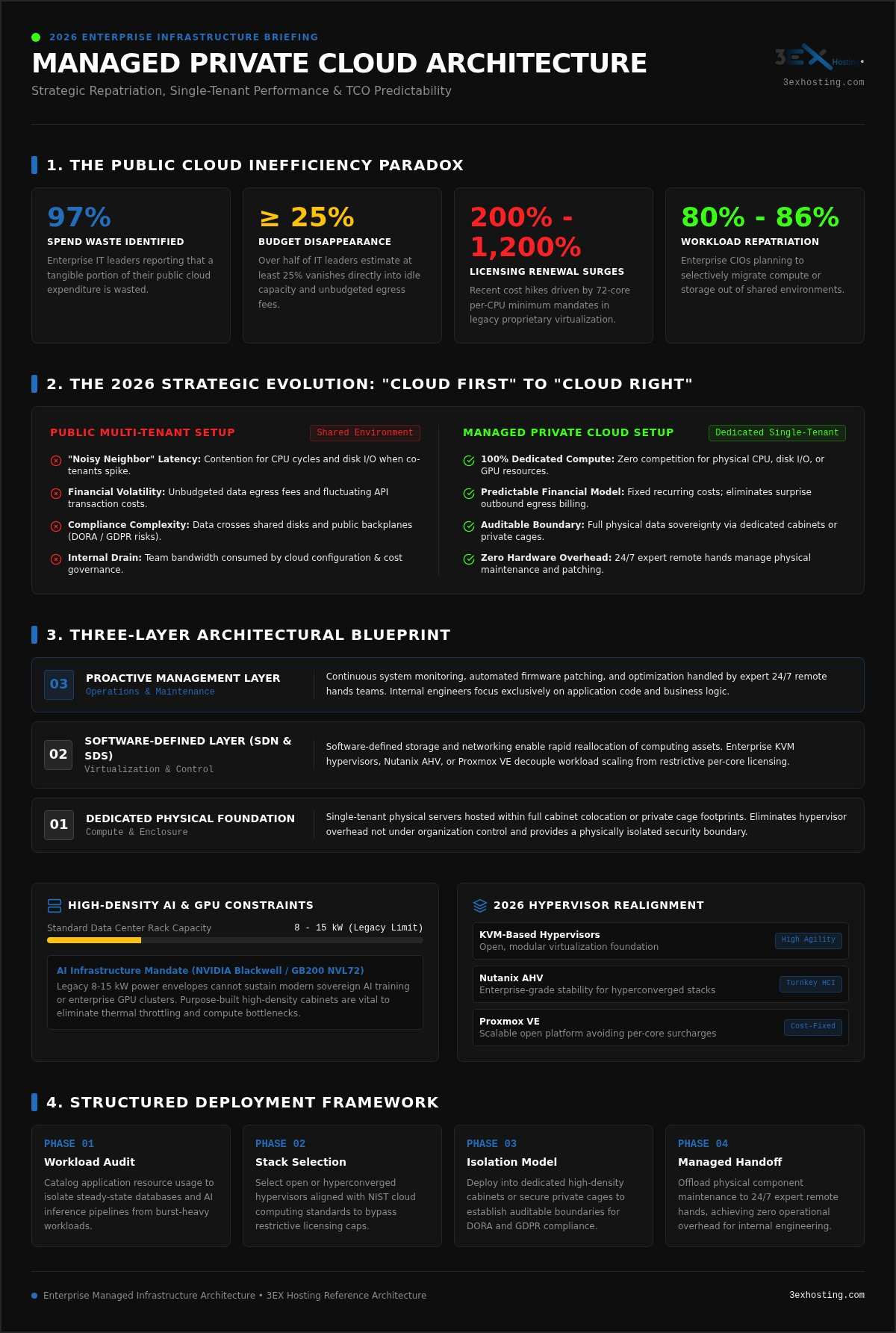
97% of enterprise IT leaders believe a portion of their public cloud spend is wasted, with over half estimating that at least 25% of their budget disappears into idle capacity and unbudgeted egress fees. It’s exhausting to watch infrastructure costs spiral while your internal team spends their bandwidth patching hardware or fighting compliance hurdles in shared environments. You’ve likely felt the pressure of Broadcom’s VMware licensing hikes or the complexity of meeting DORA requirements in a multi-tenant setup. Adopting a managed private cloud infrastructure offers a stable path out of this volatility.
This guide will show you how to master the transition to secure, high-performance systems tailored for enterprise scalability. We’ll help you achieve zero hardware management overhead and full data sovereignty without sacrificing the speed your business demands. We’ll examine the 2026 shift toward sovereign AI, the rise of KVM-based hypervisors, and how to build a predictable financial model for your most critical workloads.
Key Takeaways
- Transitioning to a “Cloud Right” strategy ensures your infrastructure matches specific workload demands while maintaining full data sovereignty and single-tenant security.
- Selecting the correct hypervisor and high-density cabinet setup is essential for scaling modern managed private cloud infrastructure, especially for AI-intensive and GPU-heavy tasks.
- Repatriating steady-state workloads from the public cloud provides immediate cost predictability by removing hidden egress fees and volatile API transaction charges.
- A structured deployment roadmap-from auditing current workloads to choosing between dedicated cabinets or private cage solutions-minimizes performance risks and transition downtime.
- Outsourcing physical hardware maintenance to expert 24/7 remote hands teams eliminates internal bandwidth exhaustion and ensures maximum infrastructure uptime.
What is Managed Private Cloud Infrastructure in 2026?
Managed private cloud infrastructure is a single-tenant environment where the underlying physical hardware is dedicated exclusively to one organization while a specialized provider handles the operational upkeep. This model has become the standard for organizations moving away from the “one size fits all” approach of early cloud adoption. In 2026, enterprise strategies have shifted from a “Cloud First” mandate to a “Cloud Right” philosophy. This evolution recognizes that while some experimental workloads thrive in shared pools, mission-critical systems require the stability of isolated resources. It’s the ultimate compromise between bare-metal control and public cloud agility.
By moving away from standard cloud computing deployment models that rely on shared hardware, enterprises regain control over their performance baselines. Research indicates that 80% to 86% of enterprise CIOs now plan to selectively repatriate specific compute or storage workloads from public environments to private or hybrid setups. This isn’t a total exit from the cloud, but a tactical relocation of steady-state databases and AI inference tasks to environments where performance is guaranteed and costs are fixed.
The Core Components of a Managed Ecosystem
A modern managed environment isn’t just a server in a rack; it’s a cohesive stack designed for high availability. The ecosystem consists of three primary layers. First, dedicated physical servers provide the raw compute power without the overhead of virtualization layers you don’t control. Second, software-defined storage and networking (SDN) allow for rapid reconfiguration of assets through software, giving you the flexibility of the cloud on your own hardware. Finally, the proactive management layer includes continuous monitoring, automated patching, and optimization. This architecture ensures your internal team doesn’t waste hours on firmware updates. They focus on the application layer while the provider maintains the foundation.
Single-Tenant vs. Multi-Tenant Environments
Public clouds use multi-tenancy to maximize provider efficiency, but this often leads to the “noisy neighbor” effect. When another company on your shared host experiences a traffic spike, your application’s latency can suffer. In a managed private cloud infrastructure, resources are 100% allocated to your workloads. You never compete for CPU cycles or disk I/O, which is critical for high-density AI or GPU tasks.
Security also improves through physical isolation. Data sovereignty is a primary driver here, as your information never sits on shared disks or travels over public backplanes. For organizations using full cabinet colocation or cage solutions, this provides a physically auditable boundary. It simplifies compliance with strict regulations like DORA or GDPR because you can point to the exact hardware where your data resides. You get the peace of mind that comes with knowing your environment is isolated, secure, and performing at peak capacity.
Architecture for Performance: From Hypervisors to GPU Clusters
The architecture of a managed private cloud infrastructure starts at the virtualization layer. In 2026, the choice is no longer limited to a single vendor. Broadcom’s licensing shifts, including the 72-core minimum per CPU, have pushed many enterprises toward KVM-based solutions, Nutanix AHV, or Proxmox VE. These platforms offer enterprise-grade stability without the 200% to 1,200% cost increases seen in recent renewals. Aligning your stack with the NIST definition of cloud computing ensures your private environment maintains the necessary resource pooling and rapid elasticity while keeping the underlying hardware dedicated to your organization.
Integrating this software layer with full cabinet colocation creates a hybrid control plane. This allows you to run legacy bare-metal systems alongside modern virtualized clusters in the same physical footprint. It’s a strategy that provides the flexibility to scale compute resources while maintaining the rigid security of isolated hardware.
High-Density Infrastructure for AI and GPU Hosting
Standard data center racks often cap out at 8-15 kW. They can’t support the extreme power demands of modern AI training or large-scale inference. NVIDIA Blackwell enterprise systems, such as the GB200 NVL72, require racks capable of handling 100 kW to 120+ kW. These environments demand direct-to-chip liquid cooling (DLC) and N+1 power redundancy to prevent thermal throttling. If your workloads involve generative AI fine-tuning, you need high density GPU colocation designed specifically for these thermal loads. This ensures your hardware runs at peak performance without the risk of power failures or heat-related downtime.
Network Interconnectivity and Cross-Connect Services
Low latency is the heartbeat of a high-performance cloud. Relying on public internet routing introduces unpredictable jitter and packet loss that can degrade application performance. Physical cross-connects within a carrier-neutral facility provide direct, private links to partners, service providers, and transit carriers. This reduces latency to sub-millisecond levels. By selecting the best path through a carrier-neutral environment, you bypass the congestion of the public web and gain granular control over your data flow.
Proactive management means your network is constantly monitored for throughput bottlenecks. If you’re ready to optimize your stack, you can request a custom infrastructure audit to see where physical cross-connects can improve your specific data pathing.
Managed Private Cloud vs. Public Cloud: A TCO Analysis
The era of dogmatic “cloud-first” mandates is ending. Today, 80% to 86% of enterprise CIOs report plans to selectively repatriate workloads to private environments. This shift isn’t about abandoning the cloud; it’s about cost efficiency and resource control. Moving steady-state, high-utilization production workloads to a modern managed private cloud infrastructure delivers an average 40% to 50% lower Total Cost of Ownership over a three to five year lifecycle. TCO in private clouds is realized through flat-rate billing and reduced compliance friction.
The Hidden Costs of Public Cloud Scaling
Public cloud environments often feel like a financial trap once you scale. Standard internet egress rates remain between $0.05 and $0.09 per GB for outbound transfers beyond initial free tiers. For data-heavy applications, these variable fees create “bill shock” that ruins monthly budget forecasting. It’s not just the bandwidth. Internal IT teams often find their bandwidth exhausted by managing complex public cloud consoles and navigating unoptimized, idle capacity. Roughly 50% of IT leaders estimate that over 25% of their total public cloud budget is lost to these inefficiencies. Managed environments replace this waste with fixed monthly spends, allowing teams to focus on performance rather than cost-control puzzles.
Security Sovereignty and Physical Isolation
Compliance is the second major driver for repatriation. While hyperscalers offer logical isolation, many auditors and regulatory frameworks now demand physically auditable hardware boundaries. The EU Digital Operational Resilience Act (DORA), which entered full application on January 17, 2025, requires explicit exit strategies and business continuity plans that are often difficult to satisfy in shared-resource environments. Organizations in finance and healthcare can’t afford the ambiguity of multi-tenant storage.
Choosing private suites ensures your data never sits on shared disks. This physical isolation simplifies HIPAA, PCI, and SOC2 audits by providing a clear, dedicated perimeter. You can customize security protocols at the firmware level, ensuring that your hardware stack is as secure as your software layer. This level of sovereignty is nearly impossible to achieve in a multi-tenant setup where you lack visibility into the underlying physical infrastructure. You gain the peace of mind that comes from knowing exactly where your data lives and who has access to the rack.
Implementing Your Infrastructure: A Roadmap for 2026
Successful implementation starts with a rigorous workload audit. You’ve already identified the high-utilization databases and AI inference tasks that benefit from repatriation. Now, you must map their specific resource requirements to hardware profiles. Not every application requires a GPU-dense cluster; some simply need the stability of isolated compute. Once these requirements are clear, you can design the physical footprint. Choosing between standard cabinets or dedicated Cage Solutions depends on your long-term scaling needs and specific audit requirements for physical isolation.
Step three involves selecting the management tier and establishing disaster recovery protocols. Your managed private cloud infrastructure must be resilient by design. It’s essential to define your Recovery Point Objectives (RPO) and Recovery Time Objectives (RTO) before the first server is racked. This ensures that your management layer isn’t just a patching service, but a comprehensive shield for your data integrity.
Disaster Recovery and Business Continuity
Security isn’t complete without a resilient recovery strategy. Integrating off-site backups with your primary nodes is a requirement for meeting modern standards like DORA. In a managed environment, high-speed failover protocols allow for nearly instantaneous transitions to secondary nodes. This maintains mission-critical uptime during localized failures. By automating these failover processes, you reduce the risk of human error during high-pressure incidents. It’s about building a system that stays online without constant manual intervention.
Move-In Assistance and Physical Migration
The physical transition is often where enterprise projects stall. You must decide between a “Lift and Shift” of existing virtual machines or “Re-platforming” onto a modern stack. While lifting VMs is faster, re-platforming often yields better performance on 2026-era hardware. Utilizing professional move-in assistance ensures your hardware arrives safely and achieves zero-day connectivity. Expert teams handle the logistics of rack-and-stack, cabling, and initial provisioning. This relieves your internal staff of the physical labor, letting them focus on application integrity during the migration. If you’re ready to start your transition, request a detailed implementation quote to secure your 2026 infrastructure roadmap.
The 3EX Hosting Advantage: Proactive Infrastructure Management
3EX Hosting operates at the intersection of physical reliability and digital flexibility. While many providers focus only on the software layer, we manage the entire stack from the data center floor to the hypervisor. This integrated approach ensures your managed private cloud infrastructure isn’t just a logical construct but a physically optimized environment. We combine elite data center standards with cloud agility to eliminate the friction between hardware procurement and service deployment. This creates a powerful synergy when pairing private hardware with our managed IT infrastructure. It provides a unified operational model for national enterprises that require both speed and stability.
24/7 Remote Hands: Your On-Site Technical Team
Physical hardware still requires physical attention. Even in a virtualized world, a loose cable or a failed drive can halt production. Our Remote Hands Support provides an on-site technical team available at any hour. They handle everything from precision cable management to complex hardware troubleshooting and component replacement. This service effectively removes the need for your internal IT staff to travel to the facility. Your team stays focused on high-level architecture while our experts handle the tactical maintenance of your managed private cloud infrastructure.
Next Steps: Customizing Your Private Environment
Every enterprise has unique scaling requirements. A one-size-fits-all solution won’t work for high-density AI clusters or legacy ERP systems. We take a consultative approach to cabinet and cloud design. This ensures your power, cooling, and compute stay perfectly balanced as your workloads grow. As a carrier-neutral partner, we provide the connectivity options needed to scale your infrastructure nationally without vendor lock-in. The first step is a comprehensive audit of your current resource utilization and future growth targets. You can get a quote today to begin designing a private environment built for the performance demands of 2026.
Securing Your Enterprise Foundation for 2026
Mastering the transition to managed private cloud infrastructure isn’t just a technical upgrade; it’s a strategic move toward financial predictability and operational resilience. By shifting steady-state workloads away from the volatile pricing models of public environments, you regain control over your performance baselines and data sovereignty. We’ve explored how a modern architecture, supported by high-density GPU ready configurations and enterprise-grade N+1 redundancy, provides the stability required for the next generation of AI-driven applications.
You don’t have to manage this evolution alone. With 24/7 Remote Hands support, your infrastructure remains in expert hands while your internal team focuses on driving innovation. The transition from public cloud volatility to private cloud security starts with a clear understanding of your current resource utilization and future scaling needs.
Take the first step toward a more stable and cost-effective digital future. Request a Custom Infrastructure Audit from 3EX Hosting to build a foundation that supports your most ambitious enterprise goals. Your path to infrastructure excellence is ready when you are.
Frequently Asked Questions
What is the difference between a private cloud and a virtual private cloud (VPC)?
A private cloud is a single-tenant environment with dedicated physical hardware. In contrast, a Virtual Private Cloud (VPC) is a logically isolated segment within a multi-tenant public cloud. While a VPC uses shared physical resources, managed private cloud infrastructure provides exclusive access to the underlying hardware. This isolation eliminates the “noisy neighbor” effect and ensures that your performance baselines remains consistent regardless of other users’ activities.
How does managed private cloud infrastructure improve data security?
Security improves through physical isolation and dedicated resources. In a private setup, your data never resides on shared disks or travels over public backplanes. This prevents cross-tenant data leaks and allows you to implement custom security protocols at the firmware level. Proactive management layers add another tier of protection through automated patching, continuous monitoring, and SLA-backed incident response that keeps your environment hardened against emerging threats.
Can I integrate my existing hardware into a managed private cloud?
Yes, you can integrate existing assets through hybrid colocation strategies. Many enterprises use full cabinet colocation to house legacy bare-metal servers while connecting them to modern virtualized private cloud nodes. This approach allows you to leverage existing hardware investments while gaining the scalability and management benefits of a cloud ecosystem. High-speed cross-connects within the data center ensure low-latency communication between your dedicated physical hardware and managed cloud resources.
What are the common hypervisors used in managed private cloud environments?
The hypervisor landscape has diversified significantly in 2026. While VMware was once the dominant choice, many organizations now utilize KVM-based platforms, Nutanix AHV, or Proxmox VE to avoid rising licensing costs. These alternatives provide enterprise-grade stability and performance. The choice often depends on your specific workload requirements and whether you need integrated hyperconverged infrastructure or a more traditional decoupled compute and storage architecture for your private environment.
How does managed private cloud help with regulatory compliance (HIPAA/GDPR)?
Private clouds simplify compliance by providing a physically auditable perimeter. Regulations like HIPAA, GDPR, and the Digital Operational Resilience Act (DORA) require strict data sovereignty and clear exit strategies. Because your data is pinned to specific, dedicated hardware, you can provide auditors with exact geographical and physical proof of isolation. This level of transparency is difficult to achieve in the logical-only isolation models of public cloud providers.
What is the role of ‘Remote Hands’ in a managed cloud setup?
Remote Hands act as your on-site technical team within the data center. These experts handle physical maintenance tasks such as racking servers, managing complex cabling, and swapping failed hardware components. This service is available 24/7, ensuring that hardware issues are resolved without requiring your internal IT staff to travel to the facility. It bridges the gap between digital cloud management and the physical reality of hardware maintenance.
How quickly can a managed private cloud environment be scaled?
Software-level scaling for CPU and RAM is nearly instantaneous within your allocated resource pool. If your growth requires additional physical hardware, the timeline depends on node procurement and installation. However, providers with on-site inventory and dedicated move-in assistance can often deploy new nodes or full cabinets faster than on-premise teams. This ensures your managed private cloud infrastructure grows at the pace of your business demands without long procurement delays.
What is the typical ROI when moving from public cloud to managed private infrastructure?
Moving steady-state workloads from a public cloud to private infrastructure often yields a 40% to 50% lower Total Cost of Ownership over a five-year period. The return on investment is driven by the elimination of unpredictable egress fees and the reduction of wasted spend on idle, unoptimized public instances. Additionally, the shift from variable monthly billing to a flat-rate model provides the financial predictability necessary for long-term enterprise budgeting.