 SUPPORT


 3EX United States
 Blog
What if scaling infrastructure meant adding control only where the workload needs it? For scalable infrastructure for high-growth companies, choosing the largest or most flexible platform upfront can create unnecessary cost and operational complexity. A better approach is to match each workload to the capacity, performance, and resilience it needs now, while keeping a clear path open for growth.
It’s reasonable to worry that today’s setup could become a bottleneck, or that moving to cloud, colocation, managed services, or a hybrid model could add more complexity than it solves. The right choice depends on workload patterns, growth plans, data movement, and your team’s ability to operate the environment. There’s no single architecture that suits every company.
This article provides a practical framework for comparing infrastructure options and deciding when to add capacity. You’ll learn how to scale in stages, assess operational risk, and evaluate provider support, connectivity, and resilience without overbuilding. We’ll also look at how managed cloud hosting, colocation, disaster recovery, remote hands support, and cross-connect services can fit into a broader plan when they match your requirements.
Key Takeaways
- Understand the difference between scaling up existing resources and scaling out across additional resources, then identify which approach fits each workload.
- Evaluate scalable infrastructure for high-growth companies by comparing control, scaling methods, connectivity, and operational responsibility across infrastructure models.
- Growth alone doesn’t mean every workload belongs in the cloud. Weigh elasticity against workload needs and the capacity your team can manage.
- Use a staged roadmap to baseline utilization, forecast demand, classify workloads, test choices, and review capacity before expanding.
- Understand how colocation, managed cloud hosting, disaster recovery, cross-connects, and remote hands support can play distinct roles in a layered strategy.
What scalable infrastructure for high-growth companies actually means
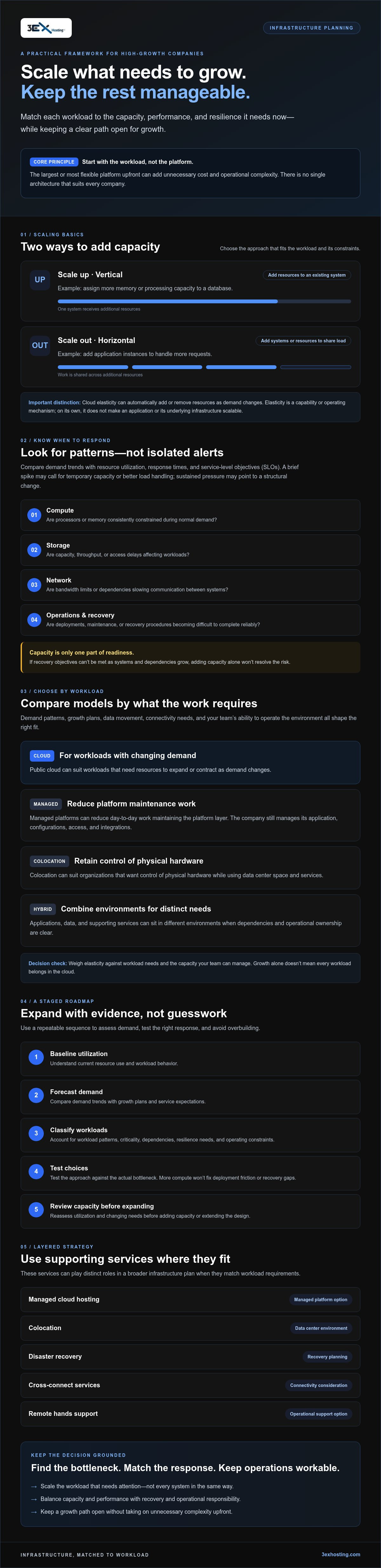
Scalable infrastructure is the ability to increase capacity, performance, or resilience as demand changes while keeping systems manageable and aligned with business needs. It describes an architecture’s ability to grow, not a promise that growth will happen automatically. Scalability commonly distinguishes vertical scaling, which adds resources to an existing system, from horizontal scaling, which adds systems or resources to share the load.
For example, a company might scale up by assigning more memory or processing capacity to a database. It might scale out by adding application instances to handle more requests. The right approach depends on the workload and its constraints. Cloud elasticity can automatically add or remove resources as demand changes, but elasticity is a capability or operating mechanism. It doesn’t, by itself, make an application or its underlying infrastructure scalable.
When assessing scalable infrastructure for high-growth companies, consider capacity alongside performance and recovery. A system may have room to handle more traffic but still lack a reliable recovery process or a workable way to deploy changes. Scalability should support both business growth and dependable operations.
Which growth signals show infrastructure needs attention?
Look for patterns, not isolated alerts. Compare demand trends with resource utilization, response times, and service-level objectives (SLOs). A brief traffic spike may call for temporary capacity or better load handling. Sustained utilization, rising latency, or repeated capacity limits can indicate that the current design needs a structural change.
Check each layer and the work required to operate it:
- Compute: Are processors or memory consistently constrained during normal demand?
- Storage: Are capacity, throughput, or access delays affecting workloads?
- Network: Are bandwidth limits or dependencies slowing communication between systems?
- Operations: Are deployments, maintenance, or recovery procedures becoming difficult to complete reliably?
Recovery gaps matter too. If recovery objectives can’t be met as systems and dependencies grow, adding capacity alone won’t resolve the risk.
Why growth does not automatically require a complete redesign
Start with the constraint. If one database is nearing capacity, a targeted resource increase may address the immediate need while the team evaluates longer-term options. If deployment friction or recovery gaps are the problem, adding compute may not help. Match the response to the bottleneck.
Timing depends on workload criticality, observed demand, and the growth forecast. A system central to daily operations may warrant earlier planning than a low-impact internal tool. Avoid scaling every system in the same way. Workloads have different demand patterns and resilience needs, so targeted changes can support growth without adding unnecessary architectural or operational complexity.
Compare infrastructure models for high-growth companies by workload
Let workload requirements determine placement, not a preference for one infrastructure model. An application with variable demand may need different capacity options from a database with predictable use, specialized hardware, or strict connectivity needs. A company can place applications, data, and supporting services in different environments, provided dependencies and operational ownership are clear.
When cloud, colocation, or hybrid infrastructure may fit
Public cloud can suit workloads that need resources to expand or contract as demand changes. Managed platforms can reduce the day-to-day work of maintaining the platform layer, though the company still needs to manage its application, configurations, access, and integrations. Colocation can suit organizations that want to retain control of physical hardware while using data center space and services. Explore 3EX Hosting’s data center services overview when assessing colocation as part of that mix.
Hybrid designs combine environments to meet distinct workload needs. For example, a company might run an application with changing demand in cloud infrastructure while keeping another system on dedicated equipment. The fit depends on data flows, performance requirements, recovery plans, and the team’s ability to manage connections and dependencies across environments.
| Model | Control | Scaling method | Operational responsibility | Connectivity | Suitable workload characteristics |
|---|---|---|---|---|---|
| Public cloud | Provider-defined infrastructure; customer controls configured resources | Provision or adjust cloud resources | Shared: provider operates underlying services; customer manages workloads and configuration | Consider network paths, integrations, and data movement | Variable demand, rapid testing, or workloads needing flexible resource changes |
| Managed platform | Less control over the platform layer | Use platform-supported capacity options | Provider manages defined platform functions; customer remains responsible for application needs | Check integration and access requirements | Applications that fit the platform’s supported environment |
| Colocation | Company retains control of its physical equipment | Add or change equipment and allocated space | Company manages its systems; facility and support responsibilities depend on the agreement | Assess required connections and network paths | Workloads needing dedicated physical infrastructure or specific hardware control |
| Hybrid | Varies by environment and workload | Scale each workload in its assigned environment | Shared across providers and internal teams; ownership must be explicit | Plan for dependable connections and cross-environment data flows | Workloads with different control, capacity, or performance needs |
Which comparison criteria matter beyond initial capacity?
Capacity is only the starting point. Compare control, portability, resilience, integration effort, team skills, and connectivity. Confirm what each provider operates and what remains your responsibility, including workload configuration, security decisions, monitoring, recovery procedures, and coordination between environments. Document provider capabilities separately from your team’s responsibilities.
For scalable infrastructure for high-growth companies, choose a model workload by workload. Reassess the choice as demand, dependencies, and operational capacity change.
Does scaling infrastructure always mean moving everything to the cloud?
No. Growth alone doesn’t show that every workload belongs in the same environment. Cloud elasticity can make it easier to add or release resources as demand changes, but it doesn’t remove the need to assess application requirements, data movement, operational ownership, and performance. Scalable infrastructure for high-growth companies may combine environments, or use a single model when that fits the workloads.
Moving every system at once can add migration work and new dependencies without addressing the actual constraint. The opposite risk is waiting too long to act: sustained capacity limits can affect response times, deployment plans, or recovery readiness. Neither overprovisioning nor delay has the same impact in every business. Assess both against workload criticality, demand patterns, and your team’s ability to operate the proposed design.
Which workloads may need different infrastructure characteristics?
Look at what each workload needs, not just how much capacity it uses. Customer-facing services may be sensitive to latency and demand spikes. Batch processing may tolerate scheduled capacity windows, while analytics workloads can depend heavily on data access and movement. Specialized compute may require closer control over hardware and configuration. These are starting points, not placement rules. Validate them against actual application behavior and dependencies.
- Compute intensity: Determine whether processing demand is variable, sustained, or tied to specific hardware requirements.
- Data access: Map where data resides, how often it moves, and which systems depend on it.
- Latency and availability: Identify response-time needs and the effect of interruptions on users or operations.
- Hardware control: Check whether the workload needs infrastructure choices that a standard cloud setup may not provide.
For specialized compute such as GPU-intensive workloads, compare the technical requirements with the available hosting or colocation models before choosing placement. For example, this guide to high-density GPU colocation can help frame the infrastructure questions involved.
How to weigh flexibility against control and operational effort
Elastic capacity is useful only when the surrounding systems and processes can support it. Establish who handles patching, monitoring, capacity planning, and incident response in each environment. A provider may operate some infrastructure layers, while your team remains responsible for workload configuration, access, integrations, and recovery procedures. Confirm the division of work before making a placement decision.
Factor in staff expertise and existing tools. A design that adds environments can also add monitoring, identity, connectivity, and troubleshooting tasks. When internal teams face capacity or skill constraints managing these responsibilities, IT services providers such as ZANGAARD can help support operational workloads. Don’t assume workloads will move easily between platforms, or that one model will always cost less or deliver a particular performance level. Test the workload under realistic conditions, document operational ownership, and review the choice as requirements change.
Use evidence before committing to new capacity. A clear baseline, staged tests, and defined ownership help turn scalable infrastructure for high-growth companies into a sequence of manageable decisions rather than a large, speculative redesign.
Build a capacity and resilience baseline
Before selecting capacity, document what you have and what it supports. Include applications, dependencies, hardware, network paths, utilization patterns, recovery objectives, and operational owners. Ask business owners to confirm recovery time objectives (RTOs) and recovery point objectives (RPOs), so recovery planning reflects business needs. Record assumptions that still need validation, such as forecast demand or dependency behavior.
Expand in stages and measure the result
Use this sequence to move from assessment to a tested capacity decision:
- Baseline: Record current utilization, response times, capacity constraints, dependencies, and recovery gaps.
- Forecast: Compare observed demand with business growth plans. Note the assumptions behind the forecast.
- Classify workloads: Group workloads by criticality, demand pattern, performance needs, recovery requirements, and operational owner.
- Compare placement: Assess suitable cloud, managed platform, colocation, or hybrid options against workload needs and your team’s ability to operate them.
- Test: Trial the proposed change with measurable acceptance criteria for performance, availability, deployment, and recovery. Include failover tests and operational handoffs where relevant.
- Review: Compare results with the baseline and actual demand. Use the findings to adjust the next capacity decision rather than expanding everything at once.
For production changes, define the rollout stages and rollback conditions in advance. Specify what result would trigger a pause or reversal, who makes that call, and how service will be restored. Test the plan before relying on it.
Physical infrastructure adds practical tasks to plan for. Clarify who handles onsite work and what support is included in the agreed scope. If you’re considering remote hands support, confirm which tasks the service covers and how it fits your operating procedures.
When assessing colocation or support options, compare them with your roadmap and operating requirements.
How 3EX Hosting can support a layered infrastructure strategy
A layered plan can combine physical infrastructure and managed services according to workload needs and internal operating capacity. 3EX Hosting offers full cabinet colocation, private colocation suites, custom cage solutions, managed cloud hosting, disaster recovery solutions, remote hands support, and cross-connect services. These are distinct options to evaluate, not a single architecture that every company needs.
Match colocation and managed services to the operating model
For workloads where your team wants to retain control of physical hardware, colocation can provide a dedicated infrastructure location. Full cabinet colocation may be relevant when dedicated cabinet space fits your requirements. Private suites or configurable cage space may suit organizations assessing different space arrangements. Consider custom cage solutions when that flexibility is relevant.
If your operating model calls for managed cloud hosting, assess which responsibilities the service covers and which remain with your team. Disaster recovery is a separate consideration: align the solution with your documented recovery objectives and dependencies. Cross-connect services may be relevant when planning connectivity between infrastructure, while remote hands support can be considered for onsite operational tasks. Confirm the specific scope and technical details of each service before relying on it in an operating plan.
The right combination depends on workload profiles, hardware control needs, connectivity, recovery requirements, and available staff. For scalable infrastructure for high-growth companies, distinguish clearly between the services a provider supplies and the tasks your team will continue to own.
What to clarify before speaking with an infrastructure provider
Prepare a concise requirements brief before discussing options. Include current and forecast capacity, workload characteristics, dependencies, connectivity needs, and recovery time and recovery point objectives. Note which systems require dedicated physical infrastructure, which may suit managed cloud hosting, and what support your team needs to operate them.
Ask providers to confirm current service specifications, capacity, connectivity options, support boundaries, and any responsibilities assigned to your team. Check how proposed services fit your existing architecture and staged expansion plan. Avoid relying on assumed service levels or outcomes; base decisions on details verified for your requirements.
To discuss how colocation or managed services could fit your infrastructure plans, contact 3EX Hosting through its website.
Build capacity with a clear plan for what comes next
Strong infrastructure planning starts with evidence: understand workload demands, dependencies, recovery needs, and team capacity before adding resources. Then match each workload to an environment that supports its performance and control requirements. A staged approach lets you test changes and adjust as demand develops, instead of expanding every system at once.
That’s the foundation of scalable infrastructure for high-growth companies. The aim isn’t to predict every future requirement. It’s to make informed capacity decisions, keep operational ownership clear, and review the plan as workloads change.
3EX Hosting’s options include full cabinet colocation, private suites, and custom cage configurations, alongside managed cloud hosting, disaster recovery, remote hands, and cross-connect services. Which combination fits depends on your infrastructure and support requirements. Discuss your infrastructure requirements with 3EX Hosting to explore relevant options.
With a measured plan and the right operating model, your infrastructure can grow one deliberate step at a time.
Frequently Asked Questions
What does scalable infrastructure mean for a growing company?
Scalable infrastructure can increase capacity, performance, or resilience as business demand changes. A company may scale up by adding resources to an existing system, or scale out by adding systems to share the workload. Scalability is not the same as automatic cloud elasticity: infrastructure may be scalable even when capacity changes require planning and manual action. The goal is to support growth without adding unnecessary complexity or capacity.
Does scalable infrastructure always mean using the cloud?
No. Cloud is one option, not a requirement for every workload. A growing company might use cloud resources for changing demand while retaining control of physical infrastructure through colocation for workloads with specific hardware or operational needs. A hybrid approach can combine environments. Assess each workload’s performance, connectivity, control, and recovery needs, along with your team’s ability to operate it, before deciding where it should run.
How do I know when my company needs to scale its infrastructure?
Look for persistent signals, not a single peak. Sustained high utilization, rising response times, recurring capacity limits, or deployment delays can indicate that infrastructure needs attention. Compare those trends with demand forecasts and service-level objectives. Check compute, storage, network, and operational workflows to identify the actual constraint. Also review recovery readiness. If a short-lived traffic spike resolves without affecting service goals, it may not justify a structural capacity change.
Can a company combine cloud and colocation infrastructure?
Yes. A company can run different workloads in cloud and colocation environments when each placement fits the workload’s requirements. For instance, variable resource needs may suit cloud, while a workload requiring control of physical hardware may fit colocation. Plan how systems exchange data, how connectivity is maintained, and who manages each layer. Hybrid designs need clear operational ownership and tested recovery procedures so dependencies across environments don’t become hidden failure points.
What should a company evaluate before choosing an infrastructure provider?
Evaluate service specifications, available capacity, connectivity options, resilience, support scope, and integration requirements. Ask what the provider operates and what your team remains responsible for, including monitoring, patching, recovery, and workload configuration. Compare those responsibilities with your staff’s expertise and tools—organizations often look to managed service specialists like carolinaitg.com to help manage ongoing IT needs and infrastructure support. Document workload profiles, growth forecasts, connectivity needs, and recovery objectives before discussions. Confirm particulars directly, and avoid relying on assumed service levels, certifications, or outcomes.
How can a company scale infrastructure without overbuilding?
Start with a baseline of current utilization, dependencies, performance, and recovery needs. Forecast demand, classify workloads, then compare placement options before adding capacity. Make changes in stages and define measurable acceptance criteria, such as response times, availability, deployment results, or recovery performance. Test the change and its rollback plan before broad production rollout. Review actual demand after each step, then use the results to guide the next capacity decision.
What role does disaster recovery play in infrastructure scalability?
Disaster recovery helps ensure that growth doesn’t outpace the ability to restore critical workloads after disruption. Define recovery time objectives, which describe how quickly a service should return, and recovery point objectives, which describe acceptable data loss. Map dependencies and test recovery procedures as infrastructure changes. Capacity additions alone don’t close recovery gaps. A disaster recovery solution should align with business priorities, workload dependencies, and the responsibilities your team can reliably manage.