 SUPPORT


 3EX United States
 Blog
In 2026, the square footage of your data center matters far less than the megawatts you can actually pull from the grid. Power availability has become the primary constraint for enterprise growth, yet many organizations still struggle with invoices that feel like a black box. It’s frustrating to see monthly costs fluctuate because of confusing kVA versus kW calculations or unexpected PUE overhead tied to high-density AI loads. You need a technical foundation where your billing aligns perfectly with your actual server utilization.
This guide will help you master the complexities of colocation power billing to ensure your infrastructure remains scalable, predictable, and cost-effective. We’ll show you how to navigate current regulatory shifts, such as the new GS-5 rate classes and federal ratepayer protections, while eliminating hidden fees. You’ll learn exactly how to audit your power consumption at the rack level to maintain a lean, high-performance operation that supports your bottom line without the surprises. By the end of this article, you’ll have the framework to transform power from a volatile utility into a manageable, transparent asset.
Key Takeaways
- Distinguish between provisioned and metered power models to ensure you only pay for the capacity your hardware actually consumes.
- Navigate the financial impact of high-density AI and GPU hosting, where power requirements can exceed 50kW per rack and require specialized cooling.
- Implement real-time auditing with Intelligent PDUs and automated alerts to prevent threshold breaches and optimize energy efficiency.
- Master the nuances of colocation power billing to eliminate hidden fees and maintain predictable OPEX across your data center footprint.
- Leverage technical stability and specialized infrastructure to scale your enterprise operations without compromising transparency or reliability.
Understanding the Fundamentals of Colocation Power Billing
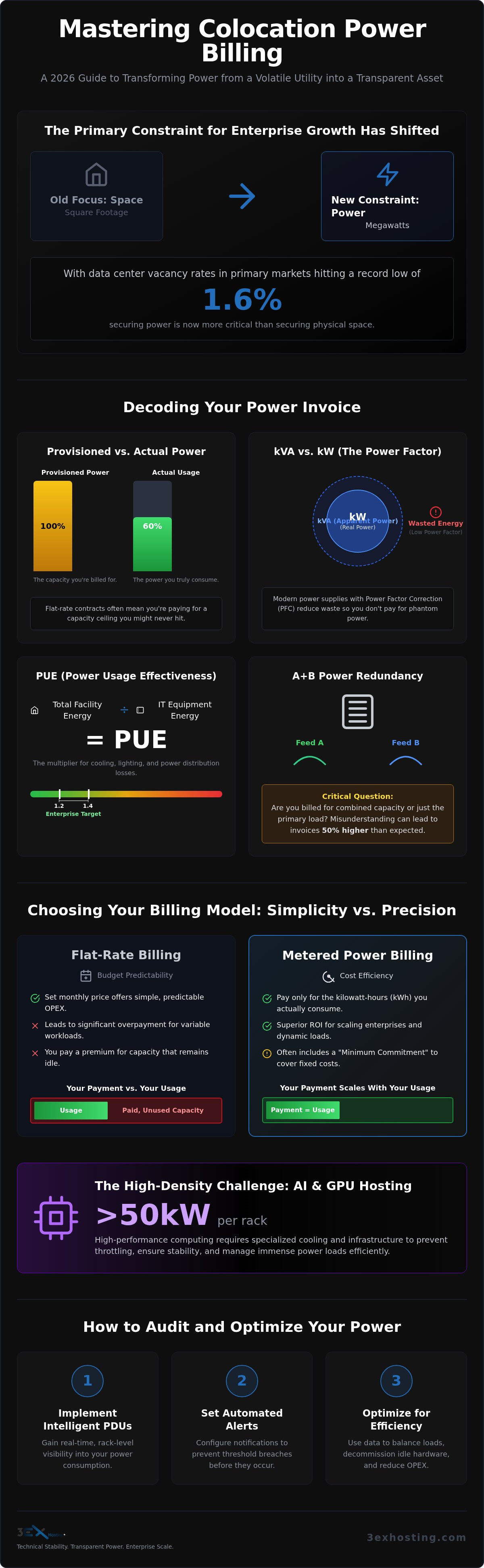
Power is the single most significant variable in data center OPEX. While rack space and floor tiles are static assets, energy consumption is dynamic. It scales directly with your compute load. A modern Colocation centre functions as a bridge between the utility grid and your hardware. In 2026, with vacancy rates hitting record lows of 1.6% in primary markets, securing power has become more critical than securing physical space. You aren’t just renting a room; you’re securing a slice of a finite electrical grid.
Most facilities use the Kilowatt (kW) as the standard unit for billing. However, you must distinguish between provisioned power and actual usage. Provisioned power is the capacity breakered at your rack. It’s the maximum amount of energy the provider guarantees to deliver. Actual usage is what your hardware pulls from the PDU during operation. If your contract is based on provisioned power, you’re paying for a ceiling you might never hit. This is why many enterprises are moving toward metered models to align costs with reality.
Redundancy also plays a major role in your total costs. Enterprise-grade setups utilize A+B power feeds to prevent downtime. This architecture provides two independent paths of electricity to every piece of equipment. While this ensures technical stability, it requires the facility to reserve double the capacity. Clear colocation power billing requires understanding whether your provider bills based on the combined capacity of both feeds or just the primary load. Misunderstanding this can lead to invoices that are 50% higher than expected.
The Role of PUE in Your Invoice
Power Usage Effectiveness (PUE) is the ratio of total facility energy to the energy delivered to IT equipment. In 2026, efficient enterprise facilities target a PUE between 1.2 and 1.4. This overhead covers cooling, lighting, and power distribution losses. When you review your invoice, look for how this multiplier is applied. If your provider has a high PUE, your effective cost per kW increases because you’re subsidizing an inefficient cooling plant. High-density deployments, like full cabinet colocation, often benefit from modern cooling designs that lower this overhead.
kVA vs. kW: The Power Factor Correction
Real power (kW) performs the actual work in your servers. Apparent power (kVA) represents the total energy the facility must supply to account for electrical inefficiencies. The relationship between these two is the Power Factor. If your hardware is inefficient, it pulls more current than it actually uses. Many providers now apply surcharges for a low Power Factor because it wastes grid capacity. You can optimize this by using modern power supplies with active Power Factor Correction (PFC). Reducing this waste ensures you don’t pay for phantom power that doesn’t contribute to your processing output.
Metered Power vs. Flat-Rate Billing Models
Choosing the right model for your colocation power billing is often a choice between simplicity and precision. Flat-rate billing offers a set monthly price regardless of how much energy your servers actually pull. This provides budget predictability. However, it often leads to significant overpayment because providers must price in the worst-case scenario. If your hardware runs at 40% load, you’re effectively paying for 60% capacity that stays idle. You’re buying peace of mind, but the premium is often steep.
Metered power flips this script. You pay for the base infrastructure plus the actual kilowatt-hours (kWh) consumed. This model is gaining traction as enterprises seek more transparency in how they subsidize Big Tech with your electricity bill through opaque utility structures. While metered billing is more efficient, most contracts include a “Minimum Commitment” clause. This ensures the facility covers its fixed costs even if your usage drops to zero. It’s a fair middle ground that protects both the provider and the tenant.
When to Choose Metered Power
Metered power is the superior choice for variable workloads or dev/test environments where compute demand isn’t constant. It’s especially effective when implementing full cabinet colocation for applications with clear peak and off-peak cycles. The long-term ROI is usually higher for scaling enterprises because you don’t pay for empty headroom until you actually need it. If your operations involve dynamic scaling, you should request a custom billing analysis to see the potential savings.
Fixed-Circuit Billing Explained
Fixed-circuit billing is the traditional approach. You pay for a specific circuit, such as a 20A or 30A feed at 208V. You must remember the 80% rule. Under National Electrical Code standards, you can only safely use 16A on a 20A breaker for continuous loads. If you exceed this, you risk tripping the breaker and causing downtime. The hidden cost here is under-utilization. If you only pull 10A on that 20A circuit, you’re still billed for the full 20A capacity. This inefficiency adds up quickly across multiple racks and can bloat your monthly OPEX without providing any technical benefit.
High-Density AI and GPU Power Challenges
AI has shattered the traditional 5kW per rack standard. Modern clusters frequently demand 20kW to 50kW+, and some bleeding-edge deployments are pushing toward 100kW per cabinet. This shift fundamentally changes how colocation power billing is structured. Providers now have to account for specialized infrastructure that wasn’t industry standard just a few years ago. If you’re running high-density workloads, you aren’t just paying for electricity; you’re paying for the massive industrial cooling and distribution systems required to keep those GPUs from melting.
One of the most significant risks in this new era is “stranded power.” In low-density environments, you usually run out of floor space before you run out of power. High-density AI flips this dynamic. You might only fill half a rack with GPUs before hitting your power limit. If your contract doesn’t allow for flexible density, you end up with stranded power, which is capacity you’ve paid for but cannot physically reach because of space or cooling constraints. Modern high density GPU colocation solves this by providing the necessary thermal headroom to fully utilize every rack unit.
Powering the AI Revolution
Deploying NVIDIA H100 or B200 architectures requires massive electrical throughput. Traditional 120V or 208V circuits often prove insufficient for these loads. Many enterprises are moving to 415V or 480V feeds to reduce line loss and lower amperage requirements. This higher voltage is more efficient but requires specialized PDUs and power strips. When you review your colocation power billing, check if your provider charges a premium for these high-voltage setups. Ideally, the efficiency gains from higher voltage should be passed back to you in the form of lower consumption metrics.
Thermal Management and Power Costs
Heat is the inevitable byproduct of AI compute. Removing that heat requires energy, and that energy shows up on your bill. If you use traditional air cooling for a 40kW rack, your PUE will skyrocket, bloating your monthly invoice. Efficient containment systems, such as hot-aisle or cold-aisle containment, are essential. Better yet, liquid-to-chip cooling or rear-door heat exchangers provide even greater efficiency. By using these advanced systems, you lower the PUE multiplier on your invoice. There’s a direct correlation here: better thermal management equals lower effective power costs. Choosing a partner that supports these high-density cooling requirements is the best way to ensure your AI training stays within budget.
How to Audit and Optimize Your Data Center Power
Transparency in colocation power billing starts with granular data. You shouldn’t rely solely on the provider’s summary at the end of the month. Using Intelligent PDUs (Power Distribution Units) allows you to track real-time consumption at the outlet level. This data identifies exactly which hardware is pulling the most current. Set up automated alerts for power threshold breaches. These notifications act as a technical safety net, alerting you before a circuit hits its limit and risks a trip. Proactive monitoring transforms power from a hidden cost into a manageable metric.
Digital logs are essential, but they don’t always reveal physical inefficiencies. Leveraging remote hands support for physical audits ensures your rack is configured for maximum efficiency. Technicians can check for cable clutter that blocks airflow or verify that blanking panels are correctly installed. Conduct a quarterly “Power vs. Performance” review. This process involves cross-referencing your compute output with your energy consumption to ensure every kilowatt is delivering business value.
Step-by-Step Power Audit
Compare your PDU logs directly against your provider’s invoices. Discrepancies often occur when billing cycles don’t align or when PUE multipliers are applied incorrectly. Identify “Zombie Servers” during this process. These are idle units that consume energy while providing zero compute value. Industry professionals often find that a significant portion of data center energy is wasted on hardware that should have been decommissioned. Finally, verify the PUE multipliers in your contract to ensure they reflect the facility’s actual performance in 2026.
Optimizing Hardware for Lower Bills
Hardware choice directly impacts your monthly invoice. Upgrade to high-efficiency power supplies, such as 80 Plus Platinum or Titanium models, to minimize energy loss during AC-to-DC conversion. Implement software-level power capping for non-critical workloads to prevent expensive usage spikes. Balance your loads across A+B feeds carefully. While this ensures technical stability, it also prevents one circuit from reaching capacity while the other remains under-utilized. If you need assistance identifying these inefficiencies, contact our engineering team for a custom infrastructure audit.
The 3EX Hosting Advantage: Transparent Enterprise Power
Technical stability and financial clarity shouldn’t be mutually exclusive. At 3EX Hosting, we’ve designed our infrastructure to eliminate the friction typically found in colocation power billing. We provide a transparent bridge between your hardware’s energy demands and your monthly OPEX. Our billing models are tailored to enterprise scale, ensuring that as your compute load grows, your costs remain predictable and auditable. We don’t hide behind complex multipliers or vague PUE overheads. You receive granular data that reflects your actual consumption.
Our national footprint focuses on data center reliability for the most demanding workloads. We’ve optimized our facilities to support high-density AI infrastructure, providing the specialized power feeds and cooling capacity required for GPU-heavy clusters. Whether you’re starting with a few racks or require fully customized private suites, our platform scales with you. You get the same level of detailed reporting and technical support at every stage of your growth. We prioritize the technical foundation so your billing stays as stable as your uptime.
Built for Stability and Speed
We provide professional, objective support for complex deployments that require more than just a standard connection. Our facilities offer N+1 and 2N redundancy options to protect your mission-critical loads from grid instability. This technical foundation supports low-latency, high-performance needs, ensuring your hardware runs at peak efficiency. We focus on the background mechanics so you can focus on your core business. It’s a partnership built on reliability, speed, and the confidence that your systems are in expert hands.
Your Partner in Infrastructure Scaling
Scaling your footprint shouldn’t be a logistical nightmare. You have direct access to technical experts who assist with power planning and load balancing from day one. We offer simplified move-in assistance and deployment support to get your hardware online faster. Our team understands the nuances of high-density power distribution and can help you avoid the common pitfalls of stranded capacity. If you’re ready for a partner that values transparency as much as performance, Get a Transparent Colocation Quote Today and see how we can optimize your operation.
Future-Proofing Your Infrastructure for the 2026 Power Landscape
Mastering your infrastructure costs requires a shift from passive observation to active management. We’ve explored how metered models provide the precision needed to eliminate wasted spend and how high-density cooling directly impacts your effective overhead. As AI workloads continue to push the boundaries of traditional data center design, maintaining a transparent view of your colocation power billing is the only way to ensure sustainable growth without unpredictable surprises.
You need a partner that provides the technical stability to back up these metrics. 3EX Hosting offers Enterprise-Grade N+1 Redundancy and 24/7 Expert Remote Hands Support to keep your hardware monitored and efficient. Our facilities are High-Density AI Infrastructure Ready, supporting the specialized feeds and thermal management your next-gen clusters require. It’s time to transform your energy footprint from a volatile utility into a predictable asset.
Request a Transparent Colocation Power Quote today to align your data center operations with your bottom line. Build your foundation on stability and clarity.
Frequently Asked Questions
What is the difference between metered and flat-rate colocation power?
Metered power billing charges you for the actual kilowatt-hours your hardware consumes, while flat-rate billing is a set fee for a fixed circuit capacity. Metered models are ideal for variable workloads because you don’t pay for idle headroom. Flat-rate models offer billing predictability but often result in overpayment if your servers don’t run at 100% utilization.
How does PUE affect my monthly colocation bill?
PUE acts as a multiplier applied to your server energy consumption to account for facility overhead like cooling and lighting. If your IT load is 10kW and the facility PUE is 1.4, you’ll be billed for 14kW. Efficient facilities in 2026 aim for PUE ratios between 1.2 and 1.3 to keep these overhead costs manageable for enterprise tenants.
Can I change my power commitment mid-contract?
Most providers allow you to increase your power commitment at any time to support rapid growth. Decreasing your commitment is usually more difficult and often restricted until the end of your contract term. It’s vital to negotiate flexible commitment windows or “ramp-up” clauses during the initial contract phase to align with your expected infrastructure scaling roadmap.
What happens if my servers exceed the provisioned power limit?
Exceeding your provisioned limit typically triggers a circuit breaker trip to prevent electrical fires or equipment damage. This results in immediate hardware downtime. Beyond the technical risk, many providers charge significant overage penalties or require an immediate, permanent upgrade to a higher-capacity circuit once their monitoring systems detect a breach of the breakered limit.
Why do I pay for two power feeds (A+B) if I only use one?
You pay for the secondary feed to guarantee technical stability through redundancy. Even if your equipment only pulls from the primary feed, the facility must reserve identical capacity at the UPS and generator levels for the “B” feed. This ensures your systems remain online during a primary power failure. It’s the cost of maintaining enterprise-grade N+1 or 2N availability.
How much power does a typical GPU server rack require in 2026?
A typical GPU server rack in 2026 requires between 20kW and 50kW of power. For intensive AI training clusters using modern hardware, requirements can exceed 60kW per cabinet. This density is a massive increase from the 5kW standard of previous years and requires specialized power distribution and cooling infrastructure to prevent thermal throttling or circuit overloads.
Is liquid cooling more expensive to power than air cooling?
Liquid cooling is actually more power-efficient than air cooling at the facility level. While the pumps require some energy, they use far less electricity than the massive fans needed for air cooling high-density racks. This efficiency results in a lower PUE, which can significantly reduce the “overhead” portion of your monthly energy bill compared to traditional air-cooled setups.
What is a “Power Factor” and why does it matter for billing?
Power Factor is the ratio of real power used to do work versus the apparent power supplied to the circuit. A low Power Factor indicates that your hardware is inefficiently drawing current. This matters for colocation power billing because providers often apply surcharges when your equipment wastes grid capacity that could have been used by other tenants or facility systems.