 SUPPORT


 3EX United States
 Blog
Could your distributed infrastructure be costing you twice as much in data transfer as it did just last year? With Google Cloud increasing North American egress rates to $0.08 per GiB as of May 2026, the financial impact of moving data between sites is now a board level concern. Many enterprises struggle with high latency between geographically separated locations and the exhausting complexity of managing a dozen different carrier relationships. It’s a common challenge that often leads to unpredictable costs when you need to scale bandwidth quickly to meet demand.
You need a way to treat your off site resources as if they’re in the same room. We understand that technical stability and speed aren’t just features; they’re the foundation of your operations. This guide explains how data center interconnect (DCI) services transform isolated racks into a unified, high performance network. You’ll discover how to achieve seamless workload mobility and automated disaster recovery failover without the usual management overhead or performance bottlenecks.
We will break down the latest 400 Gbps and 800 Gbps coherent optics trends and the impact of new FERC regulations on large scale load interconnections. By the end, you’ll have a clear path to predictable network performance and a scalable infrastructure that grows with your business needs.
Key Takeaways
- Discover how to bridge geographically separate physical sites into a single, cohesive resource pool for compute and storage.
- Evaluate the trade-offs between dark fiber and managed data center interconnect (DCI) services to find the right balance of control and scalability.
- Learn to implement real-time data replication and seamless workload mobility to ensure business continuity without user disruption.
- Identify the critical performance metrics, including latency and jitter, that dictate the success of high-demand AI and streaming applications.
- Leverage carrier hotel advantages and cross-connect services to simplify connectivity and eliminate the complexity of managing multiple carrier relationships.
What are Data Center Interconnect (DCI) Services?
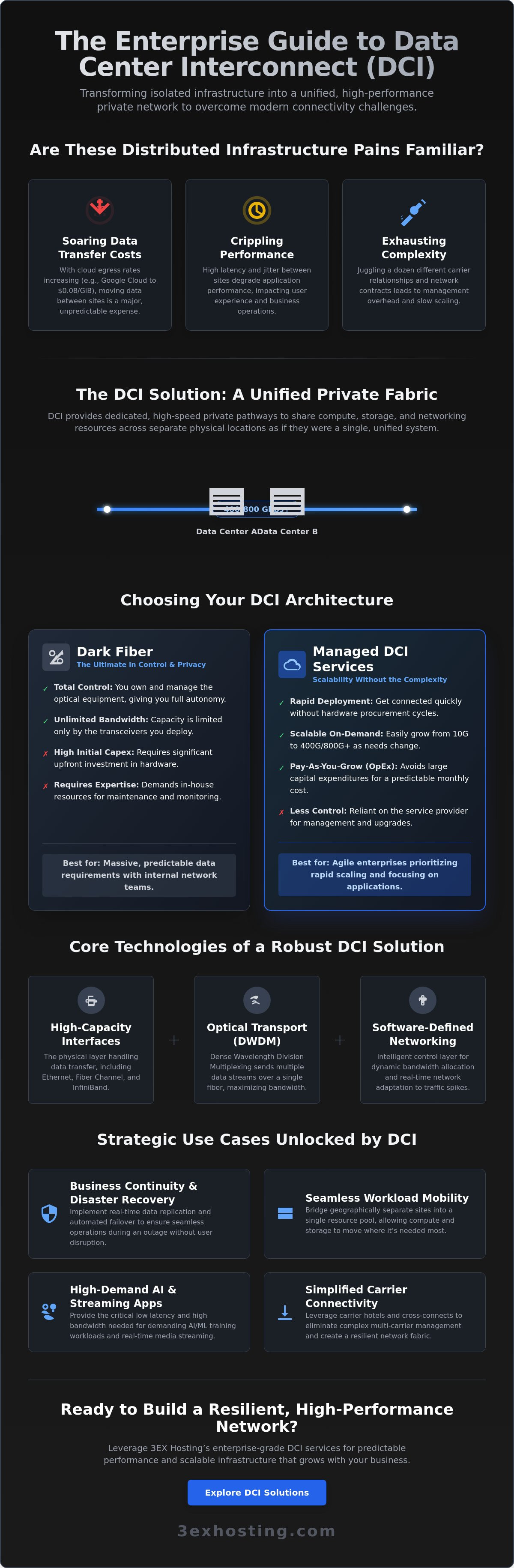
High performance infrastructure no longer lives in a single room. Technically, Data Center Interconnect (DCI) refers to the specialized networking technology that links two or more data centers together over short, medium, or long distances. These aren’t standard internet connections. They’re dedicated, high speed private pathways designed to share compute, storage, and networking resources across separate physical locations as if they were a single, unified system.
Traditional centralized models are fading. Modern enterprises now favor distributed, high availability “mesh” architectures. In this setup, data isn’t just stored; it’s constantly synchronized across multiple sites. This shift ensures that if one facility faces a challenge, the others pick up the load without a millisecond of lag. Unlike the public internet backbone, data center interconnect (DCI) services provide deterministic performance. This means you get the exact bandwidth and latency you pay for, every second of the day.
The Evolution of Interconnectivity
Interconnectivity has moved far beyond simple point-to-point links. Early setups were rigid and difficult to scale. Today, we see complex multi site mesh networks that allow for massive flexibility. By 2026, the demand for “instant-on” data has reached a peak. Enterprises can’t afford the delay of pulling data from a distant, isolated silo. This need for speed has turned carrier hotel environments into essential hubs. These facilities act as national ecosystems where hundreds of providers meet, making it easier to establish the resilient links required for modern operations.
Key Components of a DCI Solution
A robust DCI strategy relies on three technical pillars to maintain stability and speed. First, high capacity interfaces like Ethernet, Fiber Channel, and InfiniBand handle the heavy lifting of data transfer. Second, optical transport layers, specifically Dense Wavelength Division Multiplexing (DWDM), allow multiple data streams to travel over a single fiber pair. This maximizes bandwidth efficiency without the cost of laying new physical cables. Finally, Software-Defined Networking (SDN) provides the intelligence. It allows for dynamic bandwidth allocation, so your network adapts to traffic spikes in real time. Using data center interconnect (DCI) services built on these components ensures your infrastructure remains both agile and secure.
DCI Architecture: Transport Layers and Technology Options
Selecting the right architecture for your data center interconnect (DCI) services is a strategic decision that dictates your long term operational costs and performance ceilings. It’s a choice between total control and managed convenience. Enterprises must evaluate whether they have the internal expertise to manage the underlying optical hardware or if they require a turnkey solution that scales on demand. This decision typically centers on the trade-off between dark fiber and managed service models.
Dark Fiber: The Ultimate in Control and Privacy
Enterprises with massive, predictable data requirements often choose unlit fiber strands, known as dark fiber. This option provides a dedicated physical path where you own the optics and manage the light. While it requires a higher initial capital expenditure, it offers virtually unlimited bandwidth potential. You aren’t restricted by a provider’s service tiers; if you need more capacity, you simply upgrade your transceivers. However, this path demands significant internal resources to maintain the hardware and monitor signal integrity over long distances.
Managed DCI Services: Scalability Without Complexity
For organizations that prefer to focus on applications rather than optical physics, managed services provide a more agile alternative. Solutions like Ethernet Private Lines (EPL) or Ethernet Virtual Private Lines (EVPL) are the standard for high performance enterprise networking. These services allow for a pay-as-you-grow model, which is essential for national infrastructure projects. As of 2026, we’re seeing a rapid transition from 10G and 100G links to 400G and 800G standards to support AI workloads and massive data replication. If your priority is rapid deployment, our data center services provide the carrier-neutral environment needed to establish these links quickly.
The technical depth of your DCI also depends on the networking layer you choose. Layer 2 DCI offers a simple, transparent Ethernet bridge between sites, making it feel like your servers are on the same local switch. Layer 3 DCI uses IP routing, which provides better traffic management and isolation but adds complexity to the configuration. Regardless of the layer, data integrity is maintained through Optical Transport Network (OTN) protocols. These protocols act as a digital wrapper, providing advanced error correction and performance monitoring across the fiber path.
Security at the transport layer is no longer optional. Modern DCI deployments utilize MACsec (Media Access Control Security) to provide wire-speed encryption. Because this happens at the hardware level, it secures all traffic moving between your data centers without the latency penalties associated with traditional VPNs or software-based encryption. This ensures your data remains protected from the moment it leaves one facility until it’s safely processed at the next.
Strategic Use Cases: Why Enterprises Invest in DCI
Enterprises don’t invest in data center interconnect (DCI) services just to move packets. They do it to create a unified logical entity from physically separate assets. This resource pooling allows your IT team to manage storage and compute as a single elastic cloud. It removes the limitation of being tied to one specific building’s power or space constraints. With Google Cloud increasing North American egress rates to $0.08 per GiB in 2026, private DCI pathways offer a massive financial advantage. You bypass these public cloud fees by moving data across your own dedicated infrastructure.
Workload mobility is another primary driver for this technology. Imagine moving active virtual machines from one site to another during a maintenance window without losing a single user session. High speed DCI makes this possible by maintaining the same network state across different locations. It also facilitates cloud adjacency. By placing your colocation gear next to public cloud on-ramps, you get the performance of a private server with the scalability of the cloud. It’s the best of both worlds. The system scales. Your data stays safe. Efficiency improves.
Disaster Recovery and High Availability
Synchronous replication requires extremely low latency, usually under 5 milliseconds. If your sites are too far apart, you’ll switch to asynchronous replication. Your Recovery Point Objective (RPO) depends entirely on this distance and the quality of your link. Integrating these pathways with professional disaster recovery solutions ensures your failover triggers are automated and reliable. In a high speed interconnect environment, a site failure doesn’t have to mean a service outage. The transition is invisible to the end user.
Edge Computing and Content Delivery
Metro-DCI clusters bring data closer to the end user. Interconnecting local edge nodes reduces backhaul costs because you aren’t sending every request back to a central hub. This architecture is vital for the 300+ data center bills introduced across 30 states in early 2026, as it helps operators manage energy costs and grid reliability locally. By localizing traffic through metro-DCI clusters, these services effectively slash “ping” times by keeping data requests within the local fiber loop rather than routing them across the national backbone. This is essential for applications like real-time video or high-frequency financial trading where every millisecond counts.
Evaluating DCI Providers: Performance and Scalability Metrics
Latency is the primary metric for any DCI deployment. While the speed of light in fiber is a physical constant, the quality of a provider’s routing and hardware determines the actual round-trip time experienced by your applications. Every kilometer of fiber adds approximately 5 microseconds of latency. For enterprises running real-time synchronization, even a few extra milliseconds can trigger data integrity issues. High performance data center interconnect (DCI) services must provide a clear, deterministic path that minimizes these delays.
Throughput and jitter are equally critical, especially as we move into the AI era. Jitter, or the variation in packet arrival times, can disrupt the synchronization required for distributed AI training and high-definition video streaming. Consistent throughput ensures that your 400 Gbps or 800 Gbps links actually deliver their rated capacity during peak loads. You should also look for N+1 or 2N redundancy in the interconnect path. This means having geographically diverse fiber entries and redundant hardware to ensure that a single cable cut doesn’t take your entire network offline.
SLA guarantees provide the final layer of security. A professional provider won’t just promise uptime; they’ll back it with specific repair time commitments. Look for Service Level Agreements that cover not only the availability of the link but also the performance metrics like latency and packet loss. If you’re ready to design a resilient network, request a custom DCI quote to see how our infrastructure fits your scaling plans.
Carrier Neutrality and Ecosystem Access
A carrier-neutral facility offers the greatest flexibility for DCI strategies. It prevents vendor lock-in by allowing you to choose from multiple fiber providers and competing carriers. This competition naturally drives down costs and improves service quality. Establishing these links becomes significantly simpler when you utilize cross-connect services within a carrier hotel. These direct, physical connections bypass the public internet entirely, providing the lowest possible latency between your infrastructure and your partners’ networks.
Future-Proofing for AI and GPU Workloads
The rise of AI has fundamentally changed connectivity requirements. With AI-optimized facilities now costing over $20 million per MW to construct as of 2026, you cannot afford a bottleneck in your network. Specialized high density GPU colocation environments require massive DCI throughput to handle the explosive growth of training data. While 400G and 800G standards are the current benchmark, leading enterprises are already preparing for the 1.6Tbps era. Your provider must have the physical duct space and power capacity to support these massive upgrades as your AI workloads expand.
Implementing DCI with 3EX Hosting’s Enterprise Infrastructure
3EX Hosting operates as a strategic hub for data center interconnect (DCI) services, providing the physical and logical foundation for enterprise scalability. Our status as a carrier hotel simplifies the process of linking your infrastructure to global providers and local partners alike. In an environment where every millisecond matters, being physically adjacent to the major fiber backbones ensures your data moves with maximum velocity. We offer customized solutions for full cabinet colocation and private suites, giving you the dedicated space needed for high-density deployments.
Managed connectivity at 3EX Hosting scales with your business. We handle everything from simple cross-connects between racks to complex national DCI links that bridge your Florida operations with distant sites. Interconnect deployment requires precise physical handling and technical expertise. Our remote hands support team manages the intricate cabling and port configurations, so your internal staff doesn’t have to travel for every network adjustment. This allows for a more efficient, hands-off approach to infrastructure management.
Seamless Deployment and Migration
Moving your infrastructure shouldn’t disrupt your connectivity. Our move-in assistance team manages the physical interconnect setup from day one, ensuring your fiber paths are tested and certified before you go live. We help integrate DCI into your broader managed IT infrastructure, optimizing network paths for specific enterprise applications. This technical consultation is essential for maintaining the low latency required for real-time data replication and AI training workloads.
Get Started with Enterprise DCI
The first step toward a resilient, high-speed network is a comprehensive audit. We identify existing latency bottlenecks in your current setup and provide a clear roadmap for scaling your bandwidth. Our team generates custom quotes for high-bandwidth requirements, ensuring your costs remain predictable as your data needs grow. Don’t let isolated infrastructure hold back your enterprise growth. Contact 3EX Hosting for a custom DCI and colocation quote today to unify your distributed assets into a single, high-performance network.
Building a Unified Foundation for Global Scalability
Modern enterprise success depends on a network that acts as a single, resilient entity. By moving away from isolated silos and adopting high-performance data center interconnect (DCI) services, you eliminate the latency bottlenecks that stall innovation. You now understand how the right architecture choices between dark fiber and managed services provide the control needed to handle 2026 data egress challenges and the explosive growth of AI workloads. These links aren’t just cables; they’re the nervous system of your distributed infrastructure.
3EX Hosting provides the technical stability required for these mission-critical links. As a carrier-neutral facility with access to over 50 providers, we ensure you have the flexibility to avoid vendor lock-in and optimize your routing. Our infrastructure features N+1 redundancy on all mission-critical paths. Our on-site remote hands team is available 24/7 to ensure rapid deployment and continuous reliability. Your infrastructure shouldn’t be a performance limitation.
Take the next step toward a seamless, high-speed network that supports your long-term vision. Scale your enterprise network with 3EX Hosting DCI Services and build the reliable foundation your business deserves.
Frequently Asked Questions
What is the difference between DCI and standard internet connectivity?
DCI uses private, dedicated fiber pathways rather than the public internet backbone. This removes the performance unpredictability of public routing and provides deterministic latency. While standard internet relies on best-effort routing through multiple ISPs, these specialized links offer a direct path between sites with guaranteed bandwidth. This ensures that your mission-critical applications always have the throughput they need without interference from external traffic spikes.
How much latency is acceptable for synchronous data replication in DCI?
Synchronous data replication generally requires round-trip latency of 5 milliseconds or less. This strict threshold is necessary to prevent significant delays in write operations, as the source system must wait for an acknowledgment from the destination. If your sites are geographically far apart and exceed this limit, asynchronous replication is usually the more stable choice. Proper fiber path optimization is essential to stay within these millisecond requirements.
Can DCI services help with regulatory compliance for data sovereignty?
Yes, data center interconnect (DCI) services provide a private, controlled environment that keeps data within specific geographic or jurisdictional boundaries. Since traffic doesn’t traverse the public internet, enterprises can more easily document the physical path of their information. This control is critical for meeting strict regional regulations regarding where sensitive data is stored and processed. It effectively eliminates the risk of data being routed through unauthorized jurisdictions.
What are the security risks associated with data center interconnects?
Physical fiber tapping and man-in-the-middle attacks at the transport layer are the primary risks. While these links are inherently more secure than the public internet, data is still vulnerable if it isn’t encrypted. Modern solutions mitigate this risk by using MACsec to provide wire-speed encryption at the hardware level. This ensures that your information is protected from the moment it leaves one facility until it’s safely received at the next.
How does DCI support hybrid cloud and multi-cloud strategies?
DCI acts as the high-speed bridge between your private colocation and public cloud on-ramps. It allows you to move workloads between environments seamlessly while maintaining low-latency access to cloud-based services. This architecture is essential for enterprises that need the scalability of the cloud but require the performance and security of private infrastructure. It creates a unified network fabric that spans across multiple cloud providers and physical locations.
Is dark fiber always better than managed DCI services for enterprises?
Dark fiber isn’t always the superior choice; it depends on your internal technical resources and capital budget. While dark fiber offers the highest level of control and unlimited bandwidth potential, it requires you to own and manage the optical hardware. Managed data center interconnect (DCI) services provide a pay-as-you-grow model that eliminates the complexity of hardware maintenance. Many enterprises find the managed approach more agile and cost-effective for rapid scaling.
What hardware is required to implement a modern DCI solution?
Implementation typically requires high-performance transceivers, optical line systems such as DWDM, and DCI-optimized switches or routers. These components must support the specific protocols and bandwidth standards your network requires, such as 400G or 800G Ethernet. In a colocation environment, the physical link is often established through high-speed cross-connects within a carrier-neutral meet-me room. This hardware stack ensures that the connection remains stable and efficient under heavy loads.
How do DCI services impact the total cost of ownership (TCO) of colocation?
These services can lower the total cost of ownership by reducing expensive cloud egress fees and simplifying multi-site management. By unifying distributed infrastructure, you reduce the need for redundant hardware at every location. While there is a predictable cost for the link, the long-term savings in data transfer and operational efficiency often offset the initial investment. It allows for a more streamlined approach to resource allocation across your entire footprint.