 SUPPORT


 3EX United States
 Blog
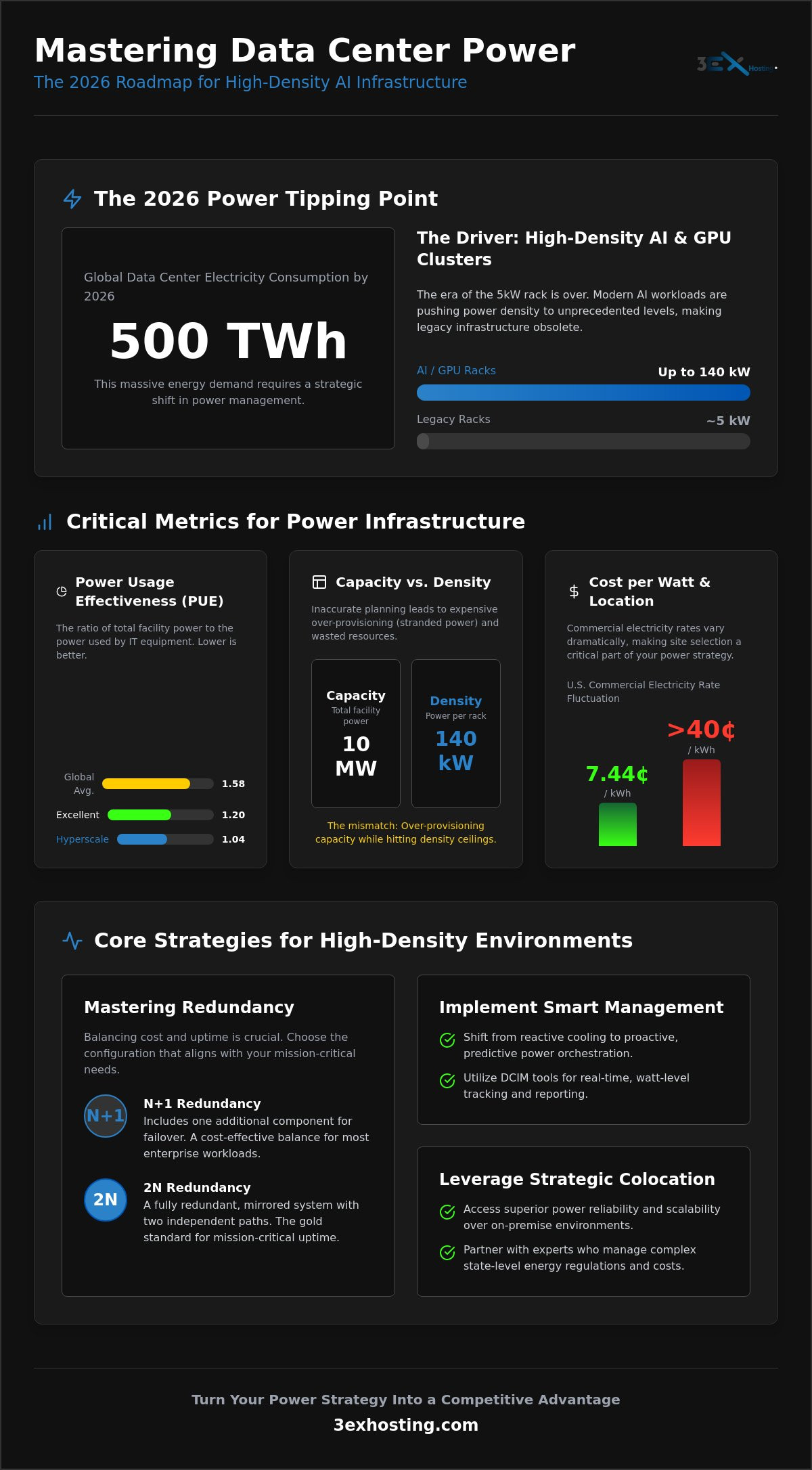
By the end of 2026, global data center electricity consumption is projected to surpass 500 TWh. This massive energy demand is largely driven by the rapid adoption of AI and GPU clusters that now require up to 140 kW per rack. To maintain stability, enterprises must prioritize advanced data center power management strategies that address both unpredictable costs and intense thermal management hurdles. It’s a complex environment where inaccurate capacity planning often leads to expensive over-provisioning and wasted resources.
You need a stable foundation to handle these shifts without sacrificing operational reliability. This guide offers a technical roadmap to master power density and ensure robust redundancy while scaling high-density AI infrastructure. We’ll also examine how to achieve a reduced Power Usage Effectiveness (PUE) and integrate remote hands support for seamless power monitoring. By the end, you’ll have the framework required to turn your power strategy into a competitive advantage and ensure your systems remain fast, secure, and fully optimized.
Key Takeaways
- Learn why 2026 is the critical tipping point for enterprise power requirements and how to adapt infrastructure for modern hybrid demands.
- Understand the vital distinction between power capacity and density to avoid costly over-provisioning and improve PUE benchmarks.
- Master advanced data center power management strategies specifically designed to handle the unique electrical and thermal profiles of high-density AI and GPU clusters.
- Evaluate the trade-offs between N+1 and 2N redundancy configurations to ensure mission-critical uptime across national deployments.
- Discover how leveraging carrier-neutral colocation facilities provides superior power reliability and scalability compared to traditional on-premise environments.
The Evolution of Data Center Power Management in 2026
Modern data center power management is no longer a back-office utility function. It’s a strategic orchestration of electricity, cooling, and compute capacity. In 2026, we’ve reached a tipping point where traditional power models are failing under the weight of global demand. With global data center electricity consumption projected to surpass 500 TWh this year, the industry has moved beyond simple monitoring. Effective data center power management strategies now require a proactive approach to prevent grid bottlenecks and ensure operational stability.
The transition from reactive cooling to proactive power orchestration is the defining shift of the current landscape. Operators can’t just wait for a temperature spike to adjust cooling systems. They must predict load fluctuations before they happen. This level of precision is necessary for national scalability. Standardized power protocols across facilities ensure that a full cabinet colocation setup operates with the same efficiency regardless of its physical location. It’s about creating a predictable, repeatable environment for mission-critical data.
The Shift Toward High-Density Workloads
The era of the 5kW rack is over. Modern enterprise needs have moved far beyond these legacy limits. Generative AI and Large Language Models (LLMs) have pushed rack-level consumption toward 120-140 kW in specialized deployments. Balancing these high-performance compute requirements with legacy hardware is a major challenge for IT directors. You need infrastructure that supports variable density. This allows for the seamless integration of GPU-heavy clusters alongside standard servers without over-provisioning the entire floor. It’s a delicate balance that requires deep technical expertise to manage effectively.
Regulatory and Sustainability Pressures
Efficiency is now a legal and financial requirement rather than a suggestion. Power Usage Effectiveness (PUE) has transitioned from a technical metric to a core corporate KPI. This shift is driven by new national energy standards and the 2025 Building Energy Efficiency Standards taking effect in January 2026. Modern data center power management strategies now incorporate Data Center Infrastructure Management (DCIM) tools to track every watt in real-time. These tools help enterprises integrate renewable energy sources and meet reporting mandates. Many organizations are moving toward private colocation suites to gain better control over their environmental footprint and regulatory compliance.
The regulatory vacuum at the federal level, following the expiration of OMB Memorandum M-25-03, has left state-level oversight to fill the gap. This makes site selection a critical part of your power strategy. You must account for varying state-level commercial electricity rates, which range from as low as 7.44¢/kWh to over 40¢/kWh. Choosing a facility that understands these dynamics is the only way to ensure long-term ROI and operational speed.
Critical Metrics and KPIs for Power Infrastructure
Effective data center power management strategies rely on a precise hierarchy of metrics. You can’t manage what you don’t measure with granularity. While capacity represents the total available power, density measures how effectively that power is delivered to specific racks. In 2026, the gap between these two is where efficiency is either won or lost. Enterprises often over-provision capacity while hitting density ceilings in high-compute zones. This mismatch leads to stranded power and inflated operational costs.
Calculating the “Cost per Watt” has become a standard for national infrastructure comparisons. With commercial electricity rates fluctuating between 7.44¢/kWh and over 40¢/kWh across the U.S., a facility’s location directly impacts your bottom line. Beyond simple utility costs, enterprises are now integrating Carbon Usage Effectiveness (CUE) into their reporting. This metric tracks the carbon emissions per unit of IT energy consumed. It provides a clearer picture of environmental impact for stakeholders who demand more than just uptime.
Measuring Power Usage Effectiveness (PUE)
Power Usage Effectiveness (PUE) is the ratio of total facility power to the power delivered specifically to IT equipment.
In 2026, a PUE of 1.2 or lower is considered excellent for enterprise facilities. The global average still hovers around 1.58, but hyperscale environments are pushing as low as 1.04. Refining your data center power management strategies requires moving beyond the basic PUE calculation to understand the specific components of non-IT energy draw. You should also identify and eliminate “zombie servers.” These are idle assets that consume power without performing useful work, often accounting for up to 30% of a facility’s energy draw. Removing these hidden drains is a quick win for any efficiency audit.
Power Density and Rack-Level Analytics
Average density is a dangerous metric for modern workloads. You must focus on peak-load management to prevent localized failures. High-density AI deployments cause rapid heat spikes that overwhelm standard air cooling. Using Intelligent PDUs (Power Distribution Units) allows for granular, rack-level monitoring. These devices provide the real-time data needed to prevent circuit overloads before they occur. By tracking power at the outlet level, you gain the visibility required to balance loads across the entire floor.
If your internal team lacks the bandwidth for constant monitoring, leveraging remote hands support can provide the necessary eyes on-site to manage these granular adjustments. This ensures your high-density environment remains stable without requiring your top engineers to be physically present for every PDU reset or load balance.
High-Density Strategies: Powering AI and GPU Clusters
GPU-heavy clusters present a radical departure from traditional server loads. Unlike standard CPU workloads that fluctuate gradually, AI training cycles create massive transient loads. Power draw can swing from idle to peak in milliseconds. This requires sophisticated data center power management strategies that account for voltage stability and harmonic distortion. If your power delivery isn’t precise, you risk damaging sensitive GPU architectures or triggering premature breaker trips. Stability at these levels is a product of rigorous engineering, not just capacity.
Redundancy configurations are a critical strategic choice in this context. For many enterprise AI training tasks, an N+1 setup provides a balance of cost and reliability. However, for mission-critical production models, a 2N configuration is often the only way to ensure total uptime. This level of redundancy protects against both utility failures and internal component issues. Future-proofing your full cabinet colocation strategy means planning for these requirements today. Next-gen chips are already pushing the boundaries of what air cooling can handle, making high-density readiness a non-negotiable requirement for 2026.
Infrastructure for AI Cloud Computing
Deploying high density GPU colocation requires specialized power paths that differ from standard enterprise setups. You can’t simply plug a 30kW rack into a standard distribution board. These environments often utilize 415V power distribution to reduce amperage and minimize line losses. This higher voltage keeps cable diameters manageable while delivering the raw power necessary for LLM training. Managing the transient loads during heavy computational cycles is essential. Without high-speed switching and robust UPS buffering, these spikes can destabilize the local grid segment and lead to hardware failure.
Thermal Management and Power Synergy
Power management and cooling efficiency are inextricably linked. Every watt consumed by a GPU is eventually converted into heat. Effective data center power management strategies use this data to optimize cooling in real-time. Containment systems, such as hot-aisle or cold-aisle isolation, ensure that airflow is directed with surgical precision. This prevents hot spots and allows for higher set points on CRAC units, directly improving your PUE. As we move through 2026, liquid-to-the-chip integration is becoming the standard for managing the thermal envelope. This synergy between electrical delivery and heat rejection is the only way to sustain the performance levels required by modern enterprise AI.
Implementing Smart Distribution and National Scalability
Scaling a national infrastructure requires more than just adding floor space. It demands a unified power distribution architecture that ensures consistency across every facility. When your operations span multiple regions, data center power management strategies must be standardized to prevent technical silos. A fragmented approach leads to unpredictable maintenance cycles and higher operational risks. By implementing a centralized power protocol, you ensure that your technical teams can manage assets with the same precision in Miami as they do in any other state-level deployment.
The role of Data Center Infrastructure Management (DCIM) software has evolved significantly in 2026. It’s no longer just a dashboard for monitoring; it’s the brain of your power ecosystem. Modern DCIM platforms integrate directly with utility feeds and rack-level sensors to provide a holistic view of your energy footprint. This visibility is essential for seamless power scaling. When you understand your real-time load profiles, you can expand capacity with confidence, knowing exactly how much headroom remains in your existing circuits.
Automation and AI-Driven Monitoring
Predictive maintenance is the new standard for high-availability environments. Machine learning models now analyze historical PDU data to identify patterns that precede hardware failure. This allows you to replace components before they impact uptime. For enterprises managing multiple private suites, automated load balancing is a critical safeguard. These systems can redistribute computational tasks across your infrastructure to prevent any single circuit from reaching a critical threshold. Real-time alerting ensures that your team is notified of anomalies within seconds, allowing for immediate intervention.
The Human Element: Remote Hands and Audits
Software provides the data, but it can’t perform physical maintenance. Physical power-cycle verification and cabling audits remain a necessity for mission-critical stability. This is where remote hands support becomes a strategic asset for national scalability. These on-site technicians act as your eyes and hands, performing PDU swaps and physical audits that remote monitoring can’t replicate. Establishing a national Standard Operating Procedure (SOP) for these audits ensures that every rack in your network meets the same rigorous safety and efficiency standards.
Maintaining this level of physical oversight is often the difference between a minor blip and a catastrophic outage. If you’re planning an expansion and need a partner who understands the nuances of high-density power delivery, request a custom quote to see how our infrastructure can support your growth.
Colocation as a Strategic Power Asset
Enterprise colocation is a specialized power delivery platform rather than a simple real estate solution. Moving away from on-premise infrastructure allows you to leverage industrial-grade utility feeds that most corporate buildings can’t support. On-premise setups often struggle with the N+1 or 2N redundancy requirements discussed in previous sections. By contrast, carrier-neutral facilities are engineered for total uptime. They provide access to multiple power grids and sophisticated backup systems that are professionally maintained. This shift is where your data center power management strategies become truly resilient and cost-effective.
3EX Hosting delivers mission-critical power for national enterprise clients who demand technical stability. We provide cage solutions that allow you to customize your power footprint with surgical precision. This ensures your specific security and electrical requirements are met without compromise. Whether you’re deploying a single high-density rack or a complex multi-cabinet environment, our infrastructure is designed to handle the load. You get the benefit of a professionally managed power ecosystem that supports your operational speed.
Full Cabinet vs. Private Suites
Determining the right configuration depends on your current power-to-cost ratio and your projected growth. A full cabinet colocation setup is often the most efficient starting point for growing IT teams. It offers a predictable cost structure and immediate scalability within a shared but secure environment. Organizations with massive power draws or specialized cooling needs should consider transitioning to private colocation suites. These suites offer dedicated power infrastructure, allowing for total control over your environment and deeper integration of custom data center power management strategies.
Future-Proofing Your Power Strategy
Success requires a 5-year roadmap for power density growth. You can’t just plan for today’s workloads. You must account for the increasing demands of next-gen hardware and the necessity of carrier-hotel connectivity. Facilities with direct carrier-hotel links provide the high-reliability power paths and low-latency connections needed for national deployments. This foundation ensures your infrastructure remains fast and secure as technology evolves. It’s about creating a stable environment where your technical assets can perform at their peak without power constraints.
Ready to optimize your infrastructure? Get a custom power and colocation quote today and see how our expertise can secure your technical future.
Secure Your Technical Foundation for 2026
Mastering data center power management strategies is no longer optional for enterprises scaling AI and high-density workloads. Success requires moving beyond basic PUE metrics to embrace real-time orchestration and high-voltage distribution. By prioritizing density over simple capacity and leveraging intelligent monitoring, you can prevent costly over-provisioning while ensuring your GPU clusters remain stable. We’ve explored how national scalability depends on standardized protocols and why colocation serves as a strategic asset for mission-critical reliability.
Your infrastructure deserves a partner that understands these technical nuances. 3EX Hosting provides the stability you need with N+1 power redundancy and high-performance carrier hotel connectivity. Our 24/7 remote hands support acts as an extension of your team, ensuring your systems stay fast and secure around the clock. Secure Your High-Density Infrastructure with 3EX Hosting today and build a roadmap for sustainable growth. You can rest easy knowing your processes are in expert hands.
Frequently Asked Questions
What is the ideal PUE for an enterprise data center in 2026?
An ideal PUE for an enterprise data center in 2026 is 1.2 or lower. While the global average remains approximately 1.58, modern facilities achieving 1.2 demonstrate superior efficiency in power delivery and cooling. Hyperscale environments can reach even lower benchmarks, sometimes between 1.04 and 1.1, by using advanced liquid cooling and optimized distribution architectures.
How does high-density GPU colocation affect power management strategies?
High-density GPU colocation dramatically increases the complexity of data center power management strategies due to rack densities reaching up to 140 kW. These workloads create massive transient loads that require specialized power paths and high-speed switching to maintain voltage stability. You must account for these spikes to prevent circuit trips and ensure the long-term health of sensitive GPU architectures.
What is the difference between metered and tiered power in colocation?
Metered power billing charges you only for the actual kilowatt-hours consumed, while tiered power involves paying for a pre-set block of capacity. Metered power provides greater transparency and cost-efficiency for variable workloads. Tiered power is often used in traditional contracts where a fixed amount of power is reserved for your equipment regardless of actual usage.
Can I manage my data center power remotely without on-site staff?
You can monitor power remotely using DCIM software and intelligent PDUs, but physical maintenance still requires on-site intervention. While dashboards provide real-time visibility into load profiles, you’ll need remote hands support for tasks like PDU swaps or physical cabling audits. This hybrid approach ensures you have eyes and hands on the ground without maintaining your own full-time staff.
How do I calculate the power redundancy requirements for my full cabinet?
To calculate redundancy, sum the peak power draw of all equipment in your full cabinet and then apply your chosen redundancy model. For an N+1 configuration, you need enough capacity to cover the load plus one additional power unit. A 2N setup requires doubling your total peak capacity across two independent power paths to ensure total uptime during a utility failure.
What are the benefits of using intelligent PDUs for power monitoring?
Intelligent PDUs offer granular monitoring at the outlet level, allowing you to track the exact energy consumption of individual servers. This data helps identify “zombie servers” and prevents circuit overloads by providing real-time alerts when thresholds are reached. They also enable remote power cycling, which is essential for resolving hardware hangs without physical site visits.
Is liquid cooling required for high-density power management?
Liquid cooling is not mandatory for all deployments, but it becomes a necessity when rack densities exceed 30 kW. Traditional air cooling often fails to dissipate the intense heat generated by modern AI clusters. Integrating liquid-to-the-chip solutions into your data center power management strategies allows for higher performance while maintaining a lower PUE in high-density environments.
How does a carrier hotel improve power and network reliability?
A carrier hotel improves reliability by offering access to multiple utility power feeds and high-density connectivity in a single location. These facilities are built on robust infrastructure designed for mission-critical uptime. By housing your gear in a carrier hotel, you gain the benefit of superior power paths and low-latency network cross-connects that standard corporate buildings cannot replicate.