 SUPPORT


 3EX United States
 Blog
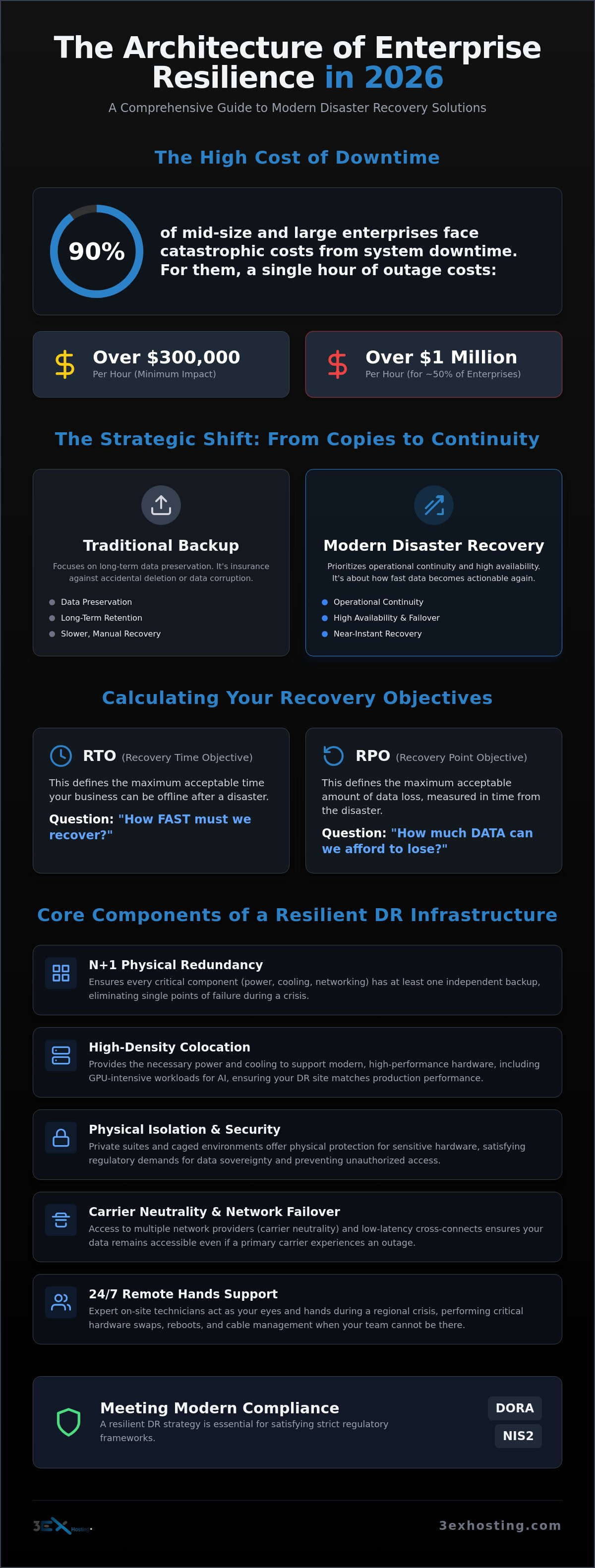
For 90% of mid-size and large enterprises in 2026, a single hour of system downtime now costs over $300,000. For many, that figure climbs past $1 million per hour. Finding the right Disaster Recovery Solutions is no longer a back-office IT task; it’s a critical pillar of your business’s survival. You likely feel the pressure of keeping data synced across multiple sites while balancing the strict requirements of DORA and NIS2 regulations against the physical reality of regional crises.
We’ll help you master the architecture of modern enterprise resilience with this comprehensive guide. You’ll gain a clear roadmap for RTO and RPO optimization while learning how managed failover strategies protect your bottom line. We explore how high-density colocation supports your infrastructure and why having expert remote hands on the ground makes all the difference when seconds count. By the end, you’ll have the technical confidence to maintain continuity through any 2026-level threat.
Key Takeaways
- Learn why modern enterprise resilience requires a strategic shift from traditional backups toward high-availability failover architectures.
- Understand the critical role of N+1 physical redundancy and low-latency cross-connects in maintaining seamless network interconnectivity.
- Master the frameworks for defining RTO and RPO to align your recovery speed with the true cost of downtime.
- Discover how to implement robust Disaster Recovery Solutions by leveraging secure colocation suites and managed cloud hosting.
- Find out how 24/7 remote hands support and strategic carrier hotel status provide the essential support needed during regional crises.
Defining Enterprise Disaster Recovery Solutions in 2026
Modern Disaster Recovery Solutions represent a strategic architecture designed to restore mission-critical IT systems within minutes of a disruptive event. In 2026, the industry has moved beyond the traditional backup and restore mindset. Organizations now prioritize high availability and failover to ensure that business processes continue even if a primary site suffers a total outage. This shift is driven by the increasing complexity of hybrid IT and the rise of sophisticated cyber threats that target production environments and secondary storage simultaneously. It’s no longer about just having a copy of your data; it’s about how fast that data becomes actionable again.
Enterprises today require multi-site redundancy to satisfy strict regulatory frameworks. Regulations like the Digital Operational Resilience Act (DORA) and the NIS2 Directive mandate documented recovery plans and regular testing for critical infrastructure. While Disaster Recovery as a Service (DRaaS) offers a consumption-based model for protecting workloads, infrastructure-led DR provides the control and performance of dedicated physical hardware for high-density enterprise loads.
The Distinction Between Backup and Disaster Recovery
A common error is treating backups and IT disaster recovery as interchangeable concepts. Backups focus on long-term data preservation. They’re your insurance against accidental deletion or localized corruption. Disaster recovery is about operational continuity. It’s the mechanism that brings your services back to life when the primary hardware fails. While managed cloud hosting provides an excellent target for secondary data, it isn’t a magic bullet. Many organizations mistakenly believe cloud-only solutions are immune to regional outages. True resilience requires a balance of physical colocation and cloud-based failover targets to avoid single points of failure.
The Business Case for Enterprise DR Solutions
The financial justification for robust Disaster Recovery Solutions is clear. Recent data shows that for over 90% of large enterprises, a single hour of downtime costs at least $300,000. For nearly half of these companies, that cost exceeds $1 million per hour. Beyond the immediate financial loss, downtime erodes brand reputation and customer trust. If your systems are offline, your competitors are only a click away. Integrating Managed Cloud Hosting into your continuity plan ensures that your applications remain responsive, even during a crisis. This proactive approach transforms IT from a cost center into a guardian of the company’s market position.
Core Components of a Resilient DR Infrastructure
Building a resilient infrastructure requires more than just off-site storage. It demands a physical environment that can withstand concurrent failures without dropping the load. At the heart of any enterprise Disaster Recovery Plan (DRP) is N+1 redundancy. This standard ensures that every critical component, from power generators to cooling units, has at least one independent backup ready to take over instantly. In 2026, relying on anything less for your Disaster Recovery Solutions creates an unacceptable risk of a secondary failure during an active crisis.
Physical isolation is equally vital for data sovereignty. Regulatory bodies now demand clear proof of physical security for sensitive workloads. Private suites and cage solutions provide this isolation, ensuring your hardware is physically protected from unauthorized access. When a regional crisis hits, your internal team might not be able to reach the site. This is why 24/7 remote hands support is the backbone of disaster response. These experts act as your on-site eyes and ears, performing hardware swaps or cable resets when you can’t be there in person.
High-Density Colocation as a DR Foundation
As AI and machine learning become core to enterprise operations, DR planning must evolve. GPU-intensive workloads generate immense heat and require power draws that standard data centers aren’t equipped to handle. Utilizing full cabinet colocation within a facility designed for power-hungry hardware ensures your DR environment performs exactly like your production site. For organizations running massive AI models, specialized High-Density GPU Colocation is the only way to guarantee that failover doesn’t result in a performance bottleneck.
Carrier Neutrality and Network Failover
Network interconnectivity is the glue that holds your DR strategy together. A carrier-neutral data center allows you to utilize multiple ISP routes, preventing a single fiber cut from isolating your backup site. High-speed cross-connect services are essential for seamless failover. They enable real-time data synchronization between your primary and secondary sites with minimal latency. Without these direct, low-latency connections, your data replication will lag, and your recovery targets will slip. If you’re looking for a facility that offers this level of connectivity, exploring a data center in Miami with strategic carrier hotel status can provide the stability your infrastructure needs.
Calculating Recovery Objectives: RTO and RPO Frameworks
Defining the success of your Disaster Recovery Solutions requires concrete metrics. Two primary frameworks govern these strategies: Recovery Time Objective (RTO) and Recovery Point Objective (RPO). RTO measures the duration from the moment of failure until the system is fully operational again. It answers the question: how long can the business survive without this specific application? RPO, on the other hand, defines the maximum volume of data loss acceptable to the organization, measured in time. If your last backup was four hours ago and the system fails now, your RPO is four hours. In 2026, the goal for most enterprises is to push these metrics as close to zero as possible, though doing so requires a careful balance of cost and performance.
High-density colocation environments shorten RTO for large datasets by providing the massive localized compute power needed to re-index and verify petabytes of information without waiting for long-distance network transfers. While cloud-based restores are convenient for small workloads, the physical proximity of high-performance hardware in a colocation suite is often the only way to meet aggressive recovery windows for data-heavy AI and enterprise applications.
Tiered Recovery Strategies for Enterprise Loads
Not every application requires an instant failover. Applying a tiered approach helps manage costs while ensuring resilience. Tier 1 includes mission-critical applications like transaction databases that require near-zero RTO and RPO. Tier 2 covers business-essential services, such as CRM systems or internal communication tools, where a recovery window of a few hours is manageable. Finally, Tier 3 is reserved for archival data and non-essential background processes that can wait 24 hours or longer without impacting the core business.
Auditing Your Current Infrastructure for DR Readiness
A resilient strategy is only as strong as its weakest link. Regular infrastructure audits are necessary to identify single points of failure within your server racks, such as a single PDU or a non-redundant network switch. You should also align your internal protocols with the National Disaster Recovery Framework to ensure a standardized response to large-scale disruptions. Testing failover protocols is the final, most critical step. It’s vital to run these tests in a controlled manner that doesn’t disrupt production traffic. If you haven’t recently evaluated your physical setup, a thorough data center audit can reveal hidden vulnerabilities before they become active threats during a crisis.
Implementing DR via Colocation and Managed Cloud Connectivity
Implementing effective Disaster Recovery Solutions requires a logical sequence of actions that bridge physical hardware with virtual flexibility. It isn’t a one-time setup; it’s an ongoing operational commitment. The process begins with geographic diversity. You must establish a secondary site in a secure enterprise data center that sits outside the blast radius of your primary location. This ensures that a regional power outage or natural disaster doesn’t impact both sites simultaneously, while local facility maintenance from providers like Miami 305 Plumbing helps prevent internal infrastructure failures from becoming a recovery event.
Once the site is established, the focus shifts to connectivity. High-speed interconnections and cross-connects provide a direct, private path between your infrastructure and carrier networks. This physical layer of connectivity is essential for real-time data replication. Without it, you risk significant data lag that can compromise your recovery objectives. By deploying managed cloud hosting as a virtualized failover target, you create a hybrid environment. This allows you to spin up critical workloads in the cloud while your physical hardware is being restored or maintained by on-site technicians.
The final steps involve human expertise and validation. You should leverage remote hands for the initial rack-and-stack and any emergency maintenance. This removes the need for your team to travel during a crisis. Finally, continuous monitoring and periodic testing are mandatory. A plan that hasn’t been tested in six months isn’t a plan; it’s a hope. Regular failover simulations ensure that your scripts, hardware, and staff are ready to respond instantly.
The Role of Private Suites in DR Security
Regulated industries, such as healthcare and finance, often require higher levels of physical isolation to meet compliance standards. Establishing your DR site within private data center suites provides this necessary security. These suites offer biometric access control and dedicated cage solutions, ensuring that your secondary hardware is physically isolated from other tenants. This layer of protection is vital for maintaining data sovereignty and satisfying auditors that your backup environment is as secure as your production site.
Leveraging Remote Hands for Rapid Response
During a site-wide disaster, your internal IT team might be restricted by local conditions or travel limitations. This is where remote hands support acts as an operational lifeline. On-site technicians are available 24/7 to perform critical physical tasks like server reboots, cable swaps, and hardware replacements. They serve as your boots on the ground, ensuring that the physical layer of your infrastructure stays online while your engineers manage the network recovery from a safe location. This support model is a key component of modern Disaster Recovery Solutions, providing the speed and reliability needed to maintain continuity.
Ready to secure your enterprise continuity? Request a quote for our managed colocation and DR services to start building your resilient infrastructure today.
Strategic Continuity with 3EX Hosting’s Enterprise Solutions
3EX Hosting specializes in bridging the gap between raw infrastructure and managed resilience. We serve as the preferred partner for national enterprises because we understand that Disaster Recovery Solutions must be as dynamic as the primary production environment. We don’t just provide rack space; we provide a carrier-neutral ecosystem. Our facility’s status as a strategic carrier hotel allows for diverse network routing, which effectively eliminates single points of failure at the ISP level. This connectivity ensures that your data synchronization remains uninterrupted, even if a major carrier backbone faces a regional outage.
Our approach integrates full cabinet colocation with managed IT infrastructure to create a seamless failover target. We offer the flexibility to scale from modular cage solutions to fully isolated private suites. This customization is critical for maintaining data sovereignty and meeting the physical security requirements of modern regulatory frameworks. By housing your DR hardware in a facility built for technical stability and speed, you ensure that your business remains operational through any disruption.
Seamless Onboarding and Move-In Assistance
Transitioning your mission-critical hardware to a secondary DR site is often the most complex phase of a continuity plan. We simplify this transition through our white-glove move-in assistance. Our team handles the logistics of enterprise hardware transport and physical installation, ensuring your equipment is racked, stacked, and cabled according to your exact specifications. This professional support allows your internal engineers to focus on network configuration and software failover logic while we manage the physical deployment.
Future-Proofing Your DR Strategy for AI and Beyond
The enterprise landscape of 2026 is increasingly dominated by AI-driven workloads and GPU-intensive processing. Your Disaster Recovery Solutions must scale alongside these high-density requirements. Our infrastructure is designed to handle the extreme power draws and cooling needs of modern AI training clusters. We provide the technical foundation to ensure your failover site isn’t just a passive backup, but a high-performance environment capable of sustaining your most advanced GPU-based operations. This forward-looking architecture guarantees that your resilience strategy remains relevant as your technology stack evolves.
Secure your enterprise’s future with a partner that prioritizes technical excellence and operational stability. Get a quote for your Disaster Recovery Solution and build a roadmap to true business continuity.
Mastering Strategic Continuity for the Modern Enterprise
Strategic resilience isn’t a luxury for the enterprise; it’s a fundamental requirement for survival. By mastering the balance between RTO/RPO frameworks and high-density infrastructure, you ensure your organization remains operational through any disruption. Effective Disaster Recovery Solutions rely on more than just software. They require a physical foundation built on N+1 power redundancy and carrier-neutral interconnectivity to prevent single points of failure. Having 24/7 remote hands support ensures your boots on the ground are ready to act when your internal team can’t reach the site.
Transitioning to a secondary site doesn’t have to be complex. With the right architecture and professional support, you can achieve near-instant failover and complete data sovereignty. We’re here to help you navigate these technical challenges with precision and speed. Take the first step toward a more secure infrastructure today.
Secure Your Enterprise Future with 3EX Hosting Disaster Recovery
Frequently Asked Questions
What is the difference between Disaster Recovery and Business Continuity?
Disaster Recovery focuses specifically on the technical restoration of IT systems and data after a disruption. Business Continuity is a broader strategy that ensures the entire organization continues to function, including personnel, physical locations, and communication channels. To ensure your team has a resilient base of operations, you can learn more about BizCity Group’s professional workspace solutions designed for business continuity. While DR is a subset of Business Continuity, it’s the technical engine that makes operational resilience possible. Effective Disaster Recovery Solutions prioritize RTO and RPO to minimize digital downtime.
How does colocation improve my Disaster Recovery strategy?
Colocation provides a physically separate, secure environment with N+1 redundancy for power and cooling that your primary office might lack. By housing your backup hardware in a professional data center, you eliminate localized risks like building-wide power outages or cooling failures. This physical diversity ensures that your secondary site remains operational even if your primary headquarters faces a total infrastructure collapse.
What are the most common causes of enterprise IT disasters in 2026?
Cybersecurity breaches, particularly sophisticated ransomware attacks, remain the leading cause of IT disasters in 2026. Regional infrastructure failures caused by extreme weather and localized power grid instability also contribute significantly to enterprise outages. Human error during complex system updates continues to be a persistent risk factor. These threats necessitate a multi-layered approach to infrastructure protection and data redundancy.
How often should an enterprise test its Disaster Recovery plan?
Enterprises should conduct functional tests of their critical failover protocols at least quarterly. Full-scale simulations that involve the entire recovery team and all business units are typically performed annually. Regular testing is the only way to identify configuration drifts or documentation gaps that could lead to failure during a real crisis. It ensures that your recovery scripts and communication channels remain valid as your infrastructure evolves.
Can I use managed cloud hosting as my only Disaster Recovery solution?
Managed cloud hosting is a highly effective failover target, but relying on it as a sole solution can introduce risks like vendor lock-in or service-wide cloud outages. A hybrid approach that combines physical colocation with cloud-based targets offers the highest level of resilience. This strategy ensures that your data is available even if a specific cloud provider’s regional zone experiences a massive technical failure.
What role do cross-connects play in data failover?
Cross-connects provide direct, private, and low-latency physical links between different networks or hardware within a data center. In a failover scenario, these connections enable real-time data replication without the latency or security risks associated with the public internet. They’re essential for achieving near-zero RPO, as they allow for continuous synchronization of large datasets between your primary production environment and your DR site.
How does 3EX Hosting support disaster recovery for high-density GPU clusters?
We provide specialized high-density colocation environments designed specifically for the power and cooling demands of GPU-intensive AI workloads. Our facility supports the extreme heat loads generated by these clusters, ensuring your DR site doesn’t throttle performance during a failover. This specialized infrastructure allows AI-driven enterprises to maintain their training and inference cycles even when their primary data center is offline.
What is the benefit of a carrier-neutral data center for DR?
Carrier neutrality allows you to choose from multiple telecommunications providers, ensuring that your network connectivity isn’t tied to a single point of failure. If one ISP experiences a fiber cut or routing issue, you can instantly switch to a different carrier within the same facility. This redundancy is critical for Disaster Recovery Solutions, as it prevents your backup site from becoming isolated during a widespread network disruption.