 SUPPORT


 3EX United States
 Blog
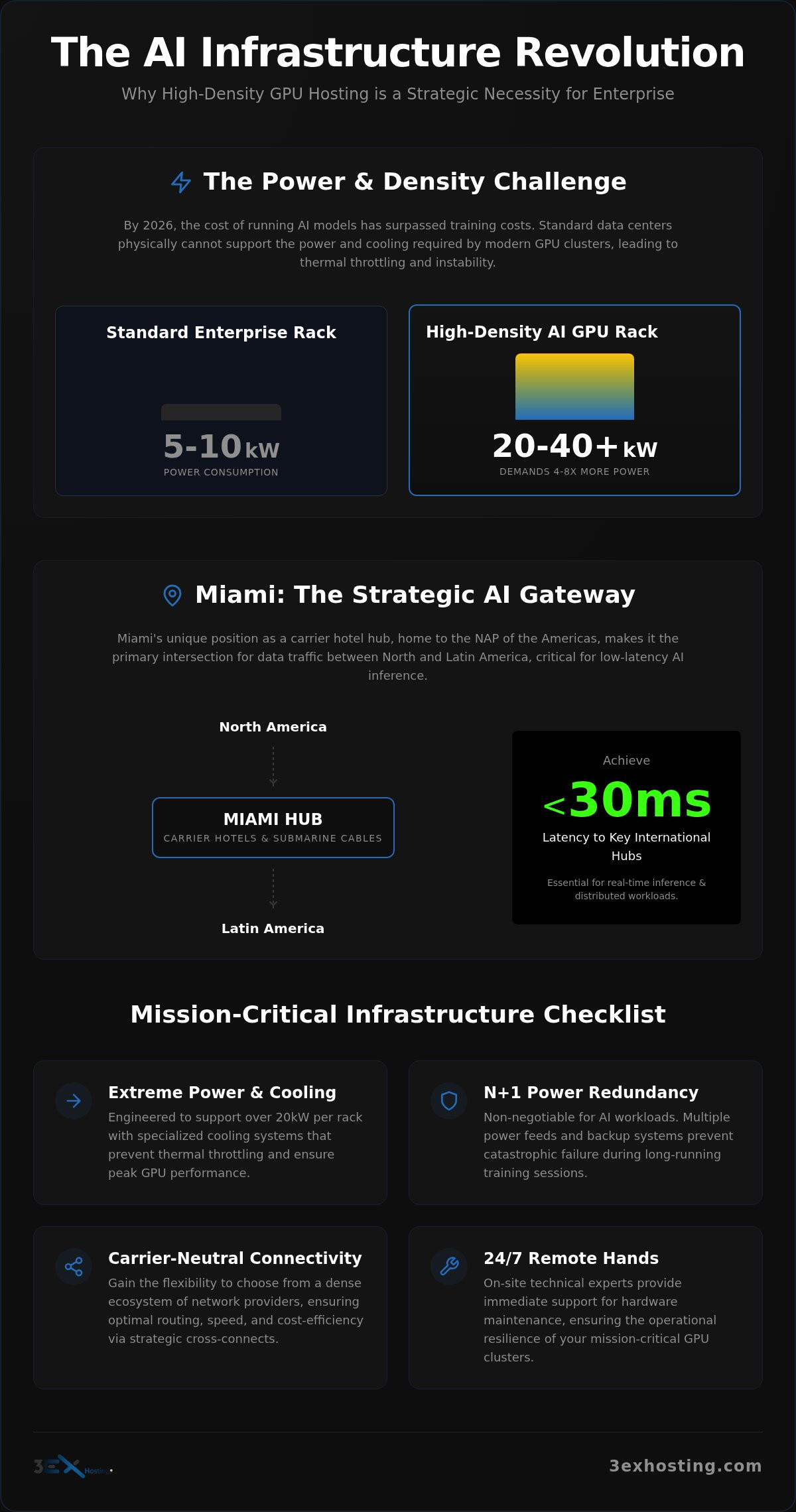
In 2026, global spending on running AI models has officially surpassed the cost of training them, yet many enterprise leaders find their local data centers are physically unable to keep up. Most standard facilities simply weren’t designed to support the 20kW per rack power density that modern GPU clusters demand. If you’re struggling with thermal throttling or insufficient power feeds, you’re likely realizing that standard colocation isn’t enough for high-performance computing. Securing reliable GPU hosting Miami has become a strategic necessity for firms that need to balance extreme power requirements with global network reach.
It’s clear that your infrastructure must be as dynamic as the models you’re deploying. This article explains how high-density colocation and strategic carrier hotel connectivity in Miami empower national enterprise AI workloads while solving the latency issues common in LATAM-based inference. You’ll discover how to achieve sub-30ms latency to key international hubs and ensure 24/7 technical oversight for your hardware. We’ll also examine the specific engineering requirements for N+1 redundant power and specialized on-site support that keep mission-critical AI clusters running without interruption.
Key Takeaways
- Understand why Miami’s carrier hotel connectivity makes it the primary strategic hub for low-latency AI inference between North America and Latin America.
- Learn how to manage the extreme power and cooling demands of high-density GPU clusters that require over 20kW of power per rack.
- Discover how N+1 power redundancy and strategic cross-connects ensure the stability and speed of mission-critical AI training.
- Evaluate the role of 24/7 remote hands in maintaining the operational resilience of specialized GPU hosting Miami infrastructure.
- Identify the scaling advantages of high-density colocation suites for national enterprises deploying next-generation AI and HPC workloads.
Understanding GPU Hosting in Miami as a Strategic National Hub
GPU hosting Miami has evolved into a cornerstone of national AI infrastructure. Unlike traditional hosting, these environments are engineered specifically for parallel processing. This allows for the high-speed execution of tasks like large language model (LLM) training, complex 3D rendering, and real-time data analytics. By 2026, the industry has seen a decisive shift. General-purpose hosting is no longer sufficient for the intense demands of modern AI hardware. Enterprises now require specialized high-density environments that can handle massive power draws while maintaining strict thermal controls. This transition is driven by the need for hardware that doesn’t just run, but performs at peak efficiency under constant load.
The Role of Carrier Hotels in AI Infrastructure
A carrier hotel is a facility where numerous network providers converge to interconnect. This density of providers is vital for low-latency GPU workloads where every millisecond affects the speed of inference. Miami hosts some of the world’s most significant network intersections, including the NAP of the Americas. This location serves as the primary gateway for data traffic moving between North America and Latin America. The concentration of submarine cable landings here ensures that data reaches international hubs with minimal delay. For organizations that need robust, carrier-neutral environments, the 3EX Hosting Miami data center provides the necessary physical and network foundation. Carrier neutrality gives enterprises the flexibility to choose their providers. It ensures they aren’t locked into a single vendor’s pricing or performance limits.
Why National Enterprises Choose This Hub for GPU Clusters
National organizations choose this hub because of its strategic proximity to major network backbones. If your users are distributed across the East Coast and LATAM, physical location is a competitive advantage. Proximity reduces the physical distance data must travel. This is a critical factor for real-time AI inference, which now accounts for a majority of global AI spending. Florida’s enterprise-grade power grids also play a major role. These grids are built to support mission-critical infrastructure, providing the stability needed for long-running AI training sessions that can last for weeks. Reliable power combined with high-speed connectivity makes Miami the logical choice for scaling GPU-heavy workloads. It’s about building a foundation that supports both current projects and future growth without the need for frequent migrations.
The Infrastructure Challenge: Power Density and Cooling for GPUs
Modern GPU clusters have fundamentally changed the physical requirements of the data center. While a traditional enterprise server rack might draw 5kW to 10kW, a single rack of NVIDIA H100 or H200 GPUs can easily exceed 40kW. This massive jump in power consumption creates a physical bottleneck for many facilities. Standard data centers often lack the electrical backbone or the specialized cooling necessary to prevent thermal throttling. When evaluating GPU hosting Miami, the first metric to examine is whether the facility can actually support these high-density loads without compromising stability.
Operational continuity is the second major hurdle. AI training sessions aren’t like standard web traffic; they’re long-running, compute-heavy processes that can last for weeks. A single power dip can result in the loss of days of progress. This makes N+1 power redundancy a non-negotiable requirement. High-performance facilities use multiple power feeds and backup systems to ensure that even if one component fails, the GPU cluster remains online. Without this level of engineering, the risk of catastrophic training interruptions becomes too high for enterprise-grade projects.
Calculating Power Requirements for AI Racks
Choosing between metered and flat-rate power is a critical financial decision. For high-density GPU workloads, metered power is often the most transparent choice. It allows you to pay for exactly what your hardware consumes during intense training cycles. For AI startups looking to scale, high-density infrastructure is a technical necessity. Using Full Cabinet Colocation gives you total control over your power distribution units (PDUs) and environmental variables. It ensures your hardware has the dedicated resources it needs to run at peak clock speeds without interference from neighboring racks.
Advanced Cooling for High-Performance Computing (HPC)
Cooling is no longer just about pushing cold air into a room. Enterprise facilities now use hot and cold aisle containment to manage the extreme thermal output of hundreds of GPUs. This strategy physically separates the intake and exhaust air, maximizing the efficiency of the cooling system. A facility’s Power Usage Effectiveness (PUE) rating directly impacts your long-term operational costs. A lower PUE means more of the power you pay for goes directly into your GPUs rather than the cooling fans. For proprietary AI models, many organizations prefer the added security of Private Data Center Suites. These suites provide a physically isolated environment for your high-value hardware while benefiting from the facility’s shared high-density cooling infrastructure. If you’re planning a large-scale deployment, it’s wise to request a technical quote to review your specific power and cooling needs.
Network Connectivity: Leveraging the LATAM and National Gateway
Miami’s status as the “Gateway to the Americas” isn’t a marketing slogan; it’s a physical reality defined by specialized infrastructure. For enterprises deploying GPU hosting Miami, this location provides a unique advantage for real-time AI inference. By placing compute resources at the intersection of major international network backbones, organizations can serve users across two continents with minimal delay. This connectivity is built on strategic cross-connects and optimized Border Gateway Protocol (BGP) routing that ensures data takes the shortest, most reliable path possible. Efficient routing is particularly vital for AI models that require frequent data exchanges between the edge and the core cluster.
Carrier neutrality is a critical component of this connectivity strategy. Facilities that allow you to choose from multiple network providers prevent vendor lock-in and provide the leverage needed to negotiate better performance and pricing. If one carrier experiences an outage or a latency spike, a neutral environment allows for rapid failover to a secondary provider. This redundancy is essential for mission-critical AI applications that cannot afford downtime. It provides a level of operational flexibility that single-carrier facilities simply cannot match.
Cross-Connect Services for Ultra-Low Latency
Cross-connects are direct, physical cable connections between different tenants or providers within the same data center. They allow your GPU clusters to bypass the congested public internet entirely. This results in faster data speeds and significantly lower jitter. For many enterprises, this enables a hybrid AI strategy. You can maintain your proprietary models on private GPU hardware while using high-speed direct links to interface with public cloud services like AWS or Azure. This setup combines the security of private colocation with the scalability of the public cloud, ensuring your data moves at the speed of your hardware.
Serving the Latin American and Caribbean Markets
Miami is the preferred hub for companies scaling AI services across the Americas because of its unmatched subsea cable density. For instance, latency from a Miami-based facility to Bogotá typically stays around 50ms, while connections to São Paulo average between 100ms and 110ms. These speeds are often significantly better than what can be achieved from other major U.S. hubs like New York or Dallas. For a deeper look at the technical requirements of these deployments, see our Pillar Guide on AI Infrastructure. Choosing a hub with these established pathways ensures your AI inference remains responsive for a global user base without the need for expensive, localized infrastructure in every target country.
Operational Resilience: Remote Hands and Managed Support
High-density GPU hardware represents a massive capital investment that requires constant physical oversight. Unlike standard web servers, GPU clusters running at peak capacity generate extreme heat and stress on mechanical components. A single failed fan or a loose power connection can stall a model training process that has already consumed thousands of dollars in compute time. Professional GPU hosting Miami services address this risk by providing immediate physical intervention. Having a technician on-site who understands the specific layout of your AI cluster ensures that small hardware issues don’t escalate into prolonged outages. This level of oversight is a fundamental requirement for maintaining the reliability of enterprise-grade AI operations.
Support isn’t just about emergency fixes; it’s about the ongoing health of the environment. Managed support includes everything from basic hardware reboots to complex cable management and labeling. In a high-density rack, airflow is everything. Poorly managed cables can create hot spots that lead to thermal throttling and hardware degradation. Technicians trained in high-performance computing (HPC) environments ensure that every component is positioned for maximum cooling efficiency. This proactive approach to physical infrastructure prevents the performance dips that often plague unmanaged or low-density facilities.
The ROI of 24/7 Remote Hands Support
The financial impact of downtime for an AI training cluster is often measured in thousands of dollars per hour. If a node fails at midnight, waiting for your internal team to travel to the facility is a costly delay. Remote Hands support acts as a critical extension of your internal IT team, providing 24/7 coverage for physical tasks. Technicians can perform component replacements, visual inspections of thermal indicators, and precise cable management to maintain optimal airflow. This immediate response capability significantly reduces Mean Time to Repair (MTTR) and protects your project timelines. It allows your engineers to focus on model architecture rather than physical maintenance.
Disaster Recovery for Mission-Critical AI
Maintaining AI service availability requires more than just stable power; it requires a comprehensive disaster recovery protocol. For enterprises, this involves integrating colocation with managed failover strategies. Physical security is equally paramount. Proprietary AI models are high-value assets that require protection through biometric access controls and 24/7 video surveillance. When transitioning your hardware to a new facility, the complexity of the move can be a major hurdle. We recommend exploring Move-In Assistance to ensure your enterprise transition is handled with the necessary technical precision. If you’re ready to secure your infrastructure, you can request a custom quote for your specific hardware configuration.
Scaling AI with 3EX Hosting Infrastructure Solutions
3EX Hosting provides the specialized physical environment required for enterprise-grade GPU hosting Miami. We don’t just provide space; we provide an engineered ecosystem capable of sustaining the industry’s most demanding AI hardware. Our facility is positioned within a primary Miami carrier hotel. This gives your infrastructure direct access to the network density needed to scale national and international workloads without friction. By combining high-density power delivery with carrier-neutral connectivity, we ensure your GPU clusters operate at their theoretical peak without infrastructure-induced bottlenecks. It’s a foundation built for the long-term stability of mission-critical AI projects.
Scalability looks different for every organization. A growing AI startup might start with a few high-density cabinets, while a multinational enterprise requires the physical isolation of a private suite. We offer the flexibility to transition between these stages seamlessly. Our engineering team works directly with yours to map out power requirements, cooling distribution, and network paths. This collaborative approach ensures that your hardware deployment is optimized for the specific parallel processing tasks your business relies on. We focus on the technical details so your team can focus on model performance.
Custom Cage and Suite Solutions for Enterprise Security
For organizations with strict regulatory or security requirements, Cage Colocation provides a physically partitioned environment within our secure facility. This setup is ideal for maintaining compliance while benefiting from our shared N+1 power redundancy and enterprise-grade cooling infrastructure. If your project demands the highest level of sovereignty, our private suites offer a completely dedicated data center environment. You gain total control over your physical security protocols and hardware configurations. This ensures your proprietary AI models and sensitive data sets remain isolated from other tenants while still leveraging our robust carrier-neutral network.
Next Steps: Securing Your GPU Infrastructure
Securing your infrastructure begins with a technical assessment of your specific needs. We look at your total kW draw, expected network throughput, and required cross-connects to build a solution that fits your roadmap. We invite decision-makers to schedule a facility tour or a technical consultation with our engineering team. This allows you to see the high-density infrastructure in person and discuss custom cooling or power configurations. Our goal is to make complex infrastructure simple. When you’re ready to move forward, the process is straightforward and efficient. Get a Custom GPU Hosting Quote Today to begin engineering your next-generation AI foundation.
Future-Proofing Your AI Infrastructure in Miami
The shift toward inference-heavy AI workloads requires a fundamental rethink of data center physics. High-density GPU clusters demand more than just floor space; they require precise power engineering and specialized thermal management. By positioning your hardware in a strategic carrier hotel, you gain the network diversity needed to serve users across the Americas with minimal latency. This combination of physical stability and global reach is what separates a standard facility from a true high-performance hub.
Securing reliable GPU hosting Miami is about more than finding a rack; it’s about engineering for the future of compute. 3EX Hosting provides the N+1 power redundancy and 24/7 Remote Hands Support necessary to keep your mission-critical clusters running at peak efficiency. We ensure your hardware is supported by the density it needs to scale without thermal bottlenecks or power interruptions. When you’re ready to deploy, our team is here to help you engineer the foundation for your next-generation AI projects.
Secure your high-density GPU infrastructure with 3EX Hosting
Frequently Asked Questions
What is the maximum power density available for GPU hosting in Miami?
High-density facilities in this region support power draws exceeding 20kW per rack, with specific configurations capable of handling 40kW or more for advanced clusters. This capacity is essential for modern GPU hosting Miami, as it prevents thermal throttling and ensures your hardware runs at peak clock speeds. Most standard data centers are capped at much lower densities, making specialized infrastructure a requirement for AI workloads.
How does Miami connectivity improve latency for AI inference in Latin America?
Miami serves as the primary landing point for the majority of subsea cables connecting North and South America. By hosting your AI inference models at this hub, you bypass the multiple network hops required when routing traffic from inland U.S. data centers. This results in significantly lower latency to major cities like Bogotá and São Paulo, which is critical for real-time AI applications.
Can I colocate my own NVIDIA H100 or B200 clusters at your facility?
Yes, our infrastructure is specifically engineered to support the extreme power and cooling requirements of NVIDIA H100 and Blackwell B200 clusters. We provide the N+1 power redundancy and hot/cold aisle containment necessary to protect these high-value assets. Our engineering team works with you to ensure your specific rack layout and PDU requirements are met before your hardware arrives on-site.
What is the difference between bare metal GPU hosting and GPU colocation?
Bare metal hosting is a rental model where you lease the provider’s hardware and pay a monthly fee for its use. GPU colocation involves placing your own owned hardware into our secure data center environment. Colocation offers greater long-term cost efficiency and total sovereignty over your hardware configuration, making it the preferred choice for enterprises with proprietary models and high-performance requirements.
Do you offer 24/7 Remote Hands support for hardware-level troubleshooting?
On-site technicians are available 24/7 to perform a wide range of physical tasks, from simple power cycles to complex component replacements. This service acts as an extension of your internal IT team, ensuring that hardware issues are addressed immediately without your staff needing to travel to the facility. We provide detailed reporting on all remote hands activities to maintain full transparency.
Is the data center facility carrier-neutral?
The facility is fully carrier-neutral, providing you with direct access to a wide variety of global and national network providers. This neutrality allows you to negotiate your own bandwidth contracts and implement diverse routing strategies to prevent downtime. It also ensures you can switch providers or add redundant links as your network requirements evolve without being locked into a single vendor.
What physical security measures are in place for proprietary AI hardware?
We maintain multiple layers of physical security, including biometric access controls, 24/7 on-site security personnel, and continuous video surveillance. For organizations requiring additional isolation, we offer private cages and dedicated suites that provide a physically partitioned environment for your GPU clusters. These measures ensure that your high-value hardware and proprietary data sets remain protected at all times.
How long does it take to deploy a full cabinet for GPU workloads?
Standard full cabinet deployments typically take between 5 and 10 business days once the technical specifications are finalized. This timeline includes the setup of your power feeds, network cross-connects, and any specialized cooling configurations your hardware requires. We offer move-in assistance to streamline the physical installation process and ensure your AI clusters are online as quickly as possible.