 SUPPORT


 3EX United States
 Blog
As of early 2026, the average rack density has surged to 27 kW, while AI training clusters are frequently pushing limits toward 100 kW per rack. You likely already know that traditional infrastructure isn’t built for this kind of intensity. Relying on legacy cooling or standard power feeds leads to thermal management failures and expensive power bottlenecks that stall mission-critical GPU clusters. To protect your hardware and ensure uptime, you need a rigorous high-density colocation requirements checklist that goes beyond marketing promises.
We’ve developed this comprehensive technical framework to help you validate data centers for AI and high-performance computing. You’ll learn how to audit for liquid cooling readiness, verify compliance with the latest NFPA 855 standards for energy storage, and ensure your provider offers the specialized remote hands necessary for complex hardware. This guide provides the validation list you need for procurement to secure a scalable power path for your next generation of hardware.
Key Takeaways
- Identify the technical shift from legacy 5kW racks to modern 100kW AI clusters to prevent hardware throttling and infrastructure failure.
- Evaluate power distribution benchmarks, including A/B feeds and rack-level redundancy, to ensure continuous uptime for high-performance compute.
- Apply a technical high-density colocation requirements checklist to audit thermal management systems and liquid cooling capabilities effectively.
- Verify operational readiness by assessing specialized remote hands support and multi-layered physical security protocols like 4k CCTV and biometric access.
- Explore how private colocation suites and custom cage solutions provide the necessary physical isolation and power scalability for GPU-heavy workloads.
Defining High-Density Colocation in 2026
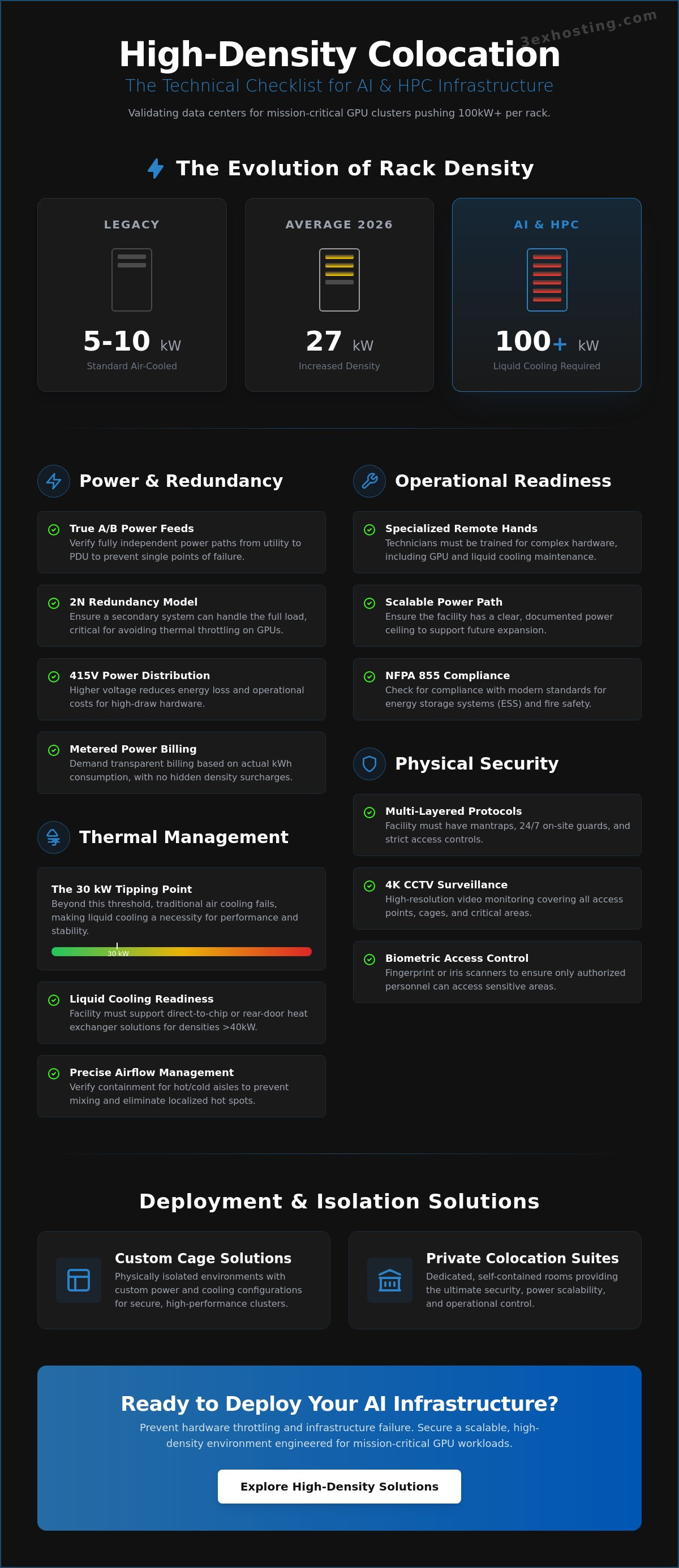
High-density colocation in 2026 isn’t just a buzzword; it’s a technical necessity for modern enterprises. While legacy facilities were designed for 5-10kW per rack, modern requirements have shifted toward much higher intensities. According to recent industry data, the average rack density has reached 27 kW, but AI training clusters are pushing well beyond 100 kW. This massive leap in power draw means a standard data center often lacks the electrical and thermal headroom to support high-performance compute (HPC).
The relationship between rack density and total cost of ownership (TCO) is direct. By consolidating hardware into fewer, more powerful racks, you reduce the physical footprint and the amount of cabling required. This efficiency lowers operational costs, provided the facility can handle the heat. Standard enterprise data centers often fail here. They experience localized hot spots and power distribution bottlenecks that lead to thermal throttling, which can cripple the performance of expensive GPU clusters.
The Evolution of Power Density
The transition from air-cooled setups to liquid-ready infrastructure marks the biggest shift in recent years. For any enterprise building a high-density colocation requirements checklist, the 30kW threshold is the critical tipping point. Beyond this level, traditional air cooling usually fails to manage the heat density effectively. Liquid cooling has become the standard for density above 40kW, with 36% of providers already implementing these solutions. Focusing on “kW per rack” rather than total cage power is the most accurate way to measure capacity in 2026. It’s the only metric that accounts for the concentrated thermal load of modern AI models.
HPC vs. Standard Colocation
Standard colocation handles general business applications, but HPC requires a different architectural approach. General workloads are often bursty and unpredictable. In contrast, AI training and large-scale data processing demand sustained, high-intensity power delivery. This constant load puts immense strain on power fabrics and cooling loops. High-density deployments allow you to condense your infrastructure significantly. Instead of spreading 100kW across ten racks, you can consolidate it into two or three specialized cabinets.
Condensing your gear into a full cabinet colocation setup provides the specialized environment needed for GPU-heavy workloads. These configurations require precise airflow management and robust power redundancy. Validating these technical specifications is the first essential step in your high-density colocation requirements checklist. Choosing a partner that understands the nuances of 2026 power fabric engineering ensures your hardware runs at peak performance without the risk of failure.
The Power and Thermal Management Checklist
High-density environments require a sophisticated power fabric that standard facilities simply can’t provide. When managing 40kW to 100kW per rack, any interruption in cooling or power delivery can lead to catastrophic hardware failure within seconds. Your high-density colocation requirements checklist must start with a verification of true A/B power feeds. These feeds must have entirely independent delivery paths, from the utility entrance down to the rack-level PDU. This level of isolation is the only way to guarantee the stability required for mission-critical AI clusters.
Redundancy is non-negotiable. For enterprise GPU clusters, a 2N redundancy model is the benchmark. This ensures that even if an entire power chain fails, the secondary system can handle the full load without thermal throttling. Standard N+1 configurations often fall short in high-density scenarios because the remaining units may not have the capacity to compensate for the concentrated heat load of modern AI hardware. Without 2N protection, your hardware remains vulnerable to cascading failures during peak processing periods.
Power Delivery and Redundancy
Efficient power distribution is critical for controlling operational costs. Look for facilities that utilize 415V power distribution. By delivering higher voltage directly to the rack, the system reduces the energy lost during multiple voltage conversions. This efficiency directly impacts your bottom line. Additionally, ensure the provider uses transparent, metered power billing. Some providers hide “density surcharges” in their pricing, but a professional partner will bill based on actual consumption. Adhering to data center energy efficiency best practices is essential for maintaining a sustainable and cost-effective deployment as you scale. Always verify the facility’s total power ceiling to ensure your future expansion isn’t throttled by local grid limitations.
Advanced Cooling Infrastructure
Traditional air cooling reaches its physical limits around 30kW per rack. To support the 2026 standard for AI workloads, your checklist must evaluate liquid-ready infrastructure. Rear Door Heat Exchangers (RDHx) and liquid-to-chip cooling are now essential for managing the thermal output of high-end GPUs. These systems remove heat more efficiently than air ever could, allowing for much tighter hardware packing. 36% of data center respondents have already implemented liquid cooling, making it a standard requirement for high-performance compute.
Physical infrastructure must also support the weight of these systems. Liquid-cooled racks and high-density battery backups are significantly heavier than standard gear. Verify that the facility has the floor loading capacity to handle these specialized setups. If you’re unsure about your current hardware’s requirements, you can request a technical consultation to see how modern infrastructure can support your specific GPU configuration. Utilizing sustainable thermal management, such as free cooling loops, can also help keep your Power Usage Effectiveness (PUE) within an optimal range.
Connectivity and Interconnection Requirements
High-density colocation is more than a power and cooling challenge; it’s a data throughput challenge. AI clusters and high-performance computing (HPC) workloads require massive data ingestion and rapid synchronization between nodes. If your network fabric can’t keep up with your GPUs, you’re paying for compute power you can’t fully utilize. A robust high-density colocation requirements checklist must prioritize low-latency interconnection and carrier-neutrality to ensure your infrastructure remains agile and cost-effective.
Carrier-neutrality is a baseline requirement for any enterprise deployment in 2026. It prevents vendor lock-in and allows you to leverage competitive transit pricing from multiple providers. Modern high-density data center design emphasizes that throughput bottlenecks often occur at the meet-me-room. Ensure your provider offers high-performance cross-connect services that can be provisioned quickly. These direct links between cabinets or to on-site carriers are essential for maintaining the sub-millisecond latency that real-time AI applications demand.
Network Fabric for AI Clusters
Standard Ethernet is often insufficient for the specialized needs of modern AI training. Your checklist should evaluate the facility’s support for InfiniBand and other specialized networking fabrics. These technologies provide the Remote Direct Memory Access (RDMA) capabilities necessary for efficient GPU-to-GPU communication. When hardware is packed at densities of 30kW to 100kW per rack, the physical cabling becomes complex. Verify that the facility supports the overhead cable management systems required for these dense fiber runs. For a deeper analysis of these specialized network requirements, refer to our High-Density GPU Colocation guide.
Carrier Hotel Access and Redundancy
Physical location still matters in a digital world. Proximity to major subsea cables and national fiber backbones is a critical factor for reducing global latency. For instance, facilities acting as a carrier hotel in Miami provide a strategic advantage for enterprises reaching Latin American and European markets. You must check for diverse fiber entry points into the building. If all fiber paths enter through a single vault, a simple construction accident can take your entire cluster offline. Your high-density colocation requirements checklist should verify:
- At least two geographically diverse fiber entry points.
- Access to a minimum of 10+ Tier-1 on-site carriers.
- Direct on-ramps to major public cloud providers for hybrid AI workflows.
Redundant network paths are just as vital as redundant power feeds. Without them, your high-density deployment is a single point of failure away from a total blackout.
The Operational and Security Checklist
High-density infrastructure brings unique operational risks that extend far beyond power and cooling. When your racks house millions of dollars in GPU hardware, the human element of data center management becomes a critical vulnerability or a primary asset. Data breaches increased 72% between 2021 and 2023, proving that physical security is now a fundamental component of a comprehensive cybersecurity strategy. A robust high-density colocation requirements checklist must prioritize facilities that integrate advanced surveillance with specialized technical support.
Technical Remote Hands Proficiency
Standard remote hands services often lack the training required for high-performance compute (HPC) environments. You need technicians who understand the delicate nature of liquid cooling loops and high-density fiber fabrics. Your checklist should verify if the on-site team can perform advanced tasks like GPU swaps, complex cable management, and precision fiber cleaning without risking downtime. Response times are equally vital. Ensure your Service Level Agreement (SLA) defines specific windows for critical interventions. Utilizing expert remote hands support services ensures that your hardware is managed by professionals who understand the nuances of 2026 infrastructure, giving you operational peace of mind while your team focuses on core development.
Physical and Cyber Security Integration
The enterprise benchmark for physical security has evolved. As of 2026, compliance with the updated ISO/IEC 27001:2022 standard is mandatory, placing a heavier emphasis on risk-based physical access management. Your facility should utilize a multi-layered approach including biometric access, man-traps, and 4k CCTV coverage with a minimum of 90 days of high-definition video retention for forensic audits. This operational section of your high-density colocation requirements checklist should also evaluate the availability of custom cage solutions. These provide physical isolation for high-value gear, preventing unauthorized proximity to your AI clusters.
Compliance isn’t just a checkbox; it’s a requirement for enterprise scalability. Verify that the provider maintains SOC 2 Type II, HIPAA, and PCI-DSS certifications to meet your specific industry regulations. Beyond security, look for logistical support that simplifies the initial deployment. High-density racks are exceptionally heavy and require specialized move-in assistance to prevent floor damage or hardware strain. If you are preparing to deploy a new AI cluster, you can contact our technical team to discuss a secure, compliant environment tailored to your power and security needs. Professional logistical support ensures that your hardware moves from the shipping dock to the rack without incident.
Implementing High-Density with 3EX Hosting
Moving from a high-density colocation requirements checklist to a live environment requires a partner capable of executing on every technical benchmark. 3EX Hosting addresses the 2026 power crunch by providing infrastructure specifically engineered for the 27kW to 100kW rack densities demanded by modern AI training. With global data center electricity demand expected to surpass 1,000 TWh by 2026, efficiency isn’t just a goal; it’s a requirement for operational survival. We provide the stable, high-voltage power fabrics and liquid-ready environments necessary to prevent thermal throttling and ensure your GPU clusters perform at their theoretical limits.
Our approach centers on technical stability and speed. We understand that enterprise workloads can’t afford delays caused by inadequate power ceilings or rigid floor plans. By offering specialized solutions like cage solutions and private suites, we provide the physical and electrical isolation required for high-performance compute. This ensures your hardware remains secure and cooled according to the precise specifications of your deployment, ensuring your high-density colocation requirements checklist is fully satisfied from day one.
Custom Infrastructure Design
Standardized solutions rarely meet the needs of specialized GPU clusters. We offer technical consultations on private data center suites for enterprises requiring maximum sovereignty and custom power configurations. Our team works directly with your engineers to tailor cooling loops and network fabrics to your hardware’s specific thermal profile. To streamline the deployment of these heavy, complex systems, we provide comprehensive move-in assistance. This service manages the logistical challenges of transporting and installing high-density racks, protecting your investment during the critical transition phase.
Future-Proofing Your Deployment
The hardware refresh cycles of 2027 will likely push densities even higher. 3EX Hosting builds with this trajectory in mind, offering scalable power paths that grow with your needs. A successful long-term strategy often involves a hybrid approach. Integrating your physical hardware with managed cloud hosting provides the agility to scale workloads while maintaining the performance of on-premise GPUs. This combination, backed by robust disaster recovery solutions, ensures your mission-critical AI models remain resilient against both local failures and regional outages. Don’t let infrastructure bottlenecks stall your innovation. Get a high-density colocation quote today and secure the power and cooling your next-generation hardware demands.
Scaling Your AI Infrastructure with Confidence
The transition to AI-driven workloads demands a fundamental shift in how enterprises approach data center procurement. Success in 2026 requires more than just floor space; it necessitates a specialized environment capable of managing 100kW rack densities through liquid-ready cooling and 2N power redundancy. By applying this high-density colocation requirements checklist, you ensure your procurement process avoids the bottlenecks of legacy facilities and protects your investment in high-performance GPU clusters.
Reliable operations depend on the combination of carrier-neutral carrier hotel access and 24/7 Expert Remote Hands capable of managing complex hardware interventions. At 3EX Hosting, we provide custom high-density cooling solutions and secure, compliant environments that grow alongside your compute needs. Our infrastructure is engineered to handle the thermal and electrical loads of tomorrow’s hardware while keeping your systems stable and fast. Take the next step in future-proofing your deployment by speaking with our technical team about your specific power and density requirements.
Secure your high-density infrastructure with a 3EX Hosting quote and build your cluster on a foundation of technical excellence.
Frequently Asked Questions
What is considered high-density colocation in 2026?
High-density colocation currently refers to any deployment exceeding 30kW per rack, with AI training environments frequently reaching 100kW or more. Legacy standards of 5-10kW are now categorized as low-density and are generally insufficient for modern high-performance compute. This shift requires specialized power distribution and thermal management systems designed to prevent hardware throttling under sustained loads.
How does liquid cooling impact colocation requirements?
Liquid cooling necessitates reinforced floor loading capacities and specialized plumbing infrastructure within the data hall. Racks equipped with Rear Door Heat Exchangers or direct-to-chip cooling are significantly heavier than traditional air-cooled units. You must verify that the facility can support these concentrated weights and provide the necessary coolant distribution units to maintain safe operating temperatures.
What are the power redundancy requirements for AI GPU clusters?
A 2N redundancy model is the benchmark for high-density GPU clusters to ensure continuous operation during any component failure. Because AI clusters maintain a constant, high-intensity power draw, N+1 configurations often lack the headroom to handle the load if a primary power chain goes offline. True A/B feeds with entirely independent delivery paths are essential for mission-critical clusters.
Why is carrier-neutrality important for high-density workloads?
Carrier-neutrality allows you to choose from multiple network providers, ensuring competitive transit pricing and the lowest possible latency routes for your data. For high-density workloads, having diverse on-site carriers prevents network bottlenecks and single points of failure. It also enables the seamless integration of specialized network fabrics like InfiniBand for rapid node synchronization.
How do I calculate the cooling requirements for my high-density rack?
Calculate your cooling needs by totaling the maximum kW draw of all hardware components and converting that figure to BTUs per hour. Your high-density colocation requirements checklist should include a verification that the facility’s cooling system can manage this concentrated thermal load without creating hot spots. Always include a safety margin to account for peak processing spikes during intense AI training sessions.
What should I look for in a remote hands SLA for specialized hardware?
Look for specific response time guarantees and technicians who have documented training in handling high-value GPU clusters and liquid cooling loops. The SLA should clearly define the team’s proficiency in advanced tasks like precision fiber cleaning and complex component swaps. Ensure the support team is available 24/7/365 to address any hardware interventions without delay.
Can I mix high-density and standard cabinets in the same cage?
You can mix densities within a single environment, but it requires precise airflow management and containment strategies to be successful. Placing high-density racks next to standard cabinets can create thermal imbalances that lead to cooling inefficiencies. Utilizing hot or cold aisle containment, or opting for private suites, helps maintain stable temperatures across varying hardware profiles.
What compliance certifications are mandatory for high-density enterprise colocation?
SOC 2 Type II and the updated ISO/IEC 27001:2022 are the foundational standards for verifying security and operational reliability. Depending on your specific industry, HIPAA for healthcare or PCI-DSS for financial data may also be mandatory requirements. These certifications provide documented proof that the facility follows rigorous protocols for physical access, data protection, and environmental controls.