 SUPPORT


 3EX United States
 Blog
Can a software-defined network ever truly outrun the physical limitations of the hardware it sits on? Many media enterprises realize too late that public cloud reliance leads to unpredictable egress fees and frustrating buffering for global users. In a market where specialized colocation environments, akin to those demanded by the fintech sector, set the standard for high-speed execution, media providers must adopt similar infrastructure rigor to stay competitive. You likely understand that while the cloud offers convenience, it often fails to deliver the sub-10ms latency required for modern high-definition streaming and real-time content delivery.
We agree that managing hardware shouldn’t feel like a constant source of technical debt or budget uncertainty. This guide will show you how to architect high-performance data center infrastructure to optimize content delivery and scale media operations efficiently. We’ll explore strategies for achieving predictable monthly costs and 24/7 hardware reliability, ensuring your systems remain stable even during the most demanding traffic spikes without the need for constant on-site intervention.
Key Takeaways
- Discover why carrier-neutral facilities and direct cross-connects are essential for bypassing public internet congestion and achieving sub-10ms latency.
- Learn to identify the tipping point where public cloud egress fees and performance variability make physical colocation a more predictable and cost-effective choice.
- Understand how the rigorous infrastructure standards found in fintech colocation miami provide the necessary stability for mission-critical media delivery.
- Evaluate the technical requirements for scaling media clusters, specifically focusing on high-density power for GPU-intensive tasks and carrier-dense environments.
- Find out how to leverage managed remote hands and enterprise-grade colocation suites to maintain 24/7 reliability without expanding your on-site engineering staff.
The Role of a Data Center for Media and Content Delivery
A specialized data center for media serves as a high-performance hub engineered specifically for massive throughput and low-latency interconnections. Unlike standard server farms, these facilities act as the physical meeting point where content producers, internet service providers, and content delivery networks (CDNs) converge. In a landscape where speed is the primary metric for success, the infrastructure must support heavy data transfers without bottlenecks. Just as fintech colocation miami prioritizes millisecond execution for financial transactions, media infrastructure requires a similar level of technical precision to eliminate buffering and packet loss.
Defining Content Delivery Infrastructure
Infrastructure for content delivery relies on the strategic placement of origin servers and edge nodes. Origin servers store the master copies of your digital assets, while edge nodes handle the actual delivery to end-users. Physical proximity to major network backbones is non-negotiable because it drastically reduces the “time to first byte.” Content Delivery Infrastructure is the physical layer of the digital experience. By housing hardware in a carrier-neutral data center, companies gain direct access to multiple fiber providers, ensuring that data takes the shortest path possible to the consumer.
Why Standard Hosting Fails Media Companies
Generic hosting environments often rely on shared bandwidth models that crumble under the weight of high-bitrate media. A standard rack might handle basic web traffic easily, but 4K and 8K video streaming create sustained, heavy loads that stress traditional network cards and switches. Media providers need dedicated, high-speed ports and guaranteed throughput that doesn’t fluctuate based on the activity of other tenants. Reliability is another critical factor. While a standard website might tolerate a brief flicker, a live broadcast cannot. This necessitates N+1 redundant power systems and advanced cooling to manage the heat generated by high-density server clusters.
The Shift to Edge-Ready Colocation
Modern media distribution has moved away from centralized models toward edge-ready colocation. This transition requires facilities that offer more than just floor space. High-density power is essential for the GPU-intensive tasks used in real-time transcoding and AI-driven content moderation. Rapid scalability is equally vital. When a live event goes viral, the underlying infrastructure must allow for the quick addition of new nodes. Leveraging full cabinet colocation provides the physical control and power density needed to scale these operations without moving facilities. This level of hardware-focused stability is what separates professional content delivery from amateur hosting. It’s about building a foundation that stays invisible because it works perfectly.
Architecting for Low Latency and High Throughput
Performance in content delivery isn’t just a software challenge. It’s a physical one. In a carrier hotel environment, the goal is to minimize the distance between your data storage and the network backbone. This physical proximity is exactly why the technical standards established in fintech colocation miami are now the blueprint for media enterprises. When every millisecond affects either a high-frequency trade or a live 8K video broadcast, you can’t leave routing to the unpredictable nature of the public internet. You need a direct path.
The Power of Direct Cross-Connects
Standard internet transit involves multiple hops across various third-party networks. Each hop adds latency and introduces a potential point of failure. By utilizing cross-connect services, you establish a direct, physical link to your partners, ISPs, and CDNs. This bypasses the public internet entirely. It’s more secure and significantly faster than traditional routing. Private peering also offers superior economic predictability. You avoid the fluctuating costs and congestion of public transit while gaining dedicated, unshared bandwidth for your most critical data streams. This setup effectively reduces hop counts to the absolute minimum, ensuring your content reaches the end-user with minimal delay.
High-Density Power for Media Processing
Modern video transcoding and real-time rendering require massive compute power, typically delivered via specialized GPU clusters. These clusters generate intense heat and consume significant wattage per rack. You must calculate your power requirements based on peak processing loads rather than idle states to avoid circuit trips. Metered power is a vital tool here. It allows you to pay only for the energy you actually consume, helping you maintain a predictable budget as your processing needs scale. For those integrating AI-driven workflows or heavy rendering, reviewing a guide on High-Density GPU Colocation is essential to ensure your infrastructure can support these thermal demands without throttling performance.
Cooling these high-density setups requires more than just standard air conditioning. Advanced airflow management, such as hot and cold aisle containment, prevents thermal recirculation. This keeps your hardware within safe operating temperatures even during 24/7 rendering tasks. If you’re looking to move away from the limitations of the cloud, you can request a custom infrastructure quote to see how our high-density cabinets can support your specific hardware configuration. This physical control over your environment ensures that your hardware performs at its peak without the “noisy neighbor” issues found in virtualized environments.
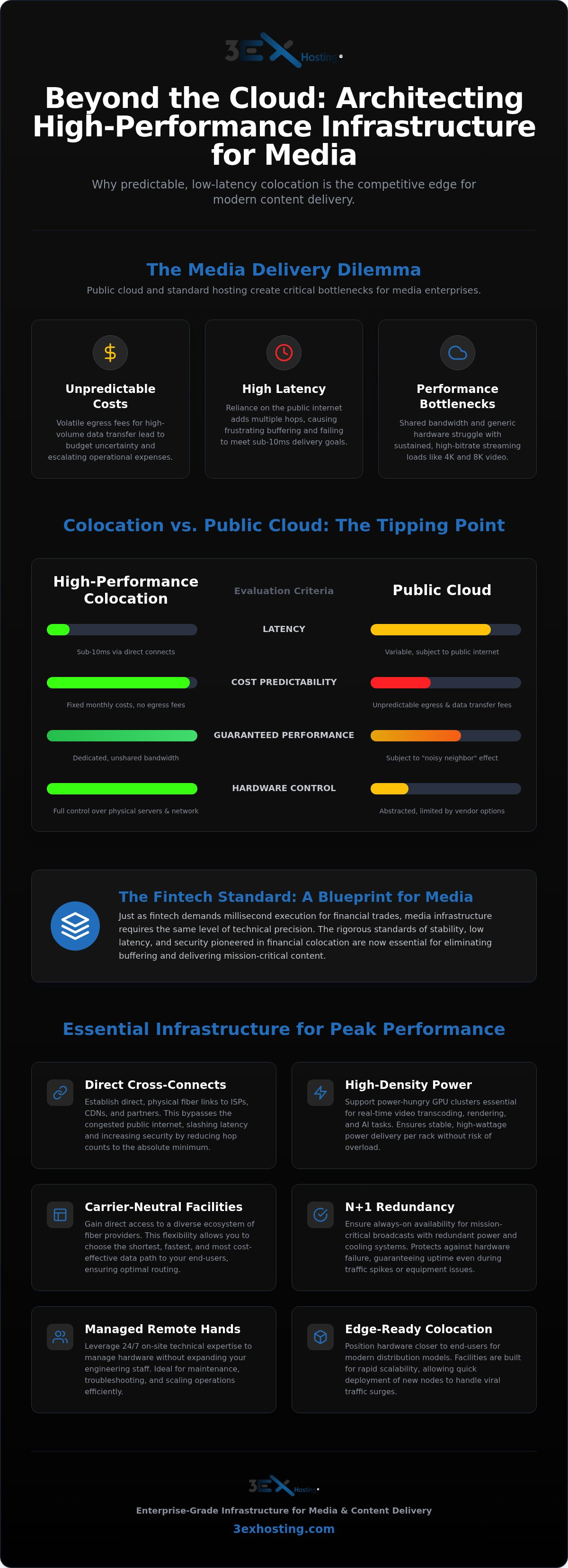
Colocation vs. Public Cloud: Which Wins for Media?
Public cloud providers offer agility, but they often fail to meet the sustained performance and cost requirements of high-volume media delivery. Media engineers are increasingly turning to hardware repatriation, moving core workloads back to physical infrastructure to regain control. This trend mirrors the shift seen in fintech colocation miami, where stakeholders demand absolute control over the physical network stack to ensure deterministic performance. While the cloud is useful for burstable workloads, it cannot match the raw, dedicated power of physical hardware for sustained 24/7 operations.
In virtualized environments, you share physical resources with other tenants. If a “noisy neighbor” on your host experiences a traffic spike, your transcoding speeds might drop or your stream could stutter. Physical hardware in a colocation environment eliminates this variable. You own 100% of the CPU and I/O cycles, ensuring consistent performance regardless of what other companies are doing. This predictability is essential for maintaining the high-quality experience users expect from modern media platforms.
The True Cost of Media Egress
Public clouds are excellent for testing, but they become prohibitively expensive at scale. The variable nature of egress fees makes quarterly budgeting nearly impossible for high-bandwidth content providers. Every gigabyte sent to a user adds to a “cloud tax” that grows alongside your success. By moving to cabinet colocation, you replace unpredictable usage-based billing with fixed, monthly infrastructure costs. This allows you to push petabytes of data through dedicated cross-connects without fear of a surprise invoice. It’s a more sustainable model for any business with high data throughput requirements.
Security and Data Sovereignty
Protecting pre-release content and sensitive media assets requires a multi-layered security approach. While cloud providers secure the hypervisor, they don’t give you control over the physical room where your data resides. For media companies, private suites represent the gold standard for data sovereignty. These suites provide physical walls and dedicated biometric access, ensuring your hardware is never touched by unauthorized personnel. This level of isolation is vital for complying with strict industry security standards and protecting your most valuable intellectual property from physical and digital threats alike. A hybrid strategy often works best, using fintech colocation miami standards for your origin and storage while utilizing the cloud only for short-term burst capacity at the extreme edge.
Essential Infrastructure Features for Content Providers
Selecting a data center for content delivery involves more than verifying floor space. It requires a rigorous audit of the facility’s ability to handle extreme throughput and power density. The technical benchmarks set by fintech colocation miami serve as an ideal baseline for media providers. These facilities are designed for millisecond accuracy and zero-fail power systems. When your business relies on 24/7 uptime, the physical features of your provider become your most significant competitive advantage.
To ensure your infrastructure is ready for 2026 demands, follow these evaluation steps:
- Step 1: Audit network density and carrier neutrality to ensure you have access to diverse, high-speed fiber routes.
- Step 2: Evaluate high-density power and cooling capabilities. Your racks must support the thermal load of GPU-intensive transcoding clusters.
- Step 3: Assess physical security and compliance. Look for SOC2 or HIPAA certifications to protect sensitive pre-release media assets.
- Step 4: Verify 24/7 availability of specialized support. On-site staff must be capable of handling emergency hardware swaps instantly.
- Step 5: Plan for modular growth. Ensure the facility offers scalable options that allow you to expand your footprint without migrating servers.
Vetting Your Carrier Hotel
A carrier-neutral ecosystem is the only way to ensure your content isn’t trapped by a single provider’s pricing or performance dips. Look for diverse fiber entry points. This redundancy protects your origin servers from physical fiber cuts or network outages. For national content providers, remote hands support is a non-negotiable requirement. You cannot afford to fly an engineer across the country for a simple hardware swap or a cable reset during a live broadcast.
Designing Your Custom Cage
Standard racks often lack the flexibility needed for custom media hardware. Modular cage solutions allow you to design a footprint that accommodates deep server chassis and complex cabling for high-performance media clusters. This approach simplifies the integration of disaster recovery protocols within your physical space. You can build a secure, isolated environment that scales as your audience grows. If you are ready to stabilize your infrastructure, request a custom quote today to see how our enterprise features can support your scaling goals.
Scaling Your Media Business with Enterprise Infrastructure
Scaling a media business requires more than just adding software licenses. It demands a physical foundation that can grow alongside your audience. 3EX Hosting provides this backbone through high-density full cabinet colocation designed for massive throughput. Our infrastructure handles the heavy lifting of national content delivery, ensuring your origin servers remain responsive under load. This level of technical stability is why firms looking for fintech colocation miami trust our facilities for their mission-critical data. We provide the same infrastructure rigor for media clusters that financial institutions require for high-frequency trading.
The transition from a startup media firm to a national-scale operation often exposes the limitations of unmanaged environments. You need a partner that understands the physical demands of 24/7 broadcasting and real-time transcoding. By leveraging our enterprise-grade cabinets, you gain the power density required for modern GPU hardware. This allows you to consolidate your processing power into a smaller physical footprint, reducing costs while increasing overall system efficiency. Our facility serves as the invisible engine behind your digital growth.
Enterprise-Grade Reliability
Reliability isn’t optional for live media. Our data centers utilize N+1 redundancy for both power and cooling systems. This architecture ensures your hardware stays online even during maintenance cycles or unexpected component failures. While your team might use managed cloud hosting for specific hybrid workloads, your core origin and storage servers need the stability of a physical environment. For distributed IT teams, remote hands support acts as a direct extension of your own staff. Our on-site technicians handle physical tasks like cable management, hardware reboots, and component swaps around the clock. This service ensures your senior engineers can focus on network architecture rather than travel logistics.
Getting Started with Content Delivery Colocation
Moving from a cloud-only model to a hybrid or colocation-first strategy is a significant technical shift. We simplify this transition with professional move-in assistance. Our team helps you plan the physical layout of your media racks and the network logic of your peering. This ensures you maximize the benefits of our carrier-dense environment from the moment your hardware is racked. You don’t have to navigate these technical complexities alone. Our experts consult with you on everything from cross-connect strategies to high-density power distribution.
Ready to stabilize your monthly infrastructure costs and achieve sub-10ms latency? You can request a custom quote to begin architecting your high-performance environment. We’ll provide a detailed breakdown of how our cabinets and connectivity can support your specific scaling goals for 2026 and beyond.
Future-Proofing Your Media Infrastructure for 2026
Content delivery performance is no longer just a software optimization problem. It’s a physical one. As we’ve explored, the transition from unpredictable public cloud costs to high-density full cabinet solutions provides the stability your media clusters require. By adopting the same rigorous infrastructure standards found in fintech colocation miami, you can achieve sub-10ms latency and eliminate the performance bottlenecks that frustrate global users. This approach replaces the “noisy neighbor” variables of virtualized environments with dedicated, deterministic hardware performance.
Success in the next era of streaming and real-time processing depends on carrier-neutral connectivity and the ability to scale hardware without logistical friction. With 24/7 Remote Hands support, your distributed team can maintain peak uptime without needing on-site staff for emergency swaps or reboots. This transition ensures your infrastructure remains a silent, reliable engine for growth rather than a source of technical debt. It’s time to take full control of your digital distribution layer.
Ready to optimize your content delivery? Get a custom colocation quote from 3EX Hosting today.
Building a high-performance foundation today ensures your media operations stay ahead of tomorrow’s technical demands.
Frequently Asked Questions
What is a data center for media and content delivery?
A media data center is a specialized facility engineered for high-bandwidth throughput and low-latency interconnections. It serves as the physical hub for origin servers and edge nodes that store and distribute digital content. These facilities differ from standard hosting by providing the massive power and cooling required for continuous, high-definition streaming and real-time processing.
How does colocation reduce latency for streaming services?
Colocation reduces latency by placing your servers in direct physical proximity to major internet backbones. By using cross-connects within the facility, your data avoids the multiple “hops” and congestion points of the public internet. This direct path ensures that content reaches the end-user with the lowest possible delay, which is critical for 4K streaming and live broadcasts.
Why is carrier neutrality important for content delivery networks?
Carrier neutrality is important because it gives you the freedom to choose from multiple network providers within the same facility. This prevents vendor lock-in and allows CDNs to optimize their routing for both performance and cost. If one carrier has a localized outage, you can instantly reroute your content through a different provider to maintain 100% uptime.
Can I use high-density GPU servers for media transcoding in colocation?
You can absolutely use high-density GPU servers for transcoding by utilizing cabinets rated for higher wattage and advanced cooling. These specialized environments manage the intense heat generated by GPU clusters during real-time rendering. This level of technical precision is a hallmark of fintech colocation miami, where hardware is pushed to its peak performance limits.
What are the benefits of remote hands for media companies?
Remote hands services offer 24/7 on-site technical assistance for physical hardware tasks like reboots, cabling, and component swaps. For media companies, this means you don’t have to send your own engineers to the data center for routine or emergency maintenance. It’s a cost-effective way to ensure your hardware is always managed by experts without expanding your on-site staff.
How does colocation help avoid high cloud egress fees?
Colocation avoids cloud egress fees by replacing metered data transfer costs with predictable, flat-rate bandwidth or port pricing. In a public cloud, you pay for every gigabyte that leaves the network, which becomes expensive as your audience grows. With colocation, you own the hardware and pay for the physical connection, making your monthly infrastructure costs much easier to forecast.
Is physical security different for media data centers?
Physical security in media-focused data centers involves multi-layered protocols like biometric access, 24/7 monitoring, and private suites to protect sensitive assets. These measures are designed to safeguard pre-release content and proprietary algorithms from unauthorized physical access. This ensures that your most valuable digital property stays secure within a controlled, enterprise-grade environment.
What is a carrier hotel and why does it matter for CDNs?
A carrier hotel is a highly connected building where dozens of internet service providers and fiber networks meet. It matters for CDNs because it provides the highest density of peering opportunities in a single location. This connectivity is why fintech colocation miami thrives in these environments, as it allows for the near-instantaneous transfer of data between different global networks.