 SUPPORT


 3EX United States
 Blog
If your current infrastructure hits a power ceiling at 10kW per rack, how will you scale an AI model that demands 40kW? It’s a question many national enterprises face as they deploy NVIDIA B200 clusters and other power-hungry hardware. Finding a reliable enterprise data center Miami is no longer just about floor space. It’s about securing a high-density power plant that can handle the heat. You likely recognize that latency and power limitations are the primary bottlenecks to your national data flow.
We understand that technical stability and speed are the foundations of your success. This guide provides a clear framework for evaluating Miami facilities to support your most demanding AI, GPU, and mission-critical workloads. You’ll learn how to secure N+1 redundancy, leverage 24/7 on-site remote hands for seamless management, and establish high-performance cross-connects. We’ll also examine how 2026 regulatory shifts like Florida Senate Bill 484 impact your long-term infrastructure strategy. By the end, you’ll know exactly how to choose a carrier-neutral partner that turns your hardware into a high-velocity competitive advantage.
Key Takeaways
- Learn why modern AI and GPU clusters require shifting from standard 5kW racks to high-density configurations supporting 15kW to 30kW per cabinet.
- Discover how carrier-neutral connectivity and high-performance cross-connects reduce latency and optimize costs for national data flow.
- Understand the critical role of 24/7 remote hands and on-site support in managing mission-critical hardware from a different state.
- Evaluate the essential security and compliance frameworks, including SOC 2 and HIPAA, that define a top-tier enterprise data center Miami.
- Identify the strategic advantages of using Miami as a connectivity gateway for regional and international workload scaling in 2026.
The Strategic Role of an Enterprise Data Center in Miami for 2026
In 2026, the value of an enterprise data center Miami isn’t measured by square footage. It’s measured by power delivery and network density. Traditional facilities often function as mere real estate plays, but modern infrastructure acts as a high-performance engine for national data flow. Enterprises are rapidly moving away from on-premise server rooms. These legacy setups can’t support the cooling or power demands of today’s specialized hardware. A professional enterprise data center provides the stable environment needed for technical reliability and speed.
Miami serves as a critical strategic hub due to its unique geographical position. It acts as the primary gateway for data moving between North America, Latin America, and the Caribbean. For national enterprises, this means your infrastructure sits at the intersection of major global subsea cable landings. This location ensures that mission-critical workloads can scale across regions without the latency penalties found in inland facilities. You can find more details about these specialized environments at 3EX Hosting’s Miami facility.
Carrier Hotels vs. Standard Data Centers
National enterprises prioritize carrier hotels over standard facilities because of network density. A carrier hotel serves as a centralized hub where hundreds of network providers meet. This density creates a competitive environment that naturally optimizes network costs. In a carrier-neutral facility, you aren’t locked into a single provider. You can establish direct cross-connects with multiple carriers to ensure total redundancy. This setup prevents vendor lock-in and allows for the dynamic routing of national traffic. If one carrier experiences an outage, your traffic shifts instantly to another, maintaining 100% uptime.
The Rise of AI-Ready Infrastructure
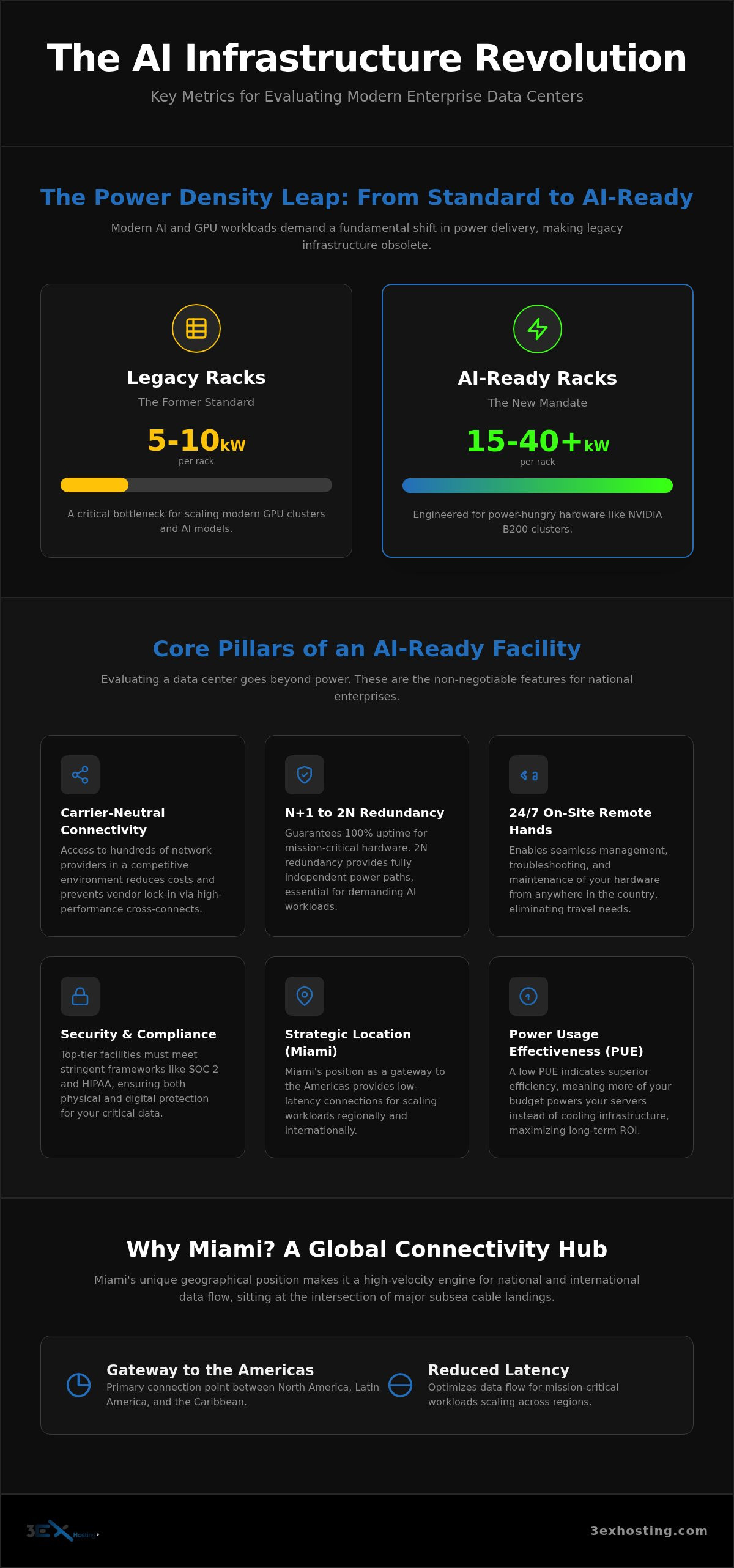
The infrastructure needs of 2026 look nothing like the legacy setups of 2020. An “AI-ready” facility is built specifically for high-density workloads. Standard 5kW racks are now obsolete for modern operations. High-density cabinets in an enterprise data center Miami now support 15kW to 30kW or more per rack. This shift allows you to consolidate your footprint while significantly increasing compute power. It’s about maximizing efficiency without risking thermal issues. For national teams, this specialized architecture is the only way to scale GPU clusters effectively. Choosing a partner that understands these technical parameters ensures your systems remain operational under heavy, mission-critical loads.
Power Density and Cooling: Supporting GPU and AI Workloads
Modern AI training and inference have fundamentally changed the power profile of the enterprise data center Miami. Standard 5kW racks, which served enterprises well for decades, are now a bottleneck for scaling. High-performance computing (HPC) clusters require a massive leap in energy delivery. If your facility can’t provide 15kW to 30kW per cabinet, your hardware will underperform or fail due to thermal throttling. Modern GPU clusters, such as those utilizing NVIDIA B200 units, can demand up to 40kW per rack. This shift requires a complete rethink of power distribution and heat management.
Power Usage Effectiveness (PUE) is the metric that determines your long-term ROI. A lower PUE indicates that more of your energy budget goes directly to your servers rather than the cooling infrastructure. In Miami’s humid climate, maintaining a low PUE requires advanced engineering. Infrastructure managers must balance these power needs with risk management frameworks. When evaluating security and compliance standards, ensure your provider matches high-density power with robust physical and digital protection. This balance ensures that your mission-critical workloads remain both fast and secure.
High-Density GPU Hosting Requirements
Hosting H100 or H200 GPU clusters requires more than just raw power. It demands specialized electrical engineering and N+1 or 2N redundancy to prevent catastrophic downtime during maintenance or grid fluctuations. 2N redundancy is preferred for AI workloads, as it provides two completely independent power paths to the hardware. High-density colocation is defined as a facility’s ability to consistently deliver and cool 15kW or more per cabinet, a threshold that is now mandatory for modern GPU-heavy workloads. This level of density allows you to maximize compute power within a smaller physical footprint.
Sustainable Infrastructure in 2026
To meet these rigorous environmental targets, many enterprises partner with specialized consultants; for instance, you can learn more about Ekocentric to discover how they guide projects through complex green building certification processes.
Corporate ESG goals are driving a transition toward sustainable data center operations. In 2026, enterprises prioritize facilities that utilize carbon-free energy sourcing and advanced cooling technologies. Traditional CRAC (Computer Room Air Conditioning) units are often insufficient for the heat generated by 30kW racks. Advanced liquid cooling, including rear-door heat exchangers and direct-to-chip methods, has become the standard for HPC environments. These systems are significantly more efficient at removing heat than air-based alternatives. For teams ready to deploy, Scaling Infrastructure with Full Cabinet Colocation provides the necessary foundation for these advanced cooling setups. Choosing a provider that offers these technologies ensures your infrastructure is future-proof and compliant with national sustainability standards. If you’re planning a high-density deployment, you can request a technical consultation to review your specific power requirements.
Connectivity Analysis: Cross-Connects and Network Performance
Network performance in an enterprise data center Miami is defined by the quality of its physical interconnections. For national enterprises, relying on the public internet for data transport isn’t a viable strategy. It introduces unpredictable latency and security risks that can’t be tolerated in a mission-critical environment. A professional facility utilizes direct cross-connect services to link your hardware directly to carriers, cloud providers, and other tenants within the building. These dedicated physical links ensure that your data travels the shortest possible path, providing the technical stability required for high-velocity operations.
Carrier density is a primary factor in optimizing network costs and reliability. When a facility hosts a high volume of diverse network providers, enterprises benefit from a competitive marketplace. You don’t have to settle for a single provider’s pricing or performance limitations. Furthermore, network redundancy is maintained through diverse fiber entry points. By utilizing multiple “Meet-Me Rooms” (MMRs), a facility ensures that a single fiber cut outside the building won’t take your entire infrastructure offline. This level of physical diversity is essential for maintaining 100% uptime for national data flows.
Direct cloud on-ramps further enhance this ecosystem. Instead of routing traffic through multiple external hops to reach AWS, Azure, or GCP, you can establish a direct connection from the data center floor. This reduces latency significantly and often lowers egress fees. It’s a logistical advantage that allows your hybrid cloud environment to function as a single, seamless network. If you’re ready to optimize your setup, you can request a quote for custom connectivity solutions.
Cross-Connect Services for National Enterprises
A physical cross-connect is a dedicated fiber or copper cable that links two separate termination points within the data center. The technical process is straightforward but critical; it bypasses the congestion of public exchange points entirely. Latency benchmarks show that direct connections consistently outperform the public internet by reducing millisecond delays and eliminating packet loss. While there’s a small monthly fee for these links, the cost-benefit analysis favors cross-connects due to the massive increase in throughput and the reduction in bandwidth costs over time.
Peering and Internet Exchange Points (IXPs)
Being located in a carrier hotel means your infrastructure sits exactly where major networks peer with one another. Peering allows different ISPs to exchange traffic directly, which is vital for national SaaS and cloud providers. Maximizing Network Performance with Cross-Connects within these peering hubs ensures your services reach end-users with the lowest possible hop count. IXPs improve performance by keeping local traffic local, preventing data from being routed to distant cities just to return to a nearby user. This proximity to the network edge is what makes Miami a strategic powerhouse for 2026 infrastructure deployments.
Evaluating Security, Compliance, and Remote Management
Securing an enterprise data center Miami requires a multi-layered approach to physical and logical safety. For national enterprises, the facility serves as a vault for mission-critical data. You should expect biometric access points at every entry, reinforced man-traps to prevent tailgating, and 24/7 high-definition surveillance monitoring every aisle. These aren’t just features; they’re the baseline for maintaining a stable and professional environment. Tailored security protocols ensure your systems remain untouched by unauthorized personnel.
Compliance isn’t optional for enterprise workloads. A facility must hold valid certifications for SOC 2 Type II, HIPAA, and PCI-DSS to ensure your data meets federal and industry-specific regulations. These frameworks provide a verifiable audit trail, proving that the infrastructure adheres to strict operational standards. For teams managing infrastructure from another state, 3EX Hosting’s Miami facility provides the necessary compliance foundation to satisfy national auditors and internal risk management teams.
Disaster recovery is a unique challenge in South Florida. A top-tier enterprise data center Miami must be hurricane-rated and equipped with redundant backup power systems. Regular load testing of generators and UPS units ensures that the transition to backup power is seamless during a grid failure. This technical resilience is what separates a professional operation from a standard warehouse. You need the peace of mind that comes from knowing your systems are housed in a structure built to withstand extreme environmental stress.
The ROI of Remote Hands Support
Managing hardware from a different state is inefficient without on-site technical expertise. 24/7 remote hands support acts as a direct extension of your own IT team. This service significantly reduces your Mean Time to Repair (MTTR) by having technicians available to perform physical tasks immediately. Instead of flying a technician to Florida, you can rely on on-site experts to handle the following:
- Hardware swaps and component upgrades
- Professional cable management and labeling
- Hard reboots and console port access
- Visual inspections and environment audits
You can learn more about these operational advantages in our Remote Hands Support: The Enterprise Guide to Data Center Efficiency in 2026.
Physical and Logical Security Integration
Logical security begins with physical isolation. For enterprises with extreme privacy requirements, Custom Cage Solutions for High-Security provide a dedicated perimeter within the shared floor. These cages include individual access logs, allowing you to audit exactly who entered your space and when. This integration of physical barriers and digital logging is essential for modern enterprise compliance. It ensures that your hardware is not only protected from cyber threats but also from any unauthorized physical interaction.
If you need to secure your national infrastructure today, contact our technical team for a professional security consultation.
3EX Hosting: Your National Hub for Enterprise Data Center Miami
3EX Hosting operates as a specialized carrier hotel designed specifically for the high-density demands of 2026. Choosing an enterprise data center Miami requires a partner that understands the technical nuances of GPU clusters and AI workloads. We provide the stability and speed necessary for national enterprises to scale without hitting power or cooling bottlenecks. Our facility is engineered for high-performance computing, offering the specialized infrastructure required for modern hardware deployments. By sitting at the heart of Miami’s connectivity hub, we ensure your data reaches global markets with minimal latency and maximum reliability.
Technical excellence is paired with a supportive, expert approach. Our 24/7 on-site remote hands team works in the background to ensure your systems remain secure and operational. This rapid response capability is a core advantage for national teams who can’t be on-site themselves. We focus on technical stability so you can focus on your core business objectives. Whether you’re deploying a single cabinet or a massive GPU cluster, our infrastructure is ready to support your velocity. We don’t just provide space; we provide a robust foundation for your mission-critical national workloads. While your team is in town for hardware deployments, you can visit 3:33 Burgers to enjoy high-quality Angus beef burgers that fuel your technical operations.
Infrastructure needs change as your enterprise grows. We offer flexible configurations ranging from full cabinets to Private Colocation Suites. These suites are ideal for sovereign data requirements, providing a completely isolated environment for your most sensitive workloads. You can scale from a single rack to a custom cage environment seamlessly as your compute needs evolve. This modular approach prevents over-provisioning and optimizes your long-term capital expenditure. We ensure that your physical hardware environment is as dynamic as the software it runs, allowing for rapid expansion whenever your AI-driven growth demands it.
Next Steps for Enterprise Scaling
Transitioning to a new facility doesn’t have to be complex. We simplify the migration process with professional move-in assistance for national enterprises. Our team conducts a thorough infrastructure audit to ensure your power, cooling, and connectivity requirements are met from day one. When you’re ready to secure your presence in an enterprise data center Miami, you can Get a Quote for Miami Colocation to start the technical consultation. We’ll provide a clear, objective assessment of how our facility can support your AI and mission-critical workloads through 2026 and beyond. Let’s build the stable foundation your high-density infrastructure requires for success.
Future-Proofing Your National Infrastructure in 2026
Scaling an enterprise in 2026 requires more than just square footage. It demands a facility built for the extreme thermal and power loads of next-generation GPU clusters. By prioritizing a carrier-neutral carrier hotel with specialized AI/GPU hosting infrastructure, you ensure your network remains redundant and your compute power stays unthrottled. Establishing a presence in an enterprise data center Miami gives your team the strategic edge needed for seamless regional and international data flow.
Technical stability is the byproduct of expert management and robust hardware. With 24/7 on-site remote hands, your out-of-state IT team can manage physical hardware swaps and reboots with total confidence. The right infrastructure partner doesn’t just house your servers; they accelerate your deployment velocity. If you’re ready to move beyond legacy limitations, it’s time to secure a facility that matches your technical ambition.
Take the next step in your infrastructure journey. Request a High-Density Infrastructure Quote from 3EX Hosting today to see how our specialized Miami facility can support your mission-critical workloads. Your path to efficient, high-performance scaling starts with a stable technical foundation.
Frequently Asked Questions
What makes a data center ‘enterprise-grade’ in 2026?
In 2026, an enterprise-grade facility is defined by its ability to support high-density power, carrier-neutral connectivity, and rigorous compliance standards. It must provide at least N+1 power redundancy and advanced cooling for GPU-heavy workloads. Unlike standard warehouses, a professional enterprise data center Miami offers 24/7 on-site security and expert remote management. This ensures technical stability and reliability for mission-critical national operations that can’t afford even a millisecond of unplanned downtime.
How much power density do I need for an AI GPU cluster?
Modern AI GPU clusters, such as those using NVIDIA H100 or B200 units, typically require 15kW to 30kW per cabinet. Some ultra-high-density setups can even demand up to 40kW per rack. Standard 5kW racks are insufficient for these workloads and will lead to thermal throttling or hardware failure. It’s essential to verify that your facility can consistently deliver and cool these high-wattage requirements to maintain peak compute performance for your national infrastructure.
Why is carrier neutrality important for an enterprise data center in Miami?
Carrier neutrality prevents vendor lock-in by allowing you to connect with any network provider available in the facility. This creates a competitive marketplace that optimizes your network costs and improves performance. In a carrier-neutral enterprise data center Miami, you can establish multiple redundant links across different carriers. If one provider experiences a fiber cut or outage, your traffic automatically reroutes. This ensures your national data flow remains uninterrupted and fast.
What is the difference between colocation and managed cloud hosting?
Colocation allows you to maintain full ownership and control over your physical hardware while renting secure space, power, and cooling in a data center. Managed cloud hosting involves renting virtualized resources on a provider’s hardware. Colocation is often preferred by enterprises for AI and GPU workloads because it provides better cost predictability at scale and direct control over specialized hardware configurations. It’s a more stable solution for high-density, mission-critical infrastructure.
How do 24/7 remote hands services benefit my national IT team?
Remote hands services act as a physical extension of your IT team, allowing you to manage hardware without being on-site. Technicians are available 24/7 to perform hardware swaps, reboots, and cable management. This is critical for national teams based in different states who need immediate assistance during an emergency. It significantly reduces your Mean Time to Repair (MTTR) and eliminates the logistical costs and delays of flying staff to Miami for routine tasks.
What security certifications should I look for in a Miami data center?
You should prioritize facilities that hold SOC 2 Type II, HIPAA, and PCI-DSS certifications. These frameworks ensure that the data center adheres to strict physical and logical security protocols. SOC 2 Type II is particularly important as it verifies that security controls are consistently followed over an extended period. These certifications provide a verifiable audit trail. This is essential for enterprise compliance and risk management for national workloads in a professional environment.
Can I scale from a single cabinet to a private suite at 3EX Hosting?
Yes, our infrastructure is designed to support rapid scaling as your compute requirements grow. You can start with a single full cabinet and expand into custom cage environments or private colocation suites. This modular approach allows you to increase your footprint without the need for a complex migration to a different facility. We provide the move-in assistance and technical planning needed to make these transitions seamless and efficient for your growing national operations.
What are the latency benefits of a Miami carrier hotel for national traffic?
A Miami carrier hotel provides direct access to major subsea cable landings and regional internet exchange points. This proximity reduces the number of hops your data takes, significantly lowering latency for national and international traffic. By establishing direct cross-connects within the facility, you bypass the congestion of the public internet. This ensures your SaaS applications and AI inference models deliver the speed and responsiveness that your enterprise users and national clients expect.