 SUPPORT


 3EX United States
 Blog
How much is a single tripped circuit breaker worth to your enterprise when it’s powering a high-density GPU cluster? With data centers projected to consume up to 15.3% of U.S. electricity by 2030, the margin for error in your rack has vanished. You likely already know that blind spots in your power draw lead to more than just unexpected overage fees. They create a constant, underlying fear of thermal failure and SLA breaches. Mastering the art of monitoring power usage in a colocation cabinet is now the only way to maintain the technical stability your hardware requires.
This guide provides the technical strategies and tools you need to gain real-time visibility into your infrastructure. You’ll learn how to leverage next-generation intelligent PDUs and DCIM software to track consumption at the device level. We’ll show you how to optimize high-density rack efficiency and document the precise uptime needed for strict compliance. We’ll explore the specific hardware and reporting protocols that keep your AI and GPU assets running at peak performance without risking a shutdown. It’s time to turn raw electrical data into a strategic advantage for your capacity planning.
Key Takeaways
- Identify the technical hardware requirements for outlet-level monitoring to gain granular control over every server in your rack.
- Effective monitoring power usage in a colocation cabinet reduces the risk of thermal instability and prevents costly power overage fees.
- Establish clear alerting hierarchies to distinguish between minor power fluctuations and critical capacity limits before they impact performance.
- Align your power strategy with high-density GPU requirements to maintain documented uptime and stay compliant with strict enterprise SLAs.
- Compare metered and monitored power options to find the right balance of transparency and cost for your specific infrastructure needs.
Understanding the Critical Role of Power Monitoring in Colocation
Granular tracking of electrical draw within a specific rack is the definition of cabinet-level monitoring. For enterprise tenants, it’s the primary safeguard between a stable environment and a series of technical failures. In the high-density environment of 2026, where GPU loads can pull 30kW or more per cabinet, the risks are magnified. Power density has shifted, and monitoring power usage in a colocation cabinet now requires precision that far exceeds the 2020 standards of simple circuit-level tracking.
Effective IT energy management begins with understanding the link between power fluctuations and hardware failure. Modern power supplies are sensitive. Consistent micro-spikes or dips degrade capacitors over time, leading to premature server death. By tracking these metrics, you can identify “ghost loads” that waste your budget without adding compute value. This visibility ensures that every watt consumed is actively supporting your business objectives.
The Financial Impact of Power Visibility
Proactive monitoring is your best defense against unexpected “bursting” fees. Many providers charge significant premiums when you exceed your committed power draw. By configuring threshold alerts, you can receive a notification before you hit these limits, allowing for immediate load balancing. This data also serves as a vital tool for validating provider billing. Having independent, cabinet-level data ensures you only pay for what you use.
Hardware and Methods: How Power is Tracked at the Rack Level
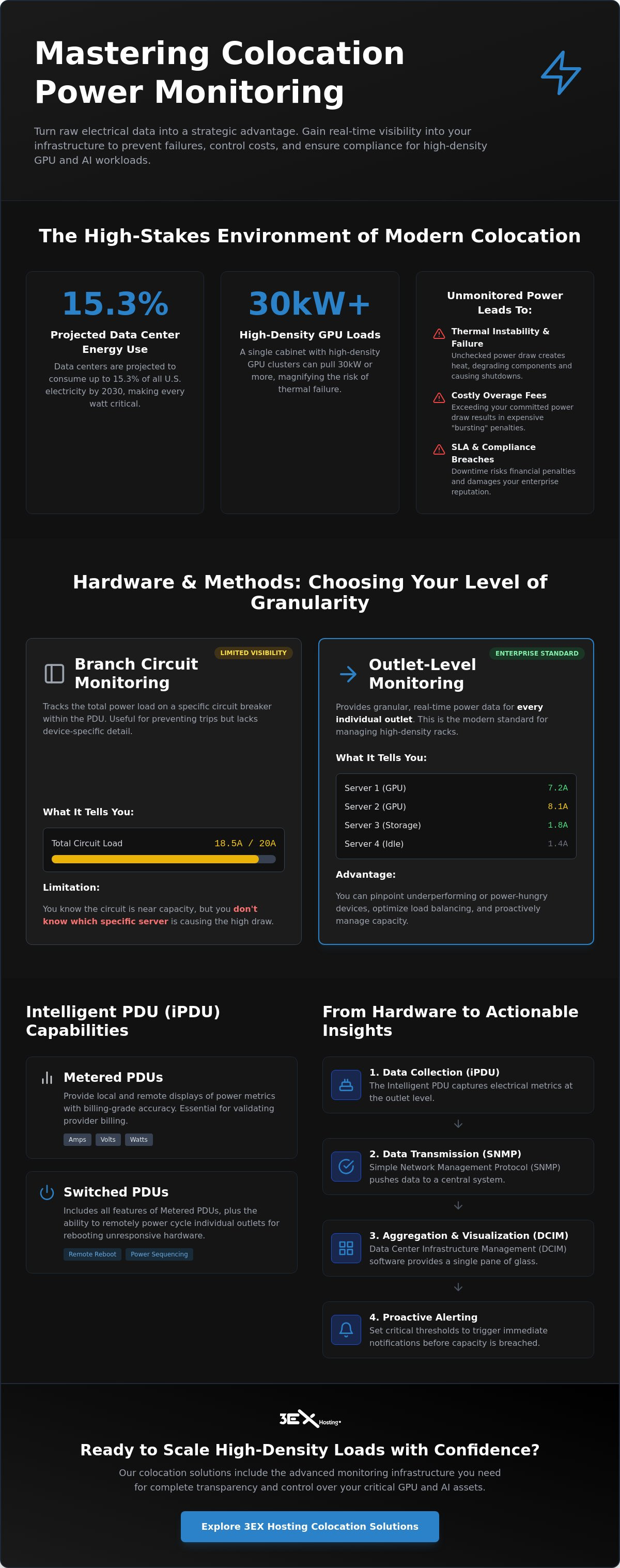
Precise monitoring power usage in a colocation cabinet depends entirely on the physical hardware installed at the edge of your network. In 2026, the standard for enterprise deployments has shifted from basic power strips to Intelligent Power Distribution Units (iPDUs). These devices act as the primary data collection points, capturing electrical metrics before they enter your server’s power supply. This granular data is vital because monitoring power for modern data centers now involves managing complex oscillations caused by variable AI and GPU workloads.
Hardware matters. You must choose between branch circuit monitoring and outlet-level monitoring. Branch monitoring tracks the total load on a specific circuit breaker, which is useful for preventing trips. However, outlet-level monitoring provides the visibility required to identify which specific server is underperforming or drawing excessive current. Pairing these electrical metrics with environmental sensors for temperature and humidity is non-negotiable. High power draw generates heat; tracking both allows you to correlate thermal spikes with compute cycles. If you’re looking to upgrade your current setup, our cabinet colocation solutions include the infrastructure needed for this level of transparency.
Intelligent PDUs: The First Line of Sight
Enterprises generally choose between metered and switched PDUs. Metered units provide local and remote displays of power metrics. Switched PDUs add the ability to remotely reboot individual outlets, which is essential for efficiency. Modern iPDUs track Amps, Volts, and Watts with billing-grade accuracy. Look for units with hot-swappable controllers. This feature allows you to replace the monitoring logic without disrupting the actual power flow to your servers, ensuring 100% uptime for your data stream.
Software Integration: DCIM and SNMP
Hardware data is only useful if it’s accessible. Most iPDUs use Simple Network Management Protocol (SNMP) to push data to a centralized management system. Data Center Infrastructure Management (DCIM) software then aggregates these individual streams into a single pane of glass. Integrating these tools simplifies monitoring power usage in a colocation cabinet across multiple geographic locations. Automated alerts are the final piece of the puzzle. You can set critical thresholds that trigger immediate notifications if a cabinet approaches its rated capacity. This proactive stance prevents the emergency scenarios that lead to unplanned downtime.
Metered Power vs. Monitored PDUs: Choosing Your Level of Granularity
Deciding on the appropriate level of transparency for your infrastructure is a balance between hardware investment and operational risk. Not every enterprise requires the same depth of data. However, as power densities increase, the business case for advanced monitoring power usage in a colocation cabinet becomes more compelling. You must evaluate three primary tiers of transparency: provider-level metering, cabinet-level branch monitoring, and granular outlet-level tracking. Each tier offers different insights into your electrical environment and carries different cost implications.
If your workload is static and predictable, basic monitoring might suffice. But for dynamic environments, especially those involving AI or GPU clusters, the lack of granularity can be a liability. High-density loads create rapid fluctuations that basic meters often fail to capture. Choosing the right level of monitoring ensures you don’t overpay for hardware you don’t need, while also protecting you from the “blind spots” that lead to circuit trips and hardware degradation.
Provider-Level Metered Power
Most colocation facilities provide some form of metered power as a baseline. This typically involves the provider tracking the total draw at the circuit breaker or the floor PDU. While this is useful for validating monthly invoices, it offers very little for internal technical troubleshooting. You’ll see the total kilowatt-hours used, but you won’t know which specific server is causing a spike.
- Billing Models: Providers often use metered-by-usage billing, where you pay for actual consumption, or flat-rate billing based on a committed power ceiling.
- Visibility Limits: You can’t see “phase imbalance” or individual device health through provider-only data.
- Troubleshooting: If a breaker trips, provider-level data won’t tell you which unit failed; it only confirms the power is out.
Granular Outlet-Level Monitoring
For enterprises managing high-density GPU colocation, outlet-level monitoring is the professional standard. This requires intelligent PDUs that track every individual plug. The primary advantage is the ability to identify specific high-draw servers within a mixed-use cabinet. If one node in a cluster begins to draw 20% more power than its peers, it’s often an early indicator of a failing fan or a thermal issue.
This level of detail also enables precise internal accountability. You can bill back individual departments or clients based on their actual consumption rather than an estimated average. When monitoring power usage in a colocation cabinet at the outlet level, you gain the data necessary for advanced thermal management. You’ll know exactly where the heat is being generated, allowing you to optimize your airflow and cooling strategies for maximum efficiency. The initial cost of these intelligent units is often recovered through the prevention of a single hour of unplanned downtime or the elimination of “zombie” hardware that draws power without providing utility.
Best Practices for Analyzing and Reporting Cabinet Power Data
Raw electrical data is only valuable when you translate it into actionable intelligence. Effective monitoring power usage in a colocation cabinet begins with establishing a baseline. You must determine your “Normal” power profile by tracking usage over a full business cycle, typically 30 days. This baseline allows you to distinguish between expected peak compute cycles and anomalous spikes that might indicate hardware failure or a security breach. Correlating these power spikes with application performance or network traffic patterns provides a complete picture of your infrastructure health.
Physical audits remain a critical component of a robust power strategy. While software provides the metrics, physical verification ensures your cabling and distribution are optimized. This is where Remote Hands Support plays a vital role. Technicians can perform visual inspections and thermal scans to validate the data your sensors are reporting. If you need professional assistance managing your environment, our Remote Hands team is available to perform these audits on your behalf.
Setting Thresholds and Alerts
Configuring a tiered alerting hierarchy is the best way to prevent unplanned downtime. Most enterprise teams follow the 80% rule. This standard, often rooted in electrical code requirements, dictates that you should never exceed 80% of a circuit’s rated capacity for continuous loads. Exceeding this threshold significantly increases the risk of tripping a breaker during a minor surge. Set your “Warning” alerts at 70% and “Critical” alerts at 75% to 80% to give your team time to react before a failure occurs.
- Automated Notifications: Ensure your management software sends SMS and email alerts to the appropriate stakeholders immediately.
- Rapid Intervention: Use professional on-site support for rapid intervention if an alert indicates a physical issue that requires immediate attention.
- Escalation Paths: Define clear protocols for who responds to specific threshold breaches during off-hours to ensure 24/7 coverage.
Reporting for Stakeholders and ROI
Reporting should bridge the gap between technical operations and business value. Monthly power efficiency reports for the CTO should highlight utilization trends and identify opportunities for hardware consolidation. Visualizing these capacity trends helps justify future infrastructure expansion before you hit a hard limit. This documentation is also essential for meeting compliance and audit requirements, proving that your environment maintains the stability promised in your enterprise SLAs. Clear data visualization transforms power management from a utility cost into a strategic asset for growth.
Scaling High-Density Loads with 3EX Hosting’s Monitoring Infrastructure
Scaling enterprise infrastructure in 2026 requires more than just floor space. It requires a partner that provides deep visibility into electrical metrics at the edge. We’ve designed our facilities specifically to support the specialized needs of High-Density GPU Colocation. Traditional power monitoring often falls short in these environments, but 3EX Hosting ensures you have the granular data needed to manage complex AI workloads safely. Our commitment to N+1 power redundancy means your systems remain operational even during maintenance cycles.
Transparency as a service is the core of our approach. You aren’t left to guess about your consumption or wait for a monthly invoice to see your draw. You can access your data directly through our enterprise portal. When you customize your Full Cabinet Colocation with us, you can choose metered power options that align with your specific reporting requirements. This real-time visibility is essential for monitoring power usage in a colocation cabinet when every watt counts toward your bottom line.
Powering the Future: AI and GPU Infrastructure
AI workloads don’t pull power in a straight line. Training phases create massive surges, while inference loads fluctuate based on user demand. Monitoring power usage in a colocation cabinet at 3EX Hosting involves using high-fidelity sensors that capture these micro-bursts accurately. We combine this with real-time thermal monitoring to ensure your high-density racks don’t develop localized hotspots. Specialized hardware requires specialized monitoring, and our infrastructure is built to handle the unique power curves of modern AI clusters without compromising stability.
Getting Started with Your Deployment
Success begins with a solid technical foundation. Our engineers consult with you during the onboarding process to help select the right PDU configurations for your specific cabinet needs. We don’t just provide space; we provide the expertise to ensure your monitoring is configured correctly. By using our Move-In Assistance, you can be certain that your monitoring tools are online and reporting data from Day 1. If you’re ready to secure a stable, high-performance environment for your next-generation hardware, Request a Custom Quote for your high-density colocation needs today.
Future-Proofing Your High-Density Infrastructure
Effective monitoring power usage in a colocation cabinet is no longer optional for the modern enterprise. It’s a technical necessity for maintaining hardware health and preventing financial overages. By implementing intelligent PDUs and establishing clear alerting thresholds, you transform raw electrical metrics into a roadmap for growth. This visibility ensures your high-density GPU and AI clusters operate within safe thermal and electrical limits at all times.
3EX Hosting provides the stability and visibility your infrastructure requires. Our facilities feature enterprise-grade N+1 power redundancy and carrier-neutral connectivity to ensure your data stays moving without interruption. With specialized support for AI and GPU infrastructure, we handle the complex power curves of next-generation hardware with ease. Our 24/7 remote hands team is always available to assist with physical audits or rapid intervention when every second counts.
Don’t leave your uptime to chance. Get a Quote for High-Density Colocation with Real-Time Power Monitoring and secure a technical foundation built for 2026 and beyond.
Frequently Asked Questions
What is the difference between kVA and kW in colocation power monitoring?
kW represents the actual real power used by your hardware to perform work, while kVA is the apparent power, which is the total power supplied to the circuit. The relationship between the two is defined by the power factor. In modern data centers, most IT equipment has a power factor near 1.0, meaning kW and kVA are often nearly identical. However, kVA is the metric that determines your circuit breaker’s capacity and your overall infrastructure footprint.
Can I install my own monitoring hardware in a 3EX Hosting cabinet?
Yes, you can install your own intelligent PDUs or specialized sensors within your dedicated space. We support tenants who want to maintain their own hardware standards for monitoring power usage in a colocation cabinet. Our technicians can assist with the physical installation and cabling to ensure your monitoring tools are integrated safely and positioned for maximum visibility from the moment your servers go live.
How often should I audit my cabinet power usage reports?
Review your power reports at least once a month to identify long-term trends and “zombie” servers that draw power without providing utility. For enterprises running high-density AI or GPU clusters, weekly audits are a better standard. Frequent reviews help you stay ahead of the 80% circuit utilization limit and allow you to adjust your load balancing before performance is impacted by thermal or electrical constraints.
What happens if my power usage exceeds my contracted limit?
Exceeding your contracted limit typically results in overage fees or “bursting” charges defined in your service agreement. Beyond the financial impact, you risk a physical outage if the draw exceeds the circuit’s rated capacity and trips the breaker. You should configure automated alerts at 70% and 75% of your limit. This gives your team enough lead time to move workloads or upgrade your power commitment before a critical threshold is reached.
Does high-density GPU hosting require different monitoring tools?
High-density GPU clusters require monitoring tools with higher sampling rates to capture rapid power oscillations. Standard meters often miss the micro-spikes that occur during intense AI training or inference phases. You need intelligent PDUs that provide billing-grade accuracy and integrated thermal sensors. This specialized hardware ensures you can correlate electrical spikes with heat generation to prevent localized hotspots in the rack.
Is remote power monitoring secure from external cyber threats?
Security is a primary concern for any networked management interface. We recommend isolating your PDU and sensor management traffic on a private, secure VLAN rather than exposing it to the public internet. Using modern, encrypted protocols like SNMPv3 and implementing strong authentication ensures that monitoring power usage in a colocation cabinet remains a secure process that doesn’t create a vulnerability in your infrastructure.
How does environmental monitoring complement power usage data?
Power data identifies the source of energy consumption, while environmental monitoring tracks the physical result of that energy. High power draw inevitably leads to increased heat production. By correlating kW draw with temperature and humidity data, you can determine if your cooling airflow is optimized. This combined data set helps you identify recirculating hot air or cooling inefficiencies that could lead to premature hardware degradation.
What is the role of a DCIM in a single-cabinet colocation setup?
DCIM software provides a centralized dashboard that aggregates data from your PDU, sensors, and hardware into actionable insights. Even for a single cabinet, it’s a vital tool for visualizing capacity trends and generating the documentation needed for SLA compliance. It simplifies the management of alerting hierarchies and allows you to predict when you’ll need to expand your infrastructure based on historical growth patterns.