 SUPPORT


 3EX United States
 Blog
Your standard shared rack isn’t just a security risk; it’s a bottleneck for your next growth phase. In a market where high-density AI demands are skyrocketing, a private colocation cage Miami provides the physical and thermal isolation your mission-critical hardware requires to perform at scale. You’ve likely felt the pressure of managing escalating power densities while worrying if a neighbor’s hardware could compromise your physical security. It’s a common concern for enterprise leaders who need to maintain strict compliance without sacrificing the agility to expand.
Managing high-performance GPU loads requires more than just floor space. It demands a strategic approach to power redundancy and cooling that shared environments simply can’t provide. This guide will show you how to master the technical and strategic requirements of private cage colocation to secure your infrastructure at national enterprise standards. We’ll explore high-density configurations, Florida’s evolving 2026 regulatory landscape under SB 484, and how carrier-neutral connectivity ensures your data moves as fast as your business. You’ll learn to eliminate operational overhead through expert remote hands and build a scalable environment that meets the most rigorous security audits.
Key Takeaways
- Identify the specific operational thresholds that signal when your organization should transition to a private colocation cage Miami for improved security and scale.
- Learn how to engineer infrastructure for high-density AI and GPU workloads by implementing three-phase power delivery for racks exceeding 20kW.
- Meet “Physical Access Control” audit requirements through multi-layered security protocols and dedicated physical partitioning within a Tier III environment.
- Design a three-year growth roadmap that utilizes strategic cross-connect placement to minimize latency and simplify cabling as your footprint expands.
- Reduce operational overhead and eliminate the need for on-site travel by leveraging 24/7 Remote Hands for mission-critical hardware management.
Understanding Private Colocation Cage Miami Solutions for Enterprise Scale
A private cage is a dedicated, partitioned area within a Tier III or IV colocation centre. It serves as a middle ground for organizations that have outgrown individual racks but don’t yet require the massive footprint of a full private suite. This setup provides a secure perimeter around your hardware, ensuring that only your authorized personnel can interact with the equipment. For national enterprises, this creates a sense of “infrastructure sovereignty.” You maintain total control over your physical environment while benefiting from the shared costs of a world-class facility’s power, cooling, and connectivity.
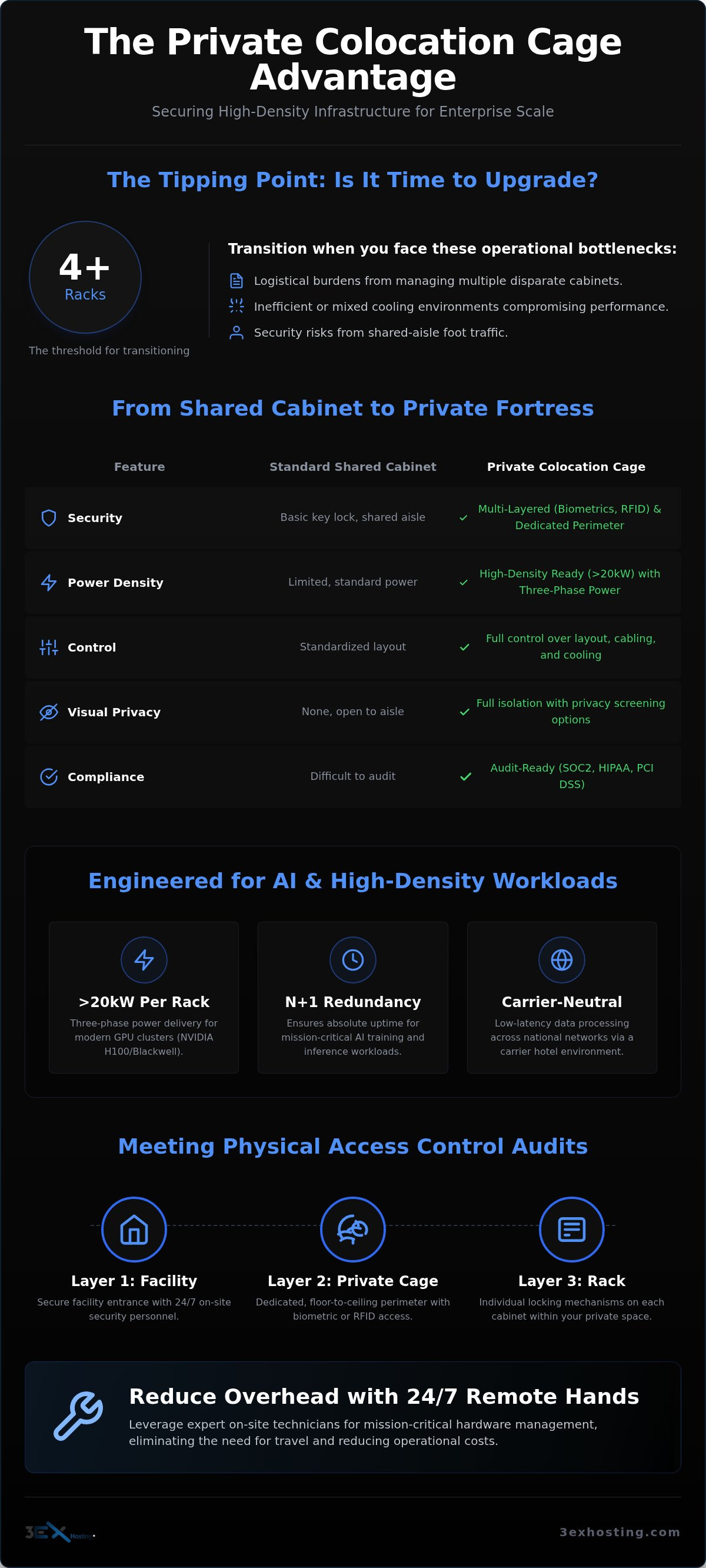
The transition point from cabinets to a private colocation cage Miami usually occurs when an organization manages four or more racks. Managing disparate cabinet keys and mixed cooling environments becomes a logistical burden at this scale. By consolidating into a cage, you eliminate the risks associated with shared-aisle traffic. It’s a strategic move that balances high-level physical security with operational flexibility. You gain the ability to manage your own internal cable plant and cooling strategies without interference from other tenants.
The Core Components of a Modern Private Cage
Building a resilient environment starts with the physical structure. Modern Cage Solutions utilize floor-to-ceiling steel mesh or solid panels to create a definitive isolation zone. This isn’t just about keeping people out; it’s about defining your operational space. Within this perimeter, you receive dedicated, metered power circuits. This allows for granular cost tracking and ensures your high-density hardware doesn’t compete for power resources with neighboring racks. Furthermore, you have the freedom to customize your rack layouts. You can orient your hardware to support specific hot or cold aisle containment strategies, which is essential for managing the thermal output of modern GPU clusters.
Security vs. Standard Cabinet Colocation
Security in a cage environment is significantly more robust than standard cabinet colocation. Access control moves beyond simple physical keys to cage-level biometric or RFID authentication. This creates a multi-layered defense: first at the facility entrance, then at the cage door, and finally at the rack itself. For organizations handling sensitive data, visual privacy is another critical factor. You can install privacy screening to prevent unauthorized visual inspection of your hardware configurations or cabling. These features aren’t just for peace of mind; they provide the documented physical access controls required for SOC2, HIPAA, and PCI DSS compliance audits. Having a dedicated, monitored perimeter simplifies the reporting process and demonstrates a commitment to national enterprise security standards.
Engineering for High-Density: GPU and AI Infrastructure Requirements
The surge in AI development has fundamentally changed how we engineer data center environments. By 2026, enterprise AI workloads often exceed 20kW per rack, a density that standard colocation facilities struggle to support. Deploying a private colocation cage Miami allows you to isolate these high-heat zones and implement the specialized power delivery required for modern GPU clusters. Standard single-phase power is no longer sufficient. High-density environments require three-phase power delivery to provide the balanced, high-capacity load necessary for NVIDIA H100 or Blackwell architectures.
Maintaining these clusters requires absolute uptime. AI training runs can last weeks; any power interruption results in massive data loss and wasted compute time. We utilize N+1 redundancy across all critical systems to ensure that your mission-critical hardware remains online during maintenance or utility failures. This reliability is paired with carrier-neutral connectivity. By leveraging a carrier hotel environment, you ensure low-latency data processing across national networks, which is vital for real-time AI inference. Properly categorizing these systems according to NIST FIPS 199 standards ensures that your security protocols match the impact level of your data.
Cooling Strategies for High-Performance Computing
Managing the thermal output of a 20kW rack requires precise airflow control. Hot aisle and cold aisle containment systems are essential in high-density cages to prevent thermal recirculation. This isolation ensures that cold air reaches the server intakes without being diluted by exhaust air. In 2026, cage efficiency is often measured by Power Usage Effectiveness (PUE). In the context of cage colocation, PUE is the ratio of total energy used by the facility to the energy delivered to your computing equipment, where a lower number indicates superior cooling efficiency. Effective containment directly reduces your operational costs by optimizing this ratio.
Power Redundancy and Distribution
Enterprise-grade reliability depends on A/B power feeds. This configuration ensures that if one power path fails or requires maintenance, your hardware continues to run on the secondary feed without interruption. We pair this with metered PDUs to provide real-time consumption tracking. This data allows you to optimize energy spend across your national footprint and identify potential hardware inefficiencies before they cause downtime. For organizations scaling rapidly, integrating high density GPU colocation is the most effective way to support AI-driven infrastructure. If you are ready to scale your compute capacity, you can request a custom infrastructure quote to see how our facility supports your specific requirements.
Physical Security and Compliance Standards in Private Cage Environments
Physical security for a private colocation cage Miami starts at the facility perimeter and extends directly to your cage wall. Enterprise-grade cages use floor-to-ceiling steel partitions that prevent unauthorized physical access to your hardware. This setup is paired with 24/7/365 video surveillance and on-site security personnel who monitor every access point. This high-touch approach is essential for maintaining national data sovereignty. By centralizing infrastructure in a carrier hotel, enterprises ensure their data remains within a controlled jurisdiction while benefiting from direct, secure fiber paths. This multi-layered defense ensures that mission-critical hardware is protected from both external threats and accidental human error.
Authentication and Access Management
Access management within a cage environment is highly granular. We move beyond simple cabinet keys to biometric scanners, such as fingerprint or iris recognition, for cage entry. This ensures that only verified individuals can enter the space. To further harden the perimeter, we implement two-factor authentication (2FA) for all physical entry points. IT directors can manage these permissions through managed access lists. This allows them to remotely grant or revoke access for vendors or staff instantly. It provides a real-time log of who entered the cage and when, which is a critical requirement for internal security protocols.
Meeting National Compliance Requirements
Physical barriers are a core component of the “Physical Access Control” requirements found in major enterprise audits. A private colocation cage Miami supports standards like PCI DSS, HIPAA, and SOC 2 Type II by providing a documented, isolated environment. To meet NIST security and privacy controls, we integrate environmental monitoring for temperature and humidity. These metrics are recorded and included in compliance reporting to prove the hardware is operating within safe, stable parameters. For organizations requiring even higher levels of isolation and sovereignty, enterprise private suites offer a completely walled-off solution. This ensures your infrastructure meets the strictest national enterprise standards while providing the audit trails necessary for regulatory approval.
Designing Your Private Cage for Long-Term Operational Scalability
Scalability isn’t just about floor space; it’s about engineering your environment for the hardware you haven’t bought yet. The phase-one design process begins with a rigorous assessment of your current rack count versus three-year growth projections. For enterprises deploying a private colocation cage Miami, this means planning for more than just physical footprint. You need to account for the increasing thermal and power requirements of next-generation chips. Logistical planning is equally vital. We provide comprehensive move-in assistance to manage hardware delivery and initial staging, ensuring your deployment starts without delays.
Space and Power Forecasting
The enterprise standard for 2026 suggests maintaining a 20% growth buffer in square footage. This extra space prevents the logistical nightmare of outgrowing your cage before your equipment lease ends. Power forecasting is even more critical. You must secure power headroom that exceeds your current draw to accommodate hardware refreshes that typically consume more energy than the systems they replace. Many organizations find it effective to use cabinet colocation as a modular starting point. This allows you to scale from a few racks into a full cage environment as your compute needs evolve, ensuring you don’t overpay for unused capacity in the early stages.
Network Architecture and Cross-Connects
Strategic placement of cross-connects is the key to minimizing internal latency. Within a carrier hotel, your cage should be positioned to optimize cable runs to the main distribution area. We facilitate high-speed cross-connect services that provide direct access to hundreds of global carriers and cloud on-ramps. To eliminate single points of failure, we design redundant network paths at the cage entry point. This ensures that even if a primary fiber line is compromised, your mission-critical data continues to flow. This architecture is designed for low-latency interconnections, which is essential for high-frequency trading or real-time AI inference.
Effective cage design requires a partner who understands the nuances of national enterprise standards. If you’re ready to map out your infrastructure requirements, request a technical consultation today to begin your phase-one design process.
Strategic Infrastructure Management with 3EX Hosting Cage Solutions
Hardware failures don’t follow a standard business schedule. When a critical server goes offline in the middle of the night, flying a technician to the facility isn’t a viable or cost-effective strategy for national organizations. Our 24/7/365 Remote Hands Support acts as a direct extension of your internal IT department. These on-site experts handle emergency troubleshooting, such as power cycling equipment or swapping out failed components, the moment an issue is detected.
Beyond emergency response, our team manages scheduled maintenance and new hardware deployments. This allows your lead engineers to oversee a full rack refresh or a complex cabling overhaul from their home office without ever stepping onto the data center floor. Utilizing 24/7 remote support allows national organizations to eliminate thousands in annual travel expenses while significantly reducing the “mean time to repair” for mission-critical infrastructure components. It’s a shift from reactive hardware management to a streamlined, managed operational model.
Customization and Deployment Flexibility
Every enterprise has unique spatial and technical requirements that standard retail colocation can’t meet. We offer tailored cage sizes that scale from small, five-rack footprints to large-scale enterprise environments designed for hundreds of units. This flexibility ensures you don’t pay for unused capacity while maintaining a clear path for expansion. As your compute needs evolve, your cage can grow with you, supported by the same N+1 power redundancy and high-density cooling discussed in previous sections.
Modern infrastructure is rarely siloed in a single environment. We support hybrid infrastructure integration, allowing you to connect your private cage directly to managed cloud hosting services through low-latency cross-connects. This creates a unified ecosystem where your sensitive AI training workloads live on private hardware while your public-facing applications leverage the elasticity of the cloud. If you’re ready to design a secure, scalable home for your mission-critical hardware, you can get a quote for a custom infrastructure solution tailored to your 2026 growth targets.
Future-Proofing Your Enterprise Infrastructure
We’ve explored how a private colocation cage Miami provides the necessary isolation for high-density AI workloads and the physical security required for national compliance. Transitioning from shared racks isn’t just a security upgrade; it’s a strategic shift toward operational sovereignty. By engineering for 20kW+ rack densities and leveraging carrier-neutral connectivity, your organization gains the performance required for the next decade of compute demands. This technical foundation allows you to scale rapidly while maintaining strict control over your physical environment.
Our facility operates as a carrier-neutral interconnection hub, ensuring your data moves at the speed of your business. With N+1 redundancy for mission-critical uptime and 24/7/365 on-site Remote Hands, your hardware remains online and expertly managed without the need for constant internal travel. Building a resilient technical foundation today ensures your infrastructure is ready for whatever the next generation of AI technology brings.
Secure your enterprise infrastructure with a custom Private Colocation Cage from 3EX Hosting
Frequently Asked Questions
What is the difference between cabinet colocation and a private cage?
Cabinet colocation involves placing hardware in individual locked racks within a shared facility aisle. A private colocation cage Miami provides a dedicated, floor to ceiling steel mesh perimeter around your racks. This creates an isolated operational zone where only your authorized staff can enter. It offers superior physical security and the flexibility to customize your cooling and cabling layouts without interference from other tenants in the data center.
How much power density can a private colocation cage support in 2026?
In 2026, our cage environments are engineered to support high density workloads often exceeding 20kW per rack. This capacity is essential for modern AI and GPU infrastructure. We utilize three phase power delivery to ensure balanced loads and N+1 redundancy to maintain uptime. This high density support allows you to consolidate compute heavy hardware within a smaller physical footprint while ensuring the facility’s cooling systems can handle the thermal output effectively.
Is a private cage required for HIPAA or PCI compliance?
While HIPAA and PCI DSS standards don’t explicitly mandate a private cage, they do require strict physical access controls. A private cage simplifies compliance by providing a documented, isolated perimeter that satisfies auditor requirements for restricted access. It ensures that unauthorized personnel cannot physically interact with your hardware. For many enterprises, the cage level biometric logs and physical barriers are the most efficient way to pass these rigorous security audits.
Can I use my own security hardware within a 3EX Hosting private cage?
Yes, you can install your own security hardware within your dedicated cage perimeter. This often includes private IP cameras, motion sensors, or specialized rack level biometric locks. While the facility provides 24/7 monitoring and biometric entry, adding your own sensors provides an extra layer of visibility. Our engineering team can assist during the design phase to ensure your hardware integrates safely with the cage’s power and physical structure.
What are cross-connect services and why do I need them in my cage?
Cross connect services are direct physical fiber or copper links between your cage and a carrier or cloud provider within the data center. Because our facility is a carrier neutral hub, you can establish low latency connections to hundreds of global networks. You need them to bypass the public internet, which reduces latency and increases security for your data transfers. These interconnections are vital for high performance AI inference and real time data processing.
Does 3EX Hosting provide move-in assistance for large cage deployments?
We provide comprehensive move-in assistance to streamline the transition of your mission critical hardware. This service includes managing the logistics of equipment delivery, unboxing, and initial rack staging within your private colocation cage Miami. Our team helps coordinate the arrival of large scale shipments to ensure they are handled securely. This reduces the time your internal staff spends on physical labor, allowing them to focus on software configuration and network testing.
What happens if my hardware fails and I am not on-site?
If a hardware failure occurs while your team is off-site, our 24/7 Remote Hands support team is available to intervene immediately. These on-site technicians can perform emergency troubleshooting, power cycles, or component swaps under your direction. This service acts as an extension of your IT department, eliminating the need for emergency travel. It ensures that hardware issues are resolved quickly to maintain your N+1 redundancy and overall system uptime.
How is power billed in a private colocation cage environment?
Power in our cage environments is typically billed based on metered consumption rather than a flat monthly rate. We utilize metered PDUs to track your real time energy usage with high precision. This model provides transparent cost tracking and ensures you only pay for the power your hardware actually consumes. It also allows your team to identify energy inefficient servers and optimize your total energy spend across your enterprise infrastructure footprint.