 SUPPORT


 3EX United States
 Blog
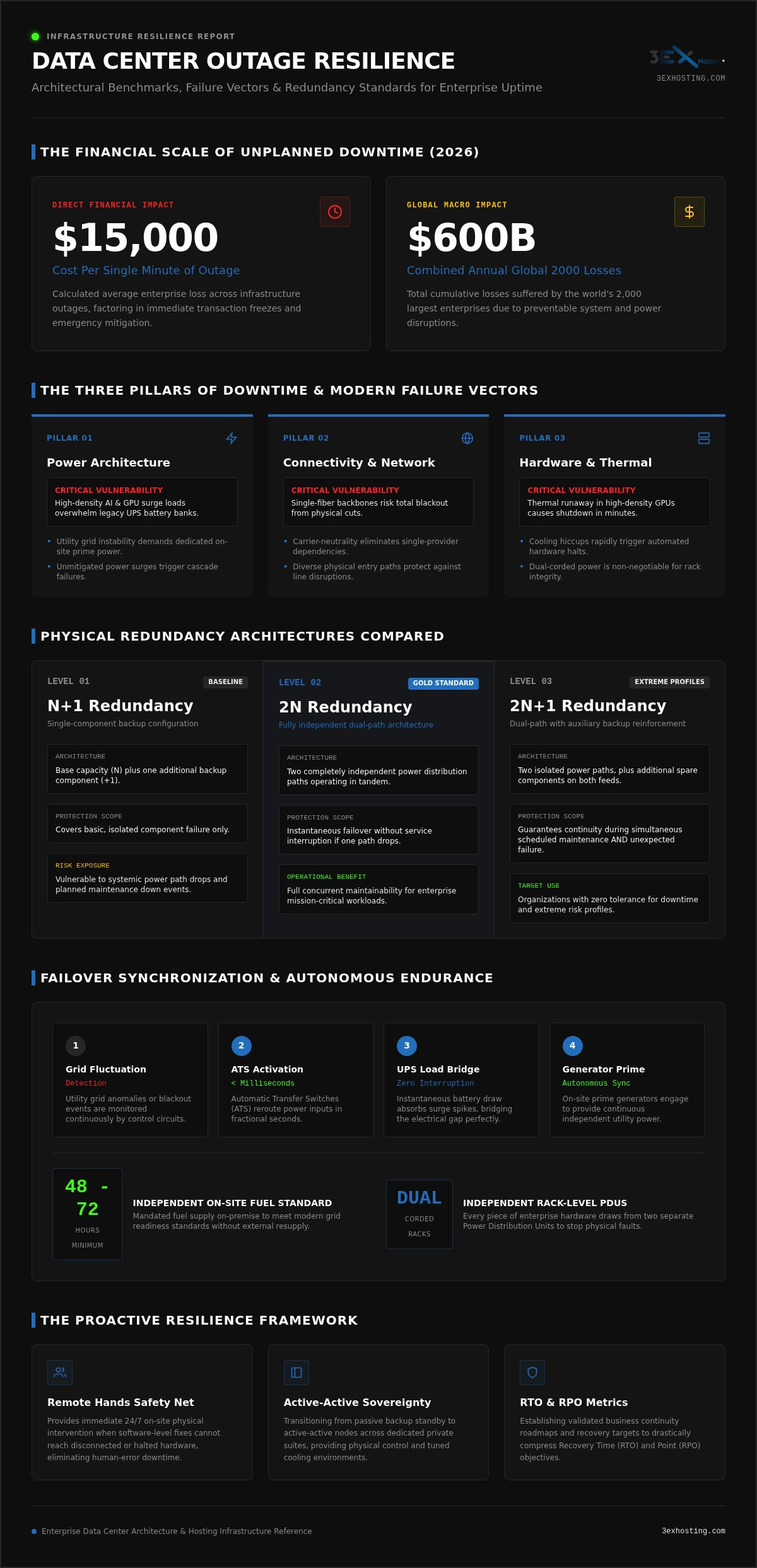
Did you know that an unplanned outage in 2026 costs the average enterprise $15,000 every single minute? For Global 2000 companies, these disruptions now represent a combined annual loss of $600 billion. Managing modern infrastructure feels like a constant battle against complexity, especially as high-density AI hardware pushes legacy cooling systems to their breaking point. You’re likely juggling multi-vendor failovers while worrying if your current disaster recovery protocols will actually hold up when the power grid fails. Protecting against data center outages isn’t just a technical goal anymore; it’s a fundamental requirement for business survival.
It’s stressful to manage these invisible risks, but you don’t have to leave your uptime to chance. This guide provides the multi-layered strategies you need to eliminate single points of failure and maintain 100% availability. We’ll explore a clear roadmap for infrastructure hardening, focusing on carrier-neutral connectivity and specialized cooling for high-density workloads. You’ll learn how to implement validated protocols that drastically reduce your RTO and RPO metrics. We’ll show you how the right combination of expert support and modern hardware ensures your operations remain stable, fast, and secure, no matter the external conditions.
Key Takeaways
- Understand why legacy power systems are insufficient for modern AI workloads and how to modernize your hardware resilience.
- Compare N+1 and 2N redundancy architectures to eliminate single points of failure in your power and cooling systems.
- Learn how carrier-neutral connectivity serves as a critical defense for protecting against data center outages caused by network disruptions.
- Establish a clear roadmap for disaster recovery by defining actionable RTO/RPO metrics and integrating managed cloud solutions.
- Utilize a professional audit checklist to validate a hosting partner’s infrastructure stability and service level agreements.
The Anatomy of a Modern Data Center Outage
Understanding a modern infrastructure failure requires looking at the three pillars of downtime: power, connectivity, and hardware. In 2026, the financial impact of these failures has reached critical levels. Research indicates the average cost of an unplanned outage is now $15,000 per minute. Protecting against data center outages is no longer a luxury for IT departments; it’s a requirement for enterprise survival. When one pillar fails, the entire stack is at risk.
Traditional Uninterruptible Power Supply (UPS) systems often fall short when facing 2026 power densities. High-density AI and GPU workloads demand massive, immediate draws that older battery technologies can’t always sustain. If your electrical architecture isn’t built for these specific surges, your backup plan might fail at the exact moment you need it most. Beyond the hardware, human error remains a significant factor in downtime. On-site expertise through Remote Hands serves as a vital safety net, allowing for immediate physical intervention when software-level fixes aren’t enough.
Primary Causes of Infrastructure Failure
Grid instability has become a common reality. Relying solely on the utility grid is a gamble that most enterprises can’t afford. Modern facilities must prioritize on-site prime power to bridge the gap during regional grid stress. Thermal runaway is another growing threat. High-density GPU clusters generate heat so rapidly that a minor cooling hiccup can lead to a total hardware shutdown in minutes. Finally, connectivity remains a major vulnerability. Facilities that rely on a single fiber path are susceptible to physical cuts that can isolate an entire enterprise. True resilience requires path diversity and carrier-neutrality to keep traffic flowing.
The Shift from Reactive to Proactive Resilience
Resilience in 2026 means moving beyond simple backups toward active-active configurations. You need systems that don’t just “fail over” but operate in a state of constant readiness. True data center sovereignty begins with private suites, which provide the physical control and dedicated environment necessary for specialized hardware. To evaluate your current position, you should audit your infrastructure against established data center tier standards. These tiers define the redundancy levels required to maintain 100% uptime. By reviewing the technical specifications of a modern data center, you can identify where your current strategy might be lacking. Proactive resilience is built on transparent SLAs and audit-ready business continuity plans that account for every potential failure point.
Hardening Physical Infrastructure: Redundancy Levels Explained
Protecting against data center outages requires a deep understanding of electrical and thermal architecture. Most facilities operate on N+1 redundancy, where a single extra component supports the system. While this covers basic component failure, it doesn’t protect against systemic issues. For mission-critical workloads, 2N redundancy is the gold standard for mission-critical uptime because it provides two entirely independent power paths. If one path fails, the second takes over instantly without interruption. For organizations with extreme risk profiles, 2N+1 adds an additional layer of backup to those dual paths, ensuring continuity even during concurrent maintenance and unexpected failures.
Dual-corded power is a non-negotiable standard for enterprise server hardware. This configuration ensures that every piece of equipment draws from two separate Power Distribution Units (PDUs). If a single power source or cable fails, the hardware continues to function on the secondary feed. Without this physical redundancy, even the most sophisticated software failovers can be rendered useless by a simple hardware fault. Protecting against data center outages starts at the rack level with these physical safeguards.
Power Redundancy: UPS and Generator Synchronization
Achieving seamless failover depends on the synchronization between UPS systems and on-site generators. Automatic Transfer Switches (ATS) detect grid fluctuations and transition the load to backup power in milliseconds. To meet modern grid readiness standards for data centers, facilities must maintain enough fuel for at least 48 to 72 hours of independent operation. Implementing full cabinet colocation allows enterprises to utilize metered power distribution, ensuring every server receives the dual-corded feed required for high availability. This level of control is essential for managing the volatile power draws common in 2026 enterprise environments.
Thermal Management for High-Density Loads
High-density infrastructure presents unique challenges that traditional cooling cannot solve. When racks exceed 30kW, localized hot spots can cause “micro-outages” that crash specific nodes while the rest of the room stays cool. Specialized AI infrastructure hosting requires advanced containment strategies or liquid cooling to manage these thermal loads effectively. While standard CRAC (Computer Room Air Conditioning) units work for legacy hardware, GPU hosting often necessitates rear-door heat exchangers or direct-to-chip liquid cooling. This precision prevents thermal runaway and extends the lifespan of expensive enterprise hardware. If you’re planning a deployment for high-performance computing, you can request a technical consultation to audit your redundancy requirements.
Eliminating Network Bottlenecks with Carrier Neutrality
Protecting against data center outages requires more than just backup generators; it demands network sovereignty. If your facility relies on a single ISP, a regional carrier failure becomes your failure. Carrier-neutral facilities eliminate this bottleneck by providing access to a vast ecosystem of providers. This diversity allows for multi-homed BGP (Border Gateway Protocol) routing, which automatically redirects traffic if one carrier goes dark. It’s a proactive layer of defense that ensures your services remain reachable even when a major backbone provider experiences a total blackout.
Beyond simple internet access, physical cross-connects allow you to bypass the public internet entirely for critical traffic. These direct cables provide a secure, high-performance link between your equipment and your partners or cloud providers. For a deeper dive into the financial and technical benefits, see our guide on Maximizing Network Performance with Cross-Connects. By controlling the physical path of your data, you remove the latency and security risks inherent in public routing. This physical-to-digital bridge is often the missing piece in most resilience strategies.
The Power of Cross-Connect Services
Establishing direct links to multiple providers significantly reduces the blast radius of any single carrier failure. If one provider suffers an outage, your cross-connects to other carriers keep your operations live. This is particularly effective in cage solutions, where you can manage complex inter-cabinet connectivity within a private, secure perimeter. Maintaining this level of control ensures that hardware remains resilient. It’s also vital to align these setups with the NIST Platform Firmware Resiliency Guidelines to ensure that even during network recovery, your underlying hardware remains secure and stable.
Redundant Pathing and Entry Points
Physical infrastructure must be as redundant as the logical routing. True resilience requires diverse fiber entry points into the facility. This protects your operation from the “backhoe fade,” a common scenario where construction crews accidentally sever a primary fiber line. If all your carriers enter through the same conduit, a single accident can isolate your entire infrastructure. High-density carrier hotels offer superior interconnection density, ensuring you have multiple physical paths to the global network. When you combine physical path diversity with carrier neutrality, you create a network architecture that’s virtually immune to localized provider failures. Protecting against data center outages is only possible when you eliminate every single point of failure in the network path.
Step-by-Step: Orchestrating a Disaster Recovery Plan
Orchestrating a resilient disaster recovery (DR) plan requires a shift from “if” to “when.” Protecting against data center outages starts with defining two critical metrics: Recovery Time Objective (RTO) and Recovery Point Objective (RPO). RTO measures how fast you need to be back online; RPO determines how much data loss your business can tolerate. A hybrid strategy often integrates managed cloud hosting as a secondary site, allowing for automated failover at both the hardware and application layers. To ensure these systems actually work, you must perform quarterly “chaos testing.” Conduct a controlled, unannounced shutdown of a primary production node to verify that your failover triggers correctly within your defined SLA.
Failover automation should be layered. At the hardware level, this might involve intelligent PDUs that switch power sources automatically. At the application layer, load balancers must be configured to detect health check failures and reroute traffic instantly. Without these automated triggers, your RTO will depend entirely on how fast a human can log in and fix the issue. Protecting against data center outages is most effective when the system can heal itself before an administrator even receives an alert.
Data Replication and Off-Site Backups
Enterprise data resilience relies on robust replication. Synchronous replication offers zero data loss but requires high-speed links and introduces latency. Asynchronous replication is often more practical for long-distance DR, providing near-instant updates without bottlenecking performance. You should apply the 3-2-1 backup rule: keep three copies of your data on two different media types, with at least one copy stored off-site. Integrating professional disaster recovery solutions ensures your off-site copy is physically secure and ready for immediate restoration.
Human Intervention: The Role of Remote Hands
Software automation is powerful, but physical infrastructure occasionally requires a human touch. During regional emergencies, your local team might be unable to reach the facility. This is where 24/7 on-site remote hands support becomes a critical safety net. These experts handle physical reboots, cable swaps, and hardware inspections when you can’t be there. Relying on a facility with dedicated on-site staff ensures that business continuity remains possible even when the digital layer is unresponsive. If you’re ready to harden your infrastructure against unplanned downtime, contact our engineering team for a custom disaster recovery assessment.
The Strategic Choice: Selecting a Resilient Hosting Partner
Choosing a colocation provider is the final, most critical step in your resilience strategy. Protecting against data center outages requires a partner who treats uptime as a managed service rather than a passive hardware feature. When you audit a potential facility, don’t just look at the generators. Evaluate their carrier-neutral status, the response time of their 24/7 Remote Hands, and their historical uptime transparency. A resilient partner provides more than just space; they offer a secure foundation where enterprise hardware and managed cloud hosting work together to eliminate single points of failure.
Future-proofing is equally vital. As AI workloads increase power densities toward 30kW per rack and beyond, your provider must have a clear roadmap for advanced thermal management. An outdated facility might support your current needs but fail when you scale your AI infrastructure. A truly resilient partner is already prepared for these high-density requirements, ensuring your hardware remains stable through the next generation of computing demands.
Infrastructure Sovereignty through Private Suites
For enterprises requiring total control, private suites offer the highest level of infrastructure sovereignty. These environments allow you to customize power and cooling at the suite level, ensuring your specific hardware configurations receive optimal support. Physical security acts as a critical deterrent for logic-based outages by preventing unauthorized access to your physical stack. Scaling within enterprise private suites provides the predictable environment necessary for long-term stability and compliance.
Next Steps: Securing Your Infrastructure
Protecting against data center outages begins with a thorough gap analysis of your current hosting environment. Identify where your current provider lacks carrier diversity or falls short on power redundancy. Once you’ve identified these vulnerabilities, transitioning to a hardened facility is the next logical step. You can request a move-in assistance consultation to streamline the migration process without risking downtime. When you’re ready to secure your mission-critical operations, get a custom quote for resilient colocation and start building your roadmap to 100% uptime.
Future-Proofing Your Infrastructure for Total Resilience
Maintaining 100% uptime requires a foundation that handles high-density AI workloads and network volatility without compromise. You’ve seen that true resilience comes from combining physical redundancy with carrier-neutral diversity. Protecting against data center outages is an ongoing commitment to eliminating single points of failure across your entire stack. By focusing on infrastructure sovereignty, you ensure that your operations remain stable and fast, regardless of grid instability or carrier disruptions.
3EX Hosting provides the specialized AI/GPU infrastructure and carrier-neutral carrier hotel access required for modern enterprise demands. Our 24/7 Remote Hands support serves as your human failover, providing immediate physical intervention when your digital layers face challenges. We don’t just offer space; we provide a technical environment designed for maximum availability and performance. Your enterprise deserves a partner that understands the technical complexities of 2026 and works magisterially in the background to keep you online. It’s time to harden your systems and secure your business continuity. Request a Quote for Enterprise Resilience today and let’s build a roadmap to permanent uptime.
Frequently Asked Questions
What is the difference between N+1 and 2N redundancy in a data center?
N+1 provides a single backup component for the whole system, while 2N offers two completely independent power or cooling paths. If a primary system fails, 2N ensures the secondary takes over without sharing any single point of failure. This distinction is vital for protecting against data center outages in mission-critical environments. 2N is generally considered the gold standard for enterprise stability because it allows for concurrent maintenance without disrupting the load.
How does carrier neutrality help protect against network outages?
Carrier neutrality allows you to connect with multiple independent internet service providers within the same facility. If one provider suffers a backbone failure or fiber cut, your traffic automatically reroutes through another carrier using BGP protocols. This eliminates the “blast radius” of a single ISP outage. Relying on a carrier-neutral provider ensures your network path isn’t tied to the fate of a single vendor, providing a critical layer of infrastructure sovereignty.
Can high-density GPU hosting cause localized data center outages?
Yes, high-density GPU hosting can cause localized “micro-outages” if thermal management isn’t handled correctly. These clusters generate extreme heat that can overwhelm traditional air-cooled systems, leading to thermal runaway. When a specific rack exceeds its cooling capacity, the hardware may shut down to prevent damage even if the rest of the facility remains functional. Specialized containment or liquid cooling is required to prevent these localized failures in high-performance computing environments.
What are Remote Hands, and how do they help during an outage?
Remote Hands are on-site technical experts who perform physical tasks on your hardware at the data center. They handle reboots, cable swaps, and component replacements when your internal team isn’t physically present. During a regional emergency or network failure, these professionals provide the immediate physical intervention needed to restore services. Having 24/7 Remote Hands support ensures that physical hardware issues don’t turn into prolonged outages just because your staff can’t reach the facility.
How often should an enterprise test its disaster recovery failover?
Enterprises should conduct “chaos testing” on their disaster recovery failover systems at least quarterly. Annual testing is often insufficient because infrastructure and application layers change frequently. Regular testing involves controlled, unannounced shutdowns of production nodes to verify that automated failover triggers correctly. This practice ensures that your Recovery Time Objective (RTO) and Recovery Point Objective (RPO) metrics remain valid as your enterprise landscape evolves and your hardware scales.
Is managed cloud hosting safer than on-premise infrastructure for outages?
Managed cloud hosting is generally more resilient than on-premise infrastructure because it leverages professional-grade redundancy that most offices can’t replicate. Cloud environments are built on N+1 or 2N architectures with 24/7 monitoring and dedicated cooling. On-premise setups often lack backup power or redundant fiber entry points, making them vulnerable to localized grid failures. Moving to a professional facility provides the hardened physical layer necessary for protecting against data center outages and maintaining 100% uptime.
What is a carrier hotel, and why is it more resilient?
A carrier hotel is a specialized data center with an extremely high density of network providers and interconnection points. These facilities are more resilient because they feature multiple diverse fiber entry points and redundant meet-me rooms. If a physical fiber cut occurs on one side of the building, traffic continues through paths on the other side. This density of cross-connect options makes carrier hotels the ultimate tool for network failover and low-latency performance.
How does metered power help prevent circuit overloads in a full cabinet?
Metered power distribution units (PDUs) provide real-time monitoring of the electrical draw within a full cabinet. By tracking exactly how much energy each server consumes, you can identify power spikes before they trip a circuit breaker. This data allows administrators to balance loads effectively and prevent accidental overloads caused by high-density hardware. It’s a proactive measure that ensures your electrical architecture remains stable even as you add more power-hungry GPU or AI servers.