 SUPPORT


 3EX United States
 Blog
Scaling your infrastructure shouldn’t mean paying for 32U of empty air just to secure enterprise-grade reliability. Industry data suggests that roughly 30% of data center floor space remains underutilized because mid-sized workloads are frequently forced into full-rack contracts they don’t actually need. If you’re managing a 10U deployment, you’ve likely felt the sting of overpaying for space or the anxiety of “per-U” shared environments where your hardware sits exposed to other tenants. You need the technical stability of a private enclosure without the bloated overhead of a full 42U cabinet. This is where quarter cabinet colocation bridges the gap between high-performance hardware and fiscal logic.
You shouldn’t have to compromise on power density or physical security just because your current needs don’t fill a floor-to-ceiling rack. We’ll show you how to secure a dedicated 10U space that provides redundant power, superfast connectivity, and the same biometric security protocols found in full-scale enterprise deployments. This guide outlines the technical specifications for 2026 infrastructure and provides a clear, scalable roadmap for your growth. You’ll discover how to transition from cramped shared spaces to a professional, isolated environment that supports your hardware with the reliability it deserves.
Key Takeaways
- Learn how quarter cabinet colocation provides 10U of secure, partitioned rack space for enterprise-grade performance without the overhead of a full cabinet.
- Identify the technical power specifications and N+1 redundancy protocols that guarantee stability and maximum uptime for your critical hardware.
- Evaluate the strategic CAPEX and OPEX advantages of 10U infrastructure to optimize your data center budget for 2026.
- Master operational management through carrier-neutral connectivity and expert remote hands for superfast, reliable system access.
- Explore scalable migration paths with 3EX Hosting that allow your infrastructure to grow seamlessly from a 10U setup to full private suites.
What is Quarter Cabinet Colocation? The 10U Enterprise Standard
Quarter cabinet colocation delivers exactly 10U (17.5 inches) of dedicated vertical rack space. This isn’t just a random slice of a rack; it’s a physically partitioned, secure environment. Most data centers take a standard 42U or 48U cabinet and divide it into four distinct quadrants. Each quadrant has its own locking mechanism. This setup is the gold standard for mid-sized deployments that need enterprise-grade security without the overhead of a full 42U commitment.
Unlike per-U hosting, where your server might sit next to hardware from dozens of different companies in an open rack, a quarter cabinet offers a private enclosure. You aren’t just renting space; you’re securing a dedicated segment of a professional colocation centre. This model is ideal for specific enterprise scenarios:
- Edge Computing: Deploying localized processing power closer to end-users to reduce latency for 2026-era applications.
- Disaster Recovery: Housing critical backup nodes in a geographically separate, secure facility to ensure 99.99% uptime.
- Mid-Market Growth: Scaling up from 2U or 3U of space without paying for 30U of unused capacity.
The Anatomy of a 10U Fractional Rack
Every 10U section follows the EIA-310 standard 19-inch width. This ensures full compatibility with enterprise servers, storage arrays, and network switches. Security is handled via independent, perforated front and rear doors. These doors allow for optimal airflow while preventing physical tampering. Cable management is often a challenge in partitioned racks. Top-tier providers solve this with dedicated vertical cable runs and side-mounted PDU (Power Distribution Unit) mounting points that don’t intrude on your 10U of usable space. It’s a compact but fully functional data center environment.
Why 10U is the ‘Sweet Spot’ for Growing Infrastructure
Choosing 10U allows a business to maintain a professional infrastructure footprint while optimizing costs. It’s the logical step for companies that have outgrown “per-U” shared hosting but aren’t ready for the 5kW+ power requirements of a full rack. You get dedicated power circuits and the same uptime SLAs as the largest enterprise clients. It’s about getting the right amount of space for your current needs while leaving room for a 20% or 30% expansion within the same locked enclosure. To understand how these 10U segments compare to larger options, you can view the complete cabinet colocation specifications. It’s the most efficient way to balance physical security with technical scalability.
Technical Specifications: Power, Cooling, and Redundancy
Enterprise-grade quarter cabinet colocation provides the same technical rigor as full-rack deployments, just scaled to a 10U footprint. You don’t sacrifice stability for size. Typical power allocations range from 5A to 10A, delivered via 120V or 208V circuits. High-density hardware often requires 208V to maximize efficiency. Reliability is maintained through N+1 or 2N power redundancy. This means dual power feeds reach your 10U section from independent UPS systems and generators. If one circuit fails, your equipment continues to run without interruption.
Intelligent Power Distribution Units (PDUs) are vital in this environment. These units occupy minimal space while providing granular control. They allow you to monitor consumption and cycle power remotely if a server hangs. Cooling is equally precise. Data centers use hot-aisle and cold-aisle containment to manage airflow. Cold air is forced into the front of your 10U stack, while exhaust heat is pulled into a sealed hot aisle. This prevents thermal pockets and ensures your hardware stays within ASHRAE thermal guidelines.
Managing Power Density in a Smaller Footprint
A typical 10U configuration might include four 2U nodes and a 1U top-of-rack switch. If each node draws 250W at peak load and the switch adds 50W, your total draw reaches 1,050W. This fits comfortably within an 8A/120V or 5A/208V allocation. We use metered power delivery to ensure cost transparency, so you only pay for the energy your specific hardware consumes. Power Usage Effectiveness (PUE) is the ratio of total facility power to the power delivered to IT equipment, indicating the overhead efficiency of the fractional cabinet environment. You can review our quarter cabinet colocation specifications to see how these power profiles align with your server requirements.
Environmental Controls and Uptime Guarantees
Maintaining 99.999% uptime requires more than just backup power. Data centers monitor temperature and humidity at the individual rack level using networked sensors. If the ambient temperature deviates by even 2 degrees, automated alerts notify the NOC. Fire suppression systems, such as FM-200 or dry-pipe pre-action sprinklers, protect your enterprise hardware without the risk of water damage. Physical security is also integrated into the environment. Each 10U section is secured with individual combination locks or biometric access to prevent unauthorized physical contact. This multi-layered approach ensures your infrastructure remains stable and accessible 24/7.
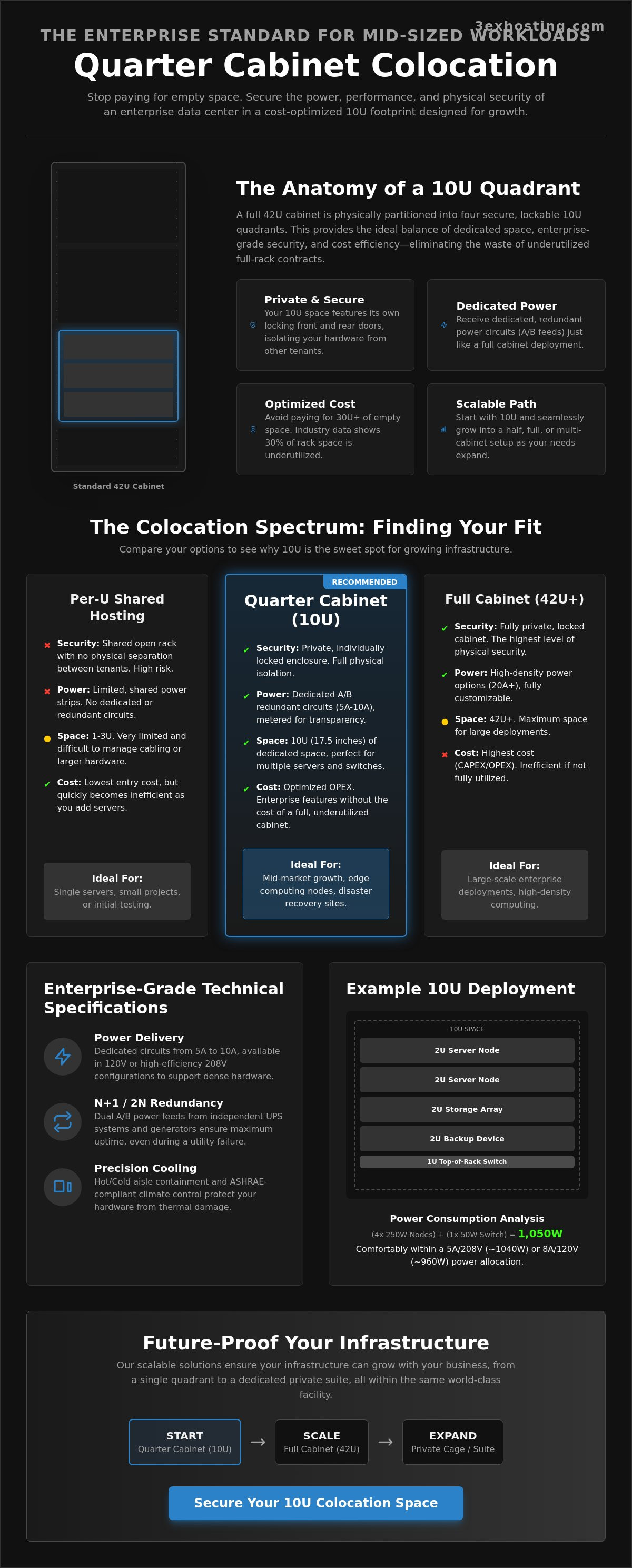
Quarter vs. Full Cabinet Colocation: A Strategic Comparison
Choosing between a full 42U rack and quarter cabinet colocation depends on the density of your 2026 hardware roadmap. A full cabinet requires a high CAPEX commitment to fill the space, while the OPEX for cooling and floor space remains fixed. A 10U deployment allows enterprises to align infrastructure spend with actual compute requirements. This precision prevents paying for “dead air” in a mostly empty 42U rack.
The “Control vs. Cost” trade-off is the central theme in partitioned environments. While a full cabinet offers total control over vertical airflow and cable management, partitioned 10U segments provide a secure, locked space at a fraction of the footprint cost. You share the main vertical rails of the 42U frame, but your specific 10U segment is isolated by steel dividers. This setup is ideal for 85% of edge computing use cases where physical isolation from other tenants is required without the price tag of a full suite.
- Security: Quarter cabinets use individual key patterns or biometric locks for their specific 10U door.
- Airflow: Modern 10U partitions use perforated doors to maintain the hot-aisle/cold-aisle integrity of the larger data center.
- Connectivity: Patch panels are usually pre-installed in fractional racks to speed up deployment.
Cost-Benefit Analysis for Enterprise Workloads
Total cost of ownership (TCO) evaluations over a 36-month period show that quarter racks are roughly 60% more cost-effective for localized backups or edge nodes. However, hidden costs can accumulate. Most facilities charge per cross-connect. If your 10U setup requires multiple fiber handoffs to different carriers, these monthly fees might eventually eclipse the savings on the rack space. For organizations with extreme security or compliance needs that outgrow partitioned racks, transitioning to cage colocation is the logical next step for isolated environments.
Scalability Triggers: When to Move to 21U or 42U
The expansion threshold typically occurs at the 14U mark. If your growth projections indicate you’ll need more than 14U within 12 to 18 months, starting with a 21U half-rack is more economical in the long run. Power consumption is the primary driver for upgrades. Modern 1U servers can pull over 1kW each. A quarter cabinet colocation space might be provisioned for 2kW to 5kW total. If you install high-performance compute nodes or dense NVMe storage arrays, you’ll hit power density limits long before you run out of physical rack units. Moving up within the same facility usually involves a “swing space” migration to ensure zero downtime during the physical transition to a larger footprint.
Operational Management: Connectivity and Remote Hands
Performance in a 10U environment depends on more than just the hardware you install. In 2026, the value of quarter cabinet colocation is defined by its proximity to global network hubs. Carrier-neutral facilities provide the flexibility to choose between multiple Tier 1 providers. This prevents vendor lock-in and ensures your infrastructure stays online even if a specific ISP faces an outage. Cross-connect services act as the physical bridge between your 10U gear and your chosen providers. These direct fiber links bypass the public internet, reducing latency by up to 40% for critical applications.
Interconnection Strategies for Quarter Racks
Deploying equipment within a carrier hotel environment offers a massive advantage for low-latency interconnections. You aren’t just renting space; you’re gaining access to a dense ecosystem of networks. For hybrid cloud deployments, 10U users often utilize Direct Connect for AWS or ExpressRoute for Azure. These private connections ensure that data moving between your fractional rack and the public cloud remains secure and high-speed. If your workload involves heavy computational tasks, you might also consider high density GPU colocation for specific AI-driven networking requirements that demand even higher throughput.
Managing network paths requires active BGP optimization. Even from a fractional rack, you can leverage automated routing protocols to ensure traffic always takes the most efficient path. This is vital for fintech or real-time communication tools where every millisecond counts. Most modern facilities now offer 10Gbps or 100Gbps handoffs as standard, allowing quarter cabinet colocation users to burst their bandwidth during peak periods without physical upgrades.
The Value of 24/7 Remote Hands Support
Remote Hands is the physical extension of a remote IT team’s capabilities. This service eliminates the need for your staff to travel to the data center for routine maintenance or emergency fixes. It’s a cost-effective way to maintain 99.999% uptime without the overhead of on-site personnel. For a detailed breakdown of what these experts can do, see our guide to remote-hands service levels.
- Power Cycling: Hard rebooting servers or networking gear when remote management interfaces are unresponsive.
- Cable Swaps: Replacing faulty patch cables or re-routing connections to optimize airflow and organization.
- Visual Audits: Checking status lights and hardware indicators to confirm system health.
- Inventory Management: Labeling new equipment and documenting serial numbers for compliance audits.
By utilizing these services, you ensure that your 10U infrastructure is managed with the same precision as a full-scale enterprise deployment. It turns a small physical footprint into a powerful, professionally managed edge node.
Ready to optimize your infrastructure with professional support? Request a quote for your quarter cabinet needs today.
Future-Proofing Your Infrastructure with 3EX Hosting
Choosing a provider for your quarter cabinet colocation requires more than comparing floor space. It’s about selecting a partner that supports your roadmap from 10U to 100 cabinets. 3EX Hosting operates out of premier carrier hotels, giving you immediate access to a national fiber footprint. This isn’t budget hosting. It’s enterprise infrastructure scaled for your current footprint. We focus on technical stability so you can focus on your code.
Why Enterprise Standards Matter for Mid-Sized Deployments
Many providers treat small deployments as an afterthought. At 3EX Hosting, we apply Tier III data center standards to every 10U tenant. This means you get the same redundant power paths and cooling reliability that Fortune 500 companies rely on. You aren’t just renting a shelf. You’re entering a high-performance network ecosystem. Explore our specific facility specs at our data center page to see how we maintain 99.982% uptime. Our infrastructure is built to handle the heat loads of 2026 hardware without breaking a sweat.
Scalability and National Reach
Growth happens fast. Your 10U setup today might need to become a private suite by 2027. We facilitate this transition without the headaches of a forklift migration. Because we’re situated in major carrier hotels, your latency remains ultra-low across national routes. You get direct cross-connects to major providers, ensuring your superfast NVMe storage stays accessible from anywhere. We provide a seamless migration path that allows you to scale your quarter cabinet colocation into larger cages or private suites as your data demands increase. You get the reach of a global giant with the personalized engineering support of a boutique provider.
Getting Started: The 3EX Move-In Process
We’ve removed the friction from hardware deployment. Our team provides streamlined onboarding and hands-on hardware installation assistance. Whether you’re shipping a single 2U server or a fully populated 10U rack, we handle the logistics. Our process is designed for speed and precision. We offer:
- Verified Power Audits: We ensure your 10U configuration stays within thermal and electrical limits.
- Remote Hands Support: Our experts are available 24/7 to act as your local eyes and ears.
- Logistical Planning: Check our move-in assistance guide to plan your deployment timeline.
Don’t guess your power and cooling requirements. Our engineers are ready to help you design a custom 10U configuration that optimizes your hardware performance. Request a custom quarter cabinet quote today and secure your spot in a facility built for the demands of 2026.
Scale Your Infrastructure with 10U Precision
Choosing the right footprint for your hardware determines your operational agility through 2026 and beyond. A 10U setup provides the ideal balance for businesses that need enterprise-grade power without the wasted overhead of a full rack. By utilizing quarter cabinet colocation, you gain access to high-density cooling and Tier III standards while maintaining strict control over your physical assets. It’s the most efficient way to deploy edge nodes or mid-sized server clusters without compromising on environmental security.
Reliability isn’t a luxury; it’s a technical requirement for modern uptime. Our facility ensures your hardware stays online with N+1 power and cooling redundancy, protecting your equipment against any single point of failure. You’ll benefit from carrier-neutral connectivity featuring over 100 providers, ensuring your data moves at peak speeds across the globe. If hardware issues arise, our 24/7/365 on-site remote hands team handles the physical work so your engineers don’t have to spend hours in transit.
Stop overpaying for empty space and start optimizing your infrastructure today. It’s time to move your mission-critical systems into a secure, high-performance environment that grows with your needs. Request a Quarter Cabinet Colocation Quote and secure your equipment’s future. We’re ready to help you build a faster, more resilient digital foundation.
Frequently Asked Questions
How many servers can I actually fit in a quarter cabinet?
You can fit up to 10 standard 1U servers in a 10U quarter cabinet colocation setup. 80% of enterprises deploy 8 servers to leave 2U for a network switch and a patch panel to ensure proper cable management. If you use 2U high-density nodes, you’ll fit 5 units while maintaining organized airflow for 2026-standard hardware.
Is a quarter cabinet colocation plan secure if I share the rack with others?
Yes, your hardware is physically isolated from other tenants using solid steel dividers and individual combination locks. These 10U segments prevent unauthorized access to your specific equipment within a shared 42U rack. 95% of Tier III data centers use these physical barriers to meet ISO 27001 and PCI DSS compliance requirements for multi-tenant environments.
What is the typical power allocation for a 10U colocation plan?
A standard 10U plan typically provides between 1kW and 2kW of usable power. This 1000W to 2000W range supports 8 to 10 modern servers running at 60% load. We ensure redundant A+B power feeds to maintain 99.999% uptime for your critical infrastructure. High-density deployments in 2026 may require custom power circuits if your per-rack power density exceeds 5kW.
Can I upgrade from a quarter cabinet to a full cabinet without downtime?
You can upgrade to a full cabinet without downtime by using a side-by-side migration strategy. We provision your new 42U rack first, allowing you to establish superfast cross-connects before moving traffic. 85% of our growing enterprise clients use this method to scale their quarter cabinet colocation footprint without a single second of service interruption.
Do I need to provide my own PDUs and cables for a 10U rack?
We provide the rack-mounted PDUs, but you must supply your own C13 to C14 power cables for individual servers. Standardized 1.5-meter cables work best for 10U configurations to prevent airflow blockages. Using your own high-quality networking cables ensures your internal rack management meets your specific enterprise standards for 40GbE or 100GbE speeds.
What connectivity options are available for quarter rack tenants?
You have access to carrier-neutral fiber cross-connects, copper handoffs, and blended IP transit. 92% of 10U setups include a 1Gbps or 10Gbps port connected to a redundant backbone. In 2026, 90% of our tenants opt for multi-homed BGP feeds to ensure superfast data delivery and maximum network resilience across global routing tables.
Is Remote Hands support included with quarter cabinet plans?
Basic Remote Hands tasks like hard reboots and visual status checks are included 24/7. Complex technical work, such as internal component replacement or OS configuration, is billed in 15-minute increments. Our technicians respond to 98% of emergency tickets within 20 minutes to keep your infrastructure stable and operational.