 SUPPORT


 3EX United States
 Blog
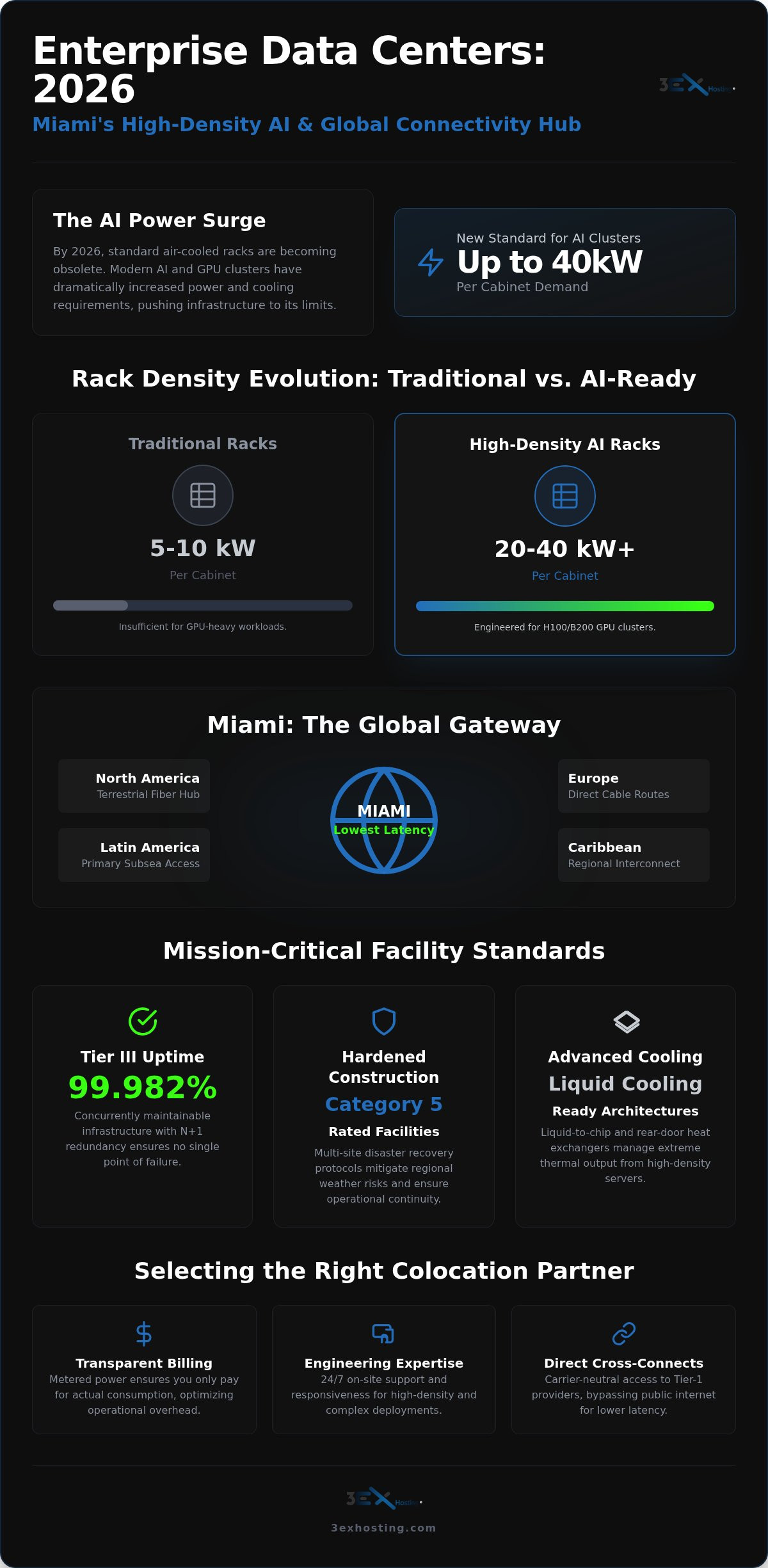
By 2026, standard air-cooled racks are becoming obsolete as modern AI clusters now demand up to 40kW per cabinet. You likely realize that traditional infrastructure can’t handle the intense power requirements or the heat generated by these GPU-heavy workloads. It’s frustrating when your hardware potential is throttled by a facility that wasn’t built for the future. Choosing the right enterprise data center Miami location is no longer just about floor space; it’s about securing a high-density hub that can scale with your most demanding projects.
We’ll show you how a strategically located enterprise data center serves as both a powerhouse for AI and a critical gateway for national and international connectivity. This article examines the strategic shift toward liquid cooling, the impact of evolving power regulations, and the robust disaster recovery protocols that keep global enterprises operational while maintaining low-latency global access. You’ll discover why advanced data center selection is the essential link for scalable AI infrastructure and global market reach.
Key Takeaways
- Understand the 2026 standard for Tier-III facilities designed to support mission-critical uptime and high-density power requirements.
- Learn how an enterprise data center Miami location provides the lowest latency for traffic moving between North America, LATAM, and Europe.
- Identify the necessity of Category 5 hardened construction and multi-site disaster recovery protocols to mitigate regional weather risks.
- Discover how transparent metered billing and direct cross-connects reduce operational overhead for AI and GPU-intensive clusters.
- Evaluate colocation partners based on their engineering responsiveness and ability to support rack densities exceeding 20kW.
What Defines an Enterprise Data Center in Miami in 2026?
By 2026, an enterprise data center is defined by its ability to maintain seamless operations under extreme computational loads. In Miami, this means moving beyond simple rack space to provide high-density power environments capable of supporting AI and GPU clusters. These facilities aren’t just regional storage sites; they’ve evolved into strategic national interconnection points. An enterprise data center Miami must offer N+1 redundancy at every level, from power distribution to cooling systems, ensuring that a single component failure doesn’t disrupt the entire environment.
National and global enterprises are choosing Miami as their primary gateway because of its unique geographic and technical advantages. A true enterprise-grade facility here requires 24/7 on-site expertise and carrier neutrality to ensure diverse pathing. This shift toward high-performance infrastructure is driven by the need for low-latency access to international markets while maintaining a secure, domestic base of operations. Reliability is no longer an option; it’s the baseline for any mission-critical deployment.
The Evolution of the Miami Carrier Hotel
Miami’s geographic position makes it the landing point for numerous subsea cables connecting North America to the Caribbean, Latin America, and Europe. This has transformed local infrastructure into a network of carrier hotels. 3EX Hosting functions as a central hub in this architecture, providing direct access to multiple Tier-1 providers. Being at this intersection of terrestrial fiber and undersea lines allows businesses to bypass the public internet, reducing latency and increasing security for global data transfers. It’s a strategic advantage that turns a local presence into a global reach.
Tier III Standards and Mission-Critical Uptime
For enterprise operations, anything less than 99.982% uptime is a liability. Tier III standards require concurrently maintainable infrastructure where any part can be removed for service without impacting the IT load. This involves redundant power paths and dual-cooled systems that operate independently to prevent thermal runaway. In the context of 2026 infrastructure, a Tier III standard defines a facility that achieves 99.982% uptime through concurrently maintainable systems, ensuring that no single component failure or planned maintenance window disrupts the critical IT load. This level of stability provides the peace of mind that your data remains accessible, regardless of maintenance schedules or external hardware failures.
Choosing an enterprise data center Miami involves verifying these technical benchmarks. You need to know that the facility can handle the power density of modern hardware while offering the connectivity required for global competition. The integration of 24/7 remote hands support further ensures that technical issues are resolved immediately, keeping your focus on business growth rather than infrastructure management.
High-Density Infrastructure: Powering AI and GPU Colocation
Modern AI workloads have shifted the baseline for infrastructure requirements. Traditional racks designed for 5kW to 10kW are no longer sufficient for H100 or B200 GPU clusters. A premier enterprise data center Miami must now support densities of 20kW to 40kW per cabinet to remain competitive. This transition requires more than just extra plugs. It necessitates specialized power distribution units and reinforced floor loading to accommodate the significant weight of high-density server chassis used in machine learning and data science.
Heat management is the primary hurdle in a subtropical environment. High-performance computing (HPC) generates massive thermal output that traditional air cooling often struggles to dissipate. We focus on optimized Power Usage Effectiveness (PUE) to keep operational costs predictable and sustainable. Metered power billing ensures you only pay for actual consumption, which is vital for managing the variable loads of AI training cycles. Maintaining this performance requires a stable environment, often supported by a comprehensive Disaster Recovery Framework for Florida to protect against regional weather disruptions and ensure continuous uptime.
GPU-Ready Power and Cooling Architectures
Air cooling remains viable for many configurations, but liquid-to-chip and rear-door heat exchangers are the 2026 standard for ultra-high-density deployments. These systems manage the thermal envelope by moving heat away from processors more effectively than fans alone. Precision is key here. If your cooling fails, your hardware throttles, and your project timelines slip. Explore our detailed breakdown on Optimizing High-Density GPU Colocation to see how we handle these specific engineering challenges for AI infrastructure.
Scalability from Full Cabinets to Private Suites
Growth in the AI sector is rarely linear. You might start with a few racks but quickly require private colocation suites as your compute needs expand. These suites offer the flexibility to customize your layout and establish dedicated cooling zones. For enterprises prioritizing physical security and hardware isolation, Cage Colocation provides a segregated area within the data center. This allows for bespoke hardware configurations and restricted access protocols tailored to your internal security requirements. If you’re ready to scale your AI infrastructure, get a custom quote tailored to your specific power requirements.
Connectivity and Low-Latency: The Gateway Advantage
Miami serves as the primary low-latency gateway connecting North America to Latin America and Europe. This geographic positioning isn’t just a matter of convenience; it’s a structural necessity for global enterprises. An enterprise data center Miami facility provides the Gateway Advantage by serving as the landing point for massive subsea cable networks. By hosting infrastructure here, you reduce the hop count for data traveling between continents. This directly improves application performance for both national and international users.
Carrier neutrality is a core requirement for a high-performance enterprise data center Miami. Accessing diverse fiber providers ensures you don’t face vendor lock-in and can maintain redundant paths for mission-critical traffic. This diversity allows your network engineers to optimize routing based on cost, speed, or reliability. By avoiding a single-carrier bottleneck, you gain the flexibility to pivot as market conditions or network performance metrics change across the globe.
Cross-Connect Services and Peering
Direct physical cross-connects offer a level of performance that public internet routing simply cannot match. In a professional colocation environment, these interconnections happen over dedicated fiber within the same building. This setup eliminates the unpredictability of the open web, providing stable, sub-millisecond latency. For financial services and SaaS firms, the economics of these interconnections are clear. Reducing the time it takes for a packet to reach its destination can translate to significant competitive advantages. Strategic use of Miami internet exchange points (IXPs) further enhances this by allowing direct peering with major content providers and ISPs, keeping local traffic local and high-speed.
Managed Cloud and Hybrid Integration
Modern infrastructure rarely exists in a vacuum. Most enterprises now utilize a hybrid model that bridges physical hardware with managed cloud hosting environments. Direct on-ramps to major hyperscale providers from a Miami base allow for secure, high-bandwidth transfers between your private racks and the public cloud. This integration ensures that your sensitive data remains on your own servers while you leverage the cloud for elastic workloads. Managing these complex hybrid setups requires expert technical support. Our Remote Hands team provides the on-site expertise needed to handle physical patches, hardware audits, and troubleshooting without requiring your staff to be physically present. This combination of global connectivity and local support creates a robust foundation for any scalable digital operation.
Disaster Recovery Framework for Florida-Based Infrastructure
Florida infrastructure requires a specific engineering approach to handle the regional climate. An enterprise data center Miami must prioritize Category 5 hardening to withstand wind speeds exceeding 157 mph. This isn’t just about the roof. It involves the entire structural envelope, including impact-resistant glass and reinforced concrete. Flood mitigation is equally critical. Facilities should be located outside of high-risk flood zones and feature raised floor designs that protect mission-critical hardware from water ingress during extreme weather events.
Reliability comes from N+1 redundancy. This ensures every critical system has an active backup. If a generator fails during a utility outage, another is ready to take the load immediately. We maintain on-site fuel reserves that can power the entire facility for several days without external resupply. This level of preparation turns Miami into a viable primary or secondary node for a national multi-site disaster recovery strategy. Choosing an enterprise data center Miami with proven disaster recovery protocols ensures your data remains accessible when other regional sites might fail.
Resilience Auditing for Enterprise Racks
Enterprises must look beyond the brochure and audit the actual resilience of their rack space. A standard audit should follow these steps:
- Step 1: Verify fuel reserves and generator testing schedules. Generators should be tested under load regularly to ensure they perform during a real outage.
- Step 2: Audit physical security layers. This includes biometrics, man-traps, and 24/7 surveillance to prevent unauthorized physical access to your hardware.
- Step 3: Test network failover and BGP routing redundancy. Your network should automatically re-route traffic if a primary fiber path is severed.
Business Continuity and Remote Hands
During travel restrictions or emergency events, your internal IT team might not be able to reach the facility. This is where remote hands support becomes essential for business continuity. On-site staff act as your eyes and ears, performing physical reboots, cable swaps, and hardware audits on your behalf. This 24/7 technical presence ensures that your infrastructure is never truly unattended. The true ROI of on-site technical expertise is measured in the minutes of uptime preserved when physical access is impossible for your internal team. If you need to secure your infrastructure against the unexpected, request a quote for our disaster recovery solutions.
Selecting the Right Colocation Partner in Miami
Choosing an enterprise data center Miami requires balancing raw capacity with operational agility. Many large-scale providers offer massive footprints but lack the engineering responsiveness needed during a critical deployment or hardware failure. You need a partner that understands the nuances of high-density AI workloads while providing direct access to the technicians managing the floor. Large providers often treat clients as ticket numbers in a global queue. In contrast, a responsive partner provides immediate access to senior engineers who understand your specific rack configuration. This direct communication line is essential when troubleshooting complex network pathing or power distribution issues in real-time. 3EX Hosting bridges this gap by offering the power of a carrier hotel with the personalized attention of a specialized provider.
Budgeting for enterprise infrastructure in 2026 demands precision. Transparent metered power billing is a non-negotiable requirement for modern budgets. It ensures you only pay for the energy your GPU clusters actually consume, rather than being locked into flat-rate estimates that favor the provider. Logistical support is another key differentiator. For national IT teams, Move-In Assistance simplifies the transition by handling the physical unboxing, racking, and cabling of expensive hardware. Our team handles the heavy lifting, from inventory management to professional cable dressing. This ensures your deployment is clean, labeled, and ready for remote management from day one. It eliminates the risks associated with third-party moving services that don’t understand the fragility of enterprise-grade hardware.
Customization vs. Commodity Colocation
Hyperscale facilities often impose rigid contracts that don’t account for the unique needs of a growing enterprise. In contrast, flexible cabinet colocation agreements allow you to scale your footprint as your compute requirements evolve. This flexibility is vital for compliance-heavy industries like healthcare or finance. Custom cage designs ensure that your infrastructure meets specific HIPAA or PCI-DSS physical security requirements. You gain a segregated, secure environment tailored to your specific hardware footprint rather than a one-size-fits-all solution. This level of customization ensures that your physical security protocols align perfectly with your internal corporate governance standards.
Next Steps for Your Infrastructure Strategy
Initiating a partnership starts with a thorough technical audit. You can conduct a remote tour to inspect the facility’s physical security layers and cooling architectures without leaving your office. Request a detailed power and cooling assessment to ensure the environment can handle your specific AI or GPU loads over the long term. This data-driven approach removes the guesswork from your deployment strategy and provides a clear roadmap for future expansion. If you’re ready to secure your position in a premier enterprise data center Miami, get a custom quote for your Miami enterprise infrastructure today. Our engineers are ready to review your specifications and build a solution that meets your performance and security requirements.
Future-Proof Your Infrastructure in Miami
Miami has evolved into a critical national interconnection point, moving far beyond its role as a regional storage hub. High-density AI workloads and GPU clusters now demand the specialized power and cooling architectures that only a top-tier enterprise data center Miami can provide. By positioning your hardware at this global gateway, you ensure low-latency connectivity to international markets while maintaining a secure, domestic base of operations.
3EX Hosting provides the stability your mission-critical applications require. Our strategic carrier hotel location features N+1 power redundancy and 24/7 on-site remote hands to keep your systems operational through any event. We’re here to help you scale quickly without the rigidity of hyperscale contracts. You don’t have to navigate infrastructure challenges alone when expert support is available on-site.
Secure your high-density enterprise infrastructure at 3EX Hosting. We look forward to building a resilient foundation for your growth.
Frequently Asked Questions
What is an enterprise data center and how does it differ from standard hosting?
An enterprise data center is a facility designed for mission-critical uptime, typically meeting Tier III standards. It differs from standard hosting by offering concurrently maintainable systems and N+1 redundancy for power and cooling. These sites support much higher rack densities and provide robust physical security layers like biometrics and man-traps. Standard hosting often lacks the infrastructure required to handle high-density AI hardware or the direct interconnection options found in a professional facility.
Why is Miami considered a ‘Carrier Hotel’ for national enterprises?
Miami acts as a carrier hotel because it’s the primary landing point for subsea cables connecting North America to global markets. These facilities house multiple Tier-1 network providers in a single location. This concentration allows national enterprises to establish direct cross-connects between their hardware and global fiber backbones. By bypassing the public internet, companies achieve lower latency and higher security for their international data transfers.
Can Miami data centers handle the high power density required for AI and GPUs?
Specialized facilities in the region are now built to handle 20kW to 40kW per cabinet. Managing these AI and GPU loads requires more than just high-amperage circuits; it necessitates liquid-to-chip cooling and reinforced floor loading. We use optimized Power Usage Effectiveness (PUE) to keep energy costs predictable. This infrastructure ensures that your high-performance computing clusters operate at peak efficiency without thermal throttling or power interruptions.
How do Miami data centers ensure uptime during hurricane season?
Facilities ensure uptime through Category 5 hardening and strategic elevation outside flood zones. They maintain on-site fuel reserves and N+1 generator redundancy to power the entire site for several days. This preparation is essential for an enterprise data center Miami to remain operational during utility grid failures. Regular load testing of backup systems ensures that power transitions happen seamlessly without affecting your active hardware or network connectivity.
What are the benefits of carrier-neutral colocation in South Florida?
Carrier neutrality allows you to choose from various fiber providers rather than being locked into a single vendor. This freedom is vital for creating redundant network paths and optimizing routing for specific global regions. In South Florida, this means you can leverage multiple subsea cable systems to ensure your traffic always takes the fastest route. It also fosters price competition among providers, helping you manage operational costs effectively.
How does remote hands support help national companies manage Miami-based hardware?
Remote hands support provides a 24/7 technical presence at the facility to manage your physical hardware. On-site technicians can perform cable swaps, hardware audits, and physical reboots on your behalf. This service is a major advantage for national companies that can’t send IT staff to Miami for every routine task. It ensures your infrastructure is always managed by experts, reducing the risk of downtime during emergency events.
What connectivity advantages does Miami offer for Latin American markets?
Miami provides the most direct network routes to the Caribbean, Central America, and South America. Most data traffic between the US and Latin America flows through Miami’s subsea cable landings. Hosting your infrastructure here provides the lowest possible latency for users in these markets. This geographic advantage is critical for SaaS, financial services, and gaming companies that require real-time responsiveness for their international customer base.
Is it more cost-effective to use full cabinet colocation or private suites?
Full cabinet colocation is typically more cost-effective for smaller, standardized deployments. However, private suites become the better investment for enterprises requiring custom security, compliance-ready cage layouts, or ultra-high-density AI configurations. A private suite allows for dedicated cooling zones and restricted access protocols tailored to your specific needs. Selecting an enterprise data center Miami partner that offers both allows you to start with cabinets and scale into a suite as your footprint grows.