 SUPPORT


 3EX United States
 Blog
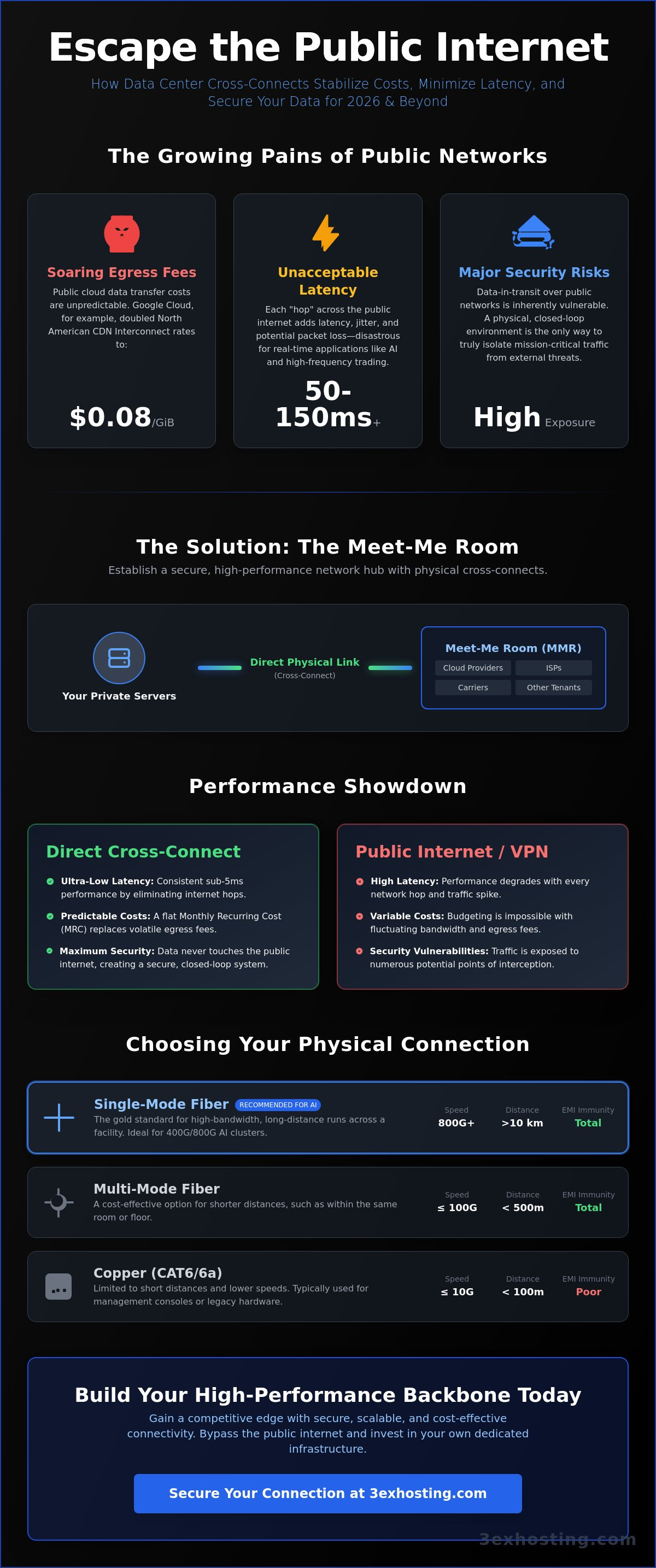
On May 1, 2026, Google Cloud doubled the cost of data transfer out through CDN Interconnect in North America to $0.08 per GiB. For enterprises relying on public cloud on-ramps, this price spike highlights the growing risk of variable bandwidth costs and the inherent security vulnerabilities of data-in-transit over public networks. It’s frustrating to watch your infrastructure budget fluctuate while your network performance hits a plateau. You need a stable, predictable foundation that bypasses the public internet. Leveraging professional data center cross connect services is the physical requirement for building a modern, high-performance carrier hotel strategy.
You likely agree that high latency and rising egress fees are signs that your current network architecture has reached its limit. This guide shows you how to evaluate and select the right interconnection services to minimize latency and maximize network scalability for the 2026 landscape. We’ll explore the strategic shift toward dark fiber and how to build a predictable backbone that provides direct access to multiple carriers and cloud providers. By the end, you’ll understand how to secure your data and stabilize your operational costs through dedicated hardware connections.
Key Takeaways
- Understand why physical interconnections are mandatory for supporting the massive data throughput required by real-time AI processing in 2026.
- Learn to distinguish between single-mode fiber and copper interconnections to optimize your network based on specific distance and speed requirements.
- Evaluate how professional data center cross connect services outperform virtual alternatives by eliminating encryption overhead and public network latency.
- Identify critical selection criteria for dark fiber providers, including carrier density in the Meet-Me Room and geographic path diversity for redundancy.
- Discover how high-density, carrier-neutral infrastructure ensures your network backbone remains scalable as your interconnection needs grow.
The Strategic Value of Data Center Cross-Connect Services in 2026
A cross-connect is a physical, point-to-point cable link between two different termination points within a facility. In 2026, this technology has moved from a convenience to a necessity. The rapid rise of real-time AI data processing means that software-defined links often can’t keep up with the raw throughput required for modern workloads. Enterprises now rely on these hardware-level connections and professional data center cross connect services to facilitate instant communication between their private servers and diverse network providers.
The Meet-Me Room (MMR) acts as the central nervous system of any high-tier facility. It’s the secure space where data center cross-connects are managed, allowing tenants to link directly to carriers, ISPs, and other customers. By establishing a physical presence here, you ensure that your mission-critical traffic never touches the public internet. This physical isolation provides a security advantage that no software firewall can replicate. It keeps your most sensitive data-in-transit safe from external interceptors by maintaining a closed-loop environment.
Bypassing the Public Internet Bottleneck
Standard ISP routing involves multiple hops across various networks. Each hop introduces potential latency, jitter, and packet loss. These issues are unacceptable for high-frequency trading or real-time streaming services. By using data center cross connect services, you eliminate these variables. You gain a direct, low-latency path that ensures consistent performance regardless of external internet traffic spikes. A cross-connect serves as a dedicated physical bridge for zero-trust data transfer. This approach guarantees that your packets follow the shortest possible path every single time.
The Economic Impact of Direct Interconnection
Cloud costs are rising. As of May 1, 2026, Google Cloud increased its North American data transfer rates to $0.08 per GiB. These egress fees can devastate an enterprise budget if traffic flows over the public internet. Direct interconnections allow you to bypass these high rates by connecting straight to hyperscale cloud providers within the same facility. You trade variable bandwidth billing for a predictable monthly recurring cost (MRC). This financial stability is crucial for long-term planning. In high-traffic environments, the ROI on these physical links is often realized within the first few months of operation. You don’t pay for “air”; you invest in your own dedicated infrastructure. If you are planning a deployment, you can get a quote to see how these efficiencies scale with your specific hardware needs.
Evaluating Physical Interconnection Types: Fiber, Copper, and Dark Fiber
Choosing the right medium is the first step in optimizing your network backbone. Not all data center cross connect services are equal. The choice between fiber and copper depends on your specific distance requirements and the throughput your hardware demands. By 2026, the industry has standardized single-mode fiber for almost all high-capacity enterprise runs. It uses a single light path to minimize signal attenuation, making it the ideal choice for high-bandwidth connections across a large facility.
Multi-mode fiber remains a cost-effective alternative for shorter distances, typically within the same room or floor. However, the emergence of AI GPU clusters has shifted the baseline. Modern clusters require 400G or even 800G interconnections to handle the massive datasets used in model training. Standard multi-mode setups often struggle at these speeds over longer distances. Copper (CAT6 or CAT6a) is still relevant but limited. It’s restricted to a maximum distance of 100 meters and is generally reserved for management consoles or legacy hardware connections.
Fiber-Optic vs. Copper: Performance Benchmarks
Fiber is the gold standard for enterprise backbones because it offers significantly higher speeds and total immunity to electromagnetic interference (EMI). In high-density rack environments, the massive power draw of AI servers generates significant EMI. This interference can degrade signals in copper cables, leading to packet loss and retransmissions. Fiber bypasses this issue entirely. It also provides a clear path for future-proofing. You can often upgrade your throughput from 10G to 100G or higher just by swapping the transceivers at either end, rather than pulling new physical cables.
Unlocking the Power of Dark Fiber Network Providers
Dark fiber refers to physical optical strands that aren’t “lit” by provider-managed electronics. You lease the raw glass and provide your own optical equipment at both ends. This approach gives you total control over the network protocol and the total bandwidth available. When comparing Dark fiber vs. lit fiber, the primary advantage is scalability. Your bandwidth potential is limited only by the hardware you choose to install.
For the financial and healthcare sectors, dark fiber is the ultimate tier for privacy and low-latency performance. There’s no shared equipment and no third-party management of your data packets, which eliminates the latency penalties found in managed services. If you’re building a high-capacity private network, our data center facilities offer the carrier density required to access these unlit strands efficiently. Utilizing professional data center cross connect services ensures these strands are terminated correctly to maintain signal integrity across your entire infrastructure.
Performance vs. Cost: Cross-Connects vs. Traditional Network Alternatives
Choosing between physical interconnections and virtual alternatives is a decision that impacts both your technical ceiling and your bottom line. While Virtual Private Networks (VPNs) and Software Defined Networking (SDN) offer flexibility, they introduce layers of abstraction that create performance bottlenecks. Professional data center cross connect services provide a raw, hardware-level path that bypasses the complexities of multi-node virtual routing. This directness translates to fewer failure points. A physical cable doesn’t suffer from software glitches or routing table errors that often plague virtual links.
Operating in a carrier-neutral environment provides a distinct strategic advantage. It allows you to avoid vendor lock-in by maintaining diverse cross-connect options to various providers. As the dark fiber network market continues to expand in 2026, enterprises are increasingly moving away from managed lit services toward these direct physical assets. This shift ensures that your network backbone remains agile, allowing you to swap carriers without overhauling your entire internal architecture.
The Latency Penalty of Virtual Private Networks
The “ping” difference between a direct cross-connect and a 10Gbps VPN is often the difference between a functional system and a failing one. VPNs require significant encryption overhead, adding processing time at every endpoint. For enterprises utilizing high density GPU colocation, sub-millisecond latency is non-negotiable. Real-time AI model inference and large-scale data synchronization demand an environment where data moves at the speed of light through glass, not through a series of virtual tunnels. Every millisecond of latency can translate to lost revenue in automated systems.
Total Cost of Ownership (TCO) Analysis
When analyzing the TCO of data center cross connect services, you must look beyond the initial setup fee. While virtual links might seem cheaper upfront, they often require more managed service provider (MSP) overhead for monitoring and troubleshooting. Physical interconnections simplify your network map. This simplicity reduces the total hours your engineering team spends diagnosing connectivity issues. For ongoing maintenance and cable organization, utilizing Remote Hands Support ensures that your physical layer is optimized without needing to send your own staff to the facility. Over a three-year cycle, the reduction in troubleshooting hours and the elimination of variable bandwidth fees often make cross-connects the more economical choice for high-traffic enterprises.
Selection Criteria: What to Look for in Dark Fiber Network Providers
Selecting a provider for unlit fiber requires a deep dive into the facility’s physical and logical architecture. Carrier density is your primary metric. A robust Meet-Me Room should house dozens of unique providers. This variety gives you the leverage to negotiate and the ability to build a truly redundant network. When evaluating professional data center cross connect services, path diversity is equally critical. Your dark fiber strands shouldn’t just be separate cables. They need to follow geographically distinct routes. This ensures that a single infrastructure accident, like a street-level conduit failure, doesn’t take your entire backbone offline.
Uptime guarantees at the physical layer must meet the 99.999% standard. While glass itself rarely fails, the termination points and patch panels are where risks reside. You should also demand high deployment speeds. In a market where AI-driven demand has pushed vacancy rates to a historic low of 1.4% in North America, your provider must be able to drop new connections into your Full Cabinet Colocation setup without bureaucratic delays. Speed of execution is a competitive advantage in 2026.
Vetting the Meet-Me Room (MMR) Infrastructure
The MMR is the most sensitive area of the data center. It must be climate-controlled and protected by multi-factor biometric access. Look at how the facility manages cable congestion. Professional environments use well-organized overhead trays rather than cluttered raised floors. This prevents “cable spaghetti” outages. Organized patch panels are the difference between a ten-minute fix and a four-hour service disruption. If the MMR looks chaotic, your network reliability will eventually reflect that chaos.
Interconnection Ecosystem and Peering
Your provider should offer more than just a link to a carrier. They must provide a gateway to a broader ecosystem. This includes direct access to Internet Exchange Points (IXPs) and hyperscale on-ramps like AWS Direct Connect or Azure ExpressRoute. Direct peering through data center cross connect services reduces egress fees and improves security by keeping data off the public web entirely. If you’re ready to stabilize your network performance, get a quote for our high-density interconnection solutions today.
Implementing Scalable Connectivity with 3EX Hosting
3EX Hosting provides the physical foundation your enterprise needs to maintain a competitive edge. Our facilities are built on a philosophy of carrier-neutrality. This gives you unrestricted access to a massive ecosystem of dark fiber network providers and global carriers. You aren’t locked into a single provider’s roadmap or pricing structure. Instead, you can leverage our professional data center cross connect services to build a network that’s as resilient as it is fast. Our infrastructure is specifically designed for the high-density requirements of 2026, supporting the massive throughput needed for AI GPU clusters and large-scale data synchronization.
Our commitment to carrier-neutrality means you have the freedom to choose the best-performing path for every workload. Whether you’re connecting to a local carrier in our data center or reaching a global hyperscaler, the choice is yours. We maintain deep relationships with a wide variety of dark fiber network providers to ensure you always have a redundant path available. This ecosystem is vital for maintaining a high-performance, predictable network backbone that avoids the congestion of public internet on-ramps. Our 24/7 technical support team is always on-site to handle rapid provisioning and troubleshooting. We understand that in a high-frequency environment, even a few minutes of downtime is unacceptable. That’s why we prioritize the stability of every physical link.
Seamless Interconnection Provisioning
Physical layer installation is a precision task. Our team handles the entire process from your cabinet to the Meet-Me Room, ensuring that every connection meets strict signal integrity standards. For organizations requiring absolute control over their environment, we integrate these links with Private Colocation Suites. This combination offers maximum network sovereignty. We also provide custom cage designs that allow for internal cross-connects between your own racks, simplifying your internal cable management while maintaining high performance. This setup allows your infrastructure to grow without the need for constant reconfiguration or external service calls.
Next Steps for Your Network Architecture
Building a predictable network backbone starts with a clear plan. You can consult with our engineers to map your specific low-latency requirements and identify the best path for your data. We provide a comprehensive list of on-net carriers and dark fiber providers available within our facilities to help you make an informed choice. Our strategic colocation solutions are designed to grow with your network. As your bandwidth needs scale from 100G to 800G, our high-density infrastructure stays ahead of the curve. When you’re ready to stabilize your infrastructure and reduce egress fees, get a custom quote for cross-connect and colocation services. Our team is ready to assist with rapid provisioning to get your systems online without delay.
Securing Your Network Backbone for the AI Era
The 2026 infrastructure landscape demands a shift away from the unpredictability of the public internet. By prioritizing physical interconnections, you eliminate the latency and variable costs associated with multi-hop routing. Professional data center cross connect services provide the direct, hardware-level path necessary for high-performance AI GPU clusters and mission-critical data synchronization. This strategy doesn’t just improve speed; it secures your data-in-transit within a controlled, zero-trust environment. You gain the predictability required for long-term financial and technical planning.
3EX Hosting offers a carrier-neutral facility equipped with high-density power and cooling specifically designed for modern AI workloads. You gain strategic access to a national backbone and the support of 24/7 Remote Hands for immediate provisioning. Our infrastructure ensures your network scales alongside your business requirements without hitting the bottlenecks of traditional virtual alternatives. It’s time to stabilize your operational costs and take full control of your interconnection ecosystem.
Maximize your network performance with 3EX Hosting Cross-Connects and build a resilient foundation for your enterprise’s future. We’re ready to help you optimize your connectivity today.
Frequently Asked Questions
What is the difference between a cross-connect and an interconnection?
An interconnection is the strategic relationship or agreement between two networks to exchange traffic, while a cross-connect is the physical cable that enables that exchange. Think of the interconnection as the logical connection and the cross-connect as the dedicated hardware link. In a carrier-neutral facility, these physical links allow for direct communication without traversing the public internet.
How much do data center cross-connect services typically cost in 2026?
Costs for data center cross connect services are generally structured as either a monthly recurring charge or a one-time installation fee. These rates depend on the medium used, such as single-mode fiber versus copper, and the specific infrastructure requirements of the facility. You should check with your provider for a detailed breakdown of their current service fees and any potential setup costs.
Can I install my own cross-connect cable between cabinets?
You typically can’t install your own cabling between cabinets for safety, security, and organizational reasons. Data centers maintain strict standards for overhead tray management and fire codes to prevent outages. Most facilities require that their own certified technicians or professional Remote Hands teams perform the installation to ensure the physical layer remains documented and secure.
What is a “Meet-Me Room” and why is it important for dark fiber?
A Meet-Me Room (MMR) is the secure, central hub where multiple carriers and dark fiber providers terminate their external lines. It’s the critical point where your private infrastructure links to the wider world. For dark fiber users, the MMR is where you connect your own optical equipment to the raw glass strands provided by your chosen carrier, giving you total control over the link.
What happens if a cross-connect cable fails?
If a cable fails, the specific link goes offline immediately, which is why path diversity is a standard requirement for mission-critical systems. While modern fiber is highly durable, physical damage or transceiver failure can occur. Implementing redundant data center cross connect services across different physical paths ensures that traffic automatically reroutes if one strand is compromised.
How long does it take to provision a new cross-connect service?
Provisioning times vary by facility but usually range from 24 to 72 hours. Factors like cable availability, the distance between termination points, and the current workload of the site technicians influence the speed. Some high-density facilities offer expedited services for urgent deployments, particularly for AI GPU clusters that require rapid scaling.
Is dark fiber more secure than traditional lit fiber cross-connects?
Dark fiber is generally more secure because it eliminates the provider-managed hardware found in lit fiber services. Since you provide the electronics at both ends, you have total control over the encryption and protocols used. This physical isolation significantly reduces the potential attack surface compared to shared, managed network layers where a provider’s equipment could be a point of vulnerability.
Do I need a cross-connect to access public cloud providers from my colocation rack?
You do need a cross-connect to access public cloud providers directly from your rack via dedicated on-ramps. Services like AWS Direct Connect or Azure ExpressRoute require a physical link between your equipment and the cloud provider’s router within the data center. This direct path is the most effective way to bypass the public internet and avoid high egress fees.