 SUPPORT


 3EX United States
 Blog
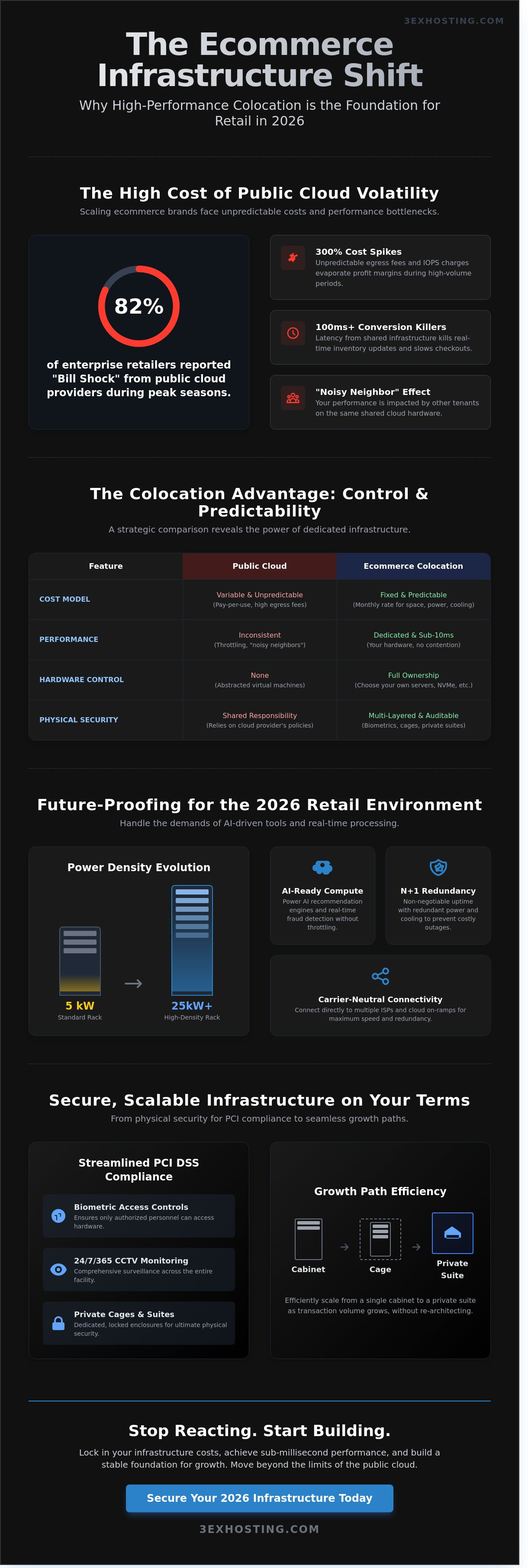
In 2024, 82% of enterprise retailers reported “bill shock” from their public cloud providers during the Q4 peak shopping season. It’s frustrating to watch your profit margins evaporate into unpredictable egress fees and surge pricing just when your sales are at their highest. You deserve technical stability and superfast performance without the financial volatility that often accompanies rapid growth. This is why high-performance retail and ecommerce colocation solutions are becoming the preferred foundation for brands scaling toward 2026.
You’ll discover how high-density colocation infrastructure provides the security, sub-millisecond speed, and cost-predictability that scaling ecommerce brands need to outperform cloud-only competitors. We’ll examine the strategic shift toward dedicated hardware that simplifies physical PCI compliance and eliminates the 100-millisecond delays that often kill conversions during real-time inventory updates. By the end of this guide, you’ll know how to lock in your infrastructure costs while maintaining a modern, superfast edge over the competition.
Key Takeaways
- Transition from cloud-only environments to hybrid infrastructure to regain control over performance and achieve long-term cost-predictability.
- Future-proof your operations with high-density cooling and N+1 redundancy designed to handle the power demands of 2026’s AI-driven retail tools.
- Streamline PCI DSS compliance by leveraging multi-layered physical security, including biometric access controls and dedicated private suites.
- Scale your infrastructure efficiently by selecting tailored retail and ecommerce colocation solutions that match your specific hardware and security requirements.
- Maximize your team’s productivity by utilizing 24/7 remote hands support to manage physical maintenance while you focus on software innovation.
What are Retail and Ecommerce Colocation Solutions?
Retail and ecommerce colocation solutions are specialized data center services where businesses lease secure space for their own servers, networking gear, and storage arrays. Unlike managed hosting, the retailer retains full ownership and configuration rights over their physical stack. By 2026, this model has become the backbone for brands requiring sub-10ms latency for omnichannel synchronization. A professional colocation centre provides the redundant power, superfast cooling, and physical security that a standard office or basic server room lacks.
The 2026 retail landscape demands more than a simple place to plug in a server. It requires carrier-neutral connectivity. This allows ecommerce brands to connect directly to multiple internet service providers and cloud on-ramps simultaneously. This redundancy is critical for real-time inventory management. When a customer buys the last item in a physical store, your online platform must update instantly to prevent overselling. Relying on 100% public cloud infrastructure often introduces unpredictable latency and rising costs that eat into margins.
The ‘Cloud Exit’ Trend in Modern Ecommerce
High-volume retailers are increasingly pulling mission-critical databases out of the public cloud. While the cloud is excellent for testing, the costs for egress fees and high-IOPS (Input/Output Operations Per Second) databases can spike by 300% as transaction volumes scale during peak seasons. Physical hardware becomes more cost-effective than virtual machines once a retailer exceeds 1,200 orders per hour consistently. By owning the hardware, brands eliminate the “noisy neighbor” effect where other companies’ traffic spikes slow down their own checkout process.
Cloud Repatriation in the 2026 retail context is the strategic migration of high-intensity workloads from public cloud environments back to dedicated physical hardware to optimize cost, security, and performance.
Colocation vs. Traditional Web Hosting for Retail
Traditional web hosting relies on shared resources. In that environment, your site performance depends on the stability of other users on the same server. Retail and ecommerce colocation solutions offer dedicated enterprise infrastructure where you are the only tenant on your hardware. This level of control is vital for custom ecommerce builds that require specific NVMe SSD configurations or specialized security protocols for PCI-DSS compliance.
- Hardware Ownership: You choose the exact CPU and RAM specifications to match your software’s needs.
- Predictable Scaling: You can expand from a single cabinet colocation setup to a private suite as your transaction volume grows.
- Security: Physical access is limited to your authorized personnel, providing a higher security tier than shared hosting environments.
Moving to colocation allows for a superfast, stable environment that handles massive traffic surges during Black Friday or flash sales without the performance “ceiling” found in shared hosting. It provides a professional foundation for brands that have outgrown the limitations of virtualized environments and need the reliability of a tier-3 data center.
High-Density Infrastructure: Powering the 2026 Retail Environment
By 2026, retail and ecommerce colocation solutions must evolve to handle the massive compute requirements of real-time AI. Modern retailers use AI-driven product recommendations that process billions of data points in milliseconds. This shift has pushed server power demands from a standard 5kW per rack to over 25kW in high-density environments. Cooling these setups requires precision engineering. Without advanced thermal management, hardware throttling occurs, leading to sluggish site performance during critical sales windows.
Uptime isn’t just a goal; it’s a requirement for survival. N+1 redundancy serves as the non-negotiable standard for ecommerce infrastructure. This configuration ensures that if a power unit or cooling module fails, a backup is already active. During 2026 peak traffic events, a single minute of downtime can result in losses exceeding $500,000 for major brands. High-density infrastructure provides the thermal headroom and power stability needed to prevent these outages.
Connectivity is the second pillar of this environment. Sub-millisecond transaction processing is essential for inventory syncing and fraud detection. Carrier hotels play a vital role here. These massive hubs house hundreds of network providers, allowing ecommerce brands to reach global audiences with minimal hops. By placing servers in these strategic locations, retailers ensure their “Add to Cart” button responds instantly, regardless of where the customer is located.
Managing High-Density Power for Retail Analytics
3EX Hosting supports high-density full cabinet colocation specifically designed for power-hungry AI workloads. We provide the robust power draws necessary for GPU-accelerated servers that drive modern retail analytics. Our facilities utilize advanced cooling systems to maintain 100% uptime, even during the extreme traffic spikes seen on Black Friday or Cyber Monday. We optimize rack layouts to maximize airflow and efficiency. This prevents hot spots and ensures your hardware runs at peak performance. If you need to scale your compute capacity quickly, consider our full cabinet colocation options for maximum control.
Interconnection and Cross-Connect Services
Speed depends on the physical distance data must travel. Our cross-connect services reduce latency by creating direct, physical links between your servers and payment gateways. This bypasses the public internet, which improves security and speed. Direct cloud on-ramps allow for a seamless hybrid retail environment, connecting your private hardware to public cloud resources instantly. Maintaining PCI Compliance is simpler when your data paths are direct and controlled. We ensure redundant network paths are always active, so your store stays online even if a primary carrier experiences a regional fiber cut. It’s a professional, super-fast approach to retail connectivity that eliminates single points of failure.
Choosing the Right Model: Cabinets, Cages, and Private Suites
Selecting the physical layout for your server environment isn’t just about finding floor space. It involves balancing power density, physical security, and long-term operational costs. For most growing businesses, retail and ecommerce colocation solutions start with a single cabinet and evolve into complex multi-cage deployments as data needs expand. Your choice today determines how quickly you can scale during high-traffic events like Black Friday or Cyber Monday.
Security tiers often dictate the model you choose. Retailers handling high volumes of sensitive customer data must adhere to strict PCI compliance requirements. These 12 core requirements often necessitate physical isolation. While a shared data center floor is secure, a private suite or cage provides an additional layer of “Defense in Depth.” If your hardware footprint exceeds 10 cabinets, moving to a private suite often becomes more cost-effective than renting individual racks.
A critical part of your strategy is the cost-to-benefit analysis of managed versus unmanaged space. Managed infrastructure includes 24/7 “Remote Hands” support. This service allows your team to focus on software and customer experience while data center experts handle hardware swaps and cabling. Unmanaged space offers lower monthly fees, but it requires you to have local staff ready to respond to hardware failures at any hour. For brands scaling across multiple regions, the managed model typically provides better ROI by reducing travel and specialized labor costs.
Full Cabinet Colocation: The Standard for Scaling Brands
For enterprise retail, full cabinet colocation serves as the primary entry point. Standardizing on 42U racks allows your IT team to create a repeatable hardware blueprint. This makes rapid scaling predictable. Power metering is a vital feature here. It allows ecommerce brands to track exact energy consumption. By paying only for the power you use, you can accurately predict monthly OpEx and avoid the “flat-rate” traps that often lead to overspending on underutilized racks.
Private Suites and Cage Solutions for Enterprise Retail
Brands with specialized hardware or extreme security needs should look toward private data center suites. These suites offer total isolation from other tenants, which is ideal for meeting the highest audit standards. If a full suite is too large, cage solutions provide a middle ground. Cages allow you to customize your internal layout and add biometric access controls. This physical isolation ensures that only your authorized technicians ever come into contact with your payment processing or inventory management servers.
PCI Compliance and Physical Security for Ecommerce Data
Securing customer payment information is the top priority for any digital storefront. By 2026, the shift toward PCI DSS 4.0 standards has made physical security even more critical for retail and ecommerce colocation solutions. Physical colocation directly addresses Requirement 9 of the PCI DSS, which mandates restricted physical access to any system that stores, processes, or transmits cardholder data. While cloud environments often leave you guessing about the exact location of your data, colocation provides a tangible, auditable perimeter.
Security at a professional data center isn’t just a locked door. It’s a multi-layered defense system. Facilities use biometric access controls, such as iris scanners or fingerprint readers, to ensure only authorized personnel enter the server room. On-site security teams monitor the premises 24/7/365, backed by high-definition video surveillance that covers every aisle and entry point. These logs provide a clear paper trail for auditors, proving that your hardware remained untouched by unauthorized hands.
Maintaining Compliance in a Physical Environment
3EX Hosting simplifies the compliance audit process for retailers by providing comprehensive access logs and maintaining a facility that meets SOC 2 and PCI standards. We handle the heavy lifting of facility maintenance, so you don’t have to document every visitor or cooling repair yourself. Physical hardware isolation prevents ‘noisy neighbor’ security risks, ensuring that a breach or resource spike in another company’s setup cannot spill over into your private environment. This dedicated approach is a cornerstone of modern retail and ecommerce colocation solutions, offering a level of predictability that shared hosting cannot match.
Disaster Recovery and Business Continuity
Infrastructure resilience is non-negotiable for retail. A single hour of downtime during a peak shopping event can cost a mid-sized retailer over $300,000 according to 2024 industry benchmarks. Integrating disaster recovery solutions into your primary site ensures that your business stays online even during regional power outages or natural disasters.
Geographically diverse backups are essential. If your primary servers are in South Florida, your failover site should be far enough away to avoid the same weather patterns. You should test your failover protocols quarterly to guarantee zero-loss transaction data. It’s not enough to have a backup; you must prove it works under pressure. Modern retail operations use real-time data replication to ensure that every order placed is recorded across multiple locations instantly. This redundancy protects your reputation and your bottom line.
Ready to harden your retail infrastructure? Explore our secure cabinet colocation options today.
Maximizing ROI with Managed Support and Remote Hands
Efficiency in 2026 depends on how well a brand allocates its most expensive resource: human talent. Lean retail IT teams shouldn’t spend hours driving to a facility to swap a failed drive or trace a cable. By utilizing retail and ecommerce colocation solutions that include comprehensive managed services, brands shift their focus from physical maintenance to ecommerce software innovation. This strategic move lowers the Total Cost of Ownership (TCO) by eliminating the overhead of 24/7 on-site staffing while ensuring hardware remains at peak performance. It’s a shift from being a hardware manager to being a growth architect.
The Role of 24/7 Remote Hands in Retail
Leveraging remote hands support is the secret weapon for modern brands. This service handles everything from complex cable management to critical hardware swaps without your team ever leaving the office. It’s about speed and precision. When a server goes dark during a seasonal sale, every second of latency impacts the bottom line. Industry data shows that 40% of consumers abandon a site that takes more than three seconds to load; a full outage is catastrophic. Having expert technicians available in the data center facility ensures emergency response times are kept to a minimum. These professionals act as your local eyes and ears, resolving physical layer issues in minutes rather than the hours it would take for your team to travel to the site.
Building a Hybrid Future with 3EX Hosting
Success in the 2026 retail market requires a balance between the stability of cabinet colocation and the agility of managed cloud. 3EX Hosting facilitates this through a carrier-neutral environment that provides global retail connectivity. This setup allows you to scale resources instantly during traffic spikes without over-provisioning hardware for the rest of the year. Our consultative approach means we don’t just provide space; we help plan your infrastructure to ensure it’s redundant, secure, and ready for AI-driven retail tools. Retail and ecommerce colocation solutions must be flexible. By combining physical server control with cloud-like management, we provide the stability your brand needs to stay online during the busiest shopping days of the year. It’s time to move beyond basic hosting and build a foundation that supports long-term brand growth through expert partnership and superfast connectivity.
Secure Your Growth for the 2026 Retail Landscape
Success in the 2026 retail landscape demands more than just basic server space. High-density power and N+1 power and cooling redundancy are essential to handle the massive data surges of modern ecommerce. Security isn’t optional; your infrastructure must maintain strict PCI compliance and physical protection to ensure customer trust. By implementing professional retail and ecommerce colocation solutions, you eliminate the risks of downtime and technical bottlenecks. Our carrier-neutral connectivity provides high-speed cross-connects that keep your storefront superfast during peak traffic periods. You’ll gain access to 24/7/365 Remote Hands Support, allowing your team to focus on growth while we manage the hardware. This technical stability translates directly into higher ROI and a seamless shopping experience. Don’t let outdated hardware limit your brand’s potential. Take the next step toward a stable, high-performance future. Our team is ready to help you scale your operations with precision and reliability.
Get a Custom Quote for Your Retail Colocation Needs
Frequently Asked Questions
What is the difference between retail colocation and wholesale colocation?
Retail colocation involves leasing space by the rack or cage, while wholesale colocation provides entire data halls or megawatts of power to a single tenant. Most ecommerce businesses choose retail options because they offer the flexibility to start with just one or two racks. Wholesale usually requires a commitment of 100 kilowatts or more, making it suitable only for global giants.
How does colocation improve my ecommerce website’s loading speed?
Colocation improves speed by placing your hardware at major Internet Exchange Points where latency stays below 5 milliseconds. This proximity to tier-1 carriers ensures that your retail and ecommerce colocation solutions deliver content faster than standard office connections. Faster response times are vital since a 100-millisecond delay can drop conversion rates by 7 percent.
Can colocation help my business achieve PCI DSS compliance?
Colocation facilities provide the physical security layer required for PCI DSS Level 1 compliance. This includes 24/7 onsite guards, biometric access, and 90 day video retention. While the data center secures the hardware, you remain responsible for the software and encryption layers. Combining these elements creates a secure environment for processing every credit card transaction.
Is colocation more expensive than public cloud for a growing ecommerce site?
Colocation often costs 30 to 40 percent less than public cloud services for predictable, high-traffic ecommerce workloads. While cloud is useful for testing, data egress fees and instance costs rack up quickly as you scale. By 2026, many firms are moving back to physical hardware to avoid the high costs of high-bandwidth database operations.
What happens to my retail data if the data center loses power?
Your data stays online because Tier III facilities utilize N+1 redundancy for all power and cooling systems. Uninterruptible Power Supply units engage instantly, followed by diesel generators that can run for 48 to 72 hours without refueling. This infrastructure prevents the 9,000 dollar per minute cost associated with unplanned data center outages.
What are ‘Remote Hands’ and why does my ecommerce business need them?
Remote Hands are on-site technicians who perform physical tasks like rebooting servers, swapping drives, or checking cables on your behalf. This service is vital for ecommerce businesses because it’s not always possible to send your own staff to the facility. Most providers offer a 15 to 30 minute response time for emergency requests, keeping your storefront active.
How quickly can I scale my infrastructure within a colocation facility?
You can scale your infrastructure within 24 to 48 hours if you’ve already reserved adjacent rack space. For larger expansions, procurement and installation of new hardware typically take 2 to 4 weeks depending on current supply chains. Modern retail and ecommerce colocation solutions allow for modular growth, so you don’t pay for space you aren’t using yet.
Do I need to provide my own servers for retail colocation?
Yes, you own and manage the servers, storage, and networking equipment in a standard colocation model. The provider only supplies the secure space, power, cooling, and internet connectivity. This gives you total control over your hardware lifecycle, allowing you to use custom configurations like superfast NVMe drives that outperform standard cloud instances.