 SUPPORT


 3EX United States
 Blog
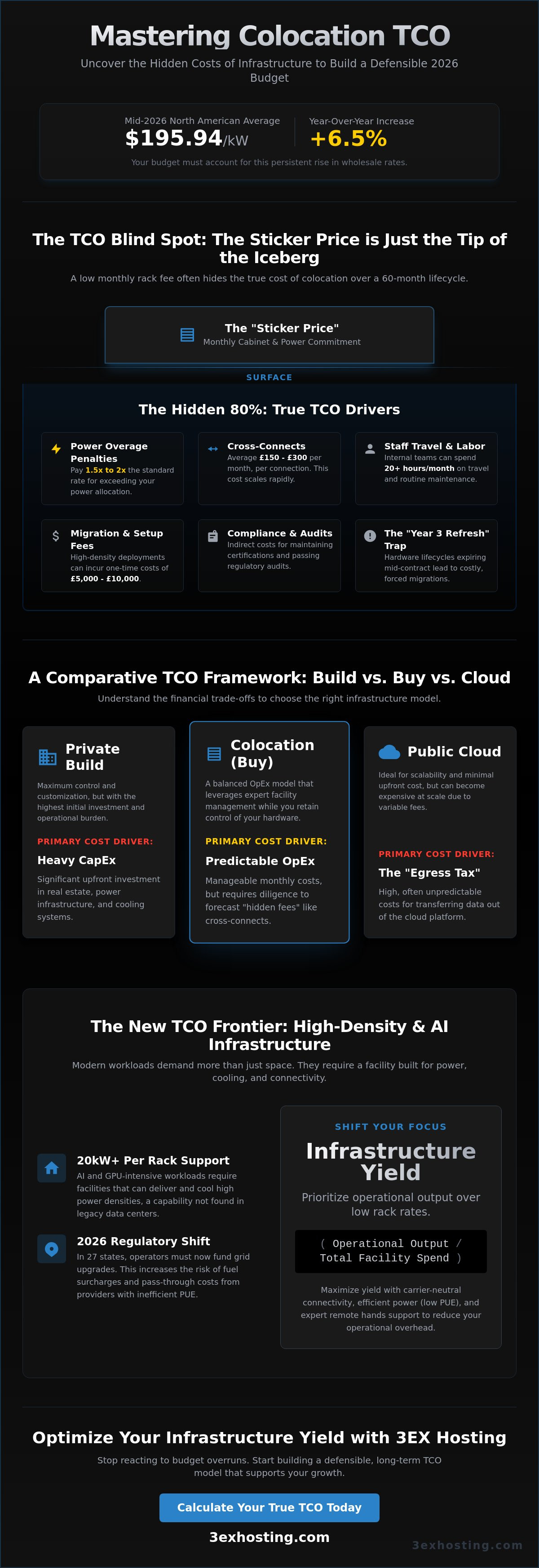
Did you know that by mid-2026, the average North American colocation rate reached $195.94 per kW, representing a 6.5% year-over-year increase? If your budget hasn’t adjusted for this shift, you’re likely facing a significant deficit before the fiscal year ends. Calculating total cost of ownership for colocation is no longer just about the monthly rack fee; it’s about accounting for the 1.5 to 2 times power overage penalties and the rising cost of cross-connects that now average £150 to £300 per month.
We understand the frustration of seeing a predictable OpEx plan derailed by hidden egress fees or the sudden cost of internal staff travel for routine maintenance. You need a stable, technical foundation that doesn’t surprise your CFO. This guide gives you the tools to master the financial framework needed to forecast long-term expenses accurately and identify hidden savings within your infrastructure. We’ll examine the real trade-offs between CapEx and OpEx while preparing your strategy for the new regulatory environment, including the 2026 shift where 27 states now require operators to fund their own grid upgrades. Let’s build a defensible model for your 2026 growth.
Key Takeaways
- Identify the hidden “sticker price” trap by evaluating interconnection and power costs over a full 60-month infrastructure lifecycle.
- Categorize indirect expenses such as staff travel, insurance, and compliance audits to prevent unexpected budget escalations.
- Master the framework for calculating total cost of ownership for colocation by comparing the heavy CapEx of private builds against the “egress tax” of public cloud.
- Evaluate the specialized cooling and power requirements for 20kW+ racks to ensure your facility can support modern AI and GPU workloads.
- Prioritize infrastructure yield over low rack rates by leveraging carrier-neutral connectivity and professional remote hands support.
The TCO Blind Spot: Why Monthly Colocation Fees Are Only the Surface
Defining Total Cost of Ownership (TCO) in a colocation environment requires looking past the monthly invoice. It’s the sum of all direct and indirect expenses over a 3 to 5 year lifecycle. When calculating total cost of ownership for colocation, enterprises often focus on the monthly cabinet rental. This is a mistake. A low sticker price often hides high interconnection costs or rigid power contracts that don’t scale. In 2026, leading firms have shifted from reactive budgeting to Infrastructure Yield modeling. Infrastructure Yield is the ratio of operational output to total facility spend.
The Fallacy of the Per-Kilowatt Price
Power is the most volatile variable in your budget. Even if your base rate is low, a poor Power Usage Effectiveness (PUE) rating drives up the final bill. While the global average PUE remains around 1.58, modern facilities like 3EX Hosting’s Miami data center focus on efficiency to lower these overheads. You must distinguish between allocated and metered power. Allocated billing charges you for capacity you might not use. Metered billing ensures you only pay for what your servers actually consume. With the 2026 energy shift where 27 states moved grid upgrade costs to operators, your TCO model must account for potential fuel surcharges and regulatory pass-through costs.
Why Enterprise Budgeting Fails Without a 5-Year Horizon
Short-term planning leads to the Year 3 Refresh trap. This happens when your hardware lifecycle expires mid-contract, forcing expensive migration or suboptimal performance. Depreciation also plays a critical role. Leased hardware might seem cheaper as OpEx, but owned hardware in a full cabinet colocation setup often provides better long-term value. To align your contracts, follow this checklist:
- Audit hardware refresh cycles against contract termination dates.
- Verify if the provider allows density increases without new setup fees.
- Calculate the cost of internal staff travel for maintenance over 60 months.
- Factor in the 6.5% average annual increase in North American wholesale rates seen in late 2025.
Calculating total cost of ownership for colocation with this level of detail ensures your budget remains defensible. It prevents the common 15% to 20% budget overruns that occur when hidden fees for cross-connects and remote hands aren’t properly forecasted.
Decoding Direct vs. Indirect Costs in the Colocation Equation
Most enterprises begin calculating total cost of ownership for colocation by tallying direct expenses. These are the visible line items: rack space, power circuits, cross-connects, and bandwidth. While these form the foundation, they rarely represent the final bill. Industry research from the Uptime Institute suggests a simple model for determining true TCO must account for both the physical plant and the operational overhead. In 2026, the “Hidden Third” of colocation costs often comes from migration, initial network engineering, and setup fees that can range from £5,000 to £10,000 for high-density deployments.
Indirect costs represent the staffing tax that many businesses overlook. This includes insurance, compliance audits, and the opportunity cost of downtime. If your internal team spends 20 hours a month managing physical infrastructure, that’s time stolen from high-value development. Utilizing remote hands support effectively converts these variable labor costs into a fixed, predictable monthly OpEx. It’s a strategic shift that ensures your technical experts focus on architecture rather than cabling.
Direct CapEx and OpEx: Power, Space, and Cooling
The choice between N+1 and 2N redundancy in a full cabinet colocation environment significantly impacts your long-term yield. While 2N redundancy offers maximum security, it often doubles your power circuit costs. High-density cooling for AI workloads adds another layer of complexity. With average monthly rates in North America rising 6.5% year-over-year by late 2025, efficiency is paramount. Don’t forget the recurring cost of cross-connect services. In major markets, these physical links to carriers typically cost between £150 and £300 per month, per connection. Over a 60-month contract, a dozen cross-connects can add over £100,000 to your TCO.
The Human Capital Factor: Travel and Remote Hands
A common budgeting failure is underestimating travel expenses. Flying a senior engineer to a facility for a simple hardware swap is expensive. Between airfare, lodging, and lost productivity, a single site visit can cost thousands. In contrast, 24/7 on-site technical expertise provides a higher ROI for mission-critical hardware. Professional move-in assistance also reduces initial deployment TCO by preventing configuration errors that lead to Day 2 troubleshooting. If you’re looking for a stable partner to manage these complexities, you can get a transparent quote that accounts for both direct and indirect variables. Calculating total cost of ownership for colocation shouldn’t be a guessing game; it should be a blueprint for stability.
Build vs. Buy vs. Cloud: A Comparative TCO Framework
When calculating total cost of ownership for colocation, you must weigh it against the alternatives of building a private data center or relying solely on the public cloud. The “Build” scenario requires massive upfront CapEx for UPS systems, industrial generators, and multi-layered physical security. Conversely, the “Cloud” scenario offers low entry costs but introduces a hidden tax through egress fees and a total lack of hardware control. Choosing to “Buy” through colocation provides a middle path of predictable scaling where infrastructure costs are shared across a professional facility. For a deeper look at regional scaling, see our Enterprise Guide to Managed IT Infrastructure.
The Hidden Burden of On-Premise Data Centers
Operating a private facility involves more than just power. You absorb the full maintenance TCO of HVAC systems and specialized fire suppression. In a colocation environment, these costs are distributed among many tenants. Compliance also becomes a major financial factor. Achieving and maintaining SOC2 or PCI-DSS certifications is significantly cheaper in a certified facility like a cage colocation environment. Finally, consider the “Real Estate Tax.” Dedicated floor space in high-rent office districts often costs 3 to 4 times more than equivalent space in a purpose-built data center. Transitioning these costs to a provider allows you to reclaim high-value office square footage for revenue-generating staff.
Cloud Egress and Variability vs. Fixed Colocation Costs
The financial gap between cloud and colocation often centers on data movement. A fixed 10Gbps cross-connect in a colocation facility provides unlimited throughput for a predictable monthly fee. In the cloud, equivalent data transfer volumes can trigger astronomical egress charges that fluctuate wildly each month. This makes colocation the superior model for “Steady State” workloads with high data output. Most enterprises find a clear break-even point: once your workload reaches a consistent 20% to 30% utilization rate, moving from cloud to colocation yields 30% to 50% in total savings.
Calculating total cost of ownership for colocation reveals that while the cloud is efficient for bursting, it’s a poor choice for long-term, high-density storage or compute. If you’re ready to see how these numbers apply to your specific footprint, you can request a custom quote to finalize your 2026 budget. Identifying these savings early prevents the “Cloud Bill Shock” that often derails enterprise IT departments by the second quarter.
High-Density and AI Infrastructure: The New TCO Frontier
AI workloads have fundamentally changed the math behind infrastructure planning. Calculating total cost of ownership for colocation now requires factoring in racks that consume 20kW to 50kW each. Many traditional data centers fail to support high density GPU colocation because their cooling systems were designed for a 4kW to 8kW average. This creates “stranded capacity,” where you pay for floor space you can’t use because the facility’s power or cooling limits are reached. In 2026, the shift to per-kilowatt pricing has become the standard for these high-performance deployments, bundling space and cooling into a single, density-based metric.
Specialized power delivery for AI training and inference hardware adds to the initial setup cost. You’ll need high-amperage circuits and specialized PDUs that can handle the sustained load of modern GPU clusters. Liquid cooling readiness is a critical factor for long-term facility TCO. Facilities built with liquid-to-chip infrastructure achieve a PUE of 1.1 to 1.2, compared to the 1.4 to 1.6 range of air-cooled sites. This efficiency directly lowers your monthly power bill, often offsetting the higher initial setup fees for specialized hardware.
Calculating the Cost of High-Density GPU Cooling
Comparing the TCO of air-cooled vs. liquid-to-chip cooling architectures reveals a clear winner for AI. While air cooling is familiar, it struggles with the heat density of modern GPUs, leading to thermal throttling and hardware degradation. Liquid cooling reduces the “Space” component of your TCO by allowing you to condense your footprint. You get more compute per square foot, which is essential in premium markets. Specialized AI infrastructure also offers reliability benefits, reducing the downtime TCO that occurs when consumer-grade cooling fails under enterprise-grade workloads.
Future-Proofing for AI Scale Without Re-Cabling Costs
Modular cage solutions are the most cost-effective way to scale AI clusters. They provide the physical security and room for “Modular Growth,” allowing you to add cabinets without re-architecting your entire network backbone. High-performance cross-connects are vital for low-latency communication between GPU nodes. By planning for these connections early, you avoid the massive re-cabling costs that occur when a cluster outgrows its initial footprint. If your 2026 strategy involves scaling AI, you can request a high-density colocation quote to lock in your infrastructure yield.
Optimizing Your Infrastructure Yield with 3EX Hosting
Maximizing your Infrastructure Yield means choosing a partner that understands the technical realities of 2026. At 3EX Hosting, we provide the stability and speed required to keep your enterprise operations running without interruption. Calculating total cost of ownership for colocation becomes much simpler when you have access to carrier-neutral connectivity within a premier carrier hotel environment. This setup allows you to leverage competitive pricing from multiple network providers, directly reducing your monthly OpEx for bandwidth and cross-connects. By avoiding carrier lock-in, you ensure your network costs remain as efficient as your hardware.
For organizations with stringent compliance needs, private colocation suites offer a significant TCO advantage. These suites provide the physical isolation required for high-security environments, which often lowers insurance premiums and simplifies the audit process for SOC2 or HIPAA. When you get a customized TCO quote from 3EX Hosting, we factor in these specific hardware loads and security requirements to give you a defensible 5-year budget. We focus on the technical details so your financial projections remain accurate and reliable.
Leveraging Remote Hands to Reduce Travel and Staffing Costs
The 24/7/365 availability of our technical experts means you don’t have to maintain a local presence or fly engineers to the facility for routine tasks. 3EX Hosting acts as a seamless extension of your internal IT team. We handle everything from cable management to complex hardware swaps with rapid incident response. This significantly reduces the downtime TCO that occurs when critical hardware fails. Instead of waiting for a team to travel, our on-site remote hands provide immediate resolution, ensuring your systems remain stable and performant. Calculating total cost of ownership for colocation must include these labor savings to reflect the true value of a managed facility.
Predictable Scaling with Full Cabinet and Private Suite Solutions
Our flexible infrastructure allows you to start with a full cabinet colocation setup and scale into a private suite as your compute needs grow. This modular approach ensures you aren’t overpaying for space you won’t use for 24 months. To minimize initial deployment friction, our move-in assistance program handles the logistical heavy lifting. We help align your hardware arrival with rack readiness, reducing the “dead time” where you’re paying for space without active hardware. Over a 5-year horizon, 3EX Hosting provides the technical excellence and predictable cost structure needed for enterprise continuity in an increasingly volatile market.
Securing Your 2026 Infrastructure Yield
Mastering the financial variables of data center management is essential as North American wholesale rates continue their 6.5% annual climb. Calculating total cost of ownership for colocation requires a shift from reactive budgeting to a proactive 60-month horizon. You’ve seen how hidden egress fees and the 2026 regulatory energy shifts in 27 states can derail a poorly planned budget. By prioritizing high-density readiness and carrier-neutral connectivity, you protect your enterprise from stranded capacity and unpredictable billing escalations.
3EX Hosting provides the technical foundation you need to scale with confidence. Our SOC2 compliant carrier hotel environment offers the stability your CFO demands. With 24/7/365 on-site remote hands and high-density GPU ready infrastructure, we ensure your systems remain performant without the staffing tax of DIY management. It’s time to move past the sticker price and build a strategy based on actual performance. Request a Custom TCO Analysis and Colocation Quote to lock in your 2026 growth strategy. Your infrastructure is in expert hands.
Frequently Asked Questions
How do egress fees impact the TCO of colocation versus public cloud?
Egress fees act as a variable tax in the cloud, whereas colocation offers fixed-cost connectivity. Public cloud providers often charge per gigabyte for data leaving their network, leading to unpredictable monthly spikes. Colocation utilizes cross-connects with flat monthly rates; this allows for unlimited data transfer without financial penalty. This predictability is a cornerstone of calculating total cost of ownership for colocation for data-intensive enterprises.
What is the average lifespan of data center hardware for TCO calculations?
Enterprise hardware typically has a 3 to 5 year operational lifespan before maintenance costs exceed performance value. While servers can physically last longer, the efficiency gains of newer generations often justify a refresh cycle by Year 4. Aligning your colocation contract with this 48 or 60 month horizon prevents the refresh trap where infrastructure and hardware cycles diverge, leading to suboptimal performance.
Is metered power or a fixed power circuit better for colocation budgeting?
Metered power is generally superior for budgeting because you only pay for actual consumption rather than peak capacity. Fixed circuits often result in stranded power costs where you pay for 10kW but only use 6kW. In 2026, metered billing provides the granular data needed for accurate carbon reporting and cost allocation across different business units, ensuring your budget reflects real usage.
How do remote hands services specifically reduce the total cost of ownership?
Remote hands services eliminate the high cost of emergency travel and lost productivity for your senior engineering staff. Instead of paying for airfare and lodging for a simple disk swap, you utilize on-site experts available 24/7. This transition from variable travel expenses to a predictable OpEx model significantly lowers the human capital component of your TCO and accelerates incident resolution times.
What are the most common hidden costs in a colocation contract?
Hidden costs frequently include setup fees for high-density cooling, cross-connect recurring charges, and power overage penalties. Providers often charge 1.5 to 2 times the standard rate if you exceed your allocated power limit. Identifying these variables early is critical when calculating total cost of ownership for colocation to avoid the 20% budget overruns that commonly occur in the first year of a contract.
Can I include disaster recovery solutions in my colocation TCO model?
Yes, disaster recovery should be a core component of your TCO model to account for the full cost of business continuity. Including off-site backups or secondary site replication provides a more realistic view of your total infrastructure spend. It also allows you to quantify the ROI of uptime by comparing the cost of redundancy against the financial impact of downtime during a system failure.
How does N+1 power redundancy affect my monthly operational costs?
N+1 redundancy increases monthly costs by requiring additional backup infrastructure that remains idle under normal conditions. While it adds a layer of security, it involves higher initial setup fees and slightly higher monthly recurring charges for the extra circuit capacity. Enterprises must weigh this cost against the risk of hardware failure and the resulting opportunity cost of service interruptions during peak hours.
What is the ROI of switching from on-premise to a carrier-neutral colocation facility?
The ROI stems from lower connectivity costs and the elimination of private facility maintenance like HVAC and fire suppression. Carrier-neutrality allows you to switch between network providers to find the best market rates; this often saves 15% to 25% on bandwidth alone. You also reclaim expensive office floor space, which can be repurposed for revenue-generating activities rather than housing server racks.