 SUPPORT


 3EX United States
 Blog
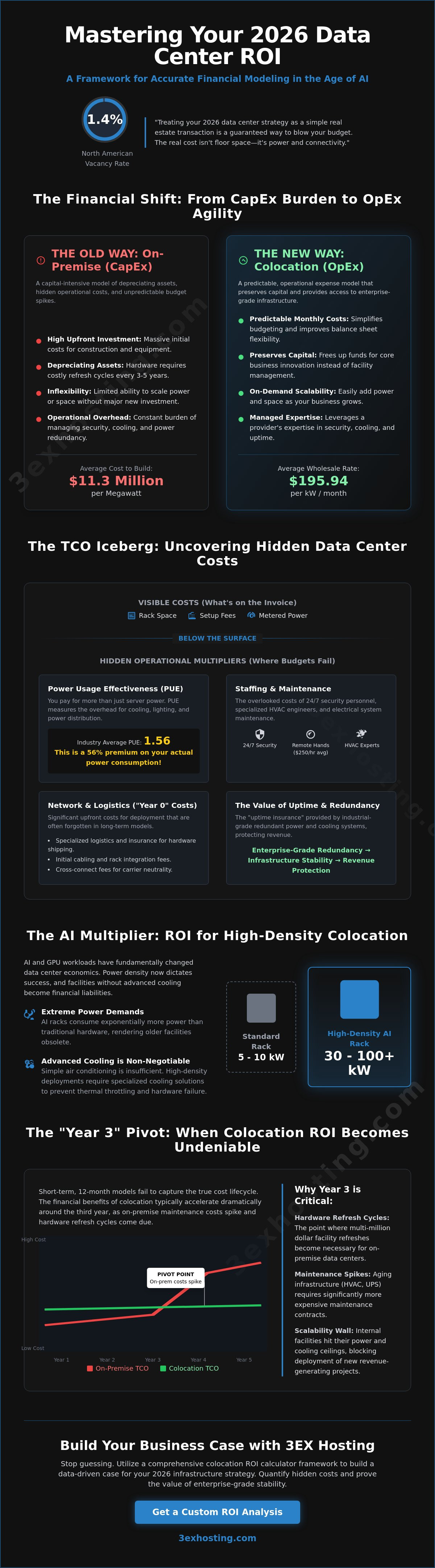
Treating your 2026 data center strategy as a simple real estate transaction is a guaranteed way to blow your budget. In a market where North American vacancy rates have plummeted to 1.4%, the real cost of infrastructure isn’t the floor space. It’s the power density and connectivity that drive your AI workloads. To get an accurate picture of your total cost of ownership, you need a colocation ROI calculator that accounts for far more than just monthly rack fees.
It’s frustrating to face unexpected bills for cross-connects or power overages that weren’t in the initial quote. You know that uptime is critical, but explaining the financial value of enterprise-grade redundancy to a board focused on immediate costs is a constant challenge. This guide provides a comprehensive framework to master your financial modeling. We’ll help you uncover hidden operational multipliers and quantify the true benefits of shifting from on-premise hardware to a managed OpEx model. We’ll break down a standardized formula that handles everything from $250 per hour remote hands fees to the $20 million per megawatt costs of high-density AI deployments.
Key Takeaways
- Learn how to transition from capital-intensive hardware investments to a predictable OpEx model that improves balance sheet flexibility and liquidity.
- Identify and quantify “hidden costs” like PUE-driven utility fluctuations and cross-connect fees that frequently skew long-term budget projections.
- Utilize a specialized colocation ROI calculator framework to account for the unique power and cooling demands of high-density AI and GPU workloads.
- Calculate the immediate financial benefit of 24/7 remote hands support by reducing truck-roll expenses and maximizing the productivity of your senior engineering team.
- Build a data-driven business case for enterprise-grade redundancy by linking infrastructure stability directly to operational uptime and revenue protection.
The Core Components of a Colocation ROI Calculator
Measuring return on investment for infrastructure requires moving past the monthly rent check. For enterprise leaders, a colocation ROI calculator must function as a strategic tool rather than a simple expense tracker. True ROI isn’t just about spending less; it’s about the technical stability and agility gained by offloading the burden of facility management. When you move your hardware into a specialized colocation data center, you’re shifting from a CapEx-heavy model of depreciating assets to a predictable OpEx model that preserves capital for core business innovation. Colocation ROI is the ratio of operational gains and cost avoidance to the total investment over a 3-5 year lifecycle.
Establishing a baseline starts with an honest Total Cost of Ownership (TCO) analysis of your current on-premise environment. Most internal models overlook the staggering costs of redundant power systems, specialized HVAC maintenance, and 24/7 security personnel. In 2026, the average cost to build a data center has climbed to $11.3 million per megawatt. By leveraging cabinet colocation, you bypass these massive entry costs while gaining access to infrastructure designed for modern performance standards. This shift improves your balance sheet by removing the need for periodic, multi-million dollar facility refreshes.
Direct vs. Indirect Cost Factors
Your financial model must distinguish between what you see on the invoice and what you save in the background. Direct costs are straightforward: the space you occupy, metered power usage, and initial setup fees. With North American wholesale rates averaging roughly $195.94 per kW, these are the easiest numbers to plug into your colocation ROI calculator. However, the indirect factors often carry more weight. These include carrier-neutral connectivity, which prevents vendor lock-in, and the “uptime insurance” provided by industrial-grade redundancy. Budgets in 2026 must prioritize power density over simple rack count. As AI workloads now require 30 kW to 100 kW per rack, a facility that can’t support high-density cooling will eventually become a financial liability.
The Time Horizon for Accurate Modeling
Short-term thinking is the enemy of accurate infrastructure planning. A 12-month model usually fails because it doesn’t account for the inevitable hardware refresh cycles or the rising cost of on-site utility management. We typically see a “Year 3” pivot where the benefits of colocation become undeniable. This is the point where on-premise maintenance costs spike and the efficiency of a professionally managed facility significantly outperforms internal operations. Scalability also has a price tag. With North American vacancy rates at a record low of 1.4%, the cost of “doing nothing” is high. If your internal facility hits its power ceiling and you can’t deploy new GPU clusters, the lost revenue from delayed projects will far outweigh the cost of a private colocation suite.
Uncovering the Hidden Costs in Data Center ROI
Most infrastructure budgets fail because they ignore the variables that exist outside the base monthly rent. Power is the most significant of these variables. Power Usage Effectiveness (PUE) determines how much of your utility bill actually powers your servers versus the facility’s cooling and lighting. With the industry average PUE currently sitting at 1.56, you’re essentially paying a 56% premium over your base power consumption. A precise colocation ROI calculator must account for this multiplier to avoid year-end budget shortfalls. In 2026, simple air conditioning is no longer sufficient for high-density hardware. If your facility lacks advanced cooling, your utility costs will spiral as fans work overtime to prevent thermal throttling.
Don’t forget the “Year 0” expenses that often vanish from long-term projections. Shipping massive GPU clusters or full cabinets requires specialized logistics and insurance. These deployment costs, along with initial cabling and rack integration, represent a significant upfront investment. Our move-in assistance services help mitigate these initial deployment risks; however, they still represent a critical line item that many enterprises overlook during the planning phase. These hidden layers of cost can shift an ROI model from positive to negative if they aren’t identified early.
Network Interconnection and Carrier Neutrality
Carrier-neutral facilities actually lower your long-term bandwidth costs by fostering competition among providers. Using a rigorous Total Cost of Ownership (TCO) Model reveals that the monthly cost of cross-connect services is often offset by the ability to switch carriers for better rates. This interconnectivity is a strategic asset for real-time applications requiring low-latency paths. While some call it a “connectivity tax,” the ROI of having direct access to multiple Tier-1 providers is measured in both reduced latency and lower per-megabit pricing over time.
Power Density Inefficiencies
Stranded power is a silent ROI killer. This happens when you pay for a 10kW circuit but the facility’s cooling capacity can only handle 6kW per rack. You’re essentially paying for 4kW of “dead air” that you cannot use. High-density power allocation reduces the required physical footprint, significantly lowering your overall rent by packing more compute power into fewer cabinets. This efficiency is vital when you consider that the cost of N+1 redundancy is far lower than the price of a single hour of downtime. If you’re unsure about your current power efficiency, request a technical audit to see how high-density hosting can optimize your spend and improve your colocation ROI calculator results.
The AI Multiplier: ROI for High-Density GPU Colocation
AI workloads don’t fit into legacy infrastructure spreadsheets. Traditional server racks typically draw between 5 kW and 10 kW, but modern AI clusters have shattered those limits. Today, high-density racks frequently require 30 kW to 100 kW of power per cabinet. This massive leap in density breaks any legacy colocation ROI calculator that prioritizes square footage over electrical capacity. In 2026, you aren’t just renting floor space; you’re investing in the specialized thermal management required to keep expensive silicon running at peak performance. By utilizing high density GPU colocation, you maximize your compute-to-footprint ratio, which reduces the total number of physical cabinets and lowers your long-term occupancy costs.
Specialized cooling is no longer a luxury for AI training environments; it’s a financial necessity. For facilities designed for these workloads, construction costs can exceed $20 million per megawatt due to the need for advanced liquid cooling and robust electrical systems. While the upfront OpEx might seem higher, the ROI comes from maximizing the lifespan and output of your GPU assets. Without precision cooling, your hardware will underperform, leading to a direct loss in computational value that far outweighs the cost of a premium data center environment.
GPU Infrastructure TCO
The CapEx for a single AI server cluster is staggering. It’s a high-stakes investment that demands a stable environment to ensure a return. If your data center design is insufficient, your hardware will engage in thermal throttling to prevent permanent damage. Throttling reduces clock speeds, meaning you’re paying for top-tier performance but receiving a fraction of the output. This effectively kills your hardware ROI. Future-proofing your deployment requires a flexible cage solution that can scale as your compute needs grow. With the AI GPU market expected to grow at a CAGR of 22.06% through 2035, your infrastructure must be ready to support rapid, high-density expansion without a complete facility migration.
Scaling AI Workloads Nationally
Centralizing your AI clusters in a high-performance carrier hotel provides a distinct competitive edge. You gain direct, low-latency access to global networks, which is essential for distributed training and real-time inference. For enterprises managing proprietary models, private colocation suites provide the physical isolation necessary to maintain strict data sovereignty. This isn’t just a security measure; it’s a way to protect the financial value of your intellectual property. When you build your business case, ensure your colocation ROI calculator accounts for these specialized security and connectivity multipliers to accurately project the success of your AI initiatives.
Operational ROI: The Value of Managed Services and Remote Hands
Operational efficiency is the invisible return in any comprehensive colocation ROI calculator. While power and space are the primary line items, the long-term cost of manual infrastructure management can quietly erode your budget. Consider the “Truck Roll” cost. Every time a senior engineer travels to a facility for a hardware swap or a reboot, you’re paying for more than just their hourly rate. You’re covering airfare, lodging, and the massive opportunity cost of taking a high-value asset away from strategic development. In 2026, professional remote hands support acts as a force multiplier, allowing your team to focus on system architecture while on-site technicians handle the physical layer.
Risk mitigation is another critical factor that stabilizes your financial modeling. The ROI of professional move-in assistance is measured in the prevention of deployment errors. A single misconfigured rack or a poorly labeled fiber run can lead to hours of troubleshooting during a critical launch. By delegating the initial setup to experts who understand the facility’s specific power and cooling dynamics, you ensure that your hardware is optimized for performance from day one. This proactive approach prevents the “Year 0” deployment delays that frequently derail infrastructure budgets and inflate the total cost of ownership.
Quantifying Labor Savings
Remote hands fees typically range from $150 to $250 per hour. While this is a direct OpEx cost, it’s a vital component of a realistic colocation ROI calculator because it’s significantly lower than the total cost of dispatching internal staff. A single emergency trip can easily exceed $2,000 when you factor in last-minute travel and the disruption of internal projects. Using remote hands ensures rapid incident response in a carrier-neutral environment. This service provides professional on-site support that acts as a seamless extension of your local IT team, ensuring that physical issues are resolved in minutes rather than the hours it takes for an internal team to arrive on-site.
Disaster Recovery and Business Continuity
The ROI of a “warm site” is defined by revenue protection. When a primary facility fails, the total loss of revenue for an enterprise can reach millions per hour. Integrating managed cloud hosting with physical colocation creates a hybrid ROI model that balances cost-efficiency with high-level resilience. Calculating the value of N+1 redundancy is straightforward: compare the incremental cost of redundant infrastructure to the catastrophic cost of an outage. If you’re looking to stabilize your operational spend and protect your uptime, request a customized quote to see how our managed services can improve your bottom line and provide the technical stability your business requires.
Building Your Business Case with 3EX Hosting
A theoretical colocation ROI calculator provides a vital baseline for your 2026 planning, but technical stability depends on the provider’s ability to deliver on those numbers in a live environment. 3EX Hosting eliminates the guesswork by providing the transparency required for precise financial auditing and long-term budget predictability. We understand that enterprise-scale AI and GPU hosting require more than just raw power; they require a partner who treats infrastructure as a performance multiplier. By matching our cage and suite solutions to your actual growth trajectory, we help you avoid the common pitfall of over-provisioning. This tailored approach ensures that your OpEx remains aligned with your computational output, turning your data center spend into a strategic advantage rather than a ballooning expense.
The advantage of our high-density infrastructure becomes clear when you scale. 3EX Hosting is built to handle the extreme thermal and electrical demands of modern GPU clusters, ensuring that your hardware runs at peak efficiency without the risk of thermal throttling. This technical excellence directly impacts your ROI by extending the lifespan of your expensive silicon and maximizing your processing throughput. We don’t just provide space; we provide the specialized environment necessary to turn massive AI investments into tangible business outcomes.
Transparency in Pricing and Power
Accuracy in financial modeling requires granular data that most providers hide behind flat-rate billing. 3EX Hosting prioritizes clear, metered power reporting so your finance team can audit usage with confidence and identify efficiency gains. This transparency prevents the “hidden cost” surprises that often plague generic infrastructure models. Our carrier hotel location in Miami offers a significant ROI for national network performance, providing the low-latency paths necessary for real-time data processing and global connectivity. To further stabilize your transition, we offer professional move-in assistance to reduce the friction of migration and ensure your hardware is integrated correctly from day one.
Requesting a Specialized ROI Analysis
Generic online tools can’t capture the nuances of high-density AI workloads or complex disaster recovery needs. Moving from a theoretical colocation ROI calculator to a validated infrastructure plan requires a consultative approach that looks at your specific technical needs. We work with your team to gather specific data points, including your required kW per rack, connectivity redundancy, and long-term scalability goals. This data allows us to build a business case that reflects your actual operational reality. When you’re ready to move beyond the spreadsheet, get a custom quote for your full cabinet or private suite needs to see how our technical excellence can secure your ROI for 2026 and beyond.
Securing Your Infrastructure ROI for 2026
Mastering your financial model for the coming years requires looking beyond simple rack rental fees. An effective colocation ROI calculator must prioritize power density for AI workloads and account for the significant cost avoidance provided by professional facility management. By shifting from high-risk on-premise builds to a scalable OpEx model, you gain the technical stability needed to compete in a high-demand market where vacancy rates are at record lows. This transition preserves capital while ensuring your hardware operates in an environment specifically designed for modern performance standards.
3EX Hosting provides the industrial-grade foundation your enterprise requires. Our facility offers N+1 Power Redundancy and Carrier Hotel Interconnectivity to ensure your systems remain online and high-performing. With 24/7 Remote Hands Support, your senior engineers are free to focus on innovation rather than hardware maintenance. This combination of technical excellence and transparent pricing ensures your infrastructure remains a strategic asset rather than a financial burden. We’re ready to help you stabilize your costs and maximize your compute value.
Calculate your enterprise infrastructure value; get a custom quote from 3EX Hosting today. We look forward to supporting your growth with the most reliable infrastructure in the region.
Frequently Asked Questions
What is the most common mistake in a colocation ROI calculator?
The most frequent error is treating the data center as a simple real estate expense instead of a performance-driven asset. Many models only look at the monthly rack rent and fail to account for variable power costs or connectivity fees. A precise colocation ROI calculator must include these “hidden” multipliers, such as remote hands fees and PUE overhead, to prevent budget overruns during the first year of operation.
How do I factor power usage effectiveness (PUE) into my ROI?
Factor PUE by using it as a multiplier for your hardware’s base electrical consumption. If your server cluster draws 10 kW and the facility has a PUE of 1.56, you’re actually paying for 15.6 kW of utility power. Lowering this multiplier through high-density cooling is one of the fastest ways to improve your long-term return on investment as energy prices fluctuate.
Is colocation more cost-effective than public cloud for AI workloads?
Colocation typically offers a superior return for steady-state AI workloads compared to the public cloud. While cloud instances are useful for bursty tasks, the high cost of persistent GPU instances can be significantly higher than owning your hardware in a managed facility. With the AI GPU market growing at 22.06% annually, owning the physical infrastructure provides better long-term cost control and predictable OpEx.
How much can remote hands support save my IT budget annually?
Remote hands support saves your budget by eliminating the need for emergency staff travel and lodging. A single emergency trip for an internal engineer can easily exceed $2,000 when you factor in last-minute airfare and the disruption of internal projects. By using on-site technicians for $150 to $250 per hour, you keep your senior staff focused on high-value development rather than routine hardware reboots.
What is the ROI of N+1 redundancy for enterprise data centers?
The ROI of N+1 redundancy is measured by the revenue protected during a primary system failure. For many enterprises, a single hour of downtime results in millions of dollars in lost revenue and potential SLA penalties. Investing in redundant power and cooling is a form of uptime insurance that pays for itself the moment a single component fails without impacting your operations.
How do cross-connect fees impact the long-term value of a data center?
Cross-connect fees are a small monthly investment that unlocks significant bandwidth savings through carrier competition. In a carrier-neutral facility, you can switch providers to secure the best market rates for data transit. This flexibility prevents vendor lock-in and ensures your network costs remain competitive even as your data requirements scale over a three-to-five-year period.
Can I include disaster recovery costs in my colocation ROI model?
You should include disaster recovery in your model as a cost-avoidance measure. Compare the monthly OpEx of a “warm site” colocation deployment to the catastrophic cost of a total business shutdown. This comparison helps justify the redundancy costs to stakeholders by framing the investment as a necessary safeguard for business continuity and revenue protection.
How does high-density colocation improve the ROI of GPU hosting?
High-density colocation improves GPU ROI by maximizing your compute-to-footprint ratio. By supporting 30 kW to 100 kW per rack, you can consolidate massive AI clusters into a much smaller physical space. This reduces your total rack count and specialized cooling overhead, which lowers your overall rent and energy spend per unit of computational processing power.