 SUPPORT


 3EX United States
 Blog
What if the biggest bottleneck in your cloud architecture isn’t your code, but the physical floor where your data meets the wire? You’ve likely felt the sting of unpredictable latency over the public internet and the shock of high egress costs that seem to grow every month. Managing physical cross-connects is a complex layer that many enterprises struggle to optimize. Finding the right Google Cloud Interconnect provider is the only way to bridge the gap between virtual performance and physical reliability. You need a partner that understands that cloud speed is physically tethered to the data center floor.
This 2026 guide helps you master the technical and commercial criteria to ensure low-latency, private connectivity. We’ll show you how to achieve sub-millisecond response times for mission-critical apps and scale your bandwidth up to 100Gbps effectively. We will preview the latest SLA requirements for 99.99% uptime, the impact of regional data transfer rates, and the specific routing protocols like LACP and EBGP-4 you’ll need to maintain a stable, high-density environment.
Key Takeaways
- Understand why transitioning from public internet VPNs to private enterprise circuits is essential for predictable performance and reduced egress costs.
- Learn how to evaluate a Google Cloud Interconnect provider based on carrier-neutral status and physical proximity to minimize “last mile” latency.
- Discover how full cabinet colocation within a carrier hotel accelerates interconnect performance by placing hardware closer to cloud on-ramps.
- Follow a precise implementation roadmap that covers everything from console ordering to securing the necessary LOA/CFA documentation.
- Identify the technical criteria required to scale your bandwidth up to 100Gbps for high-density workloads like AI and real-time analytics.
What is Google Cloud Interconnect and Why Does Your Enterprise Need It?
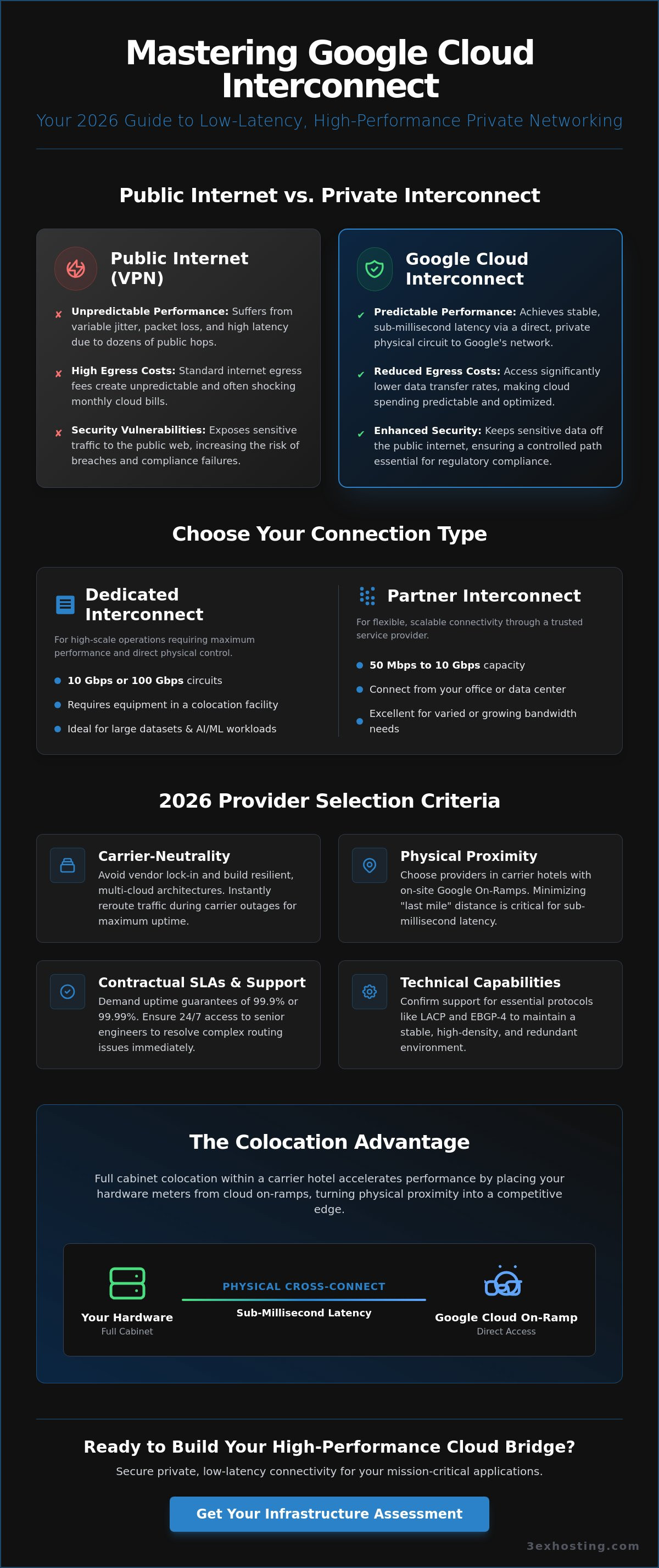
Modern enterprises in 2026 can’t afford to leave their cloud performance to the whims of the public internet. Google Cloud Interconnect (GCI) serves as a physical, private bridge between your local network and Google’s global infrastructure. It replaces the traditional public internet VPN with a direct, enterprise-grade circuit. This shift is critical for organizations moving large datasets or running latency-sensitive applications. By bypassing the public web, you eliminate the dozens of hops that typically introduce security vulnerabilities and performance bottlenecks.
The financial impact of this transition is immediate. Standard internet egress fees can be one of the most unpredictable components of a monthly cloud bill. Working with a Google Cloud Interconnect provider allows you to access significantly lower data transfer rates. Beyond cost, the performance benchmarks are clear. While public internet connections suffer from variable jitter and packet loss, a private interconnect offers stable, sub-millisecond latency. This level of precision is necessary for mission-critical apps that require real-time data processing and high-speed synchronization.
Dedicated Interconnect vs. Partner Interconnect
Choosing the right connection type depends on your bandwidth requirements and existing physical infrastructure. Dedicated Interconnect is designed for high-scale operations, offering 10 Gbps or 100 Gbps circuits. This requires your equipment to be physically located in a colocation facility where Google has a point of presence. Many enterprises utilize full cabinet colocation in carrier-neutral data centers to meet these requirements. If your needs are more modest, Partner Interconnect provides flexibility with speeds ranging from 50 Mbps up to 10 Gbps. It’s an ideal choice if you aren’t yet ready to manage your own physical cross-connects at a Google edge location.
The Business Case for Private Cloud Networking
Security and compliance are no longer optional. Keeping sensitive traffic off the public internet ensures your data follows a controlled, private path. This architecture is essential for meeting strict regulatory standards. Reliability also sees a massive boost. With the right redundant configuration, you can reach 99.9% or even 99.99% uptime, ensuring your hybrid environment stays online during regional outages. You’ll need to provide your own routing equipment and support protocols like LACP and EBGP-4. Google Cloud Interconnect is the standard for 2026 hybrid-cloud architecture.
Selection Criteria: Evaluating a Google Cloud Interconnect Provider in 2026
Selecting the right Google Cloud Interconnect provider requires looking beyond basic connectivity. In 2026, carrier-neutrality is the foundation of a resilient architecture. It allows you to build a multi-cloud approach without being locked into a single telecom vendor’s ecosystem. This independence is critical for creating redundant paths that protect your operations from local fiber cuts or carrier outages. If one carrier fails, a neutral provider lets you reroute traffic through an alternative backbone instantly.
Physical distance remains the ultimate arbiter of speed. You should prioritize providers located in carrier hotels with direct, on-site Google Cloud On-Ramps. This proximity minimizes “last mile” latency, ensuring your data doesn’t travel through unnecessary exchange points before reaching Google’s network. When every millisecond counts for AI processing or financial transactions, these physical centimeters on the data center floor translate into significant performance gains.
Don’t settle for “best effort” promises. Your provider must offer contractual uptime guarantees that align with Google’s own requirements for 99.9% or 99.99% availability. Technical support responsiveness is equally vital. When a routing issue occurs, you need immediate access to on-site expertise. A partner that provides direct access to senior engineers ensures that complex configuration hurdles don’t become day-long outages. If you’re planning a high-bandwidth deployment, a tailored infrastructure assessment can help confirm these technical standards are met.
Network Performance and Latency Metrics
Evaluating a provider’s backbone capacity is the first step in verifying their technical stability. Look for diverse fiber paths that enter the facility through separate conduits. This physical diversity prevents a single point of failure from taking your entire interconnect offline. You should always request and interpret latency test results between your primary site and the Google edge location. These metrics provide a baseline for your application performance and help identify potential bottlenecks before you go live.
Scalability and Future-Proofing
Your networking needs will change as your business grows. A reliable Google Cloud Interconnect provider must be able to handle a 10x increase in data throughput without a complete infrastructure overhaul. Support for advanced protocols like BGP (Border Gateway Protocol) and 802.1Q VLAN tagging is mandatory for modern traffic management. These technical capabilities ensure seamless integration with managed cloud hosting for complex hybrid workloads, allowing you to scale from 10 Gbps to 100 Gbps as your data demands evolve.
The Role of Colocation in Your Cloud Interconnect Strategy
Physical proximity in a carrier hotel isn’t just a convenience; it’s a performance multiplier for your hybrid architecture. When your infrastructure sits in the same facility as a Google Cloud On-Ramp, you eliminate the variable delays of long-haul fiber. A professional Google Cloud Interconnect provider bridges the physical gap between your servers and the virtual cloud. By utilizing full cabinet colocation, you can house high-performance on-premise components directly adjacent to the cloud’s edge. This setup is essential for managing high-density loads required for AI training, where data must move between local GPU clusters and cloud-based storage without hitting a bottleneck.
Physical Cross-Connects: The Foundation of GCI
The layer 1 connection is the most stable link in your network stack. A physical cross-connect is a dedicated fiber strand running from your rack to the provider’s patch panel. While software-defined options are growing in popularity, they often can’t match the raw stability and consistent throughput of a physical link. A cost-benefit analysis usually favors these circuits for high-traffic environments. Monthly cross-connect fees are predictable. They often represent a small fraction of what you’d pay for equivalent public internet bandwidth or the high egress costs associated with standard cloud connections. For organizations running specialized hardware, our high-density GPU colocation guide provides a deeper look at optimizing networking for AI-specific infrastructure.
Security and Sovereignty in Hybrid Environments
Data sovereignty is a major concern for enterprises handling sensitive information. You can maintain total control over your physical hardware by using private colocation suites. This architecture ensures your data remains on your own physical assets until it enters the private Interconnect tunnel. Physical security layers are just as important as digital ones. Top-tier facilities offer biometric access, 24/7 monitoring, and custom cage configurations to meet strict internal audits. A reliable Google Cloud Interconnect provider helps you navigate these requirements, facilitating easier compliance with HIPAA, SOC2, and PCI-DSS standards. It’s about creating a secure, cloud-adjacent environment where performance and safety coexist perfectly. This physical foundation allows your IT team to focus on scaling applications rather than troubleshooting connection drops.
Implementation Roadmap: Deploying Your Interconnect Connection
Deploying a private link to the cloud requires a synchronized effort between your networking team and your chosen Google Cloud Interconnect provider. The process moves quickly once the physical prerequisites are met. You’ll start by ordering the circuit directly through the Google Cloud Console. During this stage, you specify your desired bandwidth, such as 10 Gbps or 100 Gbps, and select the appropriate edge availability domain. This digital request triggers the generation of your Letter of Authorization and Connecting Facility Assignment (LOA/CFA).
Once you secure the LOA/CFA, you must provide it to your data center operator. This document is the “golden ticket” that authorizes the physical cross-connect on the data center floor. The provider’s technicians will then run the single-mode fiber (10GBASE-LR or 100GBASE-LR4) between your equipment and Google’s patch panel. After the physical link is light-up, you’ll move to configuring BGP sessions and verifying your 802.1Q VLAN attachments. It’s critical to verify MTU sizes, which can range from 1440 to 8896 bytes depending on your workload requirements. Finalize the deployment with rigorous load testing and the setup of redundant failover paths to ensure you meet the 99.99% uptime SLA. If you’re ready to begin the technical design phase, request a technical consultation to align your hardware with Google’s physical requirements.
The Critical Role of Remote Hands
Most cloud documentation focuses on the software console, but day-zero deployment happens on the rack. This is where remote hands support becomes essential. Outsourcing the rack-and-stack process to on-site experts ensures that your routing equipment is installed, cabled, and labeled according to enterprise standards without requiring your team to travel. Professional technicians handle the delicate fiber terminations and hardware diagnostics that software can’t see. For a deeper look at streamlining these physical operations, refer to our Remote Hands Support guide.
Monitoring and Ongoing Management
A successful deployment is only the beginning. You need tools for real-time traffic analysis and bandwidth monitoring to ensure you aren’t hitting throughput ceilings. Proactive troubleshooting is necessary to catch BGP flaps or latency spikes before they impact your end users. Establishing a strict maintenance schedule for your physical network hardware prevents avoidable failures. Your Google Cloud Interconnect provider should offer the visibility needed to monitor the health of the physical cross-connect, ensuring the layer 1 foundation remains as stable as the virtual layers above it.
Why 3EX Hosting is Your Strategic Interconnect Partner
3EX Hosting provides the technical stability and physical infrastructure required for modern enterprise networking. Our facilities are built to handle the rigorous demands of 2026, offering a national reach that connects your local hardware to the global cloud seamlessly. We operate as a carrier-neutral Google Cloud Interconnect provider. This means we don’t lock you into a single telecom ecosystem. You gain the flexibility to choose the carriers that offer the best performance and redundancy for your specific geographic regions. This independence is a cornerstone of a resilient hybrid cloud strategy.
Modern workloads, particularly those involving AI training and real-time analytics, require more than just a standard network link. They demand extreme power density and specialized thermal management. We provide direct access to high-density power and cooling systems designed specifically for GPU-intensive hardware. Our solutions are never one-size-fits-all. We offer bespoke infrastructure options ranging from full cabinet colocation to custom cage solutions. Whether you need a single rack or private colocation suites, our environment is optimized for your physical and virtual needs.
Unmatched Technical Support
Our on-site engineering team is available 24/7/365 to provide an immediate response to any infrastructure concerns. We understand that in a mission-critical environment, every minute of downtime has a significant cost. Our experts have deep experience in complex disaster recovery and business continuity planning. We help you verify that your redundant paths are truly diverse and ready for instant failover. To accelerate your deployment timeline, we offer professional move-in assistance. This service handles the logistics of getting your hardware racked, stacked, and connected according to enterprise standards.
Building Your Hybrid Cloud Future
Integrating managed cloud hosting with high-speed Interconnect links creates a unified, high-performance environment for your data. We maintain a transparent pricing model. You won’t find hidden surprises or unexpected fees in your monthly cross-connect billing. This predictability is vital for accurate long-term budget planning in a hybrid cloud model. Our infrastructure provides the stable foundation your enterprise needs to scale without friction. We focus on the technical details so you can focus on your core business goals. Ready to scale your bandwidth? Get a customized quote today and secure your high-speed private link.
Secure Your High-Performance Hybrid Infrastructure
Success in the 2026 cloud landscape depends on the physical foundation supporting your virtual assets. You’ve seen how carrier-neutral facility access and physical proximity to on-ramps eliminate the performance gaps inherent in public internet routing. Bridging your local hardware with the cloud requires more than just a cable; it demands a partner capable of supporting high-density power for AI and GPU workloads while maintaining total technical stability.
Selecting the right Google Cloud Interconnect provider ensures that your mission-critical applications benefit from sub-millisecond latency and predictable egress costs. With 24/7/365 on-site remote hands, your deployment remains secure and operational without requiring constant travel for your internal teams. You can now move forward with a roadmap that prioritizes security, scalability, and technical excellence. It’s about moving beyond best-effort connectivity to a guaranteed, enterprise-grade private link.
Ready to optimize your network? Request a custom Google Cloud Interconnect and Colocation Quote to align your infrastructure with the demands of the modern enterprise. Your transition to a faster, more reliable hybrid cloud starts with a stable physical foundation.
Frequently Asked Questions
What is the difference between Google Cloud Interconnect and a VPN?
Google Cloud Interconnect provides a physical, private connection to Google’s network, while a VPN operates over the public internet. A VPN is subject to the fluctuations of internet traffic, which leads to variable latency and jitter. In contrast, an Interconnect connection offers consistent performance and significantly lower data transfer costs. It’s the preferred choice for enterprises requiring stable, high-bandwidth links for mission-critical workloads.
How much does Google Cloud Interconnect cost in 2026?
Google’s pricing for Dedicated Interconnect starts at $2.328 per hour for a 10 Gbps port and $23.28 per hour for a 100 Gbps port. Beyond port fees, you’ll pay for VLAN attachments, which start at $0.10 per hour for speeds up to 10 Gbps. Data transfer out for North America and Europe is priced at $0.02 per GiB. These rates represent the cloud provider’s direct fees and don’t include facility-specific cabling costs.
How long does it take to provision a Dedicated Interconnect connection?
Provisioning usually takes between two to eight weeks depending on the physical requirements of your data center. The digital configuration in the Google Cloud Console is nearly instantaneous, but the physical layer requires more time. You must factor in the delivery of the Letter of Authorization (LOA) and the time needed for a Google Cloud Interconnect provider to complete the physical fiber cross-connect on the facility floor.
Does Google Cloud Interconnect include an SLA?
Google Cloud Interconnect provides tiered SLAs based on your network topology. A 99.99% uptime SLA requires four Dedicated Interconnect connections across two metropolitan areas and different edge availability domains. A 99.9% uptime SLA is available with two connections in a single metropolitan area. It’s important to note that a single Interconnect connection does not come with a service level agreement, making redundancy essential for enterprise stability.
Can I use Partner Interconnect if I am not in a Google-supported data center?
Yes, you can use Partner Interconnect to reach Google Cloud from almost any location. This service allows you to connect through a supported third-party network provider who already has a physical presence in a Google edge location. This is an ideal solution for businesses that need flexible bandwidth ranging from 50 Mbps to 50 Gbps without the complexity of managing their own physical hardware in a specific carrier hotel.
What hardware do I need for a Google Cloud Interconnect connection?
Your network must use professional routing equipment that supports specific technical protocols. You need a router capable of handling Border Gateway Protocol (BGP), 802.1Q VLAN tagging, and Link Aggregation Control Protocol (LACP). For a 10 Gbps link, you’ll need single-mode fiber with 10GBASE-LR optics. If you’re scaling to 100 Gbps, your hardware must support 100GBASE-LR4 optics to ensure a stable physical handoff with the Google Cloud Interconnect provider.
Is Google Cloud Interconnect more secure than the public internet?
Interconnect is significantly more secure because your data never touches the public internet during transit. By using a private circuit, you eliminate the risk of traffic being intercepted or redirected at public exchange points. This private path simplifies compliance for industries with strict data sovereignty requirements. You maintain full control over the routing path, ensuring that sensitive enterprise traffic stays within a defined, private infrastructure at all times.
Can I scale my Interconnect bandwidth up and down as needed?
Bandwidth flexibility depends on whether you choose a Dedicated or Partner connection. Dedicated Interconnect is fixed at 10 Gbps or 100 Gbps increments and requires physical hardware changes to scale significantly. Partner Interconnect offers much higher elasticity, allowing you to adjust your capacity between 50 Mbps and 50 Gbps through software-defined controls. This makes the partner model better suited for businesses with fluctuating data demands or those testing new cloud-adjacent workloads.