 SUPPORT


 3EX United States
 Blog
How do you maintain 99.99% uptime for hardware you can’t physically touch? In 2026, the proximity tax of sending staff to remote sites is no longer a viable business model. With the Global Remote Infrastructure Management market valued at over $16 billion and new regulations like the Remote Access Security Act (H.R. 2683) in play, the stakes for your connectivity have never been higher. You’ve likely experienced the blind spots that occur in hybrid environments or the risk of insecure remote access points. Mastering the best practices for managing remote infrastructure is now essential to bridge these visibility gaps and ensure your systems remain stable.
It’s clear that managing complex, distributed systems requires more than just a basic VPN connection. We’ll help you master the technical and operational strategies required to maintain high-performance, secure, and scalable remote IT environments. This guide provides a framework for total infrastructure observability and lower operational costs through better protocols. You’ll gain a reliable disaster recovery posture and learn how automated root cause analysis can reduce your incident resolution times by up to 31%. Let’s secure your remote operations with a focus on speed and technical excellence.
Key Takeaways
- Transition from reactive monitoring to proactive observability to gain total visibility across distributed enterprise IT environments.
- Apply best practices for managing remote infrastructure by integrating Zero Trust Architecture and secure out-of-band management for emergency access.
- Reduce operational costs and eliminate travel time by utilizing expert on-site remote hands support for physical hardware interventions.
- Optimize the performance of high-density AI workloads through specialized power management and thermal profiling for GPU dedicated servers.
- Strengthen your disaster recovery posture by leveraging geographic redundancy and private colocation suites for sovereign data protection.
The Evolution of Remote Infrastructure Management (RIM) in 2026
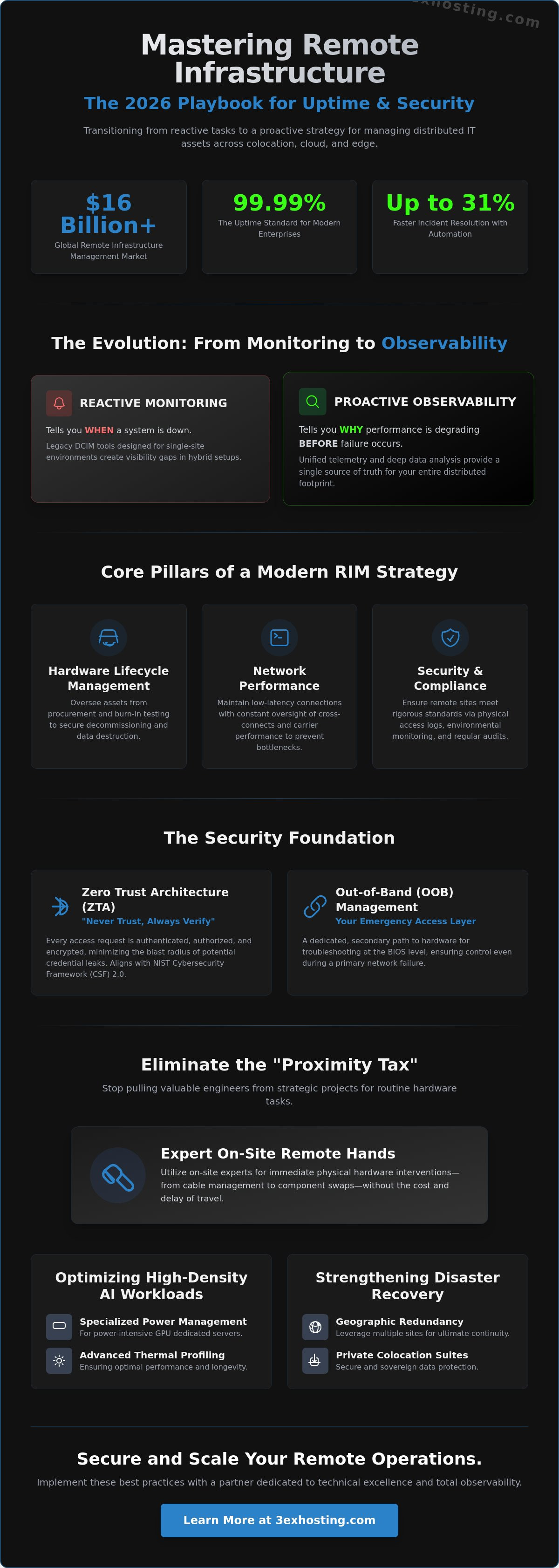
In 2026, Remote Infrastructure Management (RIM) has transitioned from a background support task to a core business requirement. We define RIM today as a holistic strategy for managing distributed IT assets across colocation facilities, cloud providers, and edge nodes. The industry has moved beyond simple monitoring. We’re now in the era of observability. While monitoring tells you when a system is down, observability uses telemetry and deep data analysis to tell you why performance is degrading before a failure occurs. This shift is vital for maintaining the 99.99% uptime that modern enterprises demand.
The “proximity tax” is no longer a sustainable cost for scaling businesses. Dispatching internal staff to remote sites is slow, expensive, and often unnecessary. It pulls your most valuable engineers away from strategic projects to handle routine hardware tasks. High-performance environments, particularly those involving AI and GPU hosting, require immediate intervention that physical distance often prevents. Adopting best practices for managing remote infrastructure means shifting these physical tasks to experts who are already on-site. This ensures technical stability without the logistical overhead.
The Core Components of a Modern RIM Strategy
- Hardware Lifecycle Management: This involves overseeing the entire journey of your assets. You must manage everything from initial procurement and burn-in testing to secure decommissioning and data destruction.
- Network Performance and Interconnectivity: Maintaining low-latency connections is critical. You need constant oversight of cross-connects and carrier performance to prevent bottlenecks in your data flow.
- Security and Compliance Auditing: Remote physical sites must meet the same rigorous standards as your primary office. This includes physical access logs, environmental monitoring, and regular security audits of the infrastructure.
Why Traditional DCIM is No Longer Enough
Traditional Data Center Infrastructure Management (DCIM) tools were designed for single-site environments. They often struggle with the complexity of hybrid setups where assets are scattered across various providers. These legacy systems lack the integrated telemetry needed for a complete view of your operations. You need a solution that bridges the gap between your cloud instances and your cabinet colocation hardware. The 2026 RIM standard is a unified visibility layer that treats your entire distributed footprint as a single, manageable entity. This approach is one of the most effective best practices for managing remote infrastructure, as it eliminates silos and provides a single source of truth for your IT team. By utilizing remote hands support, you can execute physical changes based on this data without ever stepping foot in the data center.
Establishing Security and Connectivity Protocols for Distributed Assets
Security in 2026 is no longer a perimeter-based concept. It’s a continuous verification process. Zero Trust Architecture (ZTA) serves as the foundation for modern remote access. It operates on the principle of “never trust, always verify,” which is a practical necessity for hybrid environments. Implementing ZTA ensures that every request for access is authenticated, authorized, and encrypted. This approach ranks among the top best practices for managing remote infrastructure because it minimizes the blast radius of a potential credential leak. It aligns perfectly with the NIST Cybersecurity Framework (CSF) 2.0, which emphasizes governance and risk-informed decision-making in distributed setups.
Reliable connectivity depends on more than just high bandwidth. You need secure out-of-band (OOB) management to maintain control during a primary network failure. This provides a dedicated path to your hardware console, allowing your team to troubleshoot at the BIOS level without being physically present. When administering remote systems, having this secondary access layer is the difference between a five-minute fix and a costly site visit. It’s the “break glass” protocol that ensures technical stability when the standard management network is unreachable.
High-performance workloads, such as AI processing, demand stable interconnections that avoid the congestion of the public internet. Utilizing cross-connect services within a carrier-neutral facility allows you to establish direct, low-latency links between your infrastructure and key service providers. This level of control is essential for maintaining network redundancy and ensuring your data paths remain diverse. By bypassing the public internet, you reduce the attack surface and improve the predictability of your application performance.
Hardening the Remote Access Layer
Securing the console is your first line of defense. You must enforce multi-factor authentication (MFA) for all IPMI and console access points. Don’t rely on simple passwords for hardware-level management. Use encrypted tunnels and dedicated VPNs to protect infrastructure telemetry from interception. It’s also vital to regularly audit physical access logs at your colocation facility. Knowing exactly who was near your hardware and when provides a layer of security that software-only solutions often ignore. If you’re looking for a partner to help architect these resilient paths, exploring professional colocation options can provide the technical foundation you need.
Ensuring Network Resilience and Low Latency
Resilience comes from diversity. Choose facilities that function as carrier hotels, giving you access to multiple fiber paths from different providers. Monitor BGP routes and latency constantly to ensure your mission-critical applications aren’t being rerouted through high-latency paths. Strategic use of direct interconnections helps you maintain a best practices for managing remote infrastructure approach by prioritizing speed and reliability over convenience. This ensures your remote environment performs as if it were in the same room as your users.
Bridging the Gap: Software Observability vs. Physical Remote Hands
Software observability tells you that a port is down, but it can’t tell you if a technician accidentally bumped a fiber patch cable during an adjacent install. In 2026, one of the best practices for managing remote infrastructure is clearly defining the line between digital troubleshooting and physical intervention. You shouldn’t rely solely on telemetry when hardware failures occur. While your monitoring tools provide the data, physical infrastructure requires a physical presence to resolve issues like power supply failures or cable reseating. High-performance environments depend on this balance to maintain technical stability.
The Return on Investment (ROI) of utilizing remote hands support is significant when compared to dispatching internal teams. Sending a senior engineer on a flight to handle a server reboot or a hard drive swap is a waste of specialized talent. It’s also slow. Local on-site technicians can often resolve physical issues in minutes. By standardizing physical tasks such as cabling, reboots, and hardware swaps through a trusted provider, you ensure your internal team stays focused on high-level architecture. Integrating these third-party services into your internal ticketing workflow makes the process seamless. Your team opens a ticket, and the on-site expert executes the task with precision.
Maximizing Data Center Efficiency with Remote Hands
Understanding the difference between “Remote Hands” and “Smart Hands” is crucial for operational speed. Remote hands typically cover simple physical tasks like power cycling or checking cable connections. Smart hands involve more complex troubleshooting, such as configuring a switch or performing detailed hardware diagnostics. Following remote management best practices involves using high-definition imaging for remote cabinet audits. This visual verification allows you to see your rack exactly as it sits in the facility. For a deeper look at these technical workflows, see Remote Hands Support: The Enterprise Guide to Data Center Efficiency in 2026.
Physical Inventory and Asset Tracking
Accurate record-keeping is the backbone of distributed management. You can’t manage what you can’t see. Implementing RFID or QR-based tracking for all assets in your remote cabinet ensures your inventory is always current. You need real-time rack elevation diagrams that reflect the exact position of every server and switch. This level of detail is vital when coordinating move-in assistance for new hardware deployments. Precise documentation prevents errors during installs and makes it easier for remote hands to locate specific devices. This organized approach is a core part of the best practices for managing remote infrastructure that keeps your operations running at peak performance.
Operational Best Practices for Scaling High-Density and AI Workloads
Scaling AI infrastructure remotely presents challenges that standard monitoring simply cannot solve. When you deploy GPU dedicated servers, you’re dealing with thermal profiles that fluctuate wildly within seconds. Traditional cooling strategies often fail to keep up with these rapid bursts of heat. Mastering best practices for managing remote infrastructure in this context requires a move toward dynamic cooling adjustments based on real-time compute loads. This ensures your hardware stays within safe operating parameters even during peak AI training cycles. You must have constant visibility into the temperature at the intake and exhaust points of every chassis to prevent localized hot spots from damaging your investment.
Power density management is equally critical for technical stability. A high-density GPU colocation environment often requires 30kW or more per rack in 2026. This demands precise oversight of your power distribution units (PDUs) to prevent circuit overloads that could take down an entire training cluster. You need a technical foundation that supports this level of intensity without compromising reliability. It’s about more than just having enough power capacity. You must understand how that power is distributed across your high-performance assets to maintain a balanced and resilient environment. If you’re planning a deployment of this scale, request a technical consultation and quote to ensure your power requirements are met with precision.
Power and Cooling Observability
Monitoring metered PDU data allows you to track power consumption at the individual outlet level. This granularity is essential for balancing loads across your infrastructure and identifying underutilized assets. As you scale your AI footprint, managing the transition to liquid cooling or high-airflow containment becomes a necessity rather than an option. Implementing N+1 redundancy for your power and cooling systems is critical for AI training clusters to ensure a single component failure doesn’t result in catastrophic downtime for your models.
Automation and AIOps in Remote Management
AIOps tools are now vital for identifying anomalies that human operators might miss in complex datasets. Leveraging AI-driven predictive maintenance helps you identify failing power supplies or fan degradation before they cause a hardware outage. Automating routine firmware updates across distributed server fleets reduces the risk of security vulnerabilities and ensures consistent performance. These tools are highly effective. Research indicates that automated root cause analysis can reduce incident resolution times by up to 31%. This reduction in Mean Time to Repair (MTTR) is a cornerstone of technical stability in 2026. It allows your team to focus on development rather than chasing hardware alerts. Applying these best practices for managing remote infrastructure ensures your systems remain fast, secure, and ready for any workload.
Ensuring Continuity: Disaster Recovery and Strategic Infrastructure Support
Disaster recovery in 2026 requires more than a simple off-site backup. True resilience depends on geographic redundancy. You must distribute your IT assets across multiple locations to ensure that a regional power failure or natural disaster doesn’t take your entire operation offline. Incorporating private colocation suites into your strategy provides a sovereign environment for your most sensitive data. This physical isolation ensures that your disaster recovery posture remains secure and compliant. One of the best practices for managing remote infrastructure is to treat your DR site as a living part of your network, not just a passive insurance policy.
Testing your failover protocols is the only way to guarantee they’ll work when needed. You should conduct these tests regularly without disrupting your live production environment. Use isolated VLANs or sandboxed hardware to verify that traffic reroutes correctly and that data remains synchronized. This proactive approach ensures that technical stability is maintained during a real-world crisis. It’s about building a system that’s ready for any scenario. We’ve seen that automated root cause analysis can reduce incident resolution times by 31%, but that speed is only useful if your failover infrastructure is ready to take the load.
Designing for 100% Uptime
Network resilience starts with carrier-neutral facilities. These data centers provide access to multiple fiber providers, ensuring that a single carrier outage won’t sever your connectivity. Integrating managed cloud hosting with physical colocation creates a robust hybrid DR model. This setup allows you to scale resources quickly while maintaining the control of on-premises hardware. You must also standardize your disaster recovery documentation. Clear, accessible protocols ensure that remote teams can act decisively when every second counts. This consistency is a hallmark of best practices for managing remote infrastructure.
The 3EX Approach to Managed Infrastructure
Choosing the right partner is vital for mission-critical continuity. 3EX Hosting provides the technical foundation you need to scale with confidence. Our on-site support eliminates the risks associated with managing hardware from a distance. If a component fails, our technicians are already there to resolve it. We offer customizable cage solutions that help your enterprise meet strict compliance and security requirements. Our team acts as a magbiztos extension of yours, providing the speed and reliability your business demands. Get a custom quote for your remote infrastructure needs and secure your technical future today.
Mastering the Remote Infrastructure Landscape
Success in 2026 depends on your ability to maintain total visibility across distributed assets while eliminating the logistical burden of physical site visits. You’ve seen how the shift toward observability and Zero Trust Architecture provides a secure foundation for growth. Bridging the digital and physical divide with expert support allows your senior engineers to stay focused on high-level architecture rather than hardware maintenance. Implementing these best practices for managing remote infrastructure ensures your environment remains secure, performant, and ready to scale with high-density AI workloads.
Technical stability is the product of reliable infrastructure and expert support. 3EX Hosting provides the professional foundation required for mission-critical continuity. With 24/7/365 on-site remote hands, carrier-neutral connectivity, and N+1 redundant power and cooling, your systems are always in capable hands. Don’t let distance compromise your uptime or security. Secure your mission-critical infrastructure with 3EX Hosting and gain the peace of mind that comes with expert management. Your systems are ready for the future, and we’re here to ensure they stay that way.
Frequently Asked Questions
What is the difference between RIM and DCIM?
Remote Infrastructure Management (RIM) focuses on the holistic oversight of distributed IT assets, including servers, networks, and software observability across multiple sites. Data Center Infrastructure Management (DCIM) is more localized, primarily managing the physical facility components like floor space, power circuits, and cooling systems. While DCIM monitors the environment, RIM provides the connectivity and protocols needed to manage the actual workloads from a distance.
How does remote hands support improve data center efficiency?
Remote hands support eliminates the proximity tax by providing immediate on-site technical intervention. Instead of waiting hours or days for an internal engineer to travel to a site, local technicians can perform reboots, cable reseating, or hardware swaps in minutes. This drastically reduces Mean Time to Repair (MTTR) and allows your senior staff to remain focused on high-level architecture and strategic projects.
Can I manage high-density GPU servers remotely without on-site staff?
You can manage the software and compute layers remotely, but physical maintenance for high-density GPU servers requires on-site support. These AI-heavy workloads generate intense thermal loads and power demands that need physical oversight. Professional remote hands teams handle the hardware swaps and cooling adjustments that software cannot execute, ensuring your expensive GPU clusters remain stable and performant.
What are the security risks of remote infrastructure management?
The primary risks include unauthorized console access, insecure VPN tunnels, and vulnerabilities at remote access points. Managing these threats involves implementing best practices for managing remote infrastructure such as Zero Trust Architecture and multi-factor authentication for all IPMI access. You must also audit physical access logs at your colocation facility to ensure your hardware hasn’t been tampered with physically.
How do I choose between a private suite and a full cabinet for remote assets?
Choose a full cabinet if you have a standard server footprint that requires high-tier power and cooling in a shared environment. A private colocation suite is better for enterprises needing physical isolation, custom cage configurations, or higher compliance standards. Suites provide a sovereign environment that’s ideal for sensitive data or extremely high-density AI deployments that require dedicated airflow management.
What connectivity options are best for low-latency remote management?
Direct cross-connects and carrier-neutral fiber paths provide the lowest latency for remote management. By Establishing direct links within a data center, you bypass the congestion and security risks of the public internet. This ensures that your remote console access is fast and responsive, which is critical when you need to perform emergency BIOS-level troubleshooting from a remote location.
Is remote infrastructure management cost-effective for small enterprises?
How does carrier neutrality impact remote management reliability?
Carrier neutrality is a core part of the best practices for managing remote infrastructure because it prevents vendor lock-in and increases network diversity. If one carrier experiences a fiber cut or routing issue, you can quickly reroute your management traffic through a different provider. This redundancy ensures that you never lose access to your hardware, maintaining technical stability even during major network disruptions.